
In the 24 January 2026 (Saturday) issue of the National Post, veteran journalist Barbara Kay highlights my latest novel about wolves really-gone-rogue around Tofino on Vancouver Island and the wolf conservation issues it raises.
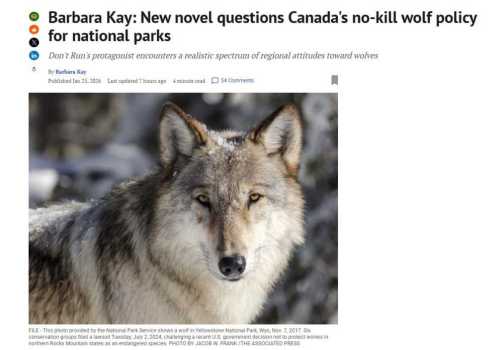
Here is some of what Barbara Kay had to say about DON’T RUN:
[Note that if you don’t have a National Post subscription, a paywall-free version is available here]
Recent incidents of open dog-stalking suggest the problem might be coming to a tragic head.
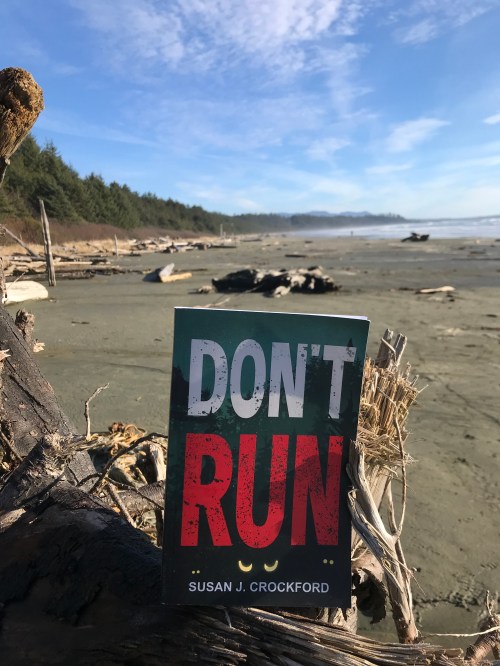
That is certainly the view of zoologist Susan Crockford, a longtime Vancouver Island resident with academic specialization in wolf evolution. Crockford is also a lively storyteller. Her latest just-published novel is titled Don’t Run, as in, if you encounter a lone wolf, stand your ground and scare him away if you can. When wolves stare at you, they aren’t seeking friendship, they’re sizing you up as potential prey. It’s a slightly futuristic fiction, based largely in fact: a fascinating primer on wolf behaviour, but also a dramatized exhortation to privilege reason over emotion in wild-animal conservation policy.
Don’t Run is set in the Tofino-Ucluelet Pacific Rim corridor in the winter of 2029. Driven by hunger, “superpacks” of wolves — 30-40 instead of the usual six or seven — have been attacking dogs, decimating livestock and even killing and eating people. The novel’s protagonist is a RCMP safety specialist sent to investigate the escalating wolf aggression. The stakeholders he encounters — lifetime residents, livestock owners, Indigenous people, tourist parents of victims, Parks Canada reps — represent a realistic spectrum of regional attitudes to wolves. It’s a pacey, plausible read that subliminally asks the reader to take a policy stand.
…
The ”villain” in Don’t Run is the PRNPR, whose no-kill wolf policy in their jurisdiction is central to their “reconciliation” mandate. A (real) paper about their “Wild About Wolves” 2018-launched project explains that “wildlife management is as much a socio-political endeavour as a biological one.” Thus, responsibility for solutions must be ceded to “the right people,” in this case the Nuu-chah-nulth nation, “rights-holders within their unceded territories.” They see the wolf is a sacrosanct “cultural keystone species,” for some elders equivalent to kinsmen. Consequently, PRNPR’s public safety ceiling is “preventative action.” Which so far has resulted in an emollient Parks Canadabulletin, advising visitors to “keep children close,” carry bear spray, “stay alert” and the like. Hmm.
The no-kill attitude of the wolf romantics is foolish and risk-enabling, while the all-kill attitude of the eradicationalists is repugnant. What is wanted is study of countries with centuries of wolf behaviour literature, such as Russia, for example, conducted through a secular, scientific and pragmatic lens, with a bias toward public safety claims, but respecting legitimate claims for animal welfare. Policies should emerge that ensure conditions separating the two species remain optimal for both. They certainly shouldn’t be based solely on fiction or cultural myth.
Paywall-free version here.
It’s ironic, really.
In the 1960s, biologist Farley Mowat wrote a fictionalized account of a wilderness study that portrayed North American wolves as harmless cousins of the domestic dog. I read that book as a kid when it first came out.
More than 60 years later, I turned that format around and wrote a science-based novel that realistically portrays the modern wild wolf in a landscape dominated by humans. My latest thriller was inspried by the fact that over the last 25 years, the true nature of wolves has come home to roost on Canada’s west coast.
As Barbara Kay stated, on the Pacific coast of Vancouver Island, authorities have been having problems with aggressive wolves challenging hikers and campers since the turn of the 21st century and I’ve been aware of these issues since they first began.
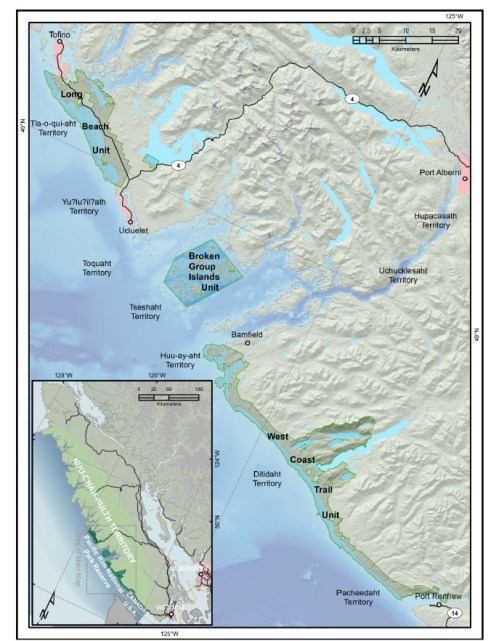
Map of the Pacific Rim Park Reserve on western Vancouver Island (from Doney et al. 2023).
By the late 1990s, I was considered the world’s leading expert in dog domestication and wolf/dog hybridization. As a consequence, in 2002 I was contacted by fellow biologist Val Geist, who’d recently retired to the Alberni Valley on central Vancouver Island.
Val told me all about the problems he and his neighbour were having with a predatory wolf pack, who’d not only attacked dogs and livestock but aggressively challenged people on both farms (Geist 2008). Shortly afterwards, in 2003, I was called on the phone by a Parks Canada employee asking for help developing an education program after hikers traversing the infamous West Coast Trail reported frightening encounters with aggressive wolves.
Since then, Parks Canada has been having recurring problems with aggressive wolves in the Long Beach Unit of the Reserve, which lies between Tofino and Ucluelet.
For example, in 2017, two area wolves were euthanized after 55 incidents of aggressive behaviour. In 2025 (see warning below), the number of frightening wolf encounters on Long Beach escalated to 40+ but no wolf control efforts were taken (Hansen 2018; MacKinnon 2017; O’Malley 2025).
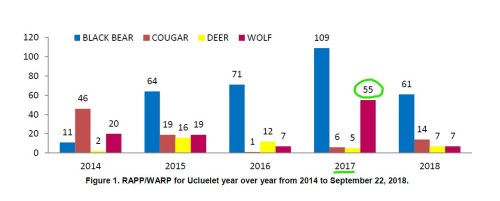
From Hansen 2018
These incidents provided the inspiration for my shocking wolf attack thriller. The story is terrifying precisely because it’s no longer a secret that wolves will kill and eat dogs and livestock, and that on occasion, they will kill and eat people.
References
Doney, E.D., Frank, B., Khan, Z., et al. (2023). Wild about wolves: Using collaboration and innovation to bridge parks, people, and predators. Conservation Science and Practice, e12949. https://doi.org/10.1111/csp2.12949
Geist, V. (2008). Beyond wolf advocacy, toward realistic policies for carnivore conservation. Boone and Crockett Magazine, Winter (Part 3 of a 3-part series). https://www.boone-crockett.org/beyond-wolf-advocacy-toward-realistic-policies-carnivore-conservation
Hansen, B. (2018). WildSafeBC Annual Report 2018. BC Ministry of Environment and Climate Change Strategy. pdf here.
MacKinnon, J.B. (2017). Death of a modern wolf. Hakai Magazine 17 October. https://hakaimagazine.com/features/death-modern-wolf/ and reprinted by The Tyee. https://thetyee.ca/News/2017/10/23/Wolves-Humans–Vancouver-Island/
O’Malley, N. (2025). Encounters climb as habituated wolves establish core territory near Ucluelet. Hashilthsa News, 7 November. https://hashilthsa.com/news/2025-11-07/encounters-climb-habituated-wolves-establish-core-territory-near-ucluelet






 polarbearscience
You must be logged in to post a comment.