Category Archives: Advocacy

Another unsupported claim of starving polar bears in Western Hudson Bay

This time it was Steven Amstrup of Polar Bears International (PBI), via a radio interview on Saturday December 28 “A Scientist’s New Job: Keeping The Polar Bears’ Plight Public.

Amstrup – co-author of the models that predict the extinction of polar bears by the end of this century – had this to say about the polar bear situation in Hudson Bay:

This year, the ice was frozen longer, so he says the bears seem to be in pretty good shape.

“But over the last two or three years, my impression has been, ‘Man, there’s a lot of skinny bears out here.’ “

On average, the sea ice in the Hudson Bay is frozen about a month less per year than it was 30 years ago. Amstrup says bears don’t eat much on land, so they lose about 2 pounds of body fat every day they’re off the ice.

“They’re 60 pounds lighter now than they might have been at this time of year 30 years ago,” he says.” [my bold]

For the last two or three years Amstrup has been seeing “a lot of skinny bears” but hasn’t taken a single photograph that he’s offered for publication or posted at PBI? Makes you wonder, doesn’t it – where are the photos of all the starving bears these guys keep talking about?

Here is a picture of a polar bear that was spending the summer on the shore of Western Hudson Bay 30 years ago, taken in July [bears were on the shore in July this year as well]. Continue reading
Zoos use myth of disappearing polar bears to breed them in captivity

Ironically, just as I was about to remind readers that we are entering the peak period of polar bear births around the Arctic (see previous post, “December is polar bear nativity month”), I came across an article about breeding polar bears in captivity — getting the bears to give birth in zoos.

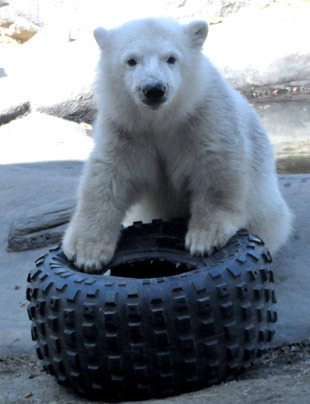
Hudson the polar bear cub moved in January 2013 from the Toronto Zoo, where he was hand-raised after being rejected by his mother, to the Assiniboine Park Zoo, Winnipeg. The Assiniboine Park Zoo were also the recent recipients of a cub orphaned when its mother was shot in the aftermath of a polar bear attack in Churchill.

Hudson the polar bear cub is a zoo-born polar bear. He moved in January 2013 from the Toronto Zoo, where he was hand-raised after being rejected by his mother, to the Assiniboine Park Zoo, Winnipeg. The Assiniboine Park Zoo were also the recent recipients of a cub orphaned when its mother was shot after a polar bear attack in Churchill. Photo from Toronto Zoo.

The newspaper article I saw was all about how technically difficult the generation of polar bear cubs has been for the Toronto Zoo (Canada) but it was the premise for the breeding program itself that caught my attention: to save them from extinction.

The zoo is not waiting until the bears are down to the last few hundred (or even thousands) – no, the zoo is starting now, while polar bears are as plentiful as they have been in the last 40 years, to prepare for their demise.
Continue reading

Furor over a tweet from the Moscow polar bear forum

The ousting of WWF and their cohorts from meetings to which they had initially been invited is the real story (so far) coming out of the International Forum on Conservation of Polar Bears (December 3-6, Moscow). However, that incident never made the mainstream media, so few people will ever know it happened.

What the public did hear about was the uproar over a tweet.

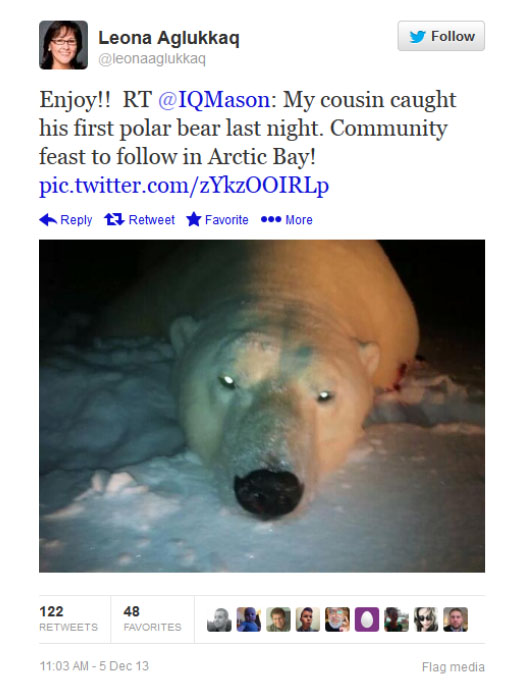
On the last day of the meeting, Canada’s Environment Minister Leona Aglukkaq drove home, in less than 140 characters and a photo, the point she and her contingent had been trying to make at the meeting.

Aglukkaq tweet_Dec 5 2013
A twitter storm erupted that got really nasty — and the media picked up on it. Within hours, newspapers across Canada had themselves a story.

Continue reading

WWF and cohorts barred from Moscow polar bear forum

Despite the fact that the World Wildlife Fund (WWF) apparently provided a significant portion of the funding for the recently concluded International Forum on Conservation of Polar Bears (December 3-6, Moscow), it appears in the end they and their NGO cohorts were prevented from having an undue amount of influence at the meeting. For that we can thank the delegates of the five Arctic nations: three cheers for common sense!

This news did not emerge until late yesterday (Friday, Dec. 6), after the meeting had concluded: no mention was made of NGOs being excluded in the press releases and stories written before then. For example, see IUCN story, Dec. 5; WWF story, Dec. 4; Times of India report, Dec. 5 and this Arctic Journal story Dec. 6. There was nothing in any of them about NGOs and journalists being barred from parts of the meeting they thought they would be allowed to attend.

Note that biologist Mitch Taylor, booted-out of the Polar Bear Specialist Group because he did not agree with the group’s position on global warming, attended as part of the Canadian contingent (see list at the end of this post), which was a bit of a surprise. However, the exclusion from the meeting of WWF and their buddies is the big news as far as I’m concerned.

[The media seems more interested in the fallout from a twitter message sent on the final day of the meeting by Canada’s Environment Minister Leona Aglukkaq — more on that in my next post].

Continue reading

International polar bear forum, Moscow: who’s invited

Re: International Forum on Conservation of Polar Bears: December 3-6, Moscow.

[Updates added Dec. 2 and Dec. 3, 2013, as noted below]

[Updated Dec. 4, 2013: Final agenda here; and as noted below]

On Tuesday, setup begins for the Moscow meeting of all Arctic nations that signed the original agreement to protect polar bears back in 1973. In my post last week, I introduced the agenda (pdf here).

I’ve also made notes on the interesting mix of folks who’ve been invited.
Continue reading

Polar bear researchers still withholding Hudson Bay data

The latest polar bear propaganda emanating from The Guardian is unscientific nonsense fed to them by activist Canadian polar bear researchers: Polar bear numbers in Hudson Bay of Canada on verge of collapse.

This episode of Goldenberg’s polar bear grandstanding includes a photo caption with a totally unsubstantiated claim that some folks might call a lie:

Melting ice is cutting polar bears off from their food source in Hudson Bay, and death rates have soared.

“Death rates have soared”? Where are all the bodies? Show us the starving bears!

In fact, the ice of Hudson Bay melts every summer and always has done. When it does, polar bears go ashore and live off the many inches of stored blubber they put on during their spring feasting on fat baby seals. The last three years, the open-water season has been only about two weeks longer than it was in the 1980s. There has been no steady increase but lots of variability.

Below I dismantle the rest of this transparently political posturing ahead of the international polar bear forum next week.
Continue reading

Polar bear researchers – are they protecting the bears or their own jobs?

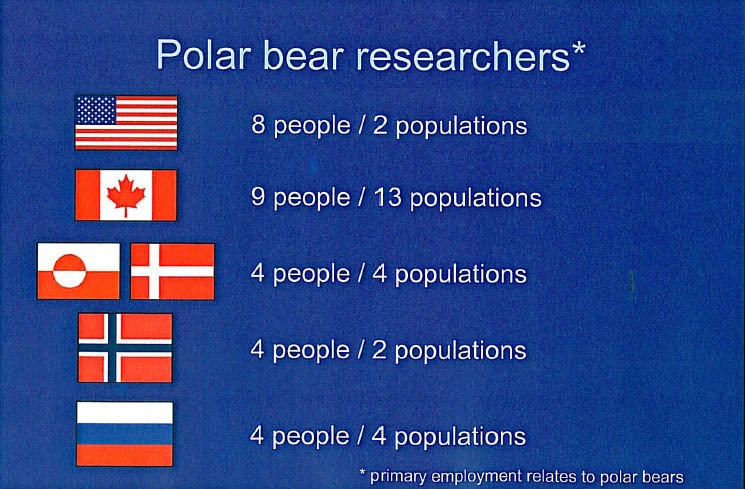
Poor polar bear researchers: there are few full time jobs worldwide and research is underfunded.

This is not my opinion but the facts according to Andrew Derocher and Ian Stirling (2011) — see Fig. 1 and 2 below. I do not dispute them.

Figure 1. The distribution of full-time polar bear researchers worldwide. Graduate students carry out much of the field work, funded by research grants – but eventually, they are going to want full-time jobs too. Where will the money come from? From Derocher and Stirling 2011. Slide 8 from “Conservation status, monitoring, and information gaps.” Invited speaker presentation to the 2011 Polar Bear Meeting in Nunavut, USA contingent. Oct 24-26, 2011.

Figure 1. The distribution of full-time polar bear researchers worldwide. From Derocher and Stirling 2011, invited speaker presentation to the 2011 Polar Bear Meeting in Nunavut, Oct 24-26.

Figure 2. The sad state of polar bear research. From Derocher and Stirling 2011. Slide from “Conservation status, monitoring, and information gaps.” Invited speaker presentation to the 2011 Polar Bear Meeting in Nunavut, USA contingent. Oct 24-26, 2011.

Figure 2. The sad state of polar bear research. From Derocher and Stirling 2011, Invited speaker presentation to the 2011 Polar Bear Meeting in Nunavut, Oct 24-26.

Since Derocher and Stirling have raised the issue, I contend it’s perfectly valid to ask: are polar bear biologists who proclaim their heartfelt fear for the future of polar bears at every opportunity behaving as advocates for polar bears or protecting their own careers?

Continue reading

Canada again under international pressure to list polar bears as threatened

There was a story in The Guardian on Friday (November 21) about an issue I covered earlier this year (in January): Canada under international pressure to list polar bears as threatened, so far holds out.

This time, Suzanne Goldenberg’s headline proclaims “Canada’s refusal to protect polar bears comes under scrutiny.

The story is all about a petition filed by the ever-litigious Center for Biological Diversity (CBD) to the North American free trade organization, the Commission for Environmental Co-operation (CEC), pdf here. The CEC, it seems, has now agreed to investigate the CBD claims.

At issue here is the fact that Canada hasn’t done exactly what the US has done in terms of enacting formal legislation to protect polar bears. Canada, home to 2/3’s of the worlds polar bears (as well as a relatively large Arctic human population) vs. the USA, with the fewest bears in the world but perhaps the loudest, “we know best” attitude. Canada has not declared polar bears to be a species threatened with extinction but the Center for Biological Diversity not only thinks otherwise but thinks someone should force Canada to change its opinion.

It’s more of the same bullying of governments by environmental groups that we’ve come to expect, aided and abetted by activist polar bear biologists.

That said, I suggest you brace yourselves: it’s only going to get worse. We can expect even more of this over the next few weeks, because an important international polar bear meeting is coming up in early December. I expect that the propaganda, aided by an all-too-willing-media, is going to get intense.  Continue reading

Human-polar bear conflicts: Stirling 1974 vs. Amstrup 2013

What a difference a few decades makes to attitudes about human-polar bear conflicts:

Ian Stirling, 1974:

Dr. Stirling felt that complete cessation of hunting, such as exists in Norway, may increase bear-man conflicts. Dr. Reimers replied that the careful harvesting of polar bears was probably desirable, but the total ban now in effect was largely an emotional and political decision rather than a biological one. Last year four bears were killed in self-defense.” [my bold]
(1974 PBSG meeting “Norway – progress reported by [Thor] Larsen”; Anonymous 1976:11).

Stephen Amstrup, 2013:

“We have predicted in no uncertain times [sic – terms?] that as bears become hungrier as the sea ice absence period is longer, more and more of these animals are going to be venturing into communities, venturing into villages, raiding food caches, getting into garbage, and even attacking people. So we predict these kinds of events are going to be more frequent and more severe because of climate change. [my bold]
(The Guardian, November 4, 2013).

Continue reading

Amstrup compares climate change to a Titanic for polar bears

Steven Amstrup, spokesperson for Polar Bears International, has ramped up his “save the polar bear” rhetoric over last week’s nonsense.

Last night (November 13), the NBC News online story (here) that accompanied their evening news clip (h/t DB) included this appalling analogy:

“…Amstrup said greenhouse gases created by humans threaten future generations of bears by threatening their ice. He said he likes to compare climate change’s effect on polar bears to the infamous Titanic ocean liner.

“[It] didn’t matter how many people were on the Titanic or how well they were doing,” he said. “When the Titanic slipped beneath the waves and they lost their habitat, that was it. So polar bears will also go away because of their dependence on sea ice.” [my bold]

Amstrup really wants people to believe that all the polar bears in the world will die some day, all at once, in some mega ice-loss catastrophe!
Continue reading