Category Archives: Conservation Status

US proposal to ban polar bear trade FAILS

Just in, the BBC reports (Matt McGrath): [UPDATE FOLLOWS]

A proposal by the US to ban cross-border trade in polar bears and their parts was defeated on Thursday at an international meeting.

The result marks a victory for Canada’s indigenous Inuit people over their bigger neighbour to the south.

Delegates at the Cites meeting in Thailand rejected the proposal to change the bear’s status from a species whose trade is regulated, not banned.

A similar proposal was defeated three years ago at the last Cites meeting.

The latest plan fell far short of the two-thirds needed to pass the Bangkok conference. It garnered 38 votes in favour, 42 against and 46 abstentions.

Sanity and good science prevailed.

See the full story here.

Continue reading

CITES Secretariat recommends rejecting US proposal to ban polar bear trade

I missed this somehow when I discussed the upcoming (March 3-14) CITES vote on banning polar bear trade (here). But a recent story in the Nunatsiaq News (excerpt below) alerted me to this recommendation by the CITES Secretariat, which rather echoes my December post, “did the PBSG game the polar bear listing process” as well as my last post,  “Ten good reasons not to worry about polar bears”:

Re: Proposal 3 Ursus maritimus (Polar bear) – Transfer from Appendix II to Appendix I
(CoP16 Doc. 7, Annex 2-p. 10 back up here)

Recommendation by the Secretariat

In accordance with the criteria in Annex 1 and the guidelines in Annex 5 of Resolution Conf. 9.24 (Rev. CoP15), the global population of Ursus maritimus does not appear to be small, the area of distribution of this species extends over several million square kilometers and is not restricted and there is insufficient evidence to show that the species has undergone a marked decline in the population size in the wild (when applying the definitions, explanations and guidelines in Annex 5). Whilst the guidelines provide for population declines to be projected by extrapolation to infer likely future values, in this instance such a projection is heavily dependent on estimates of future sea ice coverage which vary widely. An Appendix I listing would not appear to be a measure proportionate to the anticipated risk to the species at this time.

Based on the available information at the time of writing (late January 2013), the Secretariat recommends that this proposal be rejected.

Continue reading

Ten good reasons not to worry about polar bears

IMPORTANT UPDATE March 13, 2013 Benny Peiser over at the Global Warming Policy Foundation has just posted an essay by well-known author Matt Ridley, entitled “We should be listening to Susan Crockford” which is included as a foreword to a pdf of this very post (“Ten good reasons not to worry about polar bears”), suitable for sharing. I encourage you to have a look.

[Update September 28, 2013: See also this follow-up post “Polar bears have not been harmed by sea ice declines in summer — the evidence.”]

Polar Bear-Cubs-Canada_Wallpaper

PB  logo colouredThis year marks the 40th anniversary of the signing of an international agreement to protect polar bears from commercial and unregulated sport hunting. The devastating decades of uncontrolled slaughter across the Arctic, including the Bering Sea, finally came to an end. And so in honor of International Polar Bear Day (Wed. February 27) – and because some activists are calling 2013 The Year of the Polar Bear – I’ve made a summary of reasons not to worry about polar bears, with links to supporting data. I hope you find it a useful resource for tuning out the cries of doom and gloom about the future of polar bears and celebrating their current success.

Continue reading

Where were the appeals to feed starving polar bears in 1974?

The so-called “policy paper” that polar bear biologist Andrew Derocher has been promoting over the last few weeks, which I commented on briefly when the press release came out, is still grabbing headlines. Online news outlets continue to run stories on this bizarre discussion of what officials might decide to do 40 years from now if global warming causes Western Hudson Bay polar bears to spend 6 months on land (Molnar et al. 2010), causing some of those polar bears to starve (see here, here, and here) – as if this is something likely to happen within the next couple of years.

But forget imagined future starvation: where was the media attention on the plight of starving polar bears back in 1974  and 1975 when polar bears were actually starving in large numbers in the eastern Beaufort Sea?

At least two of the co-authors of the paper getting all the attention – Drs. Ian Stirling and Nick Lunn – witnessed polar bears starving in the Beaufort in 1974 because of an especially cold winter and said nothing even though polar bear populations worldwide at the time were already low due to the wanton slaughter of previous decades. Did Stirling and Lunn humanely euthanize the bears they saw starving? Contact the media? [If they did, I’d like to know.] Appeal to governments to make a plan in case it happened again? Apparently not, because it did happen again, at least twice in the following two decades – with no attendant hue and cry then either. No, those Beaufort Sea bears starved to death, time and time again, without a word to the media from Ian Stirling and Nick Lunn.
Continue reading

Misleading “State of the Polar Bear” graphic cost advocate scientists more than US$50,000

UPDATE FEBRUARY 19, 2014The misleading “State of the Polar Bear” graphic is now GONE (as of January 31, 2014). A new 2013 status table is offered by the PBSG here. It has detailed text explanations and harvest information, with references, hyperlinked to each subpopulation entry (“Press the subpopulation hyperlink and more information will appear“) and may have replaced the “State of the Polar Bear” graphic that the PBSG commissioned for upwards of US$50,000, although the PBSG website says it is being “updated [A pdf copy of the 2013 colour table is here, and my commentary on it is here.] I have left the original post as is, below.

I’ve had some time to do a little digging regarding the IUCN Polar Bear Specialist Group (PBSG) State of the Polar Bear web graphic. It turns out this fancy but misleading document was designed by a US company called Periscopic (Portland, Oregon) at a cost of US$50, 000-70,000. So apparently, rather than put $70,000 towards much-needed polar bear research, the PBSG chose to use the money to tell people, in a slightly different way, that it thinks polar bears are doomed. [see UPDATE: April 1 2013]

Just to refresh your memory, last month I pointed out that this fancy summary “tool,” which sits prominently on the home page of the PBSG website, suggests that there are now 22,600-32,000 polar bears worldwide, when tallied by nation (when you add up the individual population estimates provided on each of the two maps on this web “tool” (without clicking through to more detail), you get two different numbers that have no resemblance to the “official” estimate of 20,000-25,000: the page “Nations” gives totals by country that add up to 22,600-32,000 and the numbers given on the “Subpopulations” page (when you hover your mouse over each of the 19 regions) add up to only 13,036 – a far cry from 20,000-25,000 official estimate).

A few days later, I got a response to the email I’d sent to Norwegian polar bear biologist Dag Vongraven, who said it was his job to supervise work on this summary. But, he said, he had “not yet had time to review all details in it as well as I should.” So it seems that without a careful review of the final product, the graphic was posted on the home page of the PBSG website (sometime in October 2012).

It turns out there had been a discussion at the 2009 PBSG meeting, documented in its official report (Obbard et al. 2010:11, Fig. 1 below), about their intention to hire Periscopic as part of on-going PBSG website developments supervised by Vongraven. Several PBSG members agreed this would be a good idea and offered to help by providing data. Continue reading

Andrew Derocher refuses to accept that polar bears have been saved

Andrew Derocher, an known polar bear advocate, has been making headlines again, this time promoting a new “policy paper” he is lead author on that has just been accepted for publication. He and his colleagues simply refuse to accept that the polar bear has been saved (population numbers have rebounded dramatically since protective legislation was introduced in 1973) and it seems all they can think of to do now is press for ever more restrictive regulations.

The timing of the release of this paper is very convenient: Fish and Wildlife biologists and polar bear activists worldwide are actively campaigning to get CITES, at their meeting next month, to make it illegal to trade in legally harvested polar bear parts (see previous post here). Canada is also under international pressure to up-list the status of the polar bear to “threatened,” see post here.

The article itself is behind a paywall (abstract and co-author list below), so it is unlikely that many people outside the choir of conservation advocate subscribers of the journal will ever read it, so Derocher is talking it up big time, with the help of his university PR department. Timely indeed. [h/t WUWT]

Update Feb 12, 2013 – I now have a copy of the Derocher et al in press paper. If anyone would like to see it, please send me a note via the “Commments-Tips” page above

Update October 20, 2013 – the Derocher et al. paper is now in print and I’ve updated the citation information below

Continue reading

Why is the US pushing to ban polar bear trade? Polar bears have been saved

One of the items on the agenda at the upcoming 16th meeting of the signatories to the Convention on International Trade in Endangered Species of Wild Fauna and Flora (CITES) in Bangkok Thailand (3-14 March, 2013) is a proposal to upgrade the polar bear from Appendix II to Appendix I status – prepared by the US Fish & Wildlife Service. The suggested change is based on what is claimed to be “a marked decline in the population size in the wild, which has been inferred or projected on the basis of a decrease in area of habitat and a decrease in quality of habitat.” If this proposition is adopted by CITES, it would be illegal to trade legally harvested polar bear parts of any kind.

The US tried this maneuver at the last CITES meeting in 2010 and it failed rather miserably. I see little reason to believe it will pass this year, even though the US is actively campaigning and has motivated activists worldwide to pressure other countries to vote in their favour (see “Activists push for international ban on legal trade in polar bear items” which discusses the absurdity of the World Wildlife Fund (WWF) not supporting the CITES proposal because they want to keep the focus on model-predicted future “threats” of global warming, see Clark et al. 2012, abstract below).

But here’s the question I have for all the folks involved in this CITES petition and other similar proposals to upgrade the conservation status of the polar bear to a “threatened” or “endangered” level: why is all this time, money and effort going toward ever-more restrictive regulations for a species that has clearly been saved but about which we still know so little?

Continue reading

Canada under international pressure to list polar bears as threatened, so far holds out

[Updated Jan. 27, 2013 at 7:55 am PST Footnote added]

I was inspired to write this post after perusing the Q & A portion of the “What scientists say” section at Polar Bears International. One of the questions is this one:

Are Canadian scientists opposed to listing the polar bear as threatened, as some news organizations have reported?

While I don’t know when it was posted, this question appeared quite timely when I came across it, given the recent news (Nov. 30 2012) that “Canada is being forced to explain its policies to an international environmental watchdog” (Maclean’s magazine; see also the Calgary Herald story) because of a petition filed by the ever-litigious Center for Biological Diversity.

This petition, presented to the Commission on Environmental Co-operation by the CBD, followed on the heels of the news that Canada’s “Species at Risk Act” (SARA) will continue to list the polar bear as a species of “special concern” but not threatened or endangered (CBC story here).

The original petition was filed in November 2011 and re-issued in October 2012. It seems Canada now has until January 23, 2013 to respond to the Commission, after which an investigation could be launched.

We should hear their answer any day now – but guess what? Outspoken PBSG polar bear biologist Andrew Derocher looks to have at least inspired this petition, if he was not party to it.

Continue reading

Update: Polar bear population now 22,600-32,000 – when tallied by nation

UPDATE FEBRUARY 19, 2014The misleading “State of the Polar Bear” graphic is now GONE (as of January 31, 2014). A new 2013 status table is offered by the PBSG here. It has detailed text explanations and harvest information, with references, hyperlinked to each subpopulation entry (“Press the subpopulation hyperlink and more information will appear“) and may have replaced the “State of the Polar Bear” graphic that the PBSG commissioned for upwards of US$50,000, although the PBSG website says it is being “updated” [A pdf copy of the 2013 colour table is here, and my commentary on it is here.] I have left the original post as is, below.

[See followup posts here and here (April 1)]

Two days ago, I got a short note from PBSG chairman and website manager Dag Vongraven of the Norwegian Polar Institute, Tromso. He was responding to an email I sent him earlier this week asking about the apparent increase in global polar bear numbers when tallied by nation as depicted in the “State of the Polar Bear” dynamic “tool” featured on the Polar Bear Specialist Group (PBSG) website, which I discussed in a previous post here. The tally by nation in that PBSG document suggests that the world population estimate for polar bears is 22,600-32,000 – far higher than the 20,000-25,000 “official” estimate.

Apparently, this tool was developed by a US-based web company under Vongraven’s supervision. But, he says, he has “not yet had time to review all details in it as well as I should.So, without a careful final review, the document was posted on the front page of the PBSG website, where it has been featured for several months.

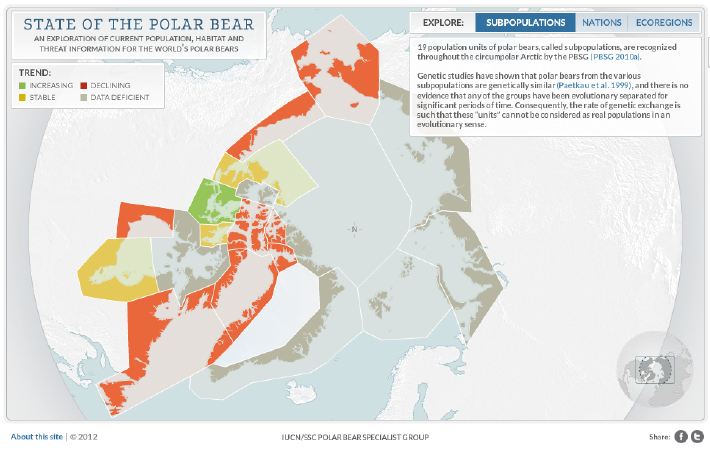
The “tool” consists of three maps – that’s it. They are titled Subpopulations, Nations, and Ecoregions. I previously discussed the population totals by Nation, but when I went back and looked at the Subpopulation numbers, I realized they are very odd as well.

The total population estimate listed on the Subpopulation map add up to just 13,036 – not even close to the 20,000-25,000 “official” estimate. The map (see screen cap below) gives no number (estimate = 0) for the following subpopulations, all of which have an official estimate (see previous post here, estimates from the 2009 PBSG report in square brackets): Foxe Basin [2,197], Viscount Melville [161], Laptev Sea [800-12,00] and Barents Sea [2,650]. On the map below, all of the regions coloured grey have no estimate provided (estimate = 0). In addition, there is no estimate provided for the Chukchi Sea subpopulation, coloured orange in this map, as per the official estimate [you can’t see the numbers given in this screen cap because they only show up when you hover your mouse over the region].

So when you add up the individual estimates provided on each of the two maps on this web tool, you get two different numbers that have no resemblance to the “official” estimate of 20,000-25,000.
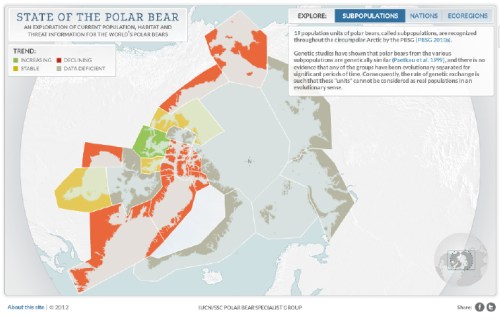
"Subpopulation" status, from the Polar Bear Specialist Group special tool, "The State of the Polar Bear." downloaded January 17, 2013

“Subpopulation” status map, from the Polar Bear Specialist Group dynamic web tool, “The State of the Polar Bear.” [downloaded January 17, 2013]. Population estimates for each region show up on the original web-based tool when you hover your mouse over the map. All of the regions coloured grey, as well as one of the orange-coloured regions (Chukchi Sea, centre top), do not have a number provided.

 Vongraven says he is recovering from surgery and so it may be awhile until someone takes a look to see what’s up with this tool. He did not seem overly concerned about it. But he assured me that the official polar bear estimate of 20,000-25,000 has not changed, although it may after the next population review at the PBSG meeting later this year.

The point is this: if you were a high school student or a teacher looking for a simple and authoritative summary on the status of the polar bear, this tool would look very attractive. The IUCN/SSC Polar Bear Specialist Group want us to consider them the ‘premiere’ experts on polar bear numbers worldwide but these maps do not accurately summarize the current state of knowledge about global polar bear population numbers. The maps are misleading and confusing. We may never know who’s bright idea this was but I in my opinion, it’s a dud.

[the “State of the Polar Bear” tool was still up on the PBSG website, in its original state, the last time I looked]

Polar bear population now 22,600-32,000 – when tallied by nation

UPDATE FEBRUARY 19, 2014The misleading “State of the Polar Bear” graphic is now GONE (as of January 31, 2014). A new 2013 status table is offered by the PBSG here. It has detailed text explanations and harvest information, with references, hyperlinked to each subpopulation entry (“Press the subpopulation hyperlink and more information will appear“) and may have replaced the “State of the Polar Bear” graphic that the PBSG commissioned for upwards of US$50,000, although the PBSG website says it is being “updated” [A pdf copy of the 2013 colour table is here, and my commentary on it is here.] I have left the original post as is, below.

This afternoon I came across some startling information. [updated here, here from Feb. 10, 2013, and here from April 1, 2013]

According to a dynamic summary report on the home page of the IUCN/SSC Polar Bear Specialist Group website  called State of the Polar Bear, there are now 22,600-32,000 polar bears worldwide, when tallied by nation.

Here are the numbers, by nation, listed in the State of the Polar Bear summary report (see map below):
Canada                              13,300-17,500
USA                                   1,200-1,800
Russia                               2,700-4,800
Norway                             1,900-3,600
Greenland
(Denmark)                        3,5000-4,400
Total                            22,600-32,000

The “Nations” page of the Polar Bear Specialist Group’s “State of the Polar Bear,” a dynamic summary that can be launched from the home page of the IUCN PBSG  http://pbsg.npolar.no/en/dynamic/app/ [published Oct. 15, 2012] Click to enlarge.

The “Nations” page of the Polar Bear Specialist Group’s “State of the Polar Bear,” a dynamic summary that can be launched from the home page of the IUCN PBSG website, http://pbsg.npolar.no/en/ [published Oct. 15, 2012] Click to enlarge.

This is a big change from the 20,000-25,000 that has been touted as the global polar bear population since 2005 (see Aars et al. 2006; Obbard et al. 2010) and my post on polar bear population estimates.
[updated Jan. 9 2013 at 8:20 PST, see end of post]

UPDATE Jan. 7. 2014 – The PBSG has announced that a new population assessment is due later this month, see this January 1 post. The graphic described in this post has moved to the page called “Population information” and the official estimate of 20,000-25,000 is no longer present. There was no press release associated with this announcement.
Continue reading