Tag Archives: food chain

Sea ice conditions continued to favour Arctic marine life in 2025

Increased primary productivity in the Arctic generated by reduced summer sea ice has continued into 2025, according to NOAA’s annual Arctic Report Card published yesterday, which means Arctic seals and whales, walrus, and polar bears will continue to flourish.
Don’t look for that take-home in the legacy media, since they will all focus on the bits of the report that feed a doom-mongering narrative.


September sea ice extent has continued to stall, rather than plummet as predicted (Table 1: eleventh lowest average September extent since 1979; 4.75 mkm2), although they don’t come out and say so. NSIDC has stopped producing monthly sea ice reports due to budget cuts in late September 2025.

From the Report Card highlights [my bold]:

  • From 2003 to 2025, phytoplankton productivity spiked by 80% in the Eurasian Arctic, 34% in the Barents Sea, and 27% in Hudson Bay.
  • Plankton productivity in 2025 was higher than the 2003-22 average in eight of nine regions assessed across the Arctic.

And from the report on primary productivity itself:

All regions, except for the Amerasian Arctic (the combined Chukchi Sea, Beaufort Sea, and Canadian Archipelago), continue to exhibit positive trends in ocean primary productivity during 2003-25, with the largest percent changes in the Eurasian Arctic (+80.2%), Barents Sea (+33.8%), and Hudson Bay (+27.1%).

I’ve explained previously how and why this works: less summer ice = more plankton, which means more food for all marine life.
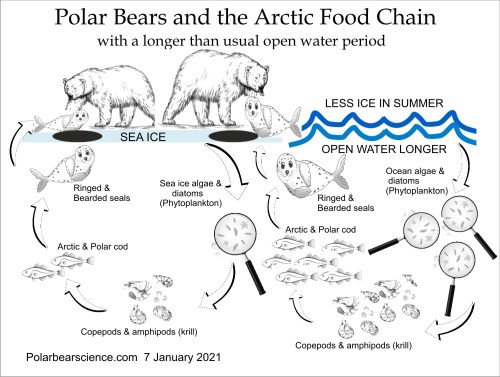
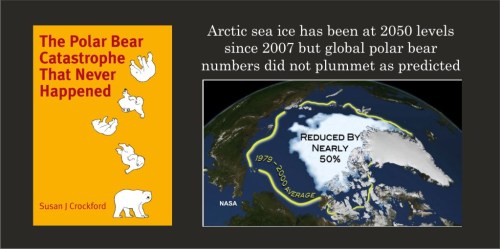
This explains why the catastrophic decline in polar bear numbers predicted in 2007 never happened.
PS. If you haven’t already, check out my new wolf attack thriller, DON’T RUN. There’s probably still time to order and get a before-Christmas delivery.
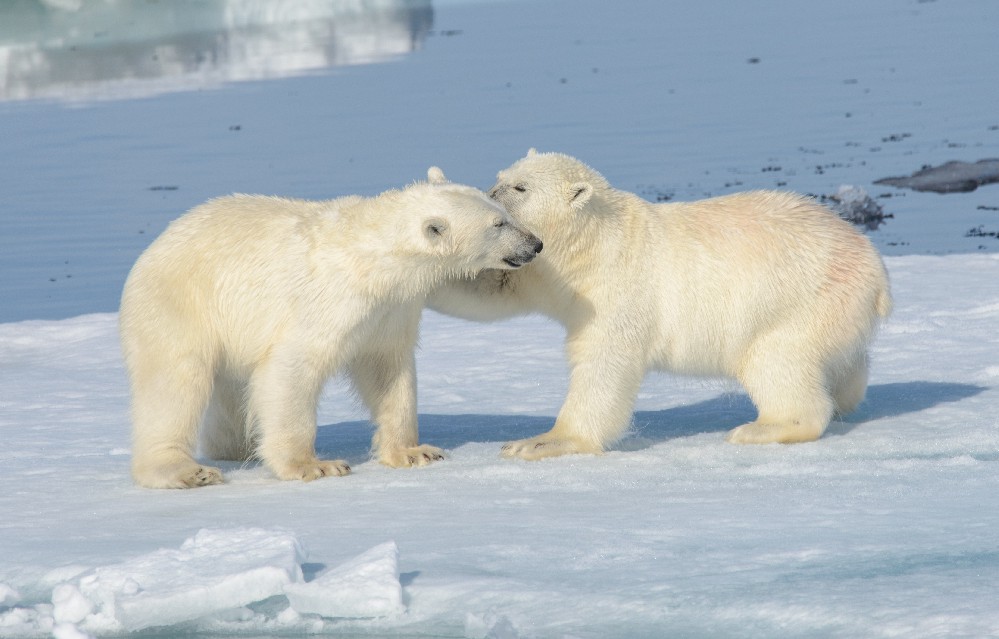
More Barents Sea polar bear habitat at mid-July 2023 than in 2012 despite more atmospheric CO2

Despite more CO2 in the atmosphere (424 vs. 392, for June), there was more sea ice cover in the Barents Sea at mid-July this year than there was in 2012.

This region has seen about 6 times the amount of summer sea ice loss as any other region of the Arctic (Regehr et al. 2016): Barents Sea bears now have a longer ice-free season than the famous Western Hudson Bay bears that we hear so much about.

Yet contrary to predictions, which insisted that protracted poor ice conditions in summer would inevitably result in catastrophic rates of starvation and death (Amstrup et al. 2007; Crockford 2017, 2019), polar bears in the Svalbard region have so far not had any documented any harm to their health or population size. In fact, field data show bears in Svalbard are in better condition than they were in the late 1990s (Lippold et al. 2019), almost certainly due to the documented increase in primary productivity that has resulted from longer ice-free summers since 2003 (Frey et al. 2022; Crockford 2023).

Continue reading

No evidence polar bears survived Eemian warmth because they were not yet fully ice-dependent

Is evolution primarily fast or slow? Does it take hundreds of thousands of years or a few generations to produce a new species? Ignoring vast evidence to the contrary, most geneticists insist that evolutionary change is imperceptibly slow and one of them is using this misconception to support the human-caused climate change narrative.

For polar bears, the question is this: could brown bears (aka grizzlies) have survived for hundreds of thousands of years living in a completely different habitat–the perpetually-frozen world of Arctic sea ice–before significant biological changes took place? I contend the answer is no. Moreover, if I am correct that polar bears arose ca. 140,000 thousand years ago (140kya) during the height of an extreme glacial period, the fossil evidence concurs. Analysis of fossil remains show that by about 115-130kya at the latest (after perhaps 10k years), polar bears were primarily eating seals as their modern counterparts do and their bones had lost the distinctive features of their grizzly ancestors.

But that’s the maximum time frame: research on other animals indicate that such critical changes almost certainly took place long before that, within the first few generations of life on the sea ice. If coordinated changes had not taken place very quickly, within ecological time, brown bears would simply not have survived the harsh life on Arctic sea ice.

Continue reading