
Category Archives: Conservation Status

Bearded and ringed seals join the polar bear as “threatened” by a computer-modeled future

As I pointed out in Featured Quote #22 (posted on Dec. 23, 2012), bearded and ringed seals have recently joined the polar bear on the American ESA’s list of animals that are “threatened” by computer-modeled predictions of Arctic sea ice declines projected 50-100 years into the future (USFWS 2008, 2012a, 2012b).
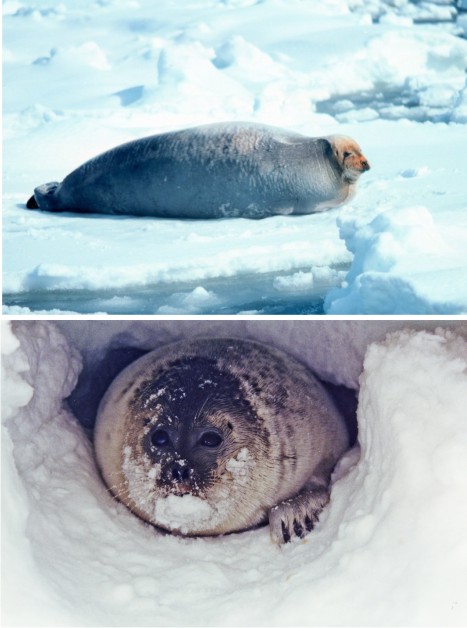
NOAA photos of bearded seal (top) and ringed seal (bottom)

NOAA photos of bearded seal (top) and ringed seal (bottom). The bearded seal is one of the largest Arctic ice seal while the ringed seal is the smallest. Both are eaten by polar bears, although ringed seals are consumed most often.

The decision by NOAA (National Oceanographic and Atmospheric Administration) affects the Arctic subspecies of ringed seal (Phoca hispida hispida) as well as the Okhotsk subspecies (Phoca hispida ochotensis) (in addition to several others) and thus includes all ringed seals off Alaska’s coast in the Beaufort, Chukchi and Bering Seas. The decision also affects two particular subpopulations of bearded seal (Erignatha barbatus): the “Beringia” [Bering Sea/Chukchi] subpopulation (about half of which reside in Alaskan waters), and the subpopulation that lives in the Sea of Okhotsk. (Alaska Fisheries (NOAA) Final Decision). Continue reading

Did the PBSG game the polar bear listing process?

I was in the process of writing about something else last week when I came across a tidbit of information that, on closer examination, turned out to be part of a much bigger issue that I thought should be documented.

The story involves some machinations behind the scenes of the international Polar Bear Specialist Group, the “PBSG,” that you might find rather astonishing – and which may have implications for the various on-going battles about the polar bear’s conservation status.

A lone polar bear walking on ice [Kathy Crane (NOAA) photo].  We'll call this a metaphor for the expulsion of Mitch Taylor from the PBSG after the Group switched from emphasizing unregulated over-hunting as the primary threat to polar bear conservation to global warming.

A lone polar bear walking on ice [Kathy Crane (NOAA) photo].
We’ll call this a metaphor for the expulsion of Mitch Taylor from the PBSG,
after the Group switched from emphasizing unregulated over-hunting
as the primary threat to polar bears to global warming.

Continue reading

‘Species-threatening’ population declines vs. polar bear declines

In 2008, polar bears in the United States were declared ‘threatened’ under the Endangered Species Act (USFWS 2008). The IUCN (to which the Polar Bear Specialist Group (PBSG) belongs) lists the polar bear as “vulnerable” (IUCN Red List 2012). In Canada (where 60% of the world’s polar bears reside), the polar bear is listed as a ‘species of special concern’ (COSEWIC 2008:iii).

As Jonathan Adler pointed out in an excellent article that appeared on the heels of the American ESA listing decision (Adler 2008:112), “Insofar as the listing is based upon climate models, ice-melt projections, and assumptions about the effects of habitat loss on the bear’s prospects for survival in the wild, its scientific basis is quite speculative.” These are also, as I understand it, unprecedented criteria for ESA listing – no other species has been listed as endangered or threatened based on such speculation of future conditions.

So what do actual polar bear population declines look like?

The Western Hudson Bay, Canada (WHB) subpopulation is the only one that has recently declined by a statistically-significant amount. [see previous post here on the status numbers] The WHB polar bear subpopulation makes up 3-5% of the global total for the species, currently estimated at 20,000-25,000 animals.

In this post, I’ll compare the documented WHB population decline to the declines seen in a few truly endangered animals, just to put the much-bandied about numbers into some perspective. Continue reading


