Category Archives: Polar bear attacks

Polar bears in winter: starving bears and attacks on humans

Winter in the Arctic can be a tough time for polar bears. Between the cold, darkness and ever-thickening sea ice with fewer open leads, polar bears often find that seals are hard to come by.

So it should not be surprising to find out that polar bears are at their lowest body weight at the end of winter (Ramsay and Stirling 1988:613; Stirling 2002:68).

In other words, polar bears lose weight over the winter – not just during the ice-free summer period. That’s why the spring and early summer feeding period is so critical: gorging on young seals rebuilds the polar bears’ fat reserves lost over the winter and packs on even more fat to tide them over the late summer/early fall ice-free period.

Last fall, a potentially serious attack by a polar bear on a Churchill, Manitoba resident on Hallowe’en night (early hours of November 1) got a lot of attention worldwide. Some media outlets suggested that the bear involved in this attack was either starving or so hungry that he was driven to attack. However, this assertion was not supported by any evidence — we simply don’t know whether he was in poor condition or not. While the bear was undoubtedly leaner at the end of October than he was in July, that doesn’t mean he was actually ‘starving.’

So, here’s the question: given that polar bears have a tough time finding seals to eat during the dark and cold Arctic winter and are presumably at their hungriest then, do serious polar bear attacks on humans also happen in winter?
Continue reading
Polar bear problems in N Hudson Bay not due to late freeze-up

The myth that northern Hudson Bay communities are having problems with polar bears this year because freeze-up is later than usual just won’t go away.

I discussed the well publicized craziness in Churchill last week (here and here), but there’s more. Polar bears are already leaving the shore of Northern Hudson Bay as the ice rapidly forms but I saw a story yesterday (dated late last week) that quoted a local official in Repulse Bay blaming their polar bear problems on late freeze-up.

I’ve written before about the peer-reviewed paper by polar bear researchers Seth Cherry and colleagues published earlier this year on breakup and freeze-up dates between 1991 and 2009. But perhaps the freeze-up data needs more emphasis. I’ve copied that graph again below, with notes, and added some ice maps. See for yourself.

Bottom line: A “late freeze-up” for northwestern Hudson Bay occurs when ice formation is delayed until early December or beyond. Freeze-up was nowhere near “late” this year, nor was the ice “slow to freeze.” It wasn’t last year either.
Continue reading

Human-polar bear conflicts: Stirling 1974 vs. Amstrup 2013

What a difference a few decades makes to attitudes about human-polar bear conflicts:

Ian Stirling, 1974:

Dr. Stirling felt that complete cessation of hunting, such as exists in Norway, may increase bear-man conflicts. Dr. Reimers replied that the careful harvesting of polar bears was probably desirable, but the total ban now in effect was largely an emotional and political decision rather than a biological one. Last year four bears were killed in self-defense.” [my bold]
(1974 PBSG meeting “Norway – progress reported by [Thor] Larsen”; Anonymous 1976:11).

Stephen Amstrup, 2013:

“We have predicted in no uncertain times [sic – terms?] that as bears become hungrier as the sea ice absence period is longer, more and more of these animals are going to be venturing into communities, venturing into villages, raiding food caches, getting into garbage, and even attacking people. So we predict these kinds of events are going to be more frequent and more severe because of climate change. [my bold]
(The Guardian, November 4, 2013).

Continue reading

Churchill polar bear attack shamelessly used to advance global warming agenda

I guess Suzanne Goldenberg, writing for The Guardian, just couldn’t help herself with this latest story (November 4):Polar bear attacks: scientists warn of fresh dangers in warming Arctic. Two people injured in latest attack as hungry bears deprived of access to sea ice increasingly look for food on land.

Reporting on the attack is one thing — several papers covered this over the weekend (see Featured Quote #46, posted yesterday, for links to two of them). However, Goldenberg shamelessly makes this about global warming, aided and abetted by Polar Bears International (PBI) representative Steven Amstrup, a claim that doesn’t hold up to even minor scrutiny.

Continue reading

Polar bears in winter: insights from Behouden Huys, 1596-1597

As a follow-up to my previous post on polar bears giving birth (December is polar bear nativity month) I thought I’d continue the generalized theme of “polar bears in winter.”

polar bear aurora_borealis_3-t2 free

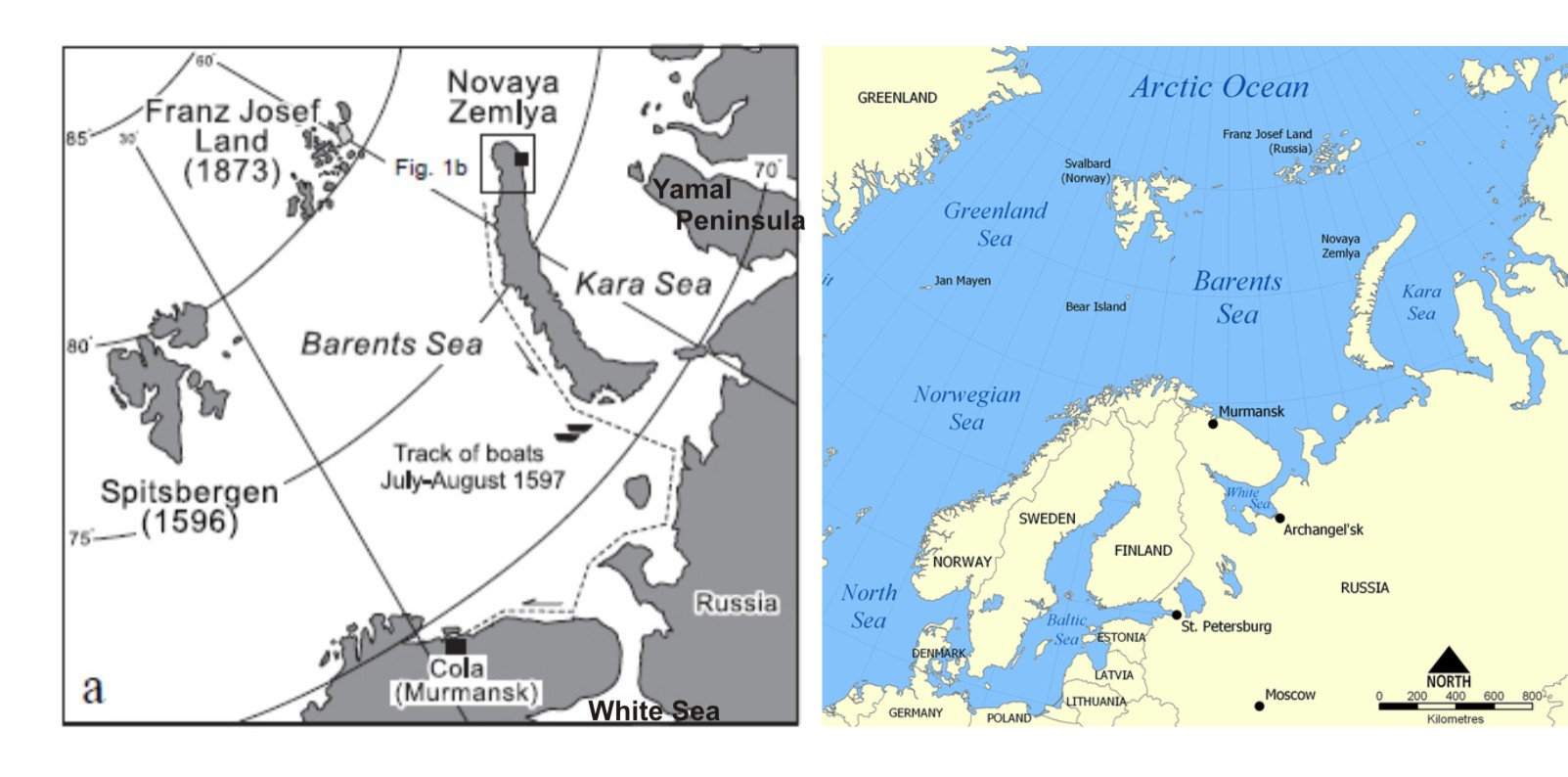
While we don’t really know for sure what non-pregnant polar bears do during the depth of the Arctic winter, we have bits of evidence – some from modern hunters and polar bear researchers but also from Arctic explorers. One explorer in particular comes to mind: William Barents [Willem Barentsz] of Holland, who attempted to reach China via the Arctic Northeast Passage in the late 16th century. On their third voyage (1596-1597), Barents and his crew were forced to spend the winter on the northern tip of Novaya Zemlya (latitude 760N, see Fig. 1) when their ship became trapped in the sea ice. Crew member Gerrit De Veer (1609) kept a journal account of the long, horrifying winter they spent on shore, in a shelter they built with materials salvaged from the ship. They called their winter home Behouden Huys (“the saved house”).

Figure 1. Location of Novaya Zemlya, in the Barents Sea. On the map at left (a), the black square marks the location of Behouden Huys, the over-winter home of William Barents and his crew (1596-97) on Novaya Zemlya (the “track of boats” noted marks the return journey of Barents in the summer of 1597). This is modified from Zeeberg et al. 2002:331. The map on the right is from Wikipedia, for perspective. click to enlarge.

Figure 1. Location of Novaya Zemlya, in the Barents Sea. On the map at left (a), the black square marks the location of Behouden Huys, the over-winter home of William Barents and his crew (1596-97) on Novaya Zemlya (the “track of boats” noted marks the return journey of Barents in the summer of 1597). This is modified from Zeeberg et al. (2002:331). The map on the right is from Wikipedia, for perspective. click to enlarge.

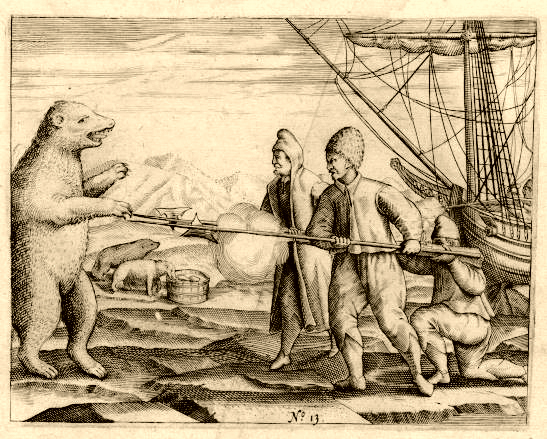
An English translation of De Veer’s journal is now available online and it offers a fascinating glimpse of what it meant to live through that long dark winter under almost-constant fear of attack by polar bears. The Dutchmen were plagued by polar bears almost the entire time they were on Novaya Zemlya (see Fig. 2). De Veer’s notes on these encounters provide a unique perspective on polar bear activities over the Arctic winter – ironically, it is not the havoc the bears caused that provides the most important clue but rather, the timing of when they left Barents and his crew alone.

Figure 2. An engraving from De Veer’s journal conveys the struggle the crew faced in warding off polar bears during their winter stay at Novaya Zemlya. The bears not only stalked and attacked the crew - they got into the food stores on the ship (From Wikipedia).

Figure 2. An engraving from De Veer’s journal conveys the struggle the crew faced in warding off polar bears during their winter stay at Novaya Zemlya. The bears not only stalked and attacked the crew, they got into the food stores on the ship.
(From Wikipedia).

Continue reading