Posted onOctober 16, 2023|Comments Off on Polar bear researchers hiding significant increase in Southern Hudson Bay numbers
Last December, researchers vigorously promoted a possible 27% decline in Western Hudson Bay (WH) polar bear abundance but kept hidden the fact that adjacent Southern Hudson Bay (SH) numbers increased by 30% over the same period.
And surprise, surprise: the bombshell SH results call into question everything the ‘experts’ have been saying about polar bears in Hudson Bay for years.
Posted onAugust 31, 2023|Comments Off on New study that claims it can directly link GHG emissions to polar bear cub survival is poppycock
A global warming miracle has happened. While no scientist worldwide has ever drawn a straight line between greenhouse gas emissions and population declines in a species considered at risk due to climate change, a new paper just published in Science Magazine claims to have performed this unlikely feat for polar bears. It’s called “Unlock the Endangered Species Act to address GHG emissions.”
Note this analysis has not been peer reviewed: as a “Policy Forum” contribution, it’s considered by the journal to be a public interest commentary, not a research paper.
One might be forgiven for asking whether this work represents solid, reproducible science or simply well-timed, sciency-looking rhetoric ready-made for the litigious Center for Biological Diversity to pressure the US government to increase protections for polar bears before the 2024 US election. It is surely no coincidence that this paper made its appearance near the seasonal low for Arctic sea ice as well as during the 15-year anniversary of the ESA listing of polar bears as ‘threatened’ and the 50th anniversary of the ESA itself.
Moreover, knowing this paper was in the pipeline might explain why the 2022 government report on the most recent Western Hudson Bay polar bear decline, which I discussed yesterday, has been kept secret for so long: the results of that report are cited in this new Science paper as supporting evidence that sea ice declines are responsible for recent population declines, which Reuters said in December was clearly not the casefor the period 2017-2021.
Posted onAugust 30, 2023|Comments Off on W. Hudson Bay polar bear numbers declined 27% in 2021 but not because of missing ice: secret paper
As will become apparent tomorrow, Western Hudson Bay polar bear numbers apparently declined 27% between 2017 and 2021 but not because of sea ice loss. This fact, gleaned from a secret government report leaked to the media, emerged just before Christmas last year and spread around the world. I commented on it here at the time.
It will also be apparent tomorrow why that government report is still unavailable. Thursdays are when the big two science magazines publish their papers, which means associated news stores promoting preferred narratives are embargoed until then. Stay tuned.
Posted onAugust 8, 2023|Comments Off on Climate activists are silent on polar bears because their doom-mongering blew up in their faces
A Grist article last week pandered to activist polar bear specialists over their failed climate change agenda as it tried to minimize why the climate movement doesn’t talk about polar bears anymore. Apparently, the Arctic icon has “largely fallen out of fashion” through “overexposure” resulting in polar bear images invoking “cynicism and fatigue.” But that isn’t really true, is it?
While there is an admission that the over-hyped lies about starving bearspromoted by National Geographic in 2017 and 2018 were a factor, there is no mention in the article of the well-known, documented evidence of scientists’ own failed assumptions that polar bears require summer sea ice for survival have had any impact on public opinion (Amstrup et al. 2007; Crockford 2015, 2019, 2022, 2023; Lippold et al. 2019; Rode et al. 2021).
Thriving populations in the Chukchi Sea and elsewhere amid low summer ice levels have busted the myth that polar bears need ice year-round.
Andrew Derocher was also allowed to repeat, unchallenged, the ridiculous narrative he and his activist supporters have peddled before, that insists the polar bear had become a climate change icon by accident rather than design, a lie I addressed in detail last year. Some excerpts from that 2022 post are copied below.
Posted onJuly 30, 2023|Comments Off on Repeat of 2013 high-profile Sierra Club polar bear attack, this time with Inuit victims
Almost 10 years later to the day, another polar bear attack resulting in serious injury has taken place in the northern Labrador/Quebec region of Eastern Canada. Remember the Sierra Club lawyer snatched, tent and all, in the middle of the night on 24 July 2013, in an almost-fatal attack that was reported around the world, see here and here? This time virtually the same thing happened to two Inuuk campers on July 26, in the same general area, as reported last week by Nunavut News. This will undoubtedly renew concerns that Davis Strait Inuit have raised about their safety in the face of high population numbers of polar bears (Tomaselli et al. 2022).
Sea ice conditions were similar in both attacks. In 2013, the attacking bear appeared to be a fully adult male in good condition that had been watching the hiking party since the previous day but this year the predatory bear was described as a small “young adult” animal, suggesting it could have been a 3-4 year old female or perhaps a 2 year old male.
Posted onJuly 17, 2023|Comments Off on More Barents Sea polar bear habitat at mid-July 2023 than in 2012 despite more atmospheric CO2
Despite more CO2 in the atmosphere (424 vs. 392, for June), there was more sea ice cover in the Barents Sea at mid-July this year than there was in 2012.
Yet contrary to predictions, which insisted that protracted poor ice conditions in summer would inevitably result in catastrophic rates of starvation and death (Amstrup et al. 2007; Crockford 2017, 2019), polar bears in the Svalbard region have so far not had any documented any harm to their health or population size. In fact, field data show bears in Svalbard are in better condition than they were in the late 1990s (Lippold et al. 2019), almost certainly due to the documented increase in primary productivity that has resulted from longer ice-free summers since 2003 (Frey et al. 2022; Crockford 2023).
Posted onMay 13, 2023|Comments Off on Polar bears in W. Hudson Bay are in good shape, says researcher. So are numbers really falling?
We’ve got ourselves another round of field data–i.e., facts–not fitting the polar-bears-are-starving-to-death narrative. According to polar bear specialist Andrew Derocher, Western Hudson Bay polar bears his team saw in April while installing collars and ear tags were in good shape this year, as he said they were last year. There was no spring field work in 2021 and 2020 but in 2019, he also said the bears he saw were in good condition.
Andrew Derocher 4 May 2023, reporting on Western Hudson Bay field work
Two years in a row of bears in good condition in spring–with no mention of starving bears–does not fit the picture of a population supposedly declining due to starvation. The most recent population count for WH, which garnered wide-spread media attention just before Christmas last year, claims that a 27% decline in numbers took place between 2017 and the fall of 2021 even though sea ice conditions had been good during those five years as well. It’s a perplexing situation. Makes me really wonder what that survey report actually says, but it still hasn’t been released, five months after the results made news around the world.
Posted onFebruary 27, 2023|Comments Off on Polar Wildlife Report reveals Arctic and Antarctic animals were thriving in 2022
The Polar Wildlife Report is a peer reviewed summary of the most recent information on polar animals, relative to historical records, based on a review of 2022 scientific literature and media reports. It is intended for a wide audience, including scientists, teachers, students, decision-makers and the general public interested in animals that live in Arctic and Antarctic habitats, including polar bears, killer whales, krill, and penguins.
Posted onFebruary 23, 2023|Comments Off on Published field study observations – not population size – prove polar bears are thriving
There is irrefutable evidence from Barents and Chukchi Sea subpopulations, among others, that polar bears are fat and reproducing well despite marked declines in summer sea ice over the last two decades. These indicators of physical and reproductive health, in any species, are signs of thriving populations. However, these facts negate the premise that polar bears require abundant summer sea ice to flourish, and that creates a problem for polar bear specialists who continue to make that claim (Amstrup et al. 2007; Crockford 2017, 2019).
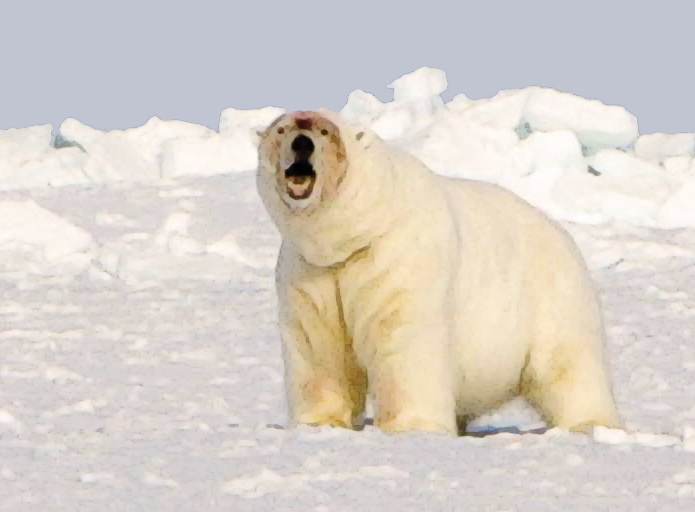
Enormously fat Chukchi Sea polar bear, USFWS.
In other words, the assessment that polar bears are currently thriving is not based solely on estimates of a slight increase in global population size but on published data gathered from field studies on the bears’ physical and reproductive health.
Oddly, biologists repeatedly turn to data from Western Hudson Bay to drive home to the public their preferred message that polar bear health and abundance are being negatively affected by recent summer sea ice declines. However, they fail to mention that robust field data from many other regions, including the Barents and Chukchi Seas, support the opposite conclusion. Moreover, wherever possible, they mumble under their breath (or leave out entirely) the fact that poor ice conditions could not be blamed for a 27% decline in polar bear numbers in Western Hudson Bay since 2016 — because their own data showed sea ice conditions had been strong!
Relying on the data I referenced used to be uncontroversial. When a CNN science journalist did an investigation similar to AFP’s in 2008, he spoke to numerous scientists and they agreed “that polar bear populations have, in all likelihood, increased in the past several decades.” When polar bears in 2008 were listed as a threatened species under the Endangered Species Act, the decision noted that the population “has grown from a low of about 12,000 in the late 1960’s to a current worldwide estimate of 20,000-25,000.” The data here haven’t changed, only the media’s willingness to disregard annoying facts.
The result is that the public is denied access to accurate data and open debate about these very important topics. Ridiculous points on one side are left standing while so-called fact-checking censors inconvenient truths. If we’re to make good climate policy, voters need a full picture of the facts. Lomborg 2023, backup link
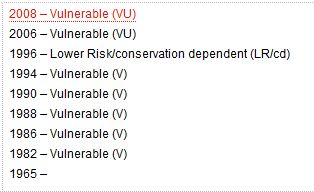
I would add this fact: in 1982, polar bears were listed by the IUCN as ‘vulnerable’ but by 1996, that had changed to ‘lower risk/conservation dependent’–now called ‘least concern‘ (see screencap below) because population numbers had rebounded after more than 20 years of international protection from over-hunting. The reversion to ‘vulnerable’ in 2006 was based entirely on predictions that population numbers would decline in the future due to see ice loss, which so far has not happened (Crockford 2017, 2019; Crockford and Geist 2018).
References
.Crockford, S.J. 2017. Testing the hypothesis that routine sea ice coverage of 3-5 mkm2 results in a greater than 30% decline in population size of polar bears (Ursus maritimus). PeerJ Preprints 19 January 2017. Doi: 10.7287/peerj.preprints.2737v1 Open access. https://peerj.com/preprints/2737/
Crockford, S.J. 2019. The Polar Bear Catastrophe That Never Happened. Global Warming Policy Foundation, London. Available in paperback and ebook formats.
Crockford, S.J. and Geist, V. 2018. Conservation Fiasco. Range Magazine, Winter 2017/2018, pg. 26-27. Pdf here.
Comments Off on Lomborg responds to polar bear abundance challenge
Watch polar bear habitat reform in the Canadian Arctic: “last 10 days” Canadian Ice Service animation (works anytime) HERE.
See Quote archive for details.











 polarbearscience
You must be logged in to post a comment.