Category Archives: Population

Fact checkers fail to refute polar bear number increases despite extensive ‘expert’ rhetoric

There’s seems to be something about polar bears that really sets off the climate change fact-checkers. Mention that the situation for the bears is not quite as dire as we were told they would be 15 years ago and they can’t wait to sink their teeth in.

In early September this year, an Australian a woman I’ve never heard of gave a lecture to students at her former girl’s school and in the process made some critical remarks about Al Gore’s ‘An Inconvenient Truth’. Gina Rinehart said, among other things:

“I’d heard that senior school students in a previous headmistress’s time, were having to watch … An Inconvenient Truth. Catchy title, but sadly short on delivery as far as truth is concerned, e.g. the sad loss of polar bears, when actually their numbers have increased…”

The folks who ‘fact-check’ at the Australian Broadcasting Corporation (ABC) seemed to feel that Ms. Rinehart needed to be taken down a peg for the temerity of that remark, perhaps as it afforded an opportunity to take me down along with her: it seems some things I’ve said or published over the last few years were identified by her office as the source of her remark that polar bear numbers had increased.

In a long-winded essay of more than 2,500 words published yesterday (26 October 2021) the fact checkers provide one of the best examples yet of how convoluted is the official answer to the question: have overall polar bear numbers declined or increased over time? They interviewed a number of experts from the Polar Bear Specialist Group (PBSG) who had a lot to say but claimed it is impossible to address the global population issue.

Sadly, the question of how many polar bears exist today compared to decades ago is unnecessarily complicated and messy, as I discovered years ago. I dealt with this topic in my latest book, The Polar Bear Catastrophe That Never Happened, so for now I’ll just quote a bit from one of the chapters and let you decide for yourselves if the experts quoted by the ABC fact-checkers have a strong enough case to say without question that Rinehart was wrong. For example, you might ask why the PBSG experts used the estimate generated for the Kara Sea subpopulation of about 3,000 bears compiled by Russian researchers (Matishov et al. 2014) for their official IUCN 2015 assessment (Wiig et al. 2015; Regehr et al. 2016) but didn’t include that number in this ‘fact-check document – or why they similarly used an estimate of 2,000 for East Greenland for the 2015 assessment but provide no number for this ‘fact-check’. I’ll probably have more to say later.

Continue reading
No signs of a climate emergency for W. Hudson Bay polar bears this year ahead of UN climate meeting

I’ve been told that another complete aerial survey of the Western Hudson Bay polar bear subpopulation (from the Nunavut to Ontario boundaries) was conducted in August this year and that the bears have been hanging out further south than usual. It will be years before the results of the population count are published, of course (especially if it’s good news) but my contacts also say virtually all of the bears are in great condition again this year.

This is significant because W. Hudson Bay bears are one of the most southern subpopulations in the Arctic (only Southern HB bears live further south) and older data from this region is being used to predict the future for the entire global population based on implausible model projections (Molnar et al. 2020). And scary predictions of future polar bear survival are often taken to be proxies for future human disasters (see ‘Polar bears live on the edge of the climate change crisis‘), a point that some activists will no doubt make in the coming weeks, as the long-awaited UN climate change bash #26 (COP26) gets underway in Glasgow, Scotland on October 31.

Continue reading

Wrangel Island research team counted a record number of Chukchi Sea polar bears in 2020

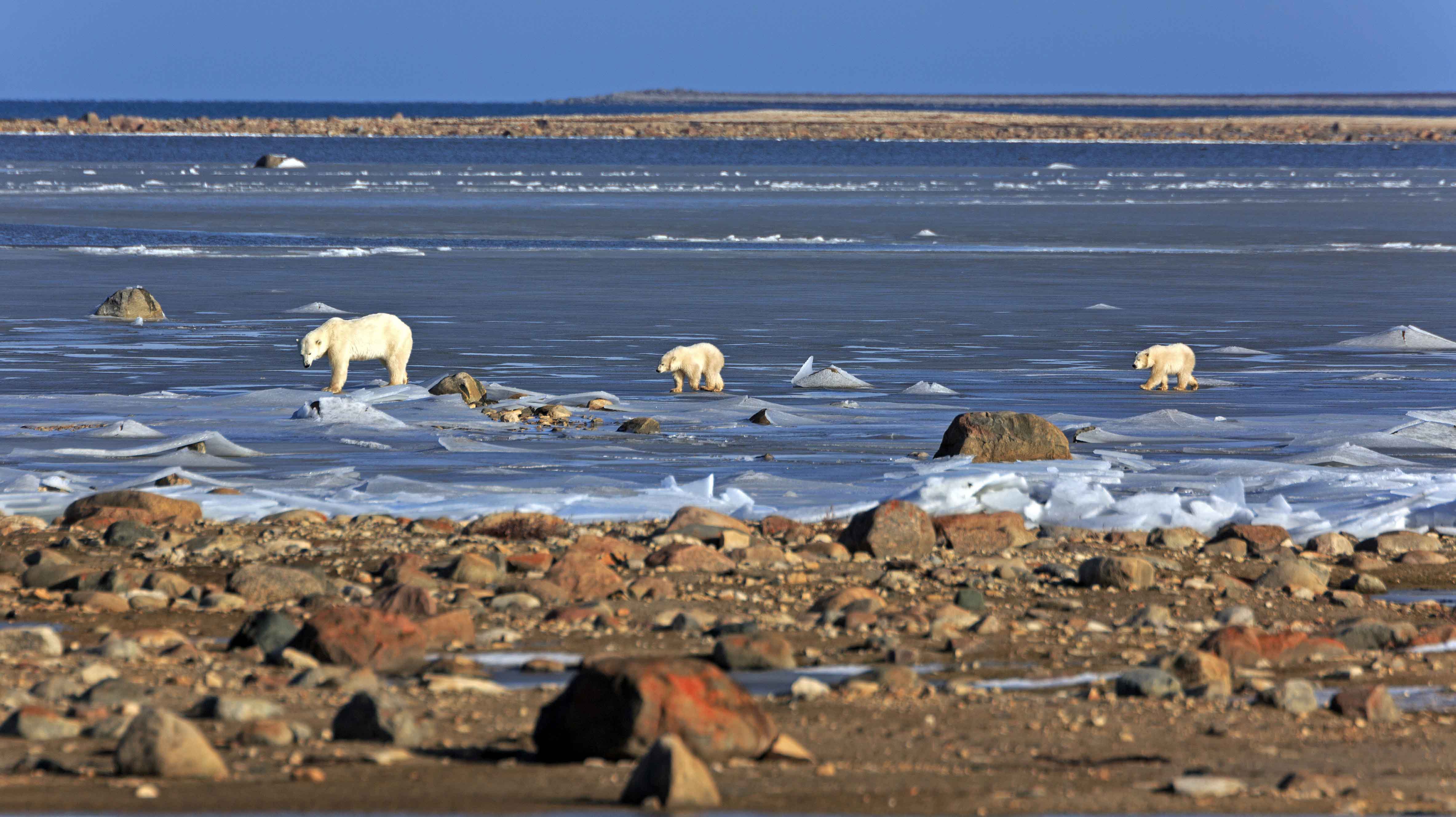
Many Chukchi Sea polar bears spend the summer on Wrangel Island and a survey there conducted by Russian researchers in 2020 reportedly collected data on a record 747 bears, well up from the 589 reportedly counted in 2017 by the same team (photo below is from 2015).

Note the latest survey of the Chukchi Sea estimated about 3,000 bears inhabit the region (AC SWG 2018; Regehr et al. 2018), at least 1,000 more that the figure of 2,000 used in recent IUCN assessments and survival predictions (Amstrup et al. 2007; Regehr et al. 2016; Wiig et al. 2015). Wrangel Island is the primary terrestrial denning area in the Chukchi Sea (Garner et al. 1984; Rode et al. 2014) and a recently published study showed that the body condition (i.e. fatness) and litter size of Chukchi Sea polar bears has not been negatively affected by low summer sea ice (Rode et al. 2021).

Continue reading

Still waiting for two thirds of polar bears worldwide to disappear due to lack of summer sea ice

It’s hard to believe that a polar bear specialist would claim that their predictions have come true, given the facts of the matter: that polar bears arguably number over 30,000 worldwide and regions with the most dramatic sea ice declines have not documented reduced polar bear health or survival. But in mid-July this year, Andrew Derocher – one of the field’s most vocal promoters – did just that: proclaimed on twitter that “virtually all of our predictions are coming true.” Except, none of them did, especially the most widely-promoted one, which failed spectacularly.

Continue reading

As much Beaufort Sea polar bear habitat at mid-July 2021 as there was in 1982

Beaufort Sea ice coverage is about average for this time of year, again failing to decline in lock-step with other Arctic regions. Will there be lots of fat bears onshore like there was in 2019? Only time will tell.

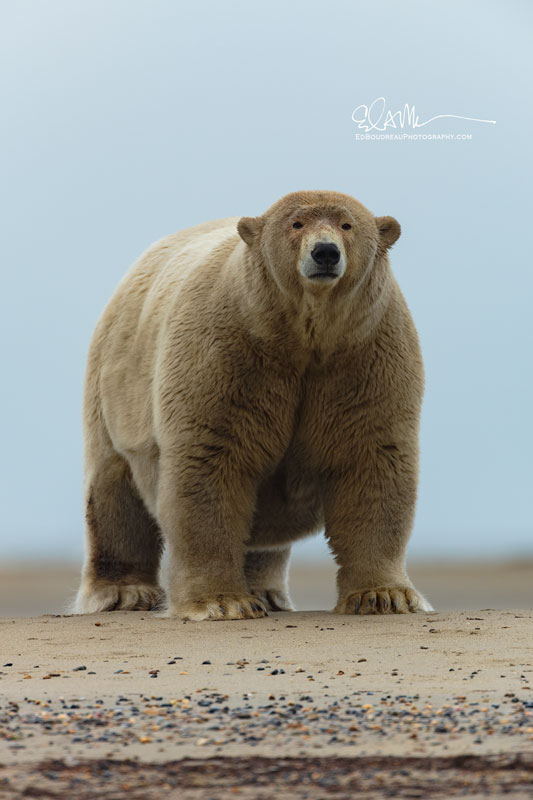
Healthy polar bear male at Kaktovik, Alaska on the Southern Beaufort Sea, September 2019, Ed Boudreau photo, with permission.
Continue reading

Constant dire predictions have been an attempt to counter effective criticism of polar bears as AGW icon says outgoing PGSG chair

In an unexpected statement, Dag Vongraven (the out-going Chairman of the Polar Bear Specialist Group) suggests that much of the incessant dire warnings of doom about the future of polar bears from PBSG members has been a counter-measure to offset the effective efforts by myself and others to expose the flawed rhetoric this group promotes.

You may remember Vongraven, who in 2014 famously sent me an email alerting me to a PBSG statement that later came back to bite them (in part because it was included in a CBC documentary called The Politics of Polar Bears later that year, see below):

It is important to realize that this range [i.e. their polar bear population estimate] never has been an estimate of total abundance in a scientific sense, but simply a qualified guess given to satisfy public demand.

Will this be another? You be the judge.

Continue reading

Barents Sea polar bears thriving despite huge summer ice loss: spring research results are in

After being locked out last year, fieldwork monitoring polar bears in the Svalbard region of the Barents Sea resumed this spring. The results show that despite having to deal with the most extreme loss of summer sea ice in the entire Arctic, polar bears in this region continue to thrive. These facts show no hint of that impending catastrophic decline in population size we keep hearing is just around the corner. No tipping point here.

Continue reading

New survey estimates 10x as many polar bears in Russian section of Chukchi Sea as in USA portion

A joint US/Russian aerial survey has estimated that a minimum of 3,435 polar bears (but possibly as many as 5,444) likely inhabited the Chukchi Sea in 2016, quite a bit more than a previous study that estimated a population size of 2,937 the same year (which used data from one small US area extrapolated to the entire region).

Continue reading

How are polar bears doing 15 years after the IUCN declared them ‘vulnerable’ to extinction?

The beginning of this month was the 15th anniversary of the day the IUCN declared polar bears ‘vulnerable’ to extinction because of climate change, the first time such a designation had ever been made. It was based on the opinion of polar bear specialists who examined the vague information available at the time and decided that in 45 years the bears might be in serious trouble. This decision changed the way the IUCN assessed species risk and led to mass confusion for the general public, who falsely assumed polar bear numbers had already declined by a huge amount.

Continue reading

Choose verifiable facts over emotional narratives on polar bear conservation

Polar bears continue to be described as ‘canaries in the coal mine’ for the effects of human-caused climate change, but the evidence shows they are far from being a highly-sensitive indicator species.” Susan Crockford, 24 February 2021

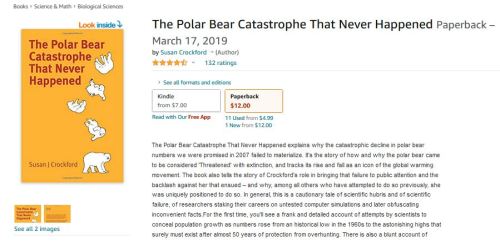
You’ll find the evidence I allude to above – backed up by references to the peer-reviewed literature – in my many publications (Crockford 2015; 2017; 2019, 2020, 2021). My open-access research paper from 2017 has been downloaded more than 6,000 times and despite this being an online forum for legitimate scientific critique, none has been offered. My comprehensive polar bear science book released just two years ago (see below) has a 4.7/5.0 star rating on Amazon, with 132 reviews so far.

For recent blog post examples of the evidence that polar bears are thriving despite profound summer sea ice loss, see this discussion about the many contradictions that exist for claims that sea ice declines have caused harm to polar bear health and survival and this review of the evidence that less summer sea ice has meant more food for polar bears.

For those who haven’t seen it, I’ve copied below the preface from The Polar Bear Catastrophe That Never Happened. This book is an antidote to the emotional blackmail coming at the public from all sides by journalists, polar bear specialists, and elite influencers like David Attenborough.
Continue reading