Tag Archives: global warming

What about the polar bears? Disconnect between predictions and observations

With all the talk this week about future climate – the global warming imagined by IPCC crystal ball models, that is – the focus for many is rightly on the gulf between predictions and observations that have taken place so far. This follows on reminders a few weeks ago of the many failed predictions that we would have seen an “ice-free Arctic” by now.

[by “ice-free” they mean “nearly ice-free,” or “when ice coverage is less than 1 million square kilometers, or about 386,000 square miles.”]

But what about the polar bears? Is there a similar disconnect between predictions and observations for polar bear survival? Yes, indeed.

Many Arctic biologists insist that polar bears are not just threatened by future global warming and a “melting ice cap.” They contend polar bears are already being harmed by declines in summer sea ice coverage, or will be shortly.

The problem is, the results of scientific studies show otherwise. Virtually all of the evidence generated by polar bear researchers shows that polar bears are not being harmed by declines in summer sea ice, and in some cases, they are doing very well indeed. In other words, they are not responding as expected.

A few weeks ago, I summarized these studies, which reveal that:

Less summer ice ≠ few bears (evidence from Davis Strait; S. Hudson Bay; Barents Sea; S. Beaufort; W. Hudson Bay).

Less summer ice ≠ “skinnier” bears (evidence from Chukchi Sea; S. Hudson Bay).

“Skinnier” bears ≠ fewer bears (evidence from S. Hudson Bay; S. Beaufort; Davis Strait).

Less summer ice ≠  lower cub survival (evidence from S. Hudson Bay; Chukchi Sea).

Less summer ice ≠ more cannibalism & hybridization

Have a look if you missed it (August 18, 2013, with pdf copies to download), “Polar bears have not been harmed by sea ice declines in summer – the evidence.”

[Update Sunday Sept 29 2013: these two stories (on the temperature pause and polar bears thriving (in which I get a mention), just out in the Mail on Sunday (UK)]
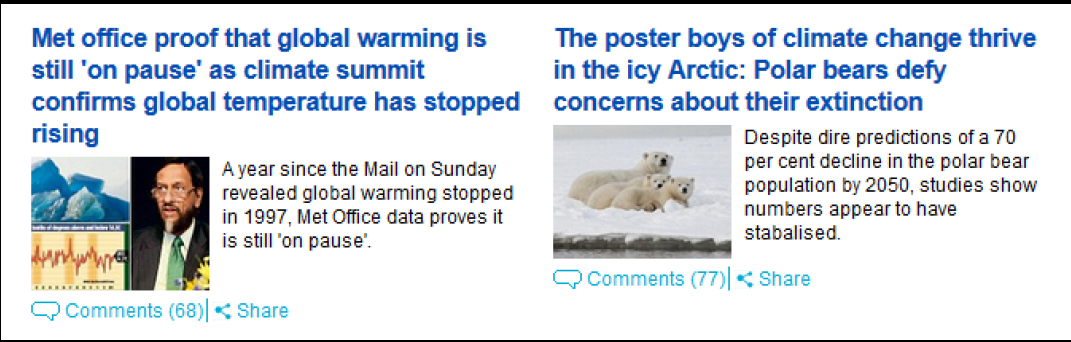
Mail on Sunday_Temp pause and polar bears_Sept 29 2013

Polar bears have not been harmed by sea ice declines in summer – the evidence

PB  logo colouredThe polar bear biologists and professional activists of the IUCN Polar Bear Specialist Group (PBSG) continue to insist that since 1979 increasingly smaller amounts of Arctic sea ice left at the end of summer (the September ice minimum) have already caused harm to polar bears. They contend that global warming due to CO2 from fossil fuels (“climate warming” in their lexicon) is the cause of this decline in summer ice.

In a recent (2012) paper published in the journal Global Change Biology (“Effects of climate warming on polar bears: a review of the evidence”), long-time Canadian PBSG  members Ian Stirling and Andrew Derocher (both of University of Alberta) summarized their position this way:

“Climate warming is causing unidirectional changes to annual patterns of sea ice distribution, structure, and freeze-up. We summarize evidence that documents how loss of sea ice, the primary habitat of polar bears (Ursus maritimus), negatively affects their long-term survival”

I’ve spent the last year examining their evidence of on-going harm, but in addition, I’ve looked at the evidence (much of it not mentioned in the Stirling and Derocher paper1) that polar bears have either not been harmed by less sea ice in summer or have thrived in spite of it.

This is a summary of my findings. I’ve provided links to my original essays on individual topics, which are fully referenced and illustrated. You are encouraged to consult them for complete details. This synopsis (pdf with links preserved, updated; pdf with links as footnotes, updated) complements and updates a previous summary, “Ten good reasons not to worry about polar bears” (pdf with links preserved; pdf with a foreword by Dr. Matt Ridley, with links as footnotes).

Update 8 September 2013: to include links to my post on the recently published Chukchi population report; updated pdfs have been added above.

Update 22 January 2014: added figure comparing March vs. September sea ice extent using the same scale, from NOAA’s “2014 Arctic Report Card,” discussed here.
Continue reading

Cooling the polar bear spin

I’ve had quite enough of the obfuscation of facts and model-based extrapolations into the future with regards to polar bears. I’m pretty sure I’m not the only one who is interested in what polar bears are doing now and, as much as can be determined, get some understanding of what the biological, geological and evolutionary history of polar bears and their habitat looks like. Spare us the emotional media hype, icon-peddling and fear-mongering about the future — we’d just like some information about the bears!

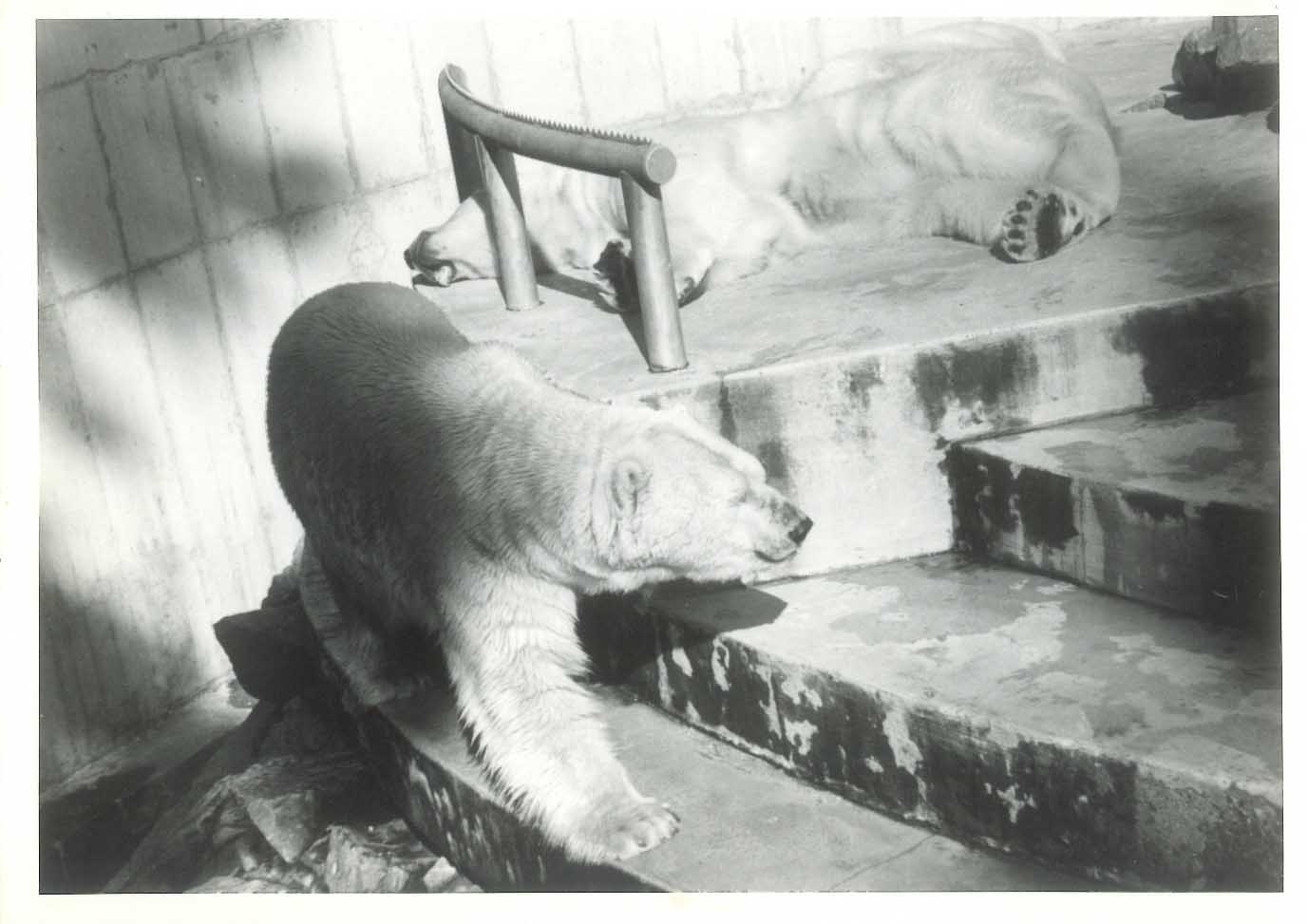
Polar bears at the Stanley Park Zoo, Vancouver, taken with my first camera in the early 1970s.

I’ve been looking at the scientific literature produced by polar bear and Arctic seal biologists for some time and I’ve found it contains some rather interesting and potentially important facts that are being left out, glossed over, or misrepresented in statements and publications generated by polar bear advocates of all kinds. It’s past time for these issues to be brought to light and publicized in one easily-accessible, up-datable forum. Hence, PolarBearScience.com — a new blog in which I discuss the science of polar bears while throwing cold water on some of the spin. Continue reading