Tag Archives: speciation

NY Times pushes an implausible story of polar bear evolution and what makes a species

Carl Zimmer over at the New York Times penned a misleading story of speciation, using the polar bear as an example. It explains polar bear evolution based on a genetic interpretation that ignores the fossil record, bear behaviour, and geological history. [h/t Kip Hanson].

In my opinion, this kind of ‘science communication’ is more misleading than enlightening because it fails to alert readers to the fact that the topic is actually more complicated and gives the impression that the author considers readers too stupid to understand a more accurate explanation.

Polar Bear Evolution does a better job for those who are really interested in the process: it doesn’t hide the complicated nature of speciation or polar bear evolution. It doesn’t pretend to present “the truth” but explains how a good scientist gets to a plausible explanation that best fits the evidence.

Continue reading

Tom Nelson interview with me about the failed polar bear narrative and rapid evolution

You can watch my interview with Tom Nelson about the latest issues in polar bear conservation and highlights of my latest book, Polar Bear Evolution.

On Youtube:

Tom tells me, “It’s also up on other video sites such as Rumble and BitChute, and will soon be available on other podcast apps such as Apple Podcasts (most, but not all, of those are audio-only).  It should also be on Spotify, Google Podcasts, Pocket Casts, Podvine, Overcast, Amazon Music podcasts, Audible podcasts, Castbox, RadioPublic, Twitter, etc.”

Summary: Susan Crockford, a zoologist, discusses the challenges in accurately estimating polar bear populations and the ongoing debate between Inuit communities and polar bear specialists regarding population sizes. She also shares her theory on the role of thyroid hormones in polar bear evolution and the quick adaptation of species to new environments using the example of the Russian foxes.

A list of topics covered, by time-stamp in the interview, is listed below.

Continue reading

Polar Bear Evolution pre-Christmas book sale: discounts on all formats!

I have reduced prices on all formats of my Polar Bear Evolution book for four weeks starting today (8 November-6 December 2023), in time for holiday gift-giving. The ebook version has the largest price reduction (60% of regular price, to US$17.40) but the other discounts are also substantial. This sale is a time limited offer: don’t miss out! Links below.

This is the book for those who are really interested in how grizzly bears could have turned into polar bears and why the story of polar bear evolution could not be told without discussing climate change.

One Amazon reviewer said this about Polar Bear Evolution:

The author of Polar Bear Evolution, Susan Crockford, is a good, credentialed scientist. Her writing is clear; her thinking is also. She has a broad understanding of biology and an informed paleo perspective. Crockford condenses a very large literature on polar bear biology and evolution in this book which will help readers understand the science related to the evolution of an Arctic species. Perhaps the most important aspect of this book is its synthesis of information from the fields of wildlife biology, molecular evolution, paleontology, and climate. Her original ideas and hypotheses on thyroid hormone’s role in evolution are very important and add a credible mechanism of phenotypic change which complements the literature on molecular genetic evolution. Polar Bear Evolution is an important contribution to science and its application in evolutionary biology and wildlife biology. Matthew A. Cronin, Ph.D.

Available at the links below (others also available):

USA https://www.amazon.com/dp/1778038328

UK https://www.amazon.co.uk/dp/1778038328

Canada https://www.amazon.ca/dp/1778038328 [shipping delay for hardcover version is 4-5 weeks]

Australia https://www.amazon.com.au/dp/1778038328

Germany https://www.amazon.de/dp/1778038328

No evidence polar bears survived Eemian warmth because they were not yet fully ice-dependent

Is evolution primarily fast or slow? Does it take hundreds of thousands of years or a few generations to produce a new species? Ignoring vast evidence to the contrary, most geneticists insist that evolutionary change is imperceptibly slow and one of them is using this misconception to support the human-caused climate change narrative.

For polar bears, the question is this: could brown bears (aka grizzlies) have survived for hundreds of thousands of years living in a completely different habitat–the perpetually-frozen world of Arctic sea ice–before significant biological changes took place? I contend the answer is no. Moreover, if I am correct that polar bears arose ca. 140,000 thousand years ago (140kya) during the height of an extreme glacial period, the fossil evidence concurs. Analysis of fossil remains show that by about 115-130kya at the latest (after perhaps 10k years), polar bears were primarily eating seals as their modern counterparts do and their bones had lost the distinctive features of their grizzly ancestors.

But that’s the maximum time frame: research on other animals indicate that such critical changes almost certainly took place long before that, within the first few generations of life on the sea ice. If coordinated changes had not taken place very quickly, within ecological time, brown bears would simply not have survived the harsh life on Arctic sea ice.

Continue reading

How grizzlies evolved into polar bears: The first book to tell the whole story is now available

Polar Bear Evolution: A Model for How New Species Arise is the fascinating story of the origin of polar bears. It reveals not just when and where the species came to be, but how it happened and why the bears were able to survive repeated cycles of sea ice change, some of unimaginable severity.

No other book like this exists. Despite decades of serving as an icon for the catastrophic climate change narrative, the polar bear has never had its evolutionary history explained so completely, never mind in a fully-referenced, plain-language style. And I couldn’t have done it without the financial help of my many supporters, so I thank you all again for your assistance in getting this important work completed.

One Amazon reviewer said this about Polar Bear Evolution:

The author of Polar Bear Evolution, Susan Crockford, is a good, credentialed scientist. Her writing is clear; her thinking is also. She has a broad understanding of biology and an informed paleo perspective. Crockford condenses a very large literature on polar bear biology and evolution in this book which will help readers understand the science related to the evolution of an Arctic species. Perhaps the most important aspect of this book is its synthesis of information from the fields of wildlife biology, molecular evolution, paleontology, and climate. Her original ideas and hypotheses on thyroid hormone’s role in evolution are very important and add a credible mechanism of phenotypic change which complements the literature on molecular genetic evolution. Polar Bear Evolution is an important contribution to science and its application in evolutionary biology and wildlife biology. Matthew A. Cronin, Ph.D.

Continue reading

Grizzlies vs. grizzly X polar bear hybrids by appearance alone: a photo essay

Hybridization with grizzlies comes up repeatedly in genetic studies that aim to zero in on polar bear origins and is one of the issues I explore in detail in my upcoming new book, Polar Bear Evolution: A Model for How New Species Arise. Here is a photo essay to get you thinking about grizzly X polar bear hybrids, because understanding the topic is critical to unravelling the genetic evidence on how polar bears came to be.

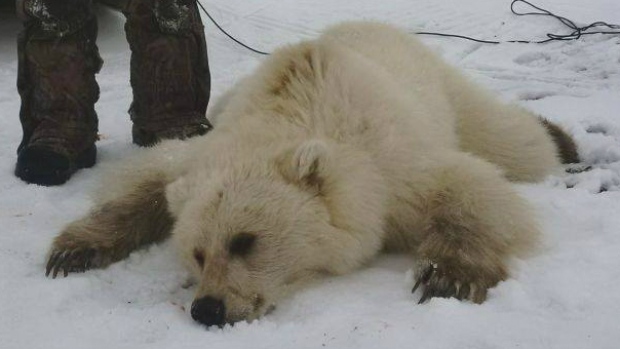
For example, who can forget the hoopla over the bear shot near Arviat on the shore of Western Hudson Bay in 2016 (shown above) that everyone, including polar bear expert Ian Stirling, decided must be a hybrid–but it turned out to be a blonde grizzly.

Explaining all the ins and outs of why hybrids are important to polar bear evolution is an important part of my book.

Continue reading

The story of polar bear evolution could not be told without discussing climate change

Polar bears arose as a new species because the climate changed and forced some brown bears to colonize the sea ice. Polar bears epitomize the story of how evolution works but perhaps not quite how you imagined it.

Moving from extremes in warmth to extremes in cold characterized the last million years of geological history, as the graph above shows, where odd-numbered Marine Isotope Stages (MIS) are warm interglacials and even-numbered stages along the bottom are cold glacials. MIS 2 was the Last Glacial Maximum.

But where and when during this period of change did polar bears come to be–and how, exactly, did it happen? My new book tells the whole story, which has never been done before. Not long to wait now, the release date is only about a week away (1st week June).

Continue reading

Polar bear evolution book is progressing well

Just a short update regarding progress on the book. I am deciding on a cover design while addressing suggested changes as they come back from the editor, and preparing marketing material. If all goes to plan, I am on track for a March publication date–thanks to your support.

In the early 1960s paleontologist Bjorn Kurtén thought that polar bears likely arose from a brown bear ancestor based on fossil evidence alone, and his estimate of when this happened was determined by the age of fossil remains of both species. As I will show in the chapters that follow, despite more fossil evidence being available and additional evidence from molecular genetic studies, his estimate is still the most likely time frame for when the polar bear came to be.

Polar bear evolution and recent genetic papers

Two scientific papers in June on polar bear evolution got a bit of media attention but not what the topic deserves. I’ve not written about them because I am currently working on a larger piece putting this conflicting genetic information into full context. Have patience, it’s coming.

Podcast with WildFed about polar bears and domestication as speciation

A couple weeks ago I had a fabulous chat with Daniel Vitalis from Wildfed about a wide range of topics, including my work on polar bears and domestication as a process of speciation. The podcast went live this morning – have a listen here (also copied below), I think you’ll enjoy it. One hour, 36 minutes.