Tag Archives: terrestrial foods

Thriving Foxe Basin and Davis Strait polar bears threaten nesting sea birds

UPDATE February 11, 2014. A reader (Kevin, at “Afton’s Waterfowl List”) has pointed out an error in Fig. 3, where I inadvertently labeled the bars on the upper graph as ending in 2011 instead of 2012 (the Pembroke graph ends at 2011. sigh..). I have corrected the figure and the text that refers to it, but do not believe it affects the overall conclusion. See for yourself. Thanks Kevin — and Alan for getting in touch!

Another round of press release inspired news stories emerged last week insisting that polar bear predation on ground-nesting birds during the summer ice-free period is evidence that they are nutritionally stressed by global warming.

A few weeks ago it was snow goose eggs in Western Hudson Bay – this time it’s thick-billed murre (Uria lomvia) and common eider (Somateria mollissima) eggs in Foxe Basin and Hudson Strait (e.g. see the story at Canada’s National Post and a short summary provided by Science [and it’s not even their paper!]). The source of the media attention this time is a newly-published paper by Samuel Iverson and colleagues (Iverson et al. 2014).
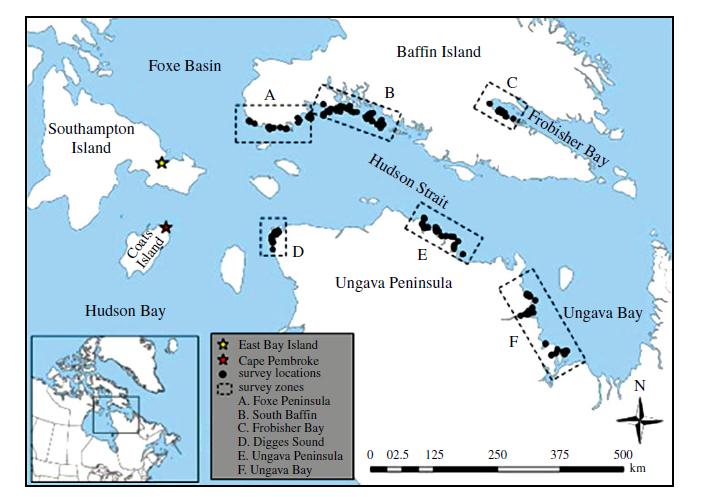
Figure 1. From Iverson et al. 2014 (their Fig.1), “map of the study area.” Most of the study sites are within the Foxe Basin polar bear subpopulation region (see Fig. 2 below), although the Ungava Peninsula (E), Ungava Bay (F) and Frobisher Bay (C) sites are in the Davis Strait subpopulation.

Figure 1. From Iverson et al. 2014 (their Fig.1), “map of the study area.” Most of the study sites are within the Foxe Basin polar bear subpopulation region (see Fig. 2 below), although the Ungava Peninsula (E), Ungava Bay (F) and Frobisher Bay (C) sites are in the Davis Strait subpopulation.

Polar bears have always preyed on ground-nesting sea bird and goose eggs while onshore (see Kelsey Eliasson’s take on the situation around Churchill, at his PolarBearAlley blog). The issue in this case is whether the increase in predation can be unquestionably blamed on reduced sea ice cover and nutritionally-stressed bears – that is, predation increases that correlate with year-to-year sea ice changes and bears in poor condition found consuming bird eggs.

As I did for the “polar bears eat more caribou and snow geese than they used to” press release, I refused to take the PR or the news stories at face value and went to the published paper and its supplemental data (it’s open access, see it for yourself here).

What I see in this paper is a spurious sea ice correlation and no data on the condition of the few bears observed consuming eggs. There is also no mention of the fact that polar bear numbers have increased in part of the study area (Davis Strait) or that bears in Foxe Basin and southern Davis Strait have been found to be in very good condition and reproducing well (Rode et al. 2014; Peacock et al. 2013). See my analysis below and judge for yourself.


Continue reading

Churchill polar bears eat more caribou and geese now than in 1968 because there are more caribou and geese, new research reveals

The press release (pdf here) issued by the American Museum of Natural History (AMNH) a few days ago, regarding several recent papers on polar bear consumption of terrestrial foods around Churchill, Manitoba (Western Hudson Bay), left a lot to be desired in terms of relaying accurate information.

21 August 2021 UPDATE: I have amended this post to correct some comments I made originally about the definition of ‘spring breakup’ of sea ice on Hudson Bay. While the ice indeed begins to break up in spring (usually defined for the Arctic as April-June, bears rarely come ashore before July 1 (summer being July-September). Confusion comes from the standard meteorological method of the defining ‘breakup’ for Western Hudson Bay as the date when ice coverage drops below 50% of the area, rather than the newer, more relevant date when most polar bears have actually come ashore after the date ice coverage reaches 30% (Castro de la Guardia et al. 2017). Using the modern method, the earliest breakup date was in 1999 (17 June), which was still the case in 2021).

Recent research on polar bear diets by Robert Rockwell and Linda Gormezano, it says, suggests that an increase in the consumption of caribou and snow geese since 1968 is a sign that the polar bears are nutritionally stressed due to recent sea ice changes in spring (blamed on global warming) but may be adapting by changing their summer/fall diet.

As the AMNH press release puts it:

polar bears in the warming Arctic are turning to alternate food sources.”

Figure 1. Polar bear feeding on a caribou carcass, taken July 26, 2010. This photo was included in one of the papers cited in the January 2014 press release (Gormezano and Rockwell 2013:3518) and was clearly taken from the air. The caption in the paper says simply, “a polar bear looks up from the recently killed caribou it was eating,” so the bear may not have killed the caribou – some other predator (wolf or grizzly) may have made the actual kill. The dark spots on the bear appear to be flies. Credit Copyright American Museum of Natural History/ R. Rockwell.

Figure 1. Polar bear feeding on a caribou carcass, taken July 26, 2010, from the air. This photo was included in virtually all media reports and in Gormezano and Rockwell (2013a:3518, Fig. 3). The caption in the paper says, “a polar bear looks up from the recently killed caribou it was eating,” implying the bear may not have actually killed the caribou – some other predator (wolf or grizzly) may have made the kill. The dark spots on the bear appear to be flies. Credit: Copyright American Museum of Natural History/R. Rockwell.

However, the AMNH press release fails to mention – as the papers it publicizes certainly do – that Western Hudson Bay populations of caribou and snow geese have increased exponentially since a similar polar bear diet study was done in 1968/69. In other words, there were hardly any caribou or geese around back in the late 60s — little wonder polar bears weren’t eating any.

While evidence of polar bears consuming caribou and geese in recent years is certainly an “increase” over late 1960s levels, that fact says more about the status of caribou and geese populations than it does about polar bears and global warming. Media outlets that quoted the press release verbatim, as many do these days (e.g. here, here, and here), missed this essential part of the story – and of course, so did their readers.

[one story picked up the goose population increase and another revealed the caribou population increase, but none that I saw caught both]

In addition, the AMNH press release makes this erroneous statement that was picked up by every media outlet I saw except one (either exactly as written or reworded slightly):

Climate warming is reducing the availability of their ice habitat, especially in the spring when polar bears gain most of their annual fat reserves by consuming seal pups before coming ashore for the summer.” [my bold]

The earliest breakup dates since 1991 for Western Hudson Bay, where this research was done, have been mid-June (according to the most recent study by Cherry et al. 2013) and for the last few years breakup has occurred in July.

Overall, the press release and resulting media reports seem to be further examples of hyping global warming at the expense of the actual science involved and I have to agree with Andrew Derocher’s interpretation of the significance of terrestrial food items for polar bears. See what you think.
Continue reading