Monthly Archives: November 2023

Western Hudson Bay polar bears on their way offshore to hunt seals: freeze-up has begun

Official confirmation has come in this morning that polar bears that have spent the summer fasting along Western Hudson Bay now have enough ice to move offshore. That makes this year a bit later than usual (average is 16 November) but is not one of the extremely late freeze-ups, as happened in 1981, 2016 and 2021 when bears didn’t leave until the first week of December (Castro de la Guardia et al. 2017; Miller et al. 2022). Since breakup of sea ice came earlier than usual this summer, this means (as of 30 November) many bears will have been off the ice and without food for 166 days or 5.5 months.

However, so far, there have been no reports from this region of incidents of cannibalism, starving bears found wandering the landscape like zombies, or desperate attacks on people that polar bear specialists have warned us to expect (Abrahms et al. 2023; Stirling and Derocher 2012; Wilder et al. 2017).

Tracking WH Bears

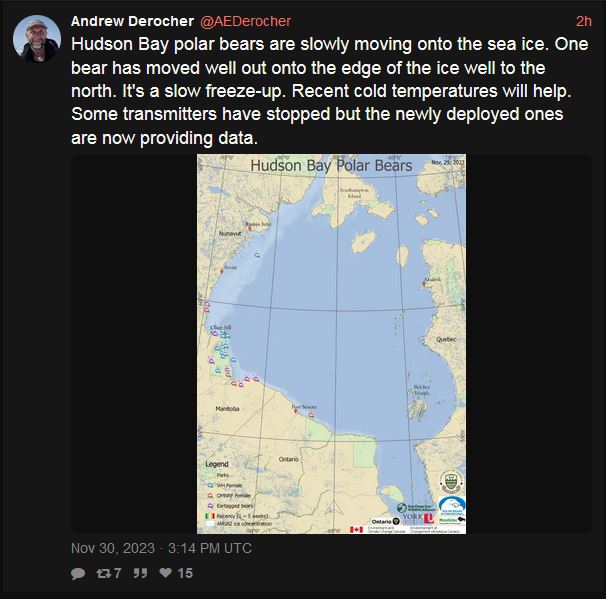
Courtesy Andrew Derocher, University of Alberta, who monitors WH bears:
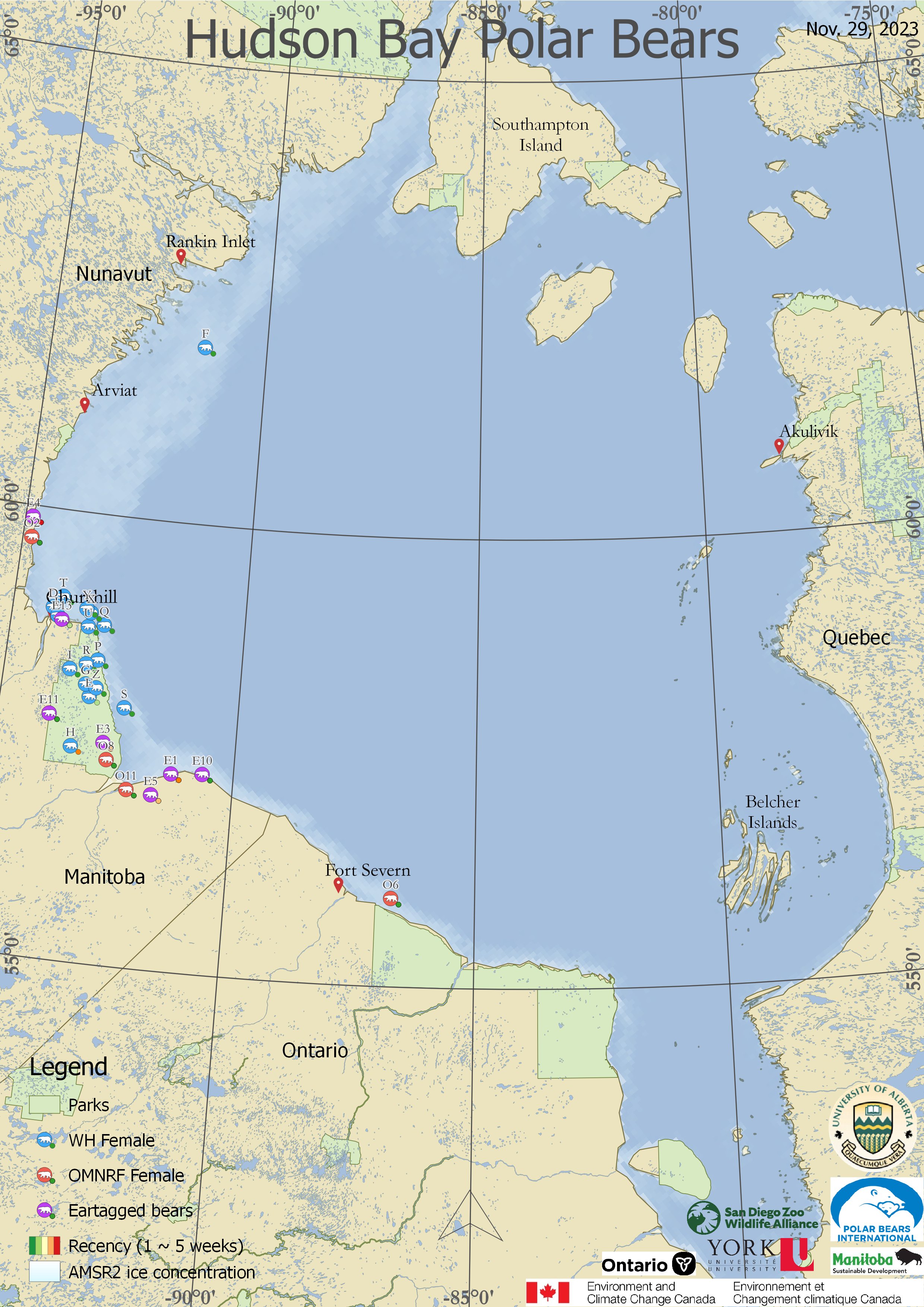
Close-up of the tracking map below. Note that pregnant females will stay ashore to give birth so not all of these tagged bears are expected to head onto the ice this fall to hunt for seals:
Still not a word from the Polar Bear Alert folks in Churchill, who as of today, haven’t released any of their weekly reports since 23 October 2023.

Ice Conditions in Canada

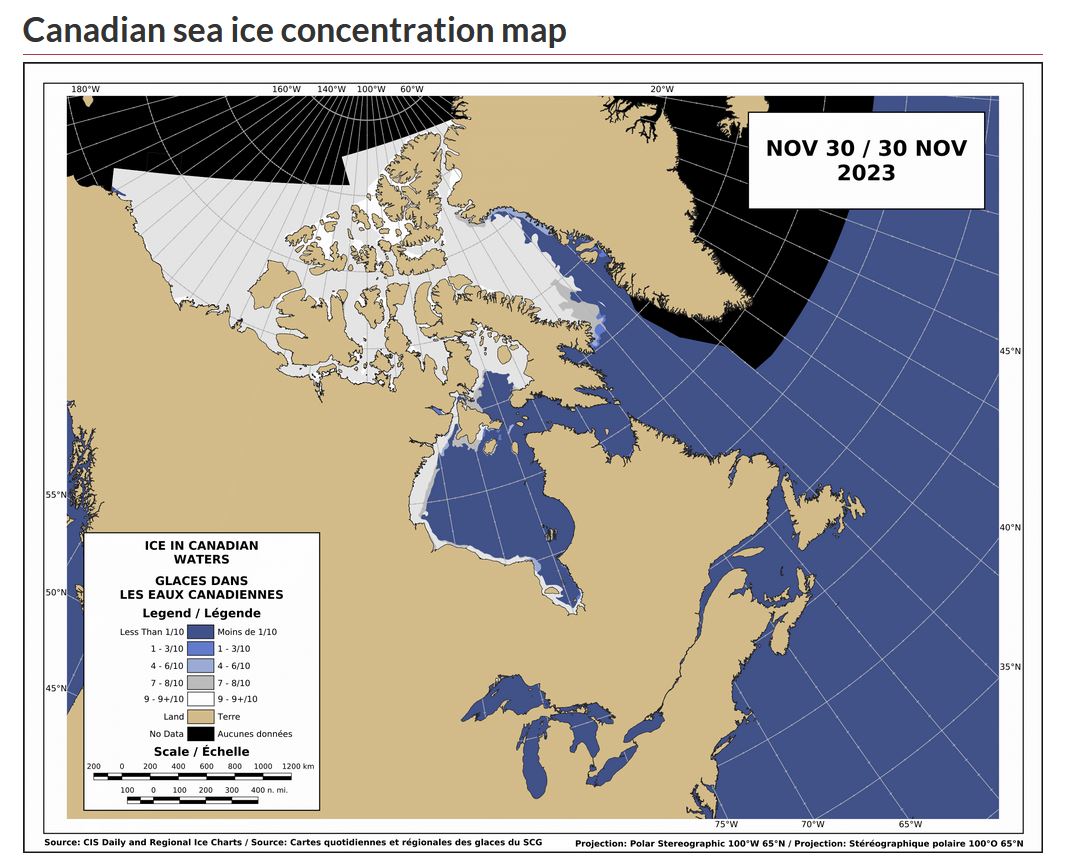
At 30 November 2023, courtesy Canadian Ice Services shows the expanding band of ice developing along the western shore of Hudson Bay but note also that the rest of the Canadian Arctic, as well as the Beaufort Sea, is completely covered in ice, as is most of Baffin Bay and Foxe Basin:
References

Abrahms, B., Carter, N.H., Clark-Wolf, T.J., et al. 2023. Climate change as a global amplifier of human–wildlife conflict. Nature Climate Change 13:224-234. https://doi.org/10.1038/s41558-023-01608-5

Castro de la Guardia, L., Myers, P.G., Derocher, A.E., Lunn, N.J., Terwisscha van Scheltinga, A.D. 2017. Sea ice cycle in western Hudson Bay, Canada, from a polar bear perspective. Marine Ecology Progress Series 564: 225–233. http://www.int-res.com/abstracts/meps/v564/p225-233/

Miller, E.N., Lunn, N.J., McGeachy, D., and Derocher, A.E. 2022. Autumn migration phenology of polar bears (Ursus maritimus) in Hudson Bay, Canada. Polar Biology 45:1023-1034.

Stirling, I. and Derocher, A.E. 2012. Effects of climate warming on polar bears: a review of the evidence. Global Change Biology 18(9): 2694–2706.

Wilder, J.M., Vongraven, D., Atwood, T., et al. 2017. Polar bear attacks on humans: implications of a changing climate. Wildlife Society Bulletin 41(3):537-547.  https://doi.org/10.1002/wsb.783

Polar bear sea ice habitat update at 15 November & problem bears in Western Hudson Bay

Abundant polar bear habitat this fall across the Arctic so far, with only Hudson Bay sea ice formation a bit behind schedule. However, Churchill has not seen the anticipated spike in problem bear reports, given the vocal pronouncement by polar bear specialists that it should be experiencing more and more problems with bears when they spent more than 4 months ashore in summer and fall.

News of the most egregious attack by a bear I could find world wide this fall is shown in the video below, filmed 14 November 2023: apparently, the offending bear had spent several days displaying this offending behaviour.

Continue reading

Walrus and polar bear population size changes in the N. Atlantic over the last 20k years

This is a lesson in how to assess the potential worth of scientific papers. One of two similar Arctic evolution studies got media attention, at least in Canada — about the polar bears, of course — but in my opinion the walrus research conclusions are much better supported, less biased by climate change rhetoric, and lack the hubris present in the polar bear paper.

Both studies use similar sample sizes for the regions they had in common (North Atlantic) and used computer models to determine genetic diversity and population size changes since the LGM. However, the tone of the walrus paper was less emotionally-charged and the caveats of the work were appropriately stated. In my opinion, papers like the polar bear example contribute to eroding the public’s trust in science.

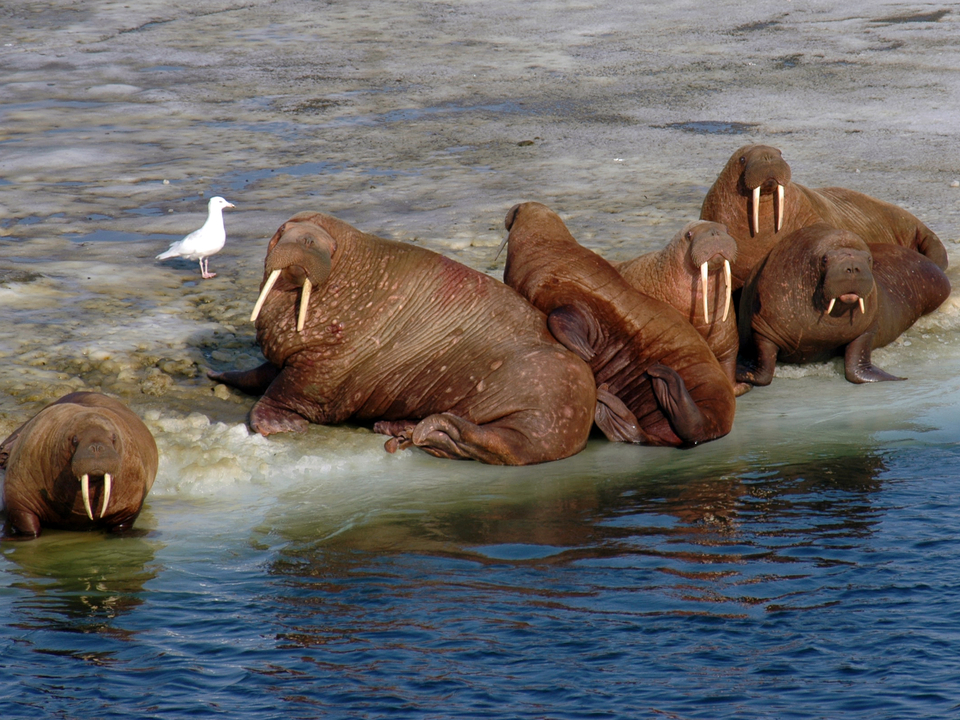
The last Ice Age peaked between about 27,000 and 19,000 years ago. At this time the Arctic was buried under kilometers of glacial ice sheets, and so marine mammals were pushed southwards to areas of ice floes and more open water. Walrus survived in some areas of the Atlantic located further to the south, and as soon as climates warmed again, the ice edge retreated and walrus populations pushed quickly northwards again. This combination of warming and climate-driven dispersal led to local walrus populations becoming more genetically differentiated. Walrus study, Lund University press release 27 September 2023

Continue reading

Polar Bear Evolution pre-Christmas book sale: discounts on all formats!

I have reduced prices on all formats of my Polar Bear Evolution book for four weeks starting today (8 November-6 December 2023), in time for holiday gift-giving. The ebook version has the largest price reduction (60% of regular price, to US$17.40) but the other discounts are also substantial. This sale is a time limited offer: don’t miss out! Links below.

This is the book for those who are really interested in how grizzly bears could have turned into polar bears and why the story of polar bear evolution could not be told without discussing climate change.

One Amazon reviewer said this about Polar Bear Evolution:

The author of Polar Bear Evolution, Susan Crockford, is a good, credentialed scientist. Her writing is clear; her thinking is also. She has a broad understanding of biology and an informed paleo perspective. Crockford condenses a very large literature on polar bear biology and evolution in this book which will help readers understand the science related to the evolution of an Arctic species. Perhaps the most important aspect of this book is its synthesis of information from the fields of wildlife biology, molecular evolution, paleontology, and climate. Her original ideas and hypotheses on thyroid hormone’s role in evolution are very important and add a credible mechanism of phenotypic change which complements the literature on molecular genetic evolution. Polar Bear Evolution is an important contribution to science and its application in evolutionary biology and wildlife biology. Matthew A. Cronin, Ph.D.

Available at the links below (others also available):

USA https://www.amazon.com/dp/1778038328

UK https://www.amazon.co.uk/dp/1778038328

Canada https://www.amazon.ca/dp/1778038328 [shipping delay for hardcover version is 4-5 weeks]

Australia https://www.amazon.com.au/dp/1778038328

Germany https://www.amazon.de/dp/1778038328