Category Archives: Hybridization

Five facts that challenge polar bear hybridization nonsense

It was inevitable, I suppose, that the putative hybrid shot in Arviat, Nunavut last week (see my post here) would initiate the global warming blame game.

Hybrids again_Washington Post 23 May 2016_title screencap

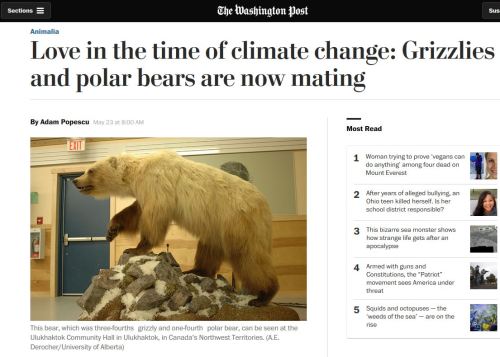
Washington Post, 23 May 2016, Adam Popescu: “Love in the time of climate change: Grizzlies and polar bears are now mating

Here are the five points you need to know about polar bear hybridization, as there are several nonsense statements contained in this Washington Post article.

UPDATE 24 May 2016: References adding below regarding grizzly sightings south of Churchill on the west coast of Hudson Bay (H/T Doug Clark).

UPDATE 28 May 2016: See this 27 May 2016 follow-up post (Most polar bear hybrids said to exist have not been confirmed by DNA testing) for details on unconfirmed sightings or reports of hybrids.

Continue reading

Another alleged grizzly-polar bear hybrid shot but it’s not a sign of climate change

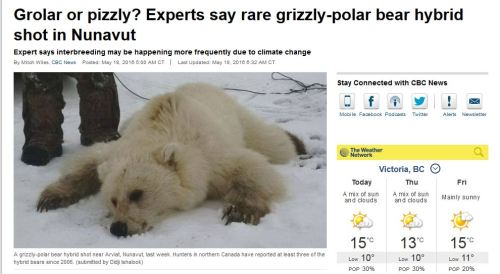
CBC News this morning (“Grolar or pizzly? Experts say rare grizzly-polar bear hybrid shot in Nunavut: Expert says interbreeding may be happening more frequently due to climate change“) suggests that a putative grizzly x polar bear hybrid bear shot outside Arviat in Western Hudson Bay is a sign of climate change, based on an interview with a black bear expert from Minnesota.

Hybrid pb shot in Arviat_CBC 18 May 2016

This bogus claim has been busted so many times it’s a wonder it still arises – even polar bear specialist Ian Stirling has said flat out that such hybrids are not due to climate change. On top of that, some of the details regarding this putative hybrid make me want to wait for confirmation from DNA testing before adding it to the roster of known hybrids.
Continue reading

Ancestor of the polar bear by any name: grizzly vs. brown bear monikers explained

Apparently, all media outlets (except Fox News) so confused the distinction between the two common names used for the ancestor of polar bears, Ursus arctos, that they got the point of a recent news story totally wrong. An Alaskan journalist explains.

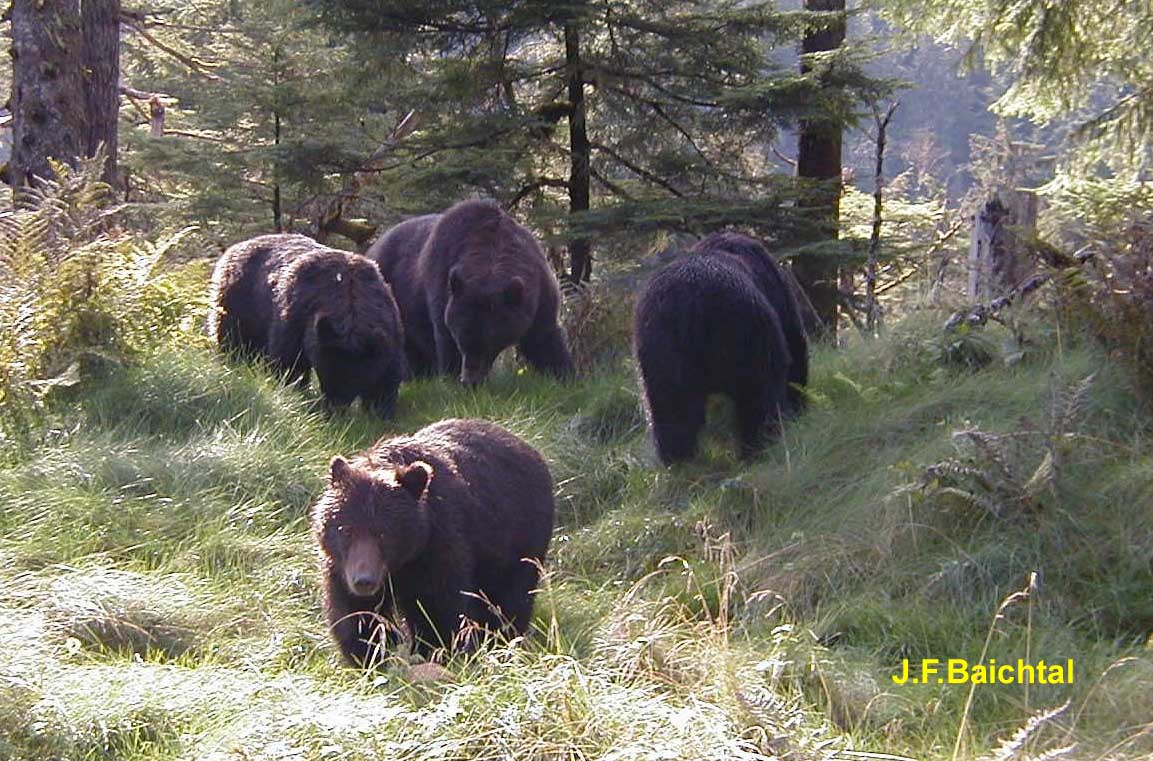
Coastal brown bears from Admiralty Island, southeast Alaska. See previous post here.

Coastal brown bears from Admiralty Island, southeast Alaska (courtesy Jim Baichtal, US Forest Service, Alaska). See previous post here.

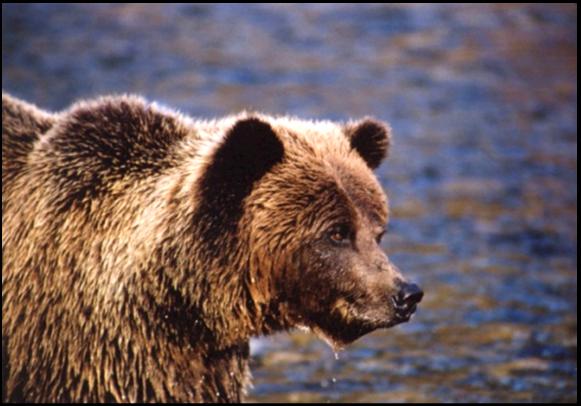
Tundra grizzly from the Yukon (courtesy Government of Yukon Territory). These bears also occur across the north slope of Alaska and are the bears that occasionally hybridize with polar bears, as explained here.

Tundra grizzly bear from the Yukon (courtesy Government of Yukon Territory). These bears also occur across the north slope of Alaska and are the bears that occasionally hybridize with polar bears this time of year, as explained here.

Continue reading

New genetic study confirms polar bears survived several warm Interglacials

There is a new polar bear genetics paper out in the Journal of Heredity, by University of Alaska Fairbanks genetics professor Matt Cronin and colleagues. Matt Cronin, in case you didn’t know, was the first to pick up the close genetic relationship between polar bears and grizzlies, as a result of research he and colleagues did back in the early 1990s (Cronin et al. 1991).

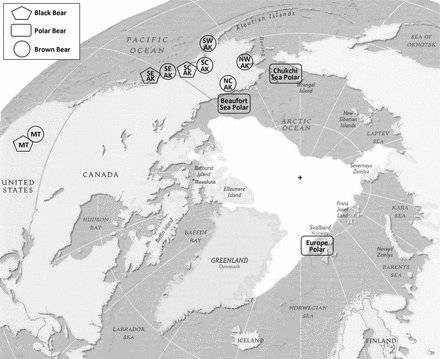
Figure1 from Cronin et al. 2014 (in press) showing the locations of bear samples used in their genetic study. MT, Montana; AK, Alaska; Polar bear samples were from the Chukchi, Beaufort and Barents Sea populations.

Figure 1 from Cronin et al. 2014 (in press) showing the locations of bear samples used in their genetic study. MT, Montana; AK, Alaska; Polar bear samples were taken from the Chukchi, Beaufort and Barents Sea populations.

While no earth-shattering new information was revealed in this new study, reported over the weekend by the Alaska paper SitNews (March 15), it used a more detailed method to confirm the results of previous work – that polar bears have been around long enough to have survived several past Interglacial periods that were warmer than today (with less ice in the Arctic) and are genetically distinct from grizzlies.

A feature that really set this work apart was how it was promoted.
Continue reading

Biologists spreading misinformation: hybridization with grizzlies not due to polar bears moving inland

A paper published last week in the journal Science, written by a team of biologists and atmospheric scientists, expounds on a possible dire future for a range of Arctic animals. It’s called, “Ecological consequences of sea-ice decline” and surprisingly, polar bears are discussed only briefly.

However, with the inclusion of one short sentence, the paper manages to perpetuate misinformation on grizzly/polar bear hybridization that first appeared in a commentary essay three years ago in Nature  (Kelly et al. 2010)1. The Post et al. 2013 missive contains this astonishing statement (repeated by a Canadian Press news report):

Hybridization between polar bears and grizzly bears may be the result of increasing inland presence of polar bears as a result of a prolonged ice-free season.

Lead author of the paper, Professor of Biology Eric Post, is quoted extensively in the press release issued by his employer (Penn State University, pdf here). In it, Post re-states the above sentence in simpler terms, removing any doubt of its intended interpretation:

“… polar and grizzly bears already have been observed to have hybridized because polar bears now are spending more time on land, where they have contact with grizzlies.

Both statements are patently false. All recent hybridization events documented (2006-2013) occurred because a few male grizzlies traveled over the sea ice into polar bear territory and found themselves a polar bear female to impregnate (see news items here and here, Fig. 1 below). These events did not occur on land during the ice-free season (which is late summer/early fall), but on the sea ice in spring (March-May).

Grizzlies have been documented wandering over the sea ice of the western Arctic since at least 1885 (Doupe et al. 2007; Fig. 2, below) and the presence in this region of hybrid grizzly/polar bear offspring is not an indicator of declining summer sea ice, whether due to global warming or natural causes, or some combination thereof.

Continue reading

Polar bears cavorting with ABC brown bears not supported by geological and fossil evidence

The authors of a new paper out in PLoS Genetics (Cahill et al. 2013, entitled “Genomic Evidence for Island Population Conversion Resolves Conflicting Theories of Polar Bear Evolution”) propose to explain how and why the brown bears (aka grizzlies) of the ABC islands of southeast Alaska (Admiralty, Baranof, and Chicagof – see previous post here), got to be so genetically distinct from brown bears on the Alaska mainland and so surprisingly similar (genetically) to polar bears. The authors determined (using a model) that this genetic pattern could be explained by an ancient hybridization event resulting from female polar bears cavorting with male brown bears in SE Alaska.

I had some issues with the way the paper was promoted by some of the co-authors, which I dealt with separately here. More importantly, I found the scenario these geneticists offered to explain how hybridization might have occurred to be patently implausible. Geological and fossil evidence from SE Alaska largely refutes their scenario, although another explanation may be more tenable. It is not impossible, in my opinion, that hybridization occurred in SE Alaska during the last Ice Age, but if it did, it almost certainly did not happen the way Cahill and colleagues suggest.

Continue reading

More evidence that the polar bear is a distinct species

Most people would not question the species status of the polar bear (Ursus maritimus). While it is true that polar bears – under certain circumstances – have successfully interbred with brown bears (aka ‘grizzlies,’ Ursus arctos)[see previous post on hybridization], there are many characteristics that distinguish each of these species as unique entities (see diagram below).

Grizzly vs polar skulls composite

Now, new genetic evidence adds weight to the balance on this issue. In this post, I’ll discuss very briefly the implications of this new paper:

Cronin, M. A. and MacNeil, M. D. 2012. Genetic relationships of extant brown bears (Ursus arctos) and polar bears (Ursus maritimus). Journal of Heredity 103 (6): 873-881. doi:10.1093/jhered/ess090 http://jhered.oxfordjournals.org/content/103/6/873.abstract

Continue reading

Is it plausible that polar bears are 4-5 million years old? Part 2, Hybridization

These are some of the points regarding this new paper by Miller et al. (2012, in press), on genetic evidence for the origin of polar bears, that I think deserve a critical look. See part 1, for my comments on Claim #1 (the fossil evidence)(see Doug Hoffman summary of the paper here).

In this post, I’ll elaborate on Claim #2. I’ve added one more to the original three listed.

Claim #1 Polar bears and brown bears (aka grizzlies) arose 4-5 million years old. [I countered with the fossil evidence]

Claim #2 Hybridization in both directions occurred repeatedly throughout the evolutionary history of polar bears and brown bears.

Claim #3 Svalbard may have been an important refugium for polar bears during warm interglacial periods.

Claim #4 Polar bear population numbers (population size estimates) over the last one million years tracked changes in climate (warmer/colder periods).

Claim #2 Hybridization in both directions occurred repeatedly throughout the evolutionary history of polar bears and brown bears [a claim also made in two other recent papers on polar bear evolution (Edwards et al. 2011; Hailer et al. 2012)].

Continue reading

ABC bears and polar bear evolution – and an adventure

A new genetic study (Miller et al. 2012, in press) suggests that polar bears arose between 4-5 million years ago and thus survived the more than 50 glacial/interglacial cycles of the 2.5 million year Pleistocene epoch. I will explore some of the claims of that paper later, suggesting why we might want to take them with a grain of salt.

But first, a bit of background and my personal caving adventure in ABC brown bear country.

Update: see new ABC bear photos added, courtesy Jim Baichtal, US Forest Service, Alaska (“real” ABC bears, he says)

continue reading