Category Archives: Summary

Biggest PBS stories of 2013 involved polar bear experts fudging data

The two top posts I published this year had one thing in common – they exposed polar bear researchers dodging full disclosure of scientific information in a way that outraged a lot of people. These two posts still draw a regular crowd of readers.

#1. “Global population of polar bears has increased by 2,650-5,700 since 2001” (published July 15, 2013) – 8,786 views as of December 30.

#2. “Ian Stirling’s latest howler: the polar bear who died of climate change” (August 7, 2013) – 7,872 views as of December 30.

[Note that #3 was the summary essay, “Ten good reasons not to worry about polar bears” (February 26, 2013), at 5,491 views. Dr. Matt Ridley wrote a foreword introducing that essay (“We should be listening to Susan Crockford”) that appeared in Canada’s Financial Post]

On this last day of the year, I thought I’d make an attempt to put these results into a wider perspective.

Continue reading

Challenging “save the polar bear” propaganda

[Updates: Note correction to point 6 and links added at the end of the post]

Polar Bears International has mustered the UK newspaper, The Guardian, to provide free publicity for a “save the polar bear” propaganda event coming up tomorrow, November 6.

From The Guardian Environment Blog:

“On Wednesday, 6 November at 10am EST and 3pm GMT you will have a chance to ask a scientist [Steven Amstrup] and a conservationist [Krista Wright] about the latest research on the state of polar bears – and the efforts to protect them.”

The “participants” of this webchat are Polar Bears International (PBI) employees. PBI is a lobbyist organization that uses its influence to pressure politicians and supposedly impartial scientific organizations, like the IUCN Polar Bear Specialist Group (PBSG), to make decisions that fit their agenda. The PBI rallying cry is “Save Our Sea Ice.They are committed to promoting legislation to curtail supposed effects of anthropogenic global warming and are using polar bears as a tool to do so.

Dr. Steve Amstrup is now a full-time, professional activist and spokesperson for PBI (Chief Scientist and Vice President”), a job he took on after a long career as a polar bear biologist. Arranging “webchats” like this is part of the job he is now paid to do.

Krista Wright has a Bachelors degree in Outdoor Education and has worked for NGOs for more than 20 years. She joined PBI in 2009 and is now the Executive Director (i.e., an administrator). She is described as “a passionate conservationist who is deeply concerned about the effects of global warming on polar bears, the Arctic, and the planet.She brings emotion to this event, not science.

Below I dissect some of the fear-mongering background presented at The Guardian, one point at a time; Guardian quotes are in italics, numbered; my responses are below, with links to pertinent previous posts that are fully referenced:

[Links to video and the webchat Q & A have been added at the end of this post as updates]

Continue reading

What about the polar bears? Disconnect between predictions and observations

With all the talk this week about future climate – the global warming imagined by IPCC crystal ball models, that is – the focus for many is rightly on the gulf between predictions and observations that have taken place so far. This follows on reminders a few weeks ago of the many failed predictions that we would have seen an “ice-free Arctic” by now.

[by “ice-free” they mean “nearly ice-free,” or “when ice coverage is less than 1 million square kilometers, or about 386,000 square miles.”]

But what about the polar bears? Is there a similar disconnect between predictions and observations for polar bear survival? Yes, indeed.

Many Arctic biologists insist that polar bears are not just threatened by future global warming and a “melting ice cap.” They contend polar bears are already being harmed by declines in summer sea ice coverage, or will be shortly.

The problem is, the results of scientific studies show otherwise. Virtually all of the evidence generated by polar bear researchers shows that polar bears are not being harmed by declines in summer sea ice, and in some cases, they are doing very well indeed. In other words, they are not responding as expected.

A few weeks ago, I summarized these studies, which reveal that:

Less summer ice ≠ few bears (evidence from Davis Strait; S. Hudson Bay; Barents Sea; S. Beaufort; W. Hudson Bay).

Less summer ice ≠ “skinnier” bears (evidence from Chukchi Sea; S. Hudson Bay).

“Skinnier” bears ≠ fewer bears (evidence from S. Hudson Bay; S. Beaufort; Davis Strait).

Less summer ice ≠  lower cub survival (evidence from S. Hudson Bay; Chukchi Sea).

Less summer ice ≠ more cannibalism & hybridization

Have a look if you missed it (August 18, 2013, with pdf copies to download), “Polar bears have not been harmed by sea ice declines in summer – the evidence.”

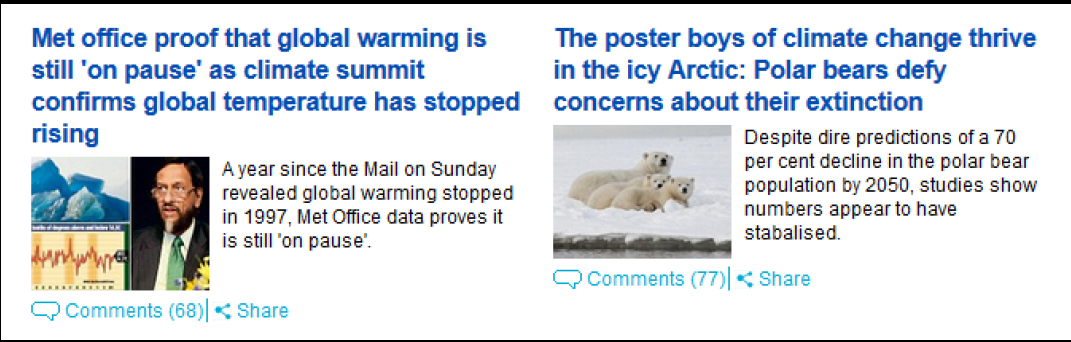
[Update Sunday Sept 29 2013: these two stories (on the temperature pause and polar bears thriving (in which I get a mention), just out in the Mail on Sunday (UK)]

Mail on Sunday_Temp pause and polar bears_Sept 29 2013

Polar bears have not been harmed by sea ice declines in summer – the evidence

PB  logo colouredThe polar bear biologists and professional activists of the IUCN Polar Bear Specialist Group (PBSG) continue to insist that since 1979 increasingly smaller amounts of Arctic sea ice left at the end of summer (the September ice minimum) have already caused harm to polar bears. They contend that global warming due to CO2 from fossil fuels (“climate warming” in their lexicon) is the cause of this decline in summer ice.

In a recent (2012) paper published in the journal Global Change Biology (“Effects of climate warming on polar bears: a review of the evidence”), long-time Canadian PBSG  members Ian Stirling and Andrew Derocher (both of University of Alberta) summarized their position this way:

“Climate warming is causing unidirectional changes to annual patterns of sea ice distribution, structure, and freeze-up. We summarize evidence that documents how loss of sea ice, the primary habitat of polar bears (Ursus maritimus), negatively affects their long-term survival”

I’ve spent the last year examining their evidence of on-going harm, but in addition, I’ve looked at the evidence (much of it not mentioned in the Stirling and Derocher paper1) that polar bears have either not been harmed by less sea ice in summer or have thrived in spite of it.

This is a summary of my findings. I’ve provided links to my original essays on individual topics, which are fully referenced and illustrated. You are encouraged to consult them for complete details. This synopsis (pdf with links preserved, updated; pdf with links as footnotes, updated) complements and updates a previous summary, “Ten good reasons not to worry about polar bears” (pdf with links preserved; pdf with a foreword by Dr. Matt Ridley, with links as footnotes).

Update 8 September 2013: to include links to my post on the recently published Chukchi population report; updated pdfs have been added above.

Update 22 January 2014: added figure comparing March vs. September sea ice extent using the same scale, from NOAA’s “2014 Arctic Report Card,” discussed here.
Continue reading