Posted onFebruary 27, 2023|Comments Off on Polar Wildlife Report reveals Arctic and Antarctic animals were thriving in 2022
The Polar Wildlife Report is a peer reviewed summary of the most recent information on polar animals, relative to historical records, based on a review of 2022 scientific literature and media reports. It is intended for a wide audience, including scientists, teachers, students, decision-makers and the general public interested in animals that live in Arctic and Antarctic habitats, including polar bears, killer whales, krill, and penguins.
Posted onFebruary 23, 2023|Comments Off on Published field study observations – not population size – prove polar bears are thriving
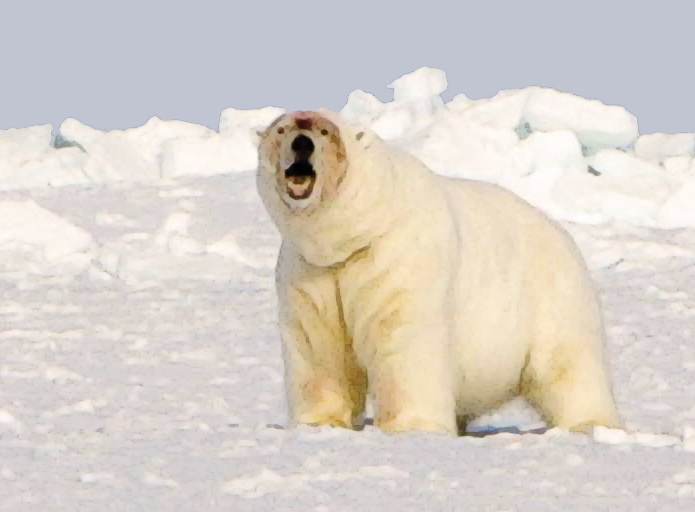
There is irrefutable evidence from Barents and Chukchi Sea subpopulations, among others, that polar bears are fat and reproducing well despite marked declines in summer sea ice over the last two decades. These indicators of physical and reproductive health, in any species, are signs of thriving populations. However, these facts negate the premise that polar bears require abundant summer sea ice to flourish, and that creates a problem for polar bear specialists who continue to make that claim (Amstrup et al. 2007; Crockford 2017, 2019).
Enormously fat Chukchi Sea polar bear, USFWS.
In other words, the assessment that polar bears are currently thriving is not based solely on estimates of a slight increase in global population size but on published data gathered from field studies on the bears’ physical and reproductive health.
Oddly, biologists repeatedly turn to data from Western Hudson Bay to drive home to the public their preferred message that polar bear health and abundance are being negatively affected by recent summer sea ice declines. However, they fail to mention that robust field data from many other regions, including the Barents and Chukchi Seas, support the opposite conclusion. Moreover, wherever possible, they mumble under their breath (or leave out entirely) the fact that poor ice conditions could not be blamed for a 27% decline in polar bear numbers in Western Hudson Bay since 2016 — because their own data showed sea ice conditions had been strong!
Posted onFebruary 17, 2023|Comments Off on Low mid-winter polar bear habitat in Barents Sea spawns warnings of more human-bear conflicts
There’s abundant sea ice in the Bering, Greenland and Labrador Seas, although less than usual in the Barents Sea because strong winds drove the ice north. Any time there is a bit less sea ice than usual the catastrophists begin caterwauling but this time the rhetoric is a little different.
Posted onFebruary 8, 2023|Comments Off on Polar bear evolution book is progressing well
Just a short update regarding progress on the book. I am deciding on a cover design while addressing suggested changes as they come back from the editor, and preparing marketing material. If all goes to plan, I am on track for a March publication date–thanks to your support.
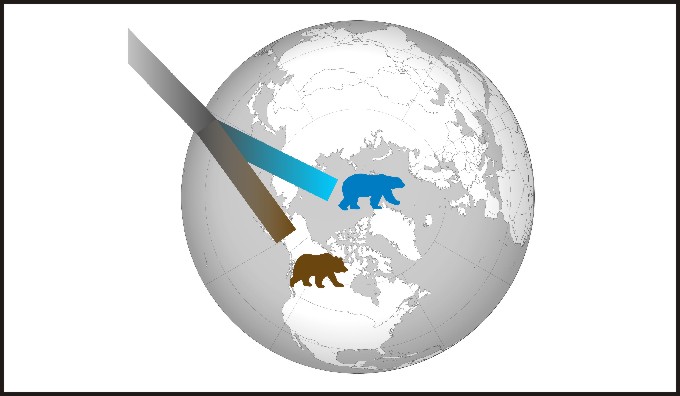
In the early 1960s paleontologist Bjorn Kurtén thought that polar bears likely arose from a brown bear ancestor based on fossil evidence alone, and his estimate of when this happened was determined by the age of fossil remains of both species. As I will show in the chapters that follow, despite more fossil evidence being available and additional evidence from molecular genetic studies, his estimate is still the most likely time frame for when the polar bear came to be.
Comments Off on Polar bear evolution book is progressing well
Posted onFebruary 6, 2023|Comments Off on Polar bear that mauled to death Alaskan mother and baby was an adult male in poor condition
The veterinarian who examined the bear responsible for the fatal attack in Wales, Alaska, three weeks ago said the bear was an “older” adult male in poor physical condition: the most dangerous bear for anyone to encounter. Recall the armed cruise ship guard who was ambushed and mauled by a desperately thin bear in July 2018 in the Svalbard archipelago–and only survived because his colleague was able to shoot the bear quickly. In this most recent attack, Summer Myomick and her 1-year-old son, Clyde Ongtowasruk didn’t stand a chance as they were ambushed in a driving snowstorm just steps from the safety of the community school they had just left.
Results of a complete necropsy won’t be available for months. Quotes from the news report below.
Posted onJanuary 30, 2023|Comments Off on Emperor penguin ESA listing in 2022 used Antarctic sea ice models known to be flawed
While Arctic sea ice has declined remarkably since 1979, Antarctic ice has been unexpectedly stable. Experts acknowledge that existing climate models–which assume that CO2 emissions drive global sea ice loss–had predicted Antarctic sea ice would have declined over the last several decades–and would decline even more in the future. They’ve finally admitted they were wrong.
John Turner (British Antarctic Survey) and Josifino Comiso (NASA) in a NATURE paper in 2017:
“Current climate models struggle to simulate the seasonal and regional variability seen in Antarctic sea ice.“
Relying on the data I referenced used to be uncontroversial. When a CNN science journalist did an investigation similar to AFP’s in 2008, he spoke to numerous scientists and they agreed “that polar bear populations have, in all likelihood, increased in the past several decades.” When polar bears in 2008 were listed as a threatened species under the Endangered Species Act, the decision noted that the population “has grown from a low of about 12,000 in the late 1960’s to a current worldwide estimate of 20,000-25,000.” The data here haven’t changed, only the media’s willingness to disregard annoying facts.
The result is that the public is denied access to accurate data and open debate about these very important topics. Ridiculous points on one side are left standing while so-called fact-checking censors inconvenient truths. If we’re to make good climate policy, voters need a full picture of the facts. Lomborg 2023, backup link
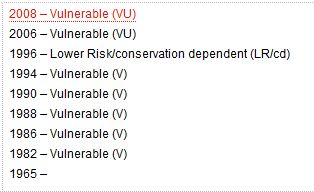
I would add this fact: in 1982, polar bears were listed by the IUCN as ‘vulnerable’ but by 1996, that had changed to ‘lower risk/conservation dependent’–now called ‘least concern‘ (see screencap below) because population numbers had rebounded after more than 20 years of international protection from over-hunting. The reversion to ‘vulnerable’ in 2006 was based entirely on predictions that population numbers would decline in the future due to see ice loss, which so far has not happened (Crockford 2017, 2019; Crockford and Geist 2018).
References
.Crockford, S.J. 2017. Testing the hypothesis that routine sea ice coverage of 3-5 mkm2 results in a greater than 30% decline in population size of polar bears (Ursus maritimus). PeerJ Preprints 19 January 2017. Doi: 10.7287/peerj.preprints.2737v1 Open access. https://peerj.com/preprints/2737/
Crockford, S.J. 2019. The Polar Bear Catastrophe That Never Happened. Global Warming Policy Foundation, London. Available in paperback and ebook formats.
Crockford, S.J. and Geist, V. 2018. Conservation Fiasco. Range Magazine, Winter 2017/2018, pg. 26-27. Pdf here.
Comments Off on Lomborg responds to polar bear abundance challenge
Posted onJanuary 18, 2023|Comments Off on Two dead in fatal polar bear attack in Alaskan village of Wales on the Bering Strait
Two people tragically died yesterday afternoon after an attack by a polar bear in the village of Wales on the Bering Strait. Few details are available and bad weather apparently hampered officials getting to the village immediately.
As expected, virtually all news reports are implying that a generic ‘lack of sea ice’ can be blamed for the incident. As usual, the specifics of this case show this claim is not only nonsense, but dangerous.
With the loss of sea ice and the ocean staying open later in the year, polar bears have been spending more time on land, which increases the chance of human encounters, said Joseph Jessup McDermott.
Polar bear attacks in winter are almost always associated with a bear that has not been able to resume feeding in the fall. More bears and restricted hunting means more young bears (as well as old bears or sick ones) become food stressed because they can’t compete with big mature males for food. Mature bears often steal any seals that young bears are able to kill, making the youngsters desperate for food.
The Chukchi Sea polar bears are currently thriving and numbers may still be increasing (AC SWG 2018; Conn et al. 2021; Regehr et al. 2018; Rode et al. 2014, 2015, 2018).
More details to follow on this horrific incident as they become available.
UPDATE 18 January 2023, 5:30PM PT: According to an Associated Press account, the victims were a 24 year old woman and her one-year old son: “Summer Myomick of Saint Michael and her son, Clyde Ongtowasruk, were killed in the attack, Alaska State Troopers said in a statement.”
No more details were provided on the state of the bear involved (sex, age, body condition). Regarding the blame-game, even though recent studies have shown that ringed and bearded seals in the Chukchi Sea are doing very well (Adam et al. 2019; Crawford and Quakenbush 2013; Crawford et al. 2015), Geoff York from Polar Bears International suggests there may not be enough seals for polar bears or the something may be wrong with the sea ice:
In this case, even though there is ice in the Chukchi and northern Bering seas, the quality of that ice is not known that well. More importantly, York said they don’t know what’s going on under the ice — or what the availability of seals and other prey is for polar bears.
The changes are also happening in winter, when people assume they are safe from polar bears being on shore.
Posted onJanuary 18, 2023|Comments Off on No more WEF backroom deals for Sir David Attenborough?
On the first anniversary of Fallen Icon, I wonder if Sir David has made his last backroom deal? His years of relentless messaging anti-capitalistclimate doom seemed like a concerted plan to build a legacy based on something other than smooth talking: I am convinced Attenborough saw the shocking film footage of walrus falling to their deaths presented in the Netflix/WWF extravaganza Our Planet as the leverage he needed to kick-start an aggressive campaign to promote action on climate change and curb capitalism. But it all collapsed at COP26 in 2021 with his failure to make any difference at all.
Watch polar bear habitat reform in the Canadian Arctic: “last 10 days” Canadian Ice Service animation (works anytime) HERE.
See Quote archive for details.









 polarbearscience
You must be logged in to post a comment.