Posted onAugust 11, 2021|Comments Off on Foxe Basin polar bear attack leaves three people seriously mauled, airlifted to hospital
The attack happened yesterday afternoon (10 August) about 2:30 PM local time near the community of Sanirajak (listed as Hall Beach on ice charts), which is in Foxe Basin, Nunavut (population about 800). There are few details yet on the human victims of the mauling other than that they were two women and a man. All three were badly injured. They are now in hospital and expected to survive.
It appears the bear died as a consequence of the attack but there has been no mention of its condition, age, etc., or the circumstances of the attack. There is no ethical reason for blaming this broad-daylight attack on lack of sea ice (although some will try), since there is abundant ice in the region at the moment, as the charts below show. Expect an update as the story unfolds.
Posted onAugust 4, 2021|Comments Off on Polar bear attack in Greenland gratuitously blamed on recent ‘heat wave’
A polar bear bit the hand of a member of a film crew near the Danish military base of Daneborg in East Greenland on Monday (2 August) and predictably, this has been blamed on recent warm temperatures in the region. There is no specific evidence of cause and effect, of course. The news outlet reporting the incident cites some non-specified ‘experts’ as providing the generic ‘warming makes polar bears starve or behave badly’ excuse that makes no sense in this particular instance.
Here is what the news report had to say (3 Aug), my emphasis:
Early on Monday, while the sun does not set in summer at this latitude, the bear poked his head through a poorly closed window of a research station where the documentary team was staying about 400 metres from the small base of Daneborg.
A Danish Arctic military unit based in Greenland said the bear bit the hand of one of the three male team members before they used warning pistols to force the animal to flee.
Transported first to Daneborg, the injured documentary maker had to be evacuated to Akureyri, a town in Iceland.
Already blamed for five incidents until now, the bear returned again later in the morning and then again overnight Monday to Tuesday when it broke a window of the research station before fleeing.
“The local authorities have from now on categorised the bear as ‘problematic,’ which allows for it to be shot dead, if it returns,” the Danish military unit said.
Any bear causing problems in this region would have just come off the ice, since three weeks ago there was plenty of ice available offshore a bit to the north (see chart below for 7 July). Virtually all bears are at their best condition at this time of year, except for young, inexperienced bears or those that are sick or injured. Warm temperatures would not be causing any bear to be desperately looking for food unless it was desperate for some other reason (sick, injured, or an under-nourished young bear). However, nothing is stated in this report about the physical condition of the bear, its approximate age or its sex, even though it has been seen multiple times. Young male bears, for example, are far more likely to become problems near communities than any other age class (Wilder et al. 2017), because these bears have to compete with older, larger bears to keep whatever seals they manage to kill.
Note the reliance on un-named ‘experts’ at the end of the same news report:
Experts say the retreat of the ice pack, the hunting ground of the polar bear, forces them to stay on land more often and they find it harder to find food and sustain a species already considered vulnerable.
Although still rare, the close encounters with humans are increasing as bears more frequently approach inhabited areas in their search for food, environmental protection officers say.
What generic pap! The community has a problem bear on its hands, a situation which northern communities across the Arctic must contend with on a continual basis. Even if there was ice offshore, there would be the possibility of bears coming ashore and causing problems.
Wilder, J.M., Vongraven, D., Atwood, T., Hansen, B., Jessen, A., Kochnev, A., York, G., Vallender, R., Hedman, D. and Gibbons, M. 2017. Polar bear attacks on humans: implications of a changing climate. Wildlife Society Bulletin, in press. DOI: 10.1002/wsb.783 http://onlinelibrary.wiley.com/doi/10.1002/wsb.783/full
Comments Off on Polar bear attack in Greenland gratuitously blamed on recent ‘heat wave’
Posted onMarch 2, 2021|Comments Off on Polar bear attack in Svalbard: victim survives, polar bear does not
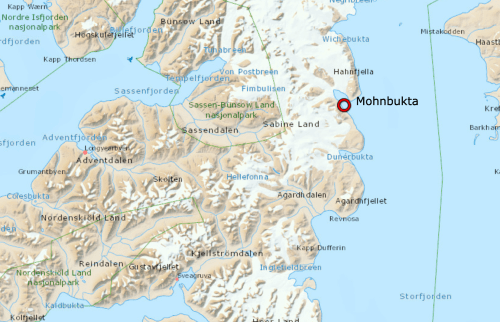
A man was attacked from behind this morning by a small male polar bear on the east coast of Svalbard, Norway, where there is abundant sea ice. His companion shot the bear and the victim escaped with minor head injuries. Most bears are very hungry at this time of year because the seal pupping season has not yet begun.
Young bears are extremely dangerous and the most likely to attack people (Crockford 2019; Wilder et al. 2017): a three year old male fatally attacked a camper in August 2020 just outside Longyearbyen, Svalbard, an incident unfairly blamed on lack of sea ice (Crockford 2021).
UPDATE 3 March 2021:Results of an autopsy conducted on the polar bear killed yesterday revealed it was a 6 year old male that weighed only 231 kg, which is less than usual for an adult bear later in the season but likely typical for a relatively young bear at the end of winter before seal pups are born. See quote from a Norwegian polar bear specialist below [my bold]:
Jon Aars, an institute researcher who has spent many years studying bears in Svalbard, told Svalbardposten the vast majority of bears ages six to 15 will weigh between 350 and 450 kilograms in April, when the spring hunting season is typically at its peak.
“It may have been aggressive because it was thin,” he said. “It is likely. The thinner they are, the greater the chance that they are dangerous. He is at an age where he is not frequently considered as a problem bear – it is mostly among the younger or the very old who have problems.”
Posted onOctober 20, 2020|Comments Off on Ten fat polar bears filmed raiding a stalled Russian garbage truck
From the Siberian Times today (20 October) is a story with few facts but a fabulous video of six fat adults and four fat cubs as they set siege to a stalled open garbage truck in the Russian Arctic. It may have been filmed on Novaya Zemlya but that has not been confirmed.
Posted onOctober 1, 2020|Comments Off on Polar bear damage to parked military helicopter shows their immense power
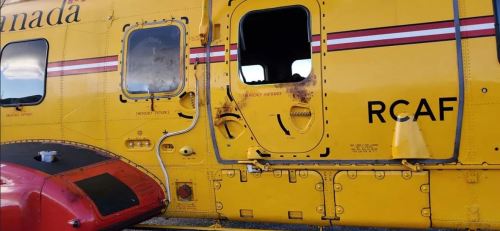
A polar bear punched out the window of a parked Royal Canadian Air Force search and rescue helicopter on 16 September in northern Labrador, which should be a reminder that these bears are extremely powerful and potentially dangerous.
If you ever thought you would be safe in a cabin or vehicle if a polar bear really wanted in, you might want to think again and remember that residents of the Arctic put up with this risk of polar bear attack, intrusion and damage all year long (Crockford 2019). And it’s not because the bears are simply ‘curious’.
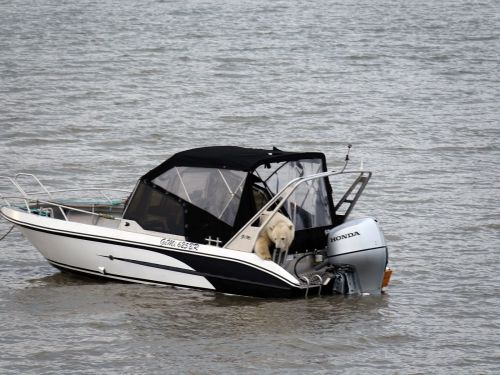
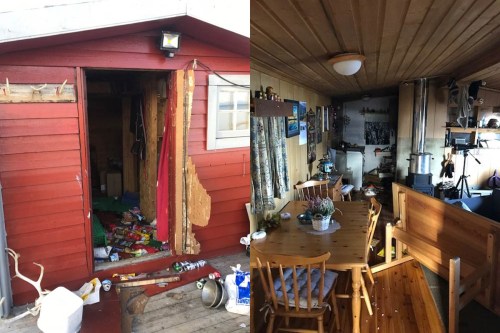
Two photos below from Svalbard: of a bear that climbed onboard a boat moored offshore in 2019 while its occupants had lunch on the beach (damaging the hydraulic steering, vinyl seats, heating system, canopy, and an inflatable raft), and of a cabin ransacked by a polar bear in 2017 after it ripped the door off its hinges. Since it is my understanding that cabin owners in Svalbard are not permitted to leave stored food in unoccupied buildings, the attractants in these empty cabins must be other things that contain oil, like cleaning products, vinyl furniture, and candles.
Posted onSeptember 5, 2020|Comments Off on Criminal charges dropped in case of polar bear shot by cruise ship guards in 2018
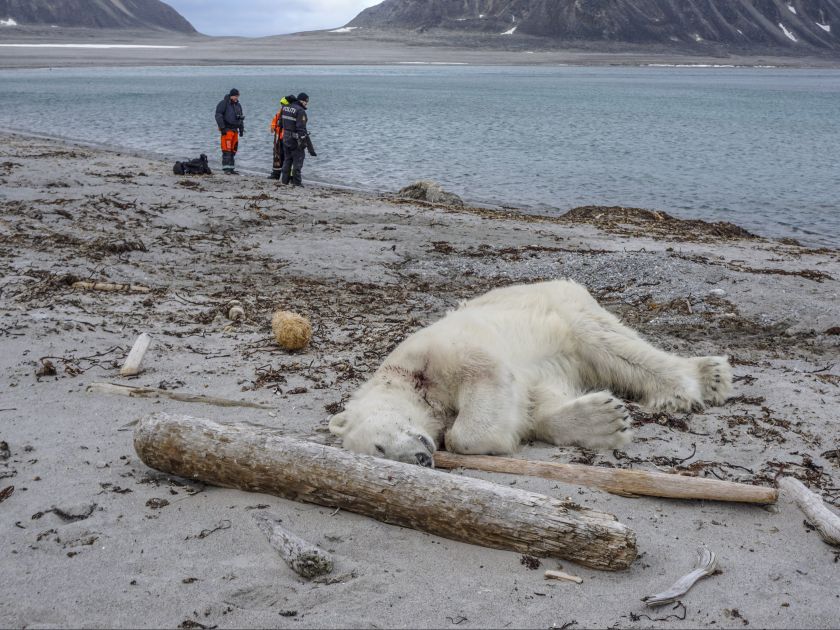
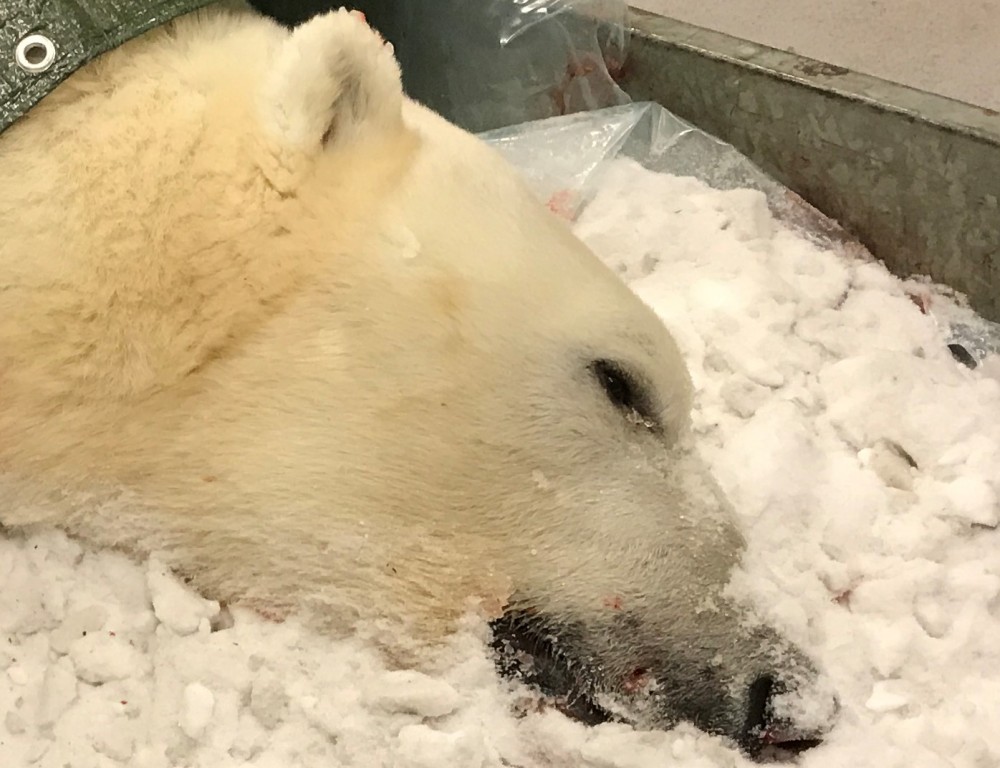
The guards from a cruise ship who shot an emaciated bear in self-defense in late July 2018 on the remote island of Phippsøya in northern Svalbard have had criminal charges against them dropped. It is illegal to kill polar bears in Norway, so the death of the bear automatically triggered a criminal investigation.
Polar bear shot in self defense on the island of Phippsøya in the Sjuoyene group north of Spitzbergen 28 July 2018 by guards from a cruise ship, photo courtesy Govenor of Svalbard.
This case, which made international headlines and sparked outrage at the time, also saw charges laid against the cruise ship that employed the guards. However, all charges against the company have also been dropped. See below for details on the decision and my post about the incident in 2018. No information on the condition of the bear was included in the statement about criminal charges.
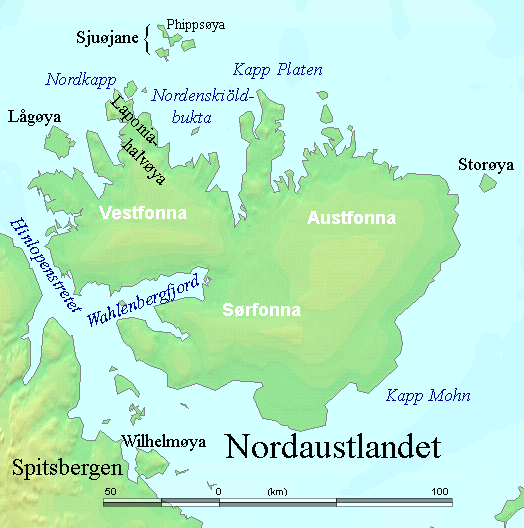
Phippsøya is part of the Sjuoyene island group in northern Svalbard.
Posted onAugust 28, 2020|Comments Off on Fatal polar bear attack in Svalbard unfairly blamed on lack of sea ice
A fatal polar bear attack in Svalbard, in the early hours of 28 August 2020 just outside the main town of Longyearbyen, is being unreasonably blamed on lack of sea ice. Details of the attack show it was made by a three year old male: such subadult bears are historically responsible for most attacks on people and they are known to be especially dangerous. It looks to me like someone should have seen this tragedy coming and stepped in to prevent it.
I will update this story as more information comes in but see below for the details known so far.
Posted onMarch 29, 2020|Comments Off on Svalbard finds tranquilizing & removing problem polar bears comes with risks to bears
In Svalbard, Norway, it is routine practice to chase polar bears away from settlements with snow machines and helicopters, then tranquilize and relocate them if necessary but in late January this approach led to the death of a young male bear.
Necropsy results released 26 March 2020 revealed that the two year old bear, who had wandered into and around Longyearbyen multiple times in late January, was captured after a prolonged helicopter chase but died enroute as it was flown north to Nordaustlandet (see map below) from circulatory failure due to administering anesthesia after the prolonged stress of being chased.
In the wee hours of New Years Day 2020 a fat Svalbard polar bear was shot because of persistent visits to downtown Longyearbyen and the public was outraged. A few weeks later a bear attacked a dogsled loaded with tourists. The death of the young bear in late January in the course of removing it(rather than shooting it) is a reminder that tranquilizing a polar bear, especially after a prolonged chase, can be as lethal as shooting it.
Posted onJanuary 2, 2020|Comments Off on Fat adult polar bear shot in Svalbard New Years Eve after persistent visits to Longyearbyen
Another rare winter visit by a polar bear on New Year’s Eve, this time in Svalbard, comes with far more detail than the sighting in Newfoundland that I wrote about yesterday.
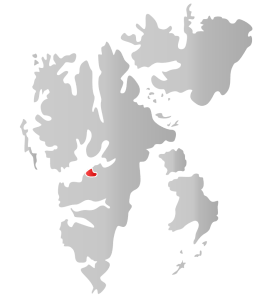
The Svalbard problem bear was shot over safety concerns after repeated visits to the downtown streets of the main town of Longyearbyen on the west coast (see map below). Neither of the reports bothered to mention that this was not a starving juvenile bear but a fat, healthy young adult – and no one blamed global warming for the incident because Svalbard has had extensive ice on the west coast this fall for the first time since 2010. The shooting of course sparked an outburst of social media outrage.
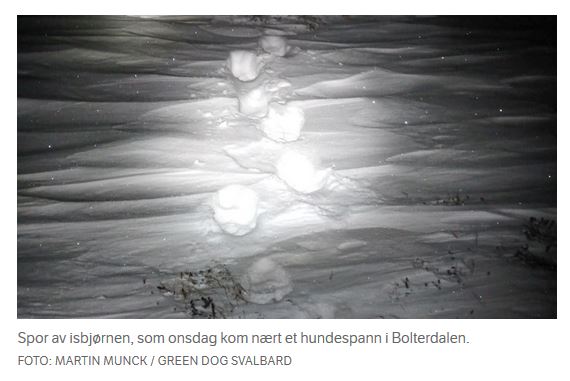
UPDATED 16 January 2020: As I predicted would happen (see below), there has been another polar bear incident about 10 km outside of Longyearbyen in Bolterdalen. On Wednesday 15 January, a bear attacked a dogteam loaded with tourists near the end of their trip. The bear was advancing so fast there was no time for the driver to grab his rifle, so he used the heavy rope used to brake the sled to hit the bear across the muzzle several times. This stopped the attack and made the bear run off. Svalbard officials are now chasing the bear well out of the area. From this report:
“Starinsky, a guide for Green Dog Svalbard, located about 10 kilometers east of Longyearbyen, told the newspaper there was no time to grab his rifle as they stopped the sleds within seconds, and the bear got within yards of a sled carrying a mother and her daughter. He grabbed “the first and best” thing he could think of – the noose-shaped brake rope hanging on the front of his sled.”
It turns out the bear’s tracks were spotted the day before just south of town. All that remains of the attack are the tracks of the bear near the dog kennel, below, and the nightmares of the people involved in the days ahead. They were very lucky indeed.
Posted onSeptember 13, 2019|Comments Off on Polar bear at a walrus haulout with cliffs in Russia: Netflix scenario all over again?
In the news this morning is a report out of Russia that a team from WWF and a Russian documentary film crew were approached from the top of the cliff by a polar bear – at what looks suspiciously like the steepest part of the same Chukotka cliff that the infamous Netflix ‘Our Planet’ walrus video was filmed in 2017. The Netflix crew insisted that no polar bears were around when the walrus deaths occurred, despite strong evidence to the contrary (including a polar bear shown in the final seconds of the film!)
Is the cliff above the same one we saw last year as walrus fell to a gruesome death on the rocks below, falsely blamed on lack of sea ice? It is mid-September, the same time of year as the 2017 walrus footage was filmed by the joint Netflix/WWF crew – and surprise, surprise, it looks like WWF are taking other filmmakers back for more of the same.
Or have they found another location with the same features?
Here is the original WWF Behind the Scenes video from the Netflix incident:
Watch polar bear habitat reform in the Canadian Arctic: “last 10 days” Canadian Ice Service animation (works anytime) HERE.
See Quote archive for details.











 polarbearscience
You must be logged in to post a comment.