Tag Archives: Chukchi

Goldilocks in the Bering Sea: Less sea ice is bad and more ice is bad

This article from yesterday about sea ice in the Bering Sea is priceless: while we are still being told that below average ice coverage (common 10-20 years ago) is a sign of global warming that means the end of polar bears sometime in the future, it turns out that too much ice is bad, less ice is friendlier and lots of ice is hopefully something that we’ll never see again.

From the article:

After a 2012 Bering Sea snow crab season that saw unusually severe sea ice inhibit fishermen’s efforts to catch almost 89 million pounds of the shellfish, 2013 is shaping up to be much friendlier.

According to Kathleen Cole, a forecaster with the National Weather Service ice desk, this winter was unlikely to match 2012, even before it began. Despite some recent rumors of encroaching ice into the Bering Sea fishery, the situation is better than last year, she said.

“We’re just not going to have a year like last year. It’s going to be, by no means, that bad,” she said. “Last year was something that we’d never seen before, and hopefully something that we’ll never see again.”

Sea ice is still well above average in the Bering Sea this year – as it has been for 7 of the last 10 years. See the ice extent map from NSIDC from yesterday below and my previous post from December 2012: Now that Bering Sea ice cover is high again, variability is normal (note that polar bears of the Bering Sea are considered part of the “Chukchi Sea” subpopulation, which we know practically nothing about, see previous post here). Continue reading

Extirpated polar bears of St. Matthew Island spent five months on land during the summer

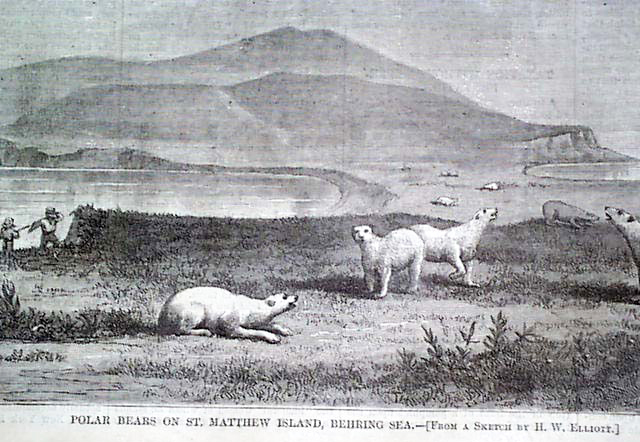
Did you know there used to be resident polar bears on two small islands in the Bering Sea? Given how much we don’t know about the polar bears of the Bering Sea, the bears that used to den and spend their summers on the St. Matthew Islands are a bright spot. These islands lay at the southern-most limit of the modern “Chukchi Sea” subpopulation (see Fig. 1) and were uninhabited by people when they were discovered in the 1760s – but they were a haven for polar bears.

We have details of the polar bears that gave birth and summered there because a US government biologist (Henry Wood Elliott) and a US navy Lieutenant (Washburn Maynard) surveyed the islands in 1874. Elliott wrote both an official report and a popular magazine article (for Harper’s Weekly Journal of Civilization) in 1875 describing the polar bears they saw; Maynard wrote a separate report in 1876. By 1899, there were none left, victims of the relentless slaughter of polar bears everywhere in the Arctic in that era (see previous discussion here).

Figure 1. St. Matthew Island is in the Bering Sea off the west coast of Alaska: north of the Pribilofs and south of St. Lawrence Island, at about 60°N latitude. Compare this to the southern end of James Bay, Canada – which has a stable population of polar bears – at about 53 0N and Churchill, Manitoba – the “polar bear capital of the world” – at 58 046’N. Maps from Wikipedia.

Figure 1. St. Matthew Island is in the Bering Sea off the west coast of Alaska at about 60°N latitude. Compare this to the southern end of James Bay, Canada (which has a stable population of polar bears) at about 53 0N and Churchill, Manitoba (the so-called “polar bear capital of the world) at 58 046’N. Maps from Wikipedia.

Figure 2. A drawing of polar bears on St. Matthew Island that accompanied the May 1, 1875 Harper’s Weekly Journal of Civilization article written by Henry Elliot. See here.

Figure 2. A drawing of polar bears on St. Matthew Island that accompanied the May 1, 1875 Harper’s Weekly Journal of Civilization article written by Henry Elliot. See here.

[UPDATE: Jan. 27, 2013: a follow-up to this post is here.]

Continue reading

The 32,000 population estimate for polar bears is not an error due to counting overlapping territories twice

UPDATE FEBRUARY 19, 2014The misleading “State of the Polar Bear” graphic is now GONE (as of January 31, 2014). A new 2013 status table is offered by the PBSG here. It has detailed text explanations and harvest information, with references, hyperlinked to each subpopulation entry (“Press the subpopulation hyperlink and more information will appear“) and may have replaced the “State of the Polar Bear” graphic that the PBSG commissioned for upwards of US$50,000, although the PBSG website says it is being “updated” [A pdf copy of the 2013 colour table is here, and my commentary on it is here.] I have left the original post as is, below.

[UPDATE April 1, 2013: see updates here and here ]

This is a brief follow-up to my last post.

I got an email from a reader suggesting that the high numbers for the world’s polar bear population, as given by the Polar Bear Specialist Group (PBSG) on their website in their State of the Polar Bear (SoPB) summary feature – as tallied by nation (22,600-32,000) – may simply be an error resulting from counting overlapping territories twice (i.e. where a subpopulation with one population estimate is shared by two nations, the total amount has been attributed to each nation, rather than giving each of them half of the total).

That is not the case and I’ll tell you why.

If you haven’t yet seen the last post, pop back and have a look – it’s short.

Then note the following:
1) Re: the numbers given for Russia (given as 2,700-4,800 in SoPB-by-nation). Russia has three subpopulations of polar bears: Chukchi (shared with the USA), Kara Sea and Laptev Sea. See previous post here on these estimates by the PBSG.

Chukchi officially has a population of zero because it has never been surveyed. The same is true for the Kara Sea: its population is officially zero and always has been. The Laptev Sea is given a tentative estimate of 800-1,200 in most subpopulation estimates but on the “State of the Polar Bear” summary, it is given as zero. Thus, at the very most, the total for Russia could be 800-1,200.

Conclusion: the estimate of 2,700-4,800 for the Chukchi Sea is not a result of an overlap in count. It’s a new number and there is no information given about where it comes from (it’s remotely possible that the SoPB-by-nation number comes from a recent survey of the Chukchi Sea, see previous post here, but that number has not been made public and the study results have not yet been published).

2) Re: numbers for the USA (given as 1,200-1,800 in SoPB-by-nation). The US has two subpopulations: Southern Beaufort (which it shares with Canada) and the Chukchi Sea (which it shares with Russia). The number usually given for the Southern Beaufort is 1,200-1,800 – so the US share is something like 600-900. While the US shares the Chukchi population with Russia, the Chukchi has never been surveyed – its population is officially zero (half of zero is still zero).

Conclusion: if there has been any “doubling up” going on, it is here. The official (documented) number for the US should be about 600-900.

3) Re: numbers for Greenland (given as 3,500-4,400 in SoPB-by-nation). East Greenland has never been surveyed and the official estimate for that subpopulation is zero. West Greenland comprises three polar bear subpopulations that it shares with Canada: Baffin Bay (total count 1,544-2,604), Davis Strait (total count 1,811-2,534) and Kane Basin (total count 94-234). That comes to 3,449-5,372. Conclusion: if there had been a “doubling” of shared population numbers, the number for Greenland should have been listed in the SoPB-by-nation map as 3,449-5,372 (not 3,500-4,400).

The estimate for the world’s polar bear population, as given by the Polar Bear Specialist Group (PBSG) on their website in their State of the Polar Bear summary feature – as tallied by nation (22,600-32,000) – is not simply an error resulting from counting overlapping territories twice.

Bearded and ringed seals join the polar bear as “threatened” by a computer-modeled future

As I pointed out in Featured Quote #22 (posted on Dec. 23, 2012), bearded and ringed seals have recently joined the polar bear on the American ESA’s list of animals that are “threatened” by computer-modeled predictions of Arctic sea ice declines projected 50-100 years into the future (USFWS 2008, 2012a, 2012b).

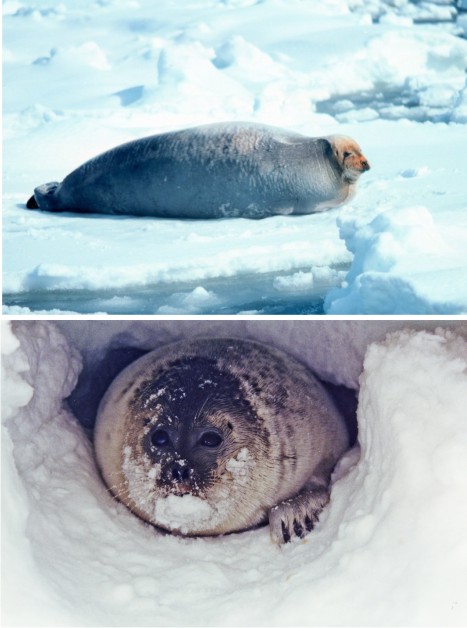
NOAA photos of bearded seal (top) and ringed seal (bottom)

NOAA photos of bearded seal (top) and ringed seal (bottom). The bearded seal is one of the largest Arctic ice seal while the ringed seal is the smallest. Both are eaten by polar bears, although ringed seals are consumed most often.

The decision by NOAA (National Oceanographic and Atmospheric Administration) affects the Arctic subspecies of ringed seal (Phoca hispida hispida) as well as the Okhotsk subspecies (Phoca hispida ochotensis) (in addition to several others) and thus includes all ringed seals off Alaska’s coast in the Beaufort, Chukchi and Bering Seas. The decision also affects two particular subpopulations of bearded seal (Erignatha barbatus): the “Beringia” [Bering Sea/Chukchi] subpopulation (about half of which reside in Alaskan waters), and the subpopulation that lives in the Sea of Okhotsk. (Alaska Fisheries (NOAA) Final Decision). Continue reading

Now that Bering Sea ice cover is high again, variability is normal

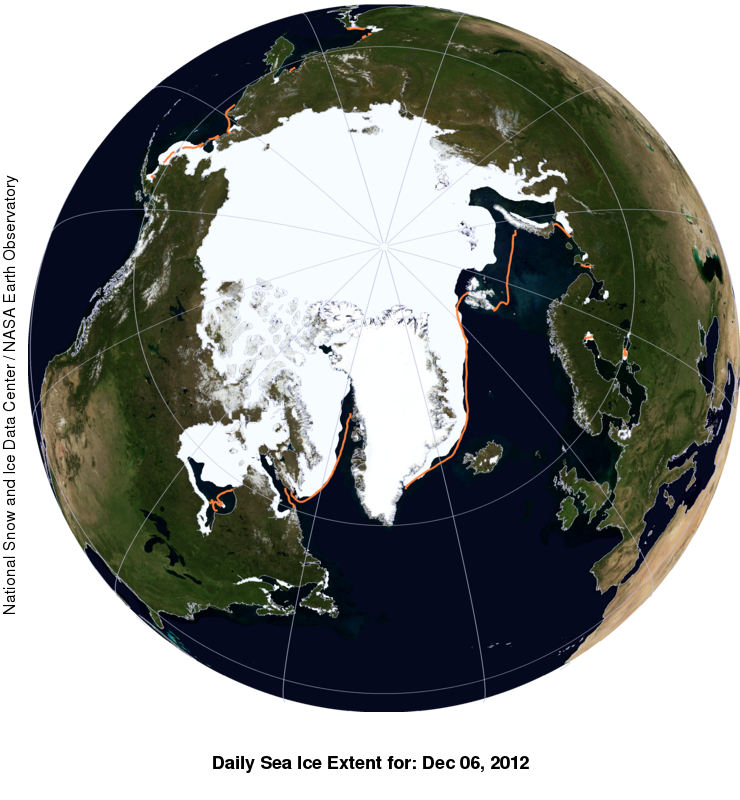
Sea ice development in the Bering Sea is trending higher than average again this year, even though it is early in the season. The NSIDC sea ice extent image for Dec 6 2012 below (Fig. 1) shows extensive ice development in the Bering Sea. [courtesy WUWT sea ice reference page]

Seven of the last 10 years have produced above-average freezing in the waters west of Alaska” says Kathleen Cole of the Alaska National Weather Service (Dec. 6, 2012) – see “Featured Quote” #20 in the right column (also filed in the “Quote Archive“).

Fig. 1 National Snow and Ice Data Center (NSIDC) sea ice extent at Dec. 6 2012. The orange line is the median extent for this date for 1979-2000.

Figure 1. NSIDC sea ice extent at Dec. 6 2012.
The orange line is the median extent for this date for 1979-2000. Click to enlarge.

The NSIDC, in their report on the annual freeze-up of the Arctic (November 2012), have this to say about the ice in the Bering Sea:

“…ice extent in the Bering Sea by the end of the month was greater than average, continuing a pattern seen in recent years. Extent in the Bering Sea was at record high levels last winter.”
Continue reading

PBSG polar bear population assessment made simple

[Update: Feb. 10 2013. I have corrected an oversight in the summary tables – the originals neglected to indicate that the Barents Sea subpopulation is shared between Norway and Russia (not controlled by Norway alone). Here is revised Table 1 and revised Table 2. ]

[Update 2: Sept. 26, 2013. See Global population of polar bears has increased by 2,650-5,700 since 2001″ for further insight. I have also made slight corrections to the tables below, now marked Version 3.]

A couple of weeks ago, a news report appeared highlighting an interview with Russian biologist Nikita Ovsyannikov, deputy director of Russia’s polar bear reserve on Wrangel Island in the Chukchi Sea. This is what the news report said:

He [Ovsyannikov] guessed the number of bears around the Chukchi Sea, which also sometimes migrate in small numbers to western Alaska, had dropped over the past three decades from “about 4,000 to no more than 1,700 at best.

See Kelsey’s comments over at Polar Bear Alley and the comment I left there, here and my related previous post here

This media focus on Chukchi Sea polar bear numbers caught my attention because I had recently spent some time going through the 15 Polar Bear Specialist Group (PBSG) meeting reports in an effort to summarize the population estimates they provided. This international group first met in Fairbanks, Alaska in 1965 to advance and coordinate polar bear research and conservation under the auspices of the International Union for Conservation of Nature (IUCN) and the Species Survival Commission (SSC). I knew that according to the PBSG, the population of the Chukchi Sea is zero – that is, no Chukchi bears are included in the official total of 20,000-25,000 bears because no reliable survey had ever been done. Ovsyannikov’s statement to the press encouraged me to finish my summary of the population estimates in the PBSG meeting report tables.

This was not an easy task, in part due to the virtually constant changes in presentation style and format in the tables used to present the data (which appeared first in the 1981 report). For example, even between the 14th (2005) and 15th (2009) meeting reports, the population data table presents the subpopulations in different order and swaps the position of two critical columns (“status” and “observed or predicted trend”), making it extremely difficult for readers to do a quick comparison between years.

So I simplified the 2009 table (the most recent available), leaving out the future predictions as irrelevant to questions about current status. I included some population estimates and status assessments from previous reports to show the changes over time (where available). The full summary table, designated Table 1,  is provided here as a pdf. [update 2013 – this is Version 3]. However, in this format, it still spans two pages, so I composed another  table that contains the 2009 status information only (2009 is the most recent available), see Table 2, version 3 below. Viewing the data this way may surprise you.

continue reading

Good news study on Chukchi polar bears is unpublished

This article from yesterday (Oct 09, 2012) caught my eye: How many polar bears live in the Arctic? by Jill Burke

Buried deep within this article (page 3, in the default format) is this statement by US Fish & Wildlife polar bear biologist Eric Regehr:

“In 2009, when the PBSG [Polar Bear Specialist Group] issued its population status reports, it listed the Chukchi Sea population, which Alaska shares with Russia, as being of unknown size, but one thought to be in decline because of anecdotal reports about possible over-harvesting in Russia. But now, newer research yet to be published has scientists reconsidering the status designations of the Chukchi population, Regehr said. It appears the bears in this area are reproducing well and maintaining good body condition.

[Indeed, the latest PBSG report (Obbard et al. 2010:63) lists the Chukchi subpopulation status as “reduced” and current trend as “declining” even though the population size is “unknown.” It also states that “The trend is believed to be declining and the status relative to historical levels is believed to be reduced based on legal/illegal harvest levels that were thought to be unsustainable. Sea ice loss is one of the highest levels in the Arctic.”]

So, it turns out that what these expert polar bear biologists “believed” to be the case – without any data to back it up – is not actually true. Even with “sea ice loss [at] one of the highest levels in the Arctic,” polar bears are doing just fine. Sort of makes you wonder what else polar bear experts “believe” to be true but actually isn’t.

However, what really popped out at me was the tossed-off comment that the results of this potentially game-changing study for US polar bears (since the Chukchi subpopulations is shared between the US and Russia) have not yet been published. Nor are we told who did the study or when, even though it is complete enough for Regehr to be discussing the results with a journalist.

Finally, some good news to report, but no peer-reviewed study to quote or examine.

Again, results are in but we are not allowed to see the data. Sound familiar? See my earlier post on the critical evidence for western Hudson Bay polar bears that is also unpublished.

Really makes me wonder how many polar bears live in the Chukchi Sea? Sounds to me like they still don’t have an estimate but I suspect when they get one, we might be surprised by how big it is.

Reference
Obbard, M.E., Theimann, G.W., Peacock, E. and DeBryn, T.D. (eds.) 2010. Polar Bears: Proceedings of the 15th meeting of the Polar Bear Specialists Group IUCN/SSC, 29 June-3 July, 2009, Copenhagen, Denmark. Gland, Switzerland and Cambridge UK, IUCN.