Tag Archives: Churchill

Churchill seemingly unworried about polar bears, fails to post problem bear reports on social media

We know transparency’s gone out the window for many public officials, but still: Since early August, I’ve been checking daily for Problem Polar Bear Reports issued by the Churchill Polar Bear Alert Program managed by Manitoba Conservation. This morning (12 September), five reports were posted at once on the Town of Churchill website, dating back to first of the season for the week of August 5-11, see image below.
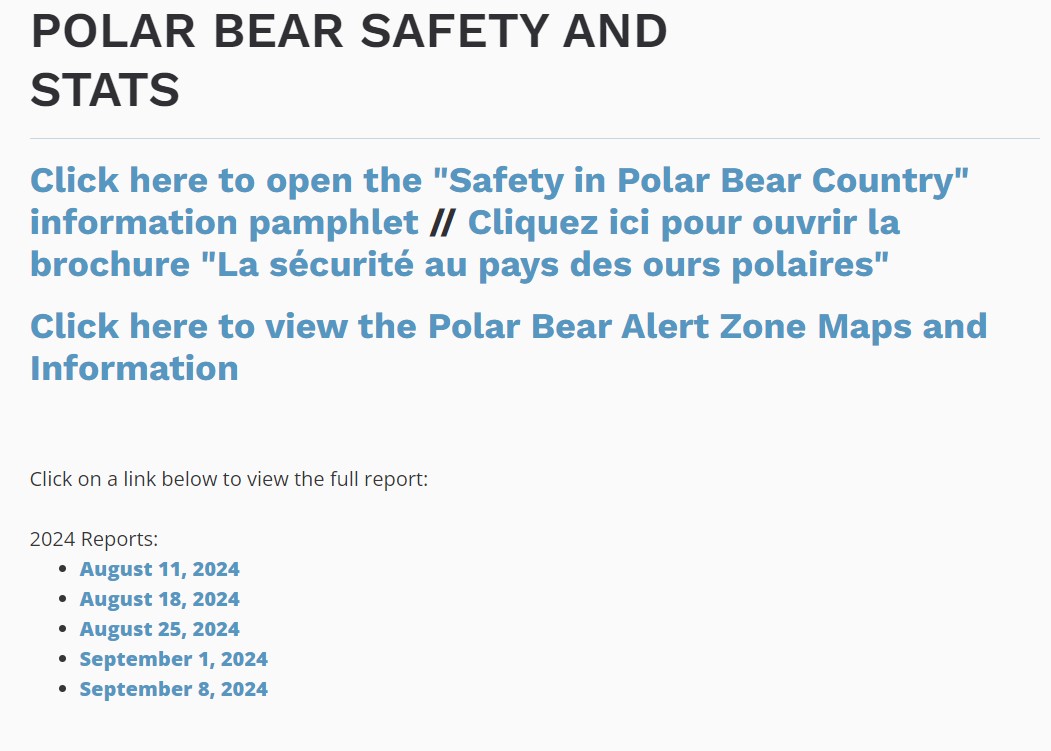
It’s apparent that the intent of these reports is in part public safety: to raise awareness of the potential threat of wandering polar bears around the town of Churchill because of the language that appears on virtually every report: “stay vigilant”, “be bear smart,” “be bear aware,” etc.

However, the X account for Town of Churchill seems to have been abandoned (last post 19 April 2024), which suggests the town is confident no residents or tourists would benefit from Alerts on X that polar bears are ashore:

The town’s Facebook account seems to be their only method of public communication yet even there, there have been no Polar Bear Alert reports posted this summer.

Oddly, even though it is now apparent from the just-released reports that one bear got so close to town that it had to captured and put in the ‘polar bear jail’ the week of 5-11 August — for the public’s safety — the only safety announcement the town issued that week was a ‘heat warning’ on 12 August:

I guess we are to assume that whoever is running this account – or the town council, or the mayor – believes that a day or two of hot weather (which Churchill gets regularly most years) is more dangerous to public safety than a massive predator wandering around town.

I can only conclude that keeping residents and tourists in the dark about potential threats from local polar bears is one way that Churchill is now adapting to climate change (from CBC News, 10 September 2024):

Bears Onshore and Effective Sea Ice Breakup dates

It is apparent from the wording of the Churchill reports that even by the last week of August this year, all bears were not yet off the ice, since they say only that “most bears” were on shore the week of 26 August to 1 September (see next section).

That suggests the last bears came ashore this year at least a week later than they did in 2020 (at 21 August), which at the time polar bear specialist Andrew Derocher presented as an anomaly (see tweet below). Compare to the situation last year here.

The last report I’ve seen from Derocher (via X) for 2024 on the status of his teams’ tagged females is that many of them (11/29 or 38%) were still on the ice as of 8 August (posted 11 Aug):

Derocher referring to this an “amazing” year that’s “similar” to the 1980s probably doesn’t tell the half of it, since he hasn’t posted any maps since then (as of noon, 12 September).

This effectively keeps secret the date when the last of these females bears actually came ashore, which is in any case a biased microcosm of the entire subpopulation. In other words, we can expect that if 40% of tagged female were still on bits of remnant ice at 8 August, there will have been many more bears, especially males, out there as well – which of course he never mentions.

He also never mentions that satellites under-report the amount of ice at this time of year by as much as 20% because of the effects of melt-water sitting on ice, but we’ve come to expect that.

Oddly, a recent study tried to explain the importance to survival of the recent phenomenon (since about 2015 or so) of bears staying out on melting bits of remnant ice rather than heading immediately to shore when the ice coverage over Western Hudson Bay drops below 50%. They suggested this behaviour was largely confined to male bears because they had to make up for feeding missed during the breeding season (McGeachy et al. 2024).

Females, alternatively, appear to respond to break-up in WH by coming onshore approximately 3 weeks after the mean ice concentration in WH reached 50%, … However, suitable habitat was still present elsewhere in the Bay and appeared to be used by a portion of WH prime age males. [McGeachy et al. 2024: 494, where “prime age males” are aged 5-19 years.]

However, these authors never mention the data reported by Derocher every year showing fairly significant numbers of tagged females lingering on tiny chunks of ice well into August, even though Derocher is a co-author. Funny, that.

Problem Bear Reports 2024, Weeks 1-5

Week 1, 5-11 August

Week 2, 12-18 August

Week 3, 19-25 August

Week 4, 26 August-September 1

Week 5, 2-8 September

References

McGeachy, D., Lunn, N.J., Richards, E.S. and Derocher, A.E. (2024). Sea ice influence on male polar bear survival in Hudson Bay. Arctic Science 10, 483-498. https://doi.org/10.1139/as-2023-004 Open access.

Western Hudson Bay sea ice breakup for polar bears like the 1980s for 3 of the last 5 yrs

The 1980s and early 1990s are said to have been the “good old days” for sea ice conditions and polar bears in Western Hudson Bay, with all tagged bears usually ashore by mid-to-late August. Then an abrupt step-change in sea ice breakup dates brought polar bears to shore an average of two weeks earlier in the late 1990s. From then until 2019, the only significant outlier to all tagged bears being ashore by about late July was 2009, which was such an unusually cold year that the last bears came ashore about August 20.

That pattern changed in 2020, when the last bears came off the ice as late as they had in 2009, on August 21. Something similar happened in 2022, when the last bears came off a small remnant of ice even later, about August 26. And this year, the bears may be moving ashore even later: there is even more ice remaining off WH and much of it is thick compacted ice that hasn’t melted much over the last few weeks, which means bears have been as late onshore as the 1980s for three out of the last five years.

Continue reading

W. Hudson Bay sea ice not going away anytime soon as polar bears sit tight offshore

A broad band of sea ice is jammed up against the western shore of Hudson Bay, hanging on despite warm mid-July temperatures. Its unusual thickness suggests it won’t be gone anytime soon, which means most Western Hudson Bay polar bears will likely remain offshore for at least a few more weeks.

The dark blue in the “departure from normal” chart below shows just how unusual this phenomenon is for the northern reaches of Hudson Bay:

Continue reading

Churchill end-of-season problem polar bear reports finally published

Today the Town of Churchill finally published the final problem bear reports of the season, which presents an opportunity to do a quick comparison to recent years.

This season lasted 24 weeks, the longest I can remember but apparently only the 5th longest on record. There were a total of 265 incidents by the end of November, more than 100 less than the most recent late-freeze-up year of 2016, which didn’t end until the first week of December (after bears had spent 22 weeks onshore). However, two recent years when freeze-up didn’t come until the end of November (2017 and 2020) had far fewer incidents (more than 100 less each compared to this year).

Continue reading

Despite hand-wringing about Churchill polar bears this year, 2023 wasn’t their worst summer

For months, the media has been bleating about the poor polar bears of Churchill suffering from lack of sea ice blamed on human-caused climate change during the so-called ‘hottest year’ on record: in April, July, August, November, and December.

From a Churchill Wild report on the condition of WH polar bears, January 2023

However, while breakup of sea ice on Hudson Bay was indeed early this year and freeze-up came later than usual, Western Hudson polar bears apparently spent only the fifth-longest time on land since 1979, according to a polar bear specialist. How is that even possible, given that sea ice conditions should be getting worse and worse as CO2 levels increase and average global temperatures rise? As I’ve pointed out before, it is apparent that Arctic sea ice is not closely coupled to CO2 levels (as the ‘experts’ claim), which makes me wonder if there is any ecologically-relevant correlation between CO2 and sea ice at all.

Money quote from Geoff York, from Polar Bears International: “As of Nov. 28 this year, the bears in western Hudson Bay had spent 164 days on shore, he said. That’s tied for the fifth-longest amount of time the bears have spent off the ice since 1979.CBC, 9 December 2023 [my bold]

Continue reading

Polar bear sea ice habitat update at 15 November & problem bears in Western Hudson Bay

Abundant polar bear habitat this fall across the Arctic so far, with only Hudson Bay sea ice formation a bit behind schedule. However, Churchill has not seen the anticipated spike in problem bear reports, given the vocal pronouncement by polar bear specialists that it should be experiencing more and more problems with bears when they spent more than 4 months ashore in summer and fall.

News of the most egregious attack by a bear I could find world wide this fall is shown in the video below, filmed 14 November 2023: apparently, the offending bear had spent several days displaying this offending behaviour.

Continue reading

Churchill so far has few problems with polar bears despite predictions of a record bad year

Despite misleading warnings in mid-August that a record number of incidents had already taken place, and that Churchill was on track for a record-number of bear problems this fall, the number of incidents and bears captured so far have been well below other years after the same number of weeks ashore. And while this is shaping up to be the longest ice-free season on record for Western Hudson Bay bears, it may not be a record year for problem bears in Churchill.

On average, officers receive around 250 calls from residents and detain around 50 bears every year, according to statistics provided to Live Science by the Manitoba government. The record number of bears captured in a single year was 176, in 2003.” LiveScience, 16 August 2023

Pro

Conservation officers misleading the public about polar bear problems in Churchill

Canadian government-funded media outlet CBC ran a story this morning about problem polar bears in the town of Churchill, Manitoba, the self-described “Polar Bear Capital of the World” that contains some very misleading statements from Manitoba Conservation officers.

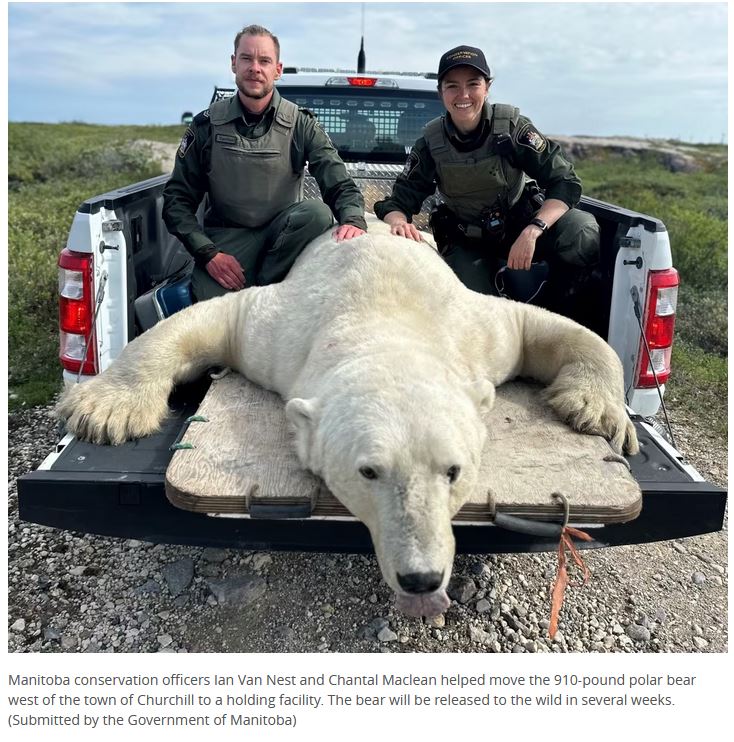
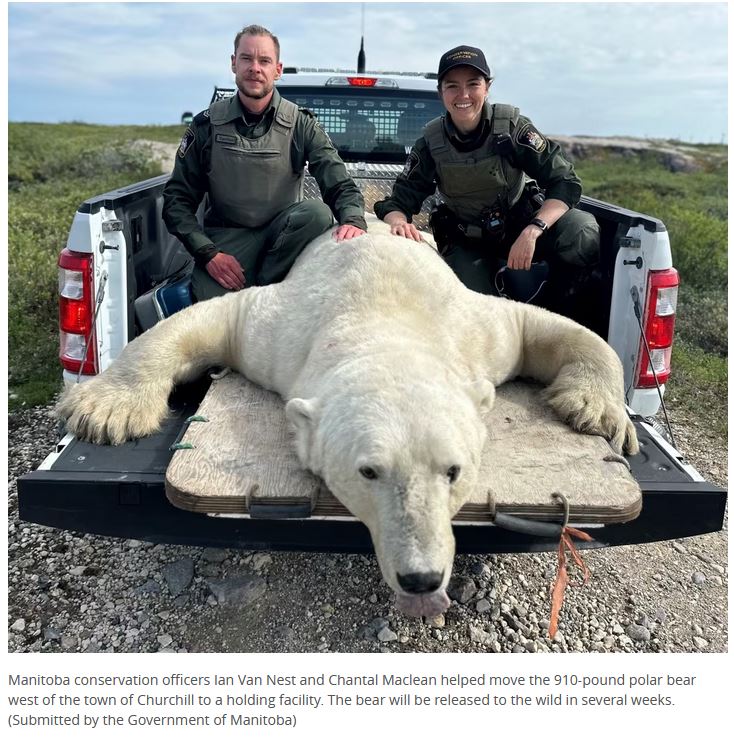
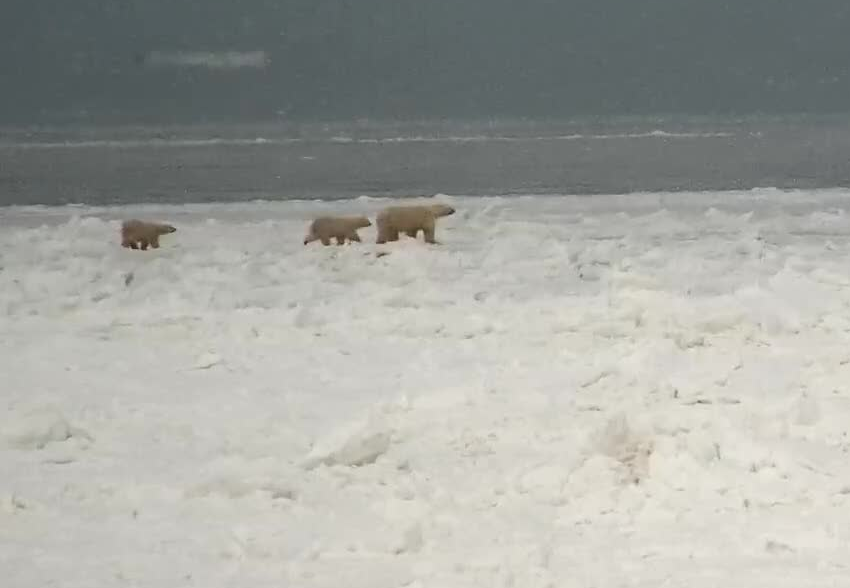
Breakup of sea ice on Hudson Bay was earlier this year than it has been in more than a decade (17 June) and some people are trying to hype the significance of this phenomenon to support a tenuous link to human-caused climate change, even though bears out on the ice this spring were reportedly in good condition and one of the problem bears captured on 8 August was also in good condition (a male weighing 910 lbs, photo above). Unfortunately, reports for similar early breakup years in the early 2000s have not been made public. However, I’ve been keeping track of these Polar Bear Alert Program Reports since 2015 and have read the available literature about their history: these records simply do not corroborate the statements in this CBC account.

Continue reading

Early sea ice breakup in W Hudson Bay caused by “record breaking” warmth in 2023 but not 2015?

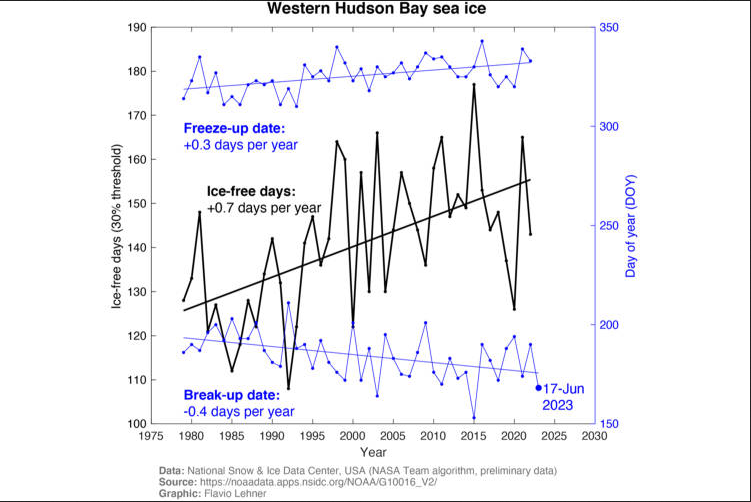
According to Polar Bears International, the “3rd-earliest” breakup date for Western Hudson Bay was caused by a “record breaking” heat wave in May. Western Hudson Bay sea ice hit the 30% coverage threshold used by PBI to define “breakup” on 17 June this year, prompting speculation about potential future impacts on polar bear survival should breakup come even earlier.

This year’s break-up date of June 17 is the 3rd earliest in the 45 years of satellite-based sea ice data from Western Hudson Bay, after 2015 and 2003.” [Flavio Lehner, PBI]

17 June 2023 is day 168 on the Julian calendar used to graph the data in the image included in the PBI essay (see copy below). However, the data point for 2003 is about three days earlier, on day 166 (14 June) and the point for 2015 is on day 152 (1 June).

If “record-breaking” heat caused this year’s early ice retreat, what caused the ice to retreat more than two weeks earlier in 2015? May was warm that year along the west coast as well but obviously not “record-breaking” warmth, because the records were broken this year. In fact, whatever warmth that occurred only affected ice melt in the western sector, while very thick ice over the rest of the bay resisted melt and allowed bears to stay out many weeks later than usual.

Continue reading

Polar bear specialist calls Hudson Bay freeze-up ‘late’ yet bears were moving offshore 2 weeks ago

Predictably, polar bear specialist Andrew Derocher has finally posted a tracking map of the Western Hudson Bay bears his team has fitted with collars and eartags–two weeks after bears were released from Churchill’s polar bear jail, which is the local signal that there is enough sea ice for bears to leave shore. As I reported two weeks ago, release of jailed bears happened this year on 10 November. And as I predicted in that post, by waiting so long after that event to post his map, Derocher can make it seem to his naive followers on Twitter that the bears are just starting to leave now (the last map he posted was on 11 November, when none of his bears had moved). He reinforces this by calling WH freeze-up “late”, when by all objective measures (including local informants reporting bears on the ice) it was as early as it had been in the 1980s (Castro de la Guardia et al. 2017).

Recall that fall is the second-most important feeding season for polar bears, due to the fact that seals are strongly attracted to newly-forming sea ice. It’s their chance to regain some or all of the weight lost over the summer, before the long winter fast begins (while bears indeed hunt when they can, they are not often successful during the depths of the Arctic winter: most bears are at their lowest weight by March).

Continue reading