Posted onSeptember 2, 2016|Comments Off on Columnist admits video on polar bears and global warming contained a serious error
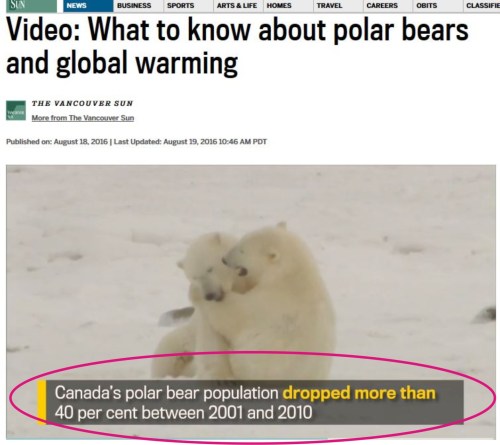
Since mid-August, Vancouver Sun columnist Daphne Bramham has been filing a series of articles from an expedition cruise through the Northwest Passage for a feature called “Above the Arctic Circle”. One of these appeared on August 18, along with a video called “What to know about polar bears and global warming” and it contained an egregious error that should have stood out to any educated person as being wrong by several orders of magnitude:
We are not talking about a difference of opinion or interpretation but a simple fact that was outrageously wrong by a wide margin. You see it, don’t you? Continue reading
Comments Off on Columnist admits video on polar bears and global warming contained a serious error
Posted onAugust 13, 2016|Comments Off on Narwhal and beluga ice entrapment is natural – not caused by global warming
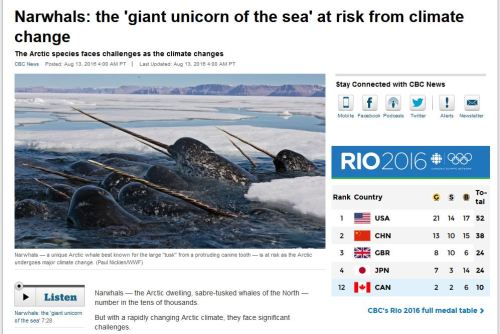
A part-time Arctic researcher eager for media attention suggested earlier today that the ice entrapment of narwhals in 2008 and again in 2015at Pond Inlet (that made headlines around the world) was the result of “sudden changes in temperature” caused by climate change. This grossly misleading claim ignores the facts: ice entrapment of narwhals is an entirely natural feature of the Arctic that has been known about for hundreds of years.
“Narwhals: the ‘giant unicorn of the sea’ at risk from climate change” (CBC, 13 August 2016), a print version of a CBC Radio interview with Clint Wright that aired 8 August 2016. Wright is the general manager at the Vancouver Aquarium and apparently has “joined a team of researchers to tag and study” narwhals for several years – but does not seem to know much about the history or circumstances of natural ice entrapment.
Ice entrapment of small whales is nothing new. The first formally documented incident – in English – occurred in 1915 (Porsild 1918) and the phenomenon has probably occurred as long as there has been ice in the Arctic (millions of years).
Animals routinely become trapped in a few specific areas due to local geography: when ice that forms in the north moves south quickly, it blocks the entrances to inlets or coastal bays that still have open water. The presence of the pack ice causes nearby temperatures to drop quickly. Rapid development of ice on the bay proceeds from the mouth toward the head of the bay. Any whales present cannot escape to open water and will eventually die or be eaten.
Pond Inlet at the north end of Baffin Island is one such place but Disko Bay in western Greenland is another. In fact, Pond Inlet and Disko Bay are almost identical in geographic layout even though they lie on opposite sides of Baffin Bay, so it’s not surprising that both are locations of repeated entrapment events.
Three highly informative journal articles on the phenomenon of ice entrapment of narwhals and beluga are open access documents that reveal some fascinating details of such incidents, including polar bear predation on trapped whales. h/t T. Nelson Continue reading →
Comments Off on Narwhal and beluga ice entrapment is natural – not caused by global warming
Posted onJune 30, 2016|Comments Off on USGS polar bear researchers publish their rebuttal to 2015 IUCN Red List assessment
Surprise! US Geological Survey polar bear specialists have just published another opinion-based model that concludes – yet again – that there is no hope for polar bears of the future unless the world drastically reduces fossil fuel use. This appears to be the Amstrup-led rebuttal to the hated 2015 IUCN Red List polar bear assessment I have been expecting, written in tandem with the Red List document by two of the same co-authors (Steve Amstrup and Todd Atwood).
Really, no surprises here – just more of the same overwrought fear-mongering about polar bears that we’ve been hearing from USGS since 2007. I saw Atwood and Amstrup last week in a British-made TV film that expressed the same sentiments (The Great Polar Bear Feast – it oddly featured dozens of fat/very fat Kaktovik polar bears while mostly USGS ‘experts’ talked about impending starvation). On camera, Atwood and Amstrup were almost indistinguishable in their statements of doom, and even though the film aired 6 months ago in the UK, it has so far not garnered the angst it seems to have intended.
Some folks may be even more convinced than ever by this new PR strategy [TV movie plus a published paper] that the polar bears are all going to die unless we (not they) change our wicked ways and stop using fossil fuels, but chances are that many more will detect the desperation in their escalated pitch and continue to refuse to buy what they are so frantically trying to sell.
Posted onJune 9, 2016|Comments Off on Some inconvenient polar bear facts supported by scientific literature
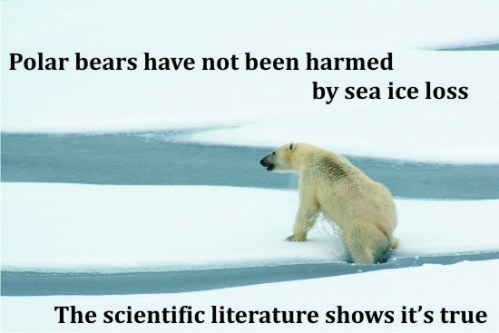
The evidence that polar bears have not been harmed by recent declines in sea ice is contained in the scientific literature, no matter what some researchers say when they talk to the media.
Here’s a few of those facts (not all, by any means), with the references to back them up: Continue reading
Comments Off on Some inconvenient polar bear facts supported by scientific literature
Posted onMay 23, 2016|Comments Off on Five facts that challenge polar bear hybridization nonsense
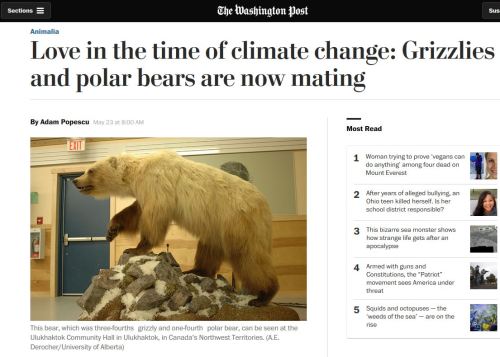
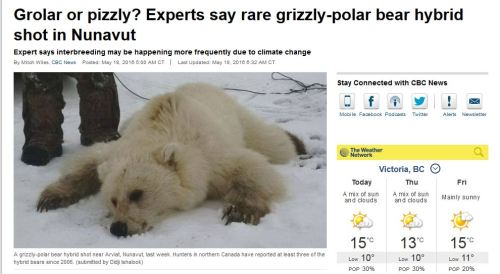
It was inevitable, I suppose, that the putative hybrid shot in Arviat, Nunavut last week (see my posthere) would initiate the global warming blame game.
Here are the five points you need to know about polar bear hybridization, as there are several nonsense statements contained in this Washington Post article.
UPDATE 24 May 2016: References adding below regarding grizzly sightings south of Churchill on the west coast of Hudson Bay (H/T Doug Clark).
This bogus claim has been busted so many times it’s a wonder it still arises – even polar bear specialist Ian Stirling has said flat out that such hybrids are not due to climate change. On top of that, some of the details regarding this putative hybrid make me want to wait for confirmation from DNA testing before adding it to the roster of known hybrids. Continue reading
Comments Off on Another alleged grizzly-polar bear hybrid shot but it’s not a sign of climate change
Posted onApril 16, 2016|Comments Off on More politics of polar bears courtesy WWF: impaled polar bear sculpture
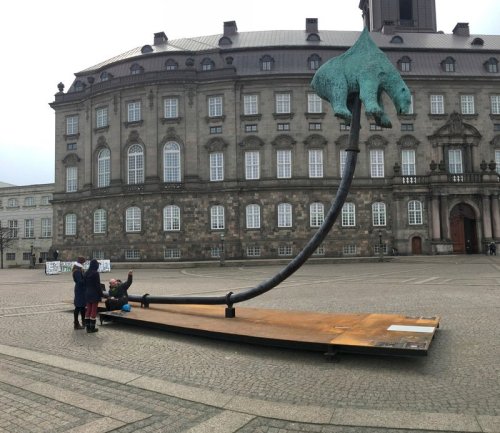
The offensively tasteless “art” produced by Danish sculptor Jens Galschiøt, in collaboration with the World Wildlife Fund, for the specific purpose of influencing politics has reappeared.
‘Unbearable’ is a portable exhibit originally designed for the Paris COP21 climate talks in December 2015 but here it is again in Copenhagen. [h/t Tom Nelson]
It’s simply the Politics of Polar Bears on a global scale that has no basis in science: polar bear numbers have not declined as CO2 has risen. Jens Galschiøt’s tasteless and costly message funded by WWF is not much better than Plane Stupid’s 2009 ad of polar bears falling from the sky (see below). It’s just about as asinine and not supported by science. Continue reading →
Comments Off on More politics of polar bears courtesy WWF: impaled polar bear sculpture
Posted onMarch 24, 2016|Comments Off on Both sides now: New paper critiques Canadian polar bear population status
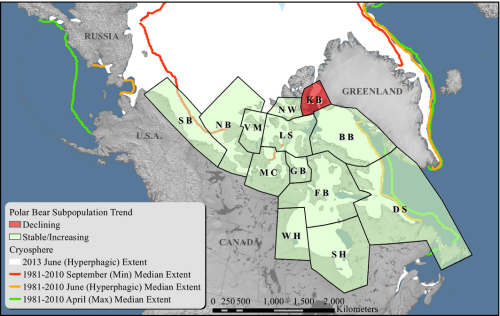
Demographic and traditional knowledge perspectives on the current status of Canadian polar bear subpopulations. 2016 (in press). Jordan York, Martha Dowsley, Adam Cornwell, Miroslaw Kuc and Mitchell Taylor. Ecology and Evolution 6(9):2897-2924. DOI: 10.1002/ece3.2030
Take home quote:
“We see reason for concern, but find no reliable evidence to support the contention that polar bears are currently experiencing a climate crisis. We suggest that the qualitative projections for dramatic reductions in population numbers and range are overly pessimistic given the response of polar bears, climate, and sea ice to the present.”
Posted onFebruary 27, 2016|Comments Off on Biggest threat to polar bears reconsidered
What presents a bigger risk to current polar bear populations: natural hazards that have already proven deadly or potential, yet-to-be-realized threats prophesied to occur due to human activities? That’s a perfect question for International Polar Bear Day.
Dag Vongraven, chair of the IUCN Polar Bear Specialist Group, remarked last year that “until 2001, everything was fine.”
Polar bear researchers thus assume that 2001 was the year climate change became the new over-hunting – but is it true? What are the relative harms presented by proven natural causes, potential human-caused threats, and predicted threats due to sea ice declines blamed on global warming? Considered objectively, is climate change really the single biggest threat to polar bear health and survival right now? Continue reading
Comments Off on Biggest threat to polar bears reconsidered
Posted onFebruary 23, 2016|Comments Off on Cannibalism video shot in 2015 did not involve a starving polar bear
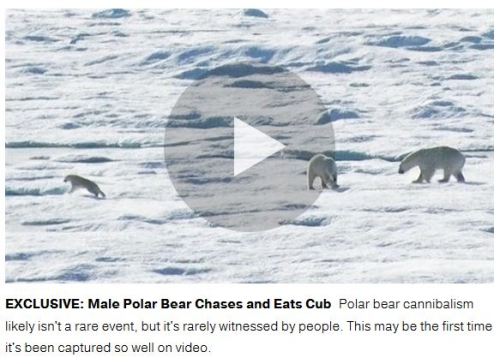
National Geographic has just posted an exclusive video shot mid-summer of 2015 of a male polar bear killing and eating a young cub.
It’s worth watching (23 February 2016; “Polar bear cannialzies cub“) [update: Youtube version posted below]. It was filmed in 2015 in Baffin Bay at mid-summer (during either their July 28-Aug 9 or Aug 7- 19 cruise; pdf of itinerary, dates and prices – oh my god, the prices! here). [Summer is 1 July-30 September]
You’ll soon realize the male bear was not thin or starving (as was true of a much-publicized 2011 event captured on film off Svalbard).
It is also obvious based on the dates listed above that this incident debunks the explanation that cannibalism by adult males is driven primarily by their desire to mate with the mother of the consumed cub: this incident occurred sometime between August 7 and August 19 (as I was informed via email, by a reader on one of those two cruises), which is well past the breeding season for polar bears. A male bear would not still have viable sperm by August and a female could not be forced into estrus. [added 26 February 2016]
National Geographic is already hyping this incident as more evidence of climate change harming polar bears, as the article accompanying the video suggests. However, this is just the typical oversell that accompanies much to do with polar bear these days.
The bear was not “driven to desperation” : he simply took advantage of a rare chance to eat during the summer:
“Without the ability to hunt seals, polar bears may be driven to ever more extreme cannibalism, if they’re not already.”
It’s clear to me that this was an opportunistic kill made at a time of year when few seals are available, as even Stirling admits. It reiterates the point I’ve made many times before, that polar bears on the sea ice in summer have few feeding opportunities.
Incidents of cannibalism cannot be said to be increasing because there is no scientific baseline for which recent occurrences can be compared. Scattered anecdotal reports of any behaviour cannot be touted as evidence for a trend even though they may be of interest and worth recording.
UPDATE 23 February 2016: Video now posted on Youtube, see it copied below:
Comments Off on Cannibalism video shot in 2015 did not involve a starving polar bear
Watch polar bear habitat reform in the Canadian Arctic: “last 10 days” Canadian Ice Service animation (works anytime) HERE.
See Quote archive for details.







 polarbearscience
You must be logged in to post a comment.