Tag Archives: decline

USGS promotes another flawed polar bear model: GHG emissions still “primary threat”

It’s still based on the same flawed ecological premise as all previous models – it assumes that sea ice was a naturally stable habitat until human-caused global warming came along. It also uses slight-of-hand maneuvers to correlate declining summer sea ice and declining polar bear population numbers.

PolarBearCV1_USGS_2009

Just because they keep repeating the same hype doesn’t make it true.
Continue reading

When was the earliest ice breakup year for Western Hudson Bay polar bears?

Was 1990 really the earliest ice breakup year for Western Hudson Bay polar bears – and why aren’t breakup dates derived from the same data identical? Two serious questions that need answering.

Sea ice extent Canada 2015 June 17 CIS

The suggestion a few weeks ago by Andrew Derocher that the unusual breakup pattern of sea ice breakup in Hudson Bay this year might set a new record reminded me how often I’ve questioned the claim that 1990 had the earliest breakup for WHB since 1971.

I call this date into question for two reasons: 1) sea ice maps and charts like those shown below suggest an early breakup in 1990 was not possible, by any definition of the term; 2) none of the research reports on WHB bears, for periods that included 1990, mention that breakup in 1990 was especially early, even though many commented (often at length) about the especially late breakup in 1992.

How much does this very early breakup in 1990 contribute to the apparent declining trend in breakup dates since 1979?1  Is the early breakup date in 1990 real, perhaps a bizarre consequence of analyzing the data square-by-square over a grid? Or, were there errors in 1990 sea ice data that eventually got corrected by sea ice folks but not by polar bear biologists?

UPDATE 17 June 2015 PDF HERE of this post, with higher resolution images, for those who want to explore the questions I’ve posed or share them.
Continue reading

What about the polar bears? Disconnect between predictions and observations

With all the talk this week about future climate – the global warming imagined by IPCC crystal ball models, that is – the focus for many is rightly on the gulf between predictions and observations that have taken place so far. This follows on reminders a few weeks ago of the many failed predictions that we would have seen an “ice-free Arctic” by now.

[by “ice-free” they mean “nearly ice-free,” or “when ice coverage is less than 1 million square kilometers, or about 386,000 square miles.”]

But what about the polar bears? Is there a similar disconnect between predictions and observations for polar bear survival? Yes, indeed.

Many Arctic biologists insist that polar bears are not just threatened by future global warming and a “melting ice cap.” They contend polar bears are already being harmed by declines in summer sea ice coverage, or will be shortly.

The problem is, the results of scientific studies show otherwise. Virtually all of the evidence generated by polar bear researchers shows that polar bears are not being harmed by declines in summer sea ice, and in some cases, they are doing very well indeed. In other words, they are not responding as expected.

A few weeks ago, I summarized these studies, which reveal that:

Less summer ice ≠ few bears (evidence from Davis Strait; S. Hudson Bay; Barents Sea; S. Beaufort; W. Hudson Bay).

Less summer ice ≠ “skinnier” bears (evidence from Chukchi Sea; S. Hudson Bay).

“Skinnier” bears ≠ fewer bears (evidence from S. Hudson Bay; S. Beaufort; Davis Strait).

Less summer ice ≠  lower cub survival (evidence from S. Hudson Bay; Chukchi Sea).

Less summer ice ≠ more cannibalism & hybridization

Have a look if you missed it (August 18, 2013, with pdf copies to download), “Polar bears have not been harmed by sea ice declines in summer – the evidence.”

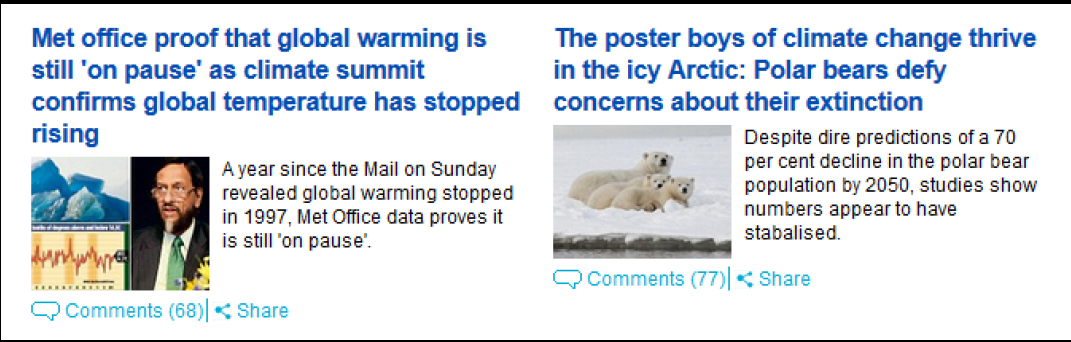
[Update Sunday Sept 29 2013: these two stories (on the temperature pause and polar bears thriving (in which I get a mention), just out in the Mail on Sunday (UK)]
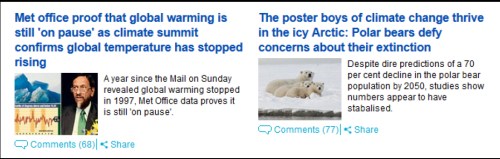

Mail on Sunday_Temp pause and polar bears_Sept 29 2013