Posted onJune 25, 2024|Comments Off on Arctic sea ice at the summer solstice: more polar bear habitat than 2022 after hottest year on record
We are just into the 2024 sea ice melt season in the Arctic with no signs of any big, dramatic changes despite claims that 2023 was the warmest year on record (since 1850). There is still abundant sea ice habitat for polar bears ahead of the summer months (July-September) when Arctic ice melts back considerably.
Polar bears in Western Hudson Bay are still on the ice despite vast open water levels normally signaling “breakup” has happened: the wind-driven ice is packed tight against the western shore and the bears are still on it.
Posted onMarch 25, 2024|Comments Off on 2024 Arctic sea ice maximum a whopping 14th below average following hottest year since 1850
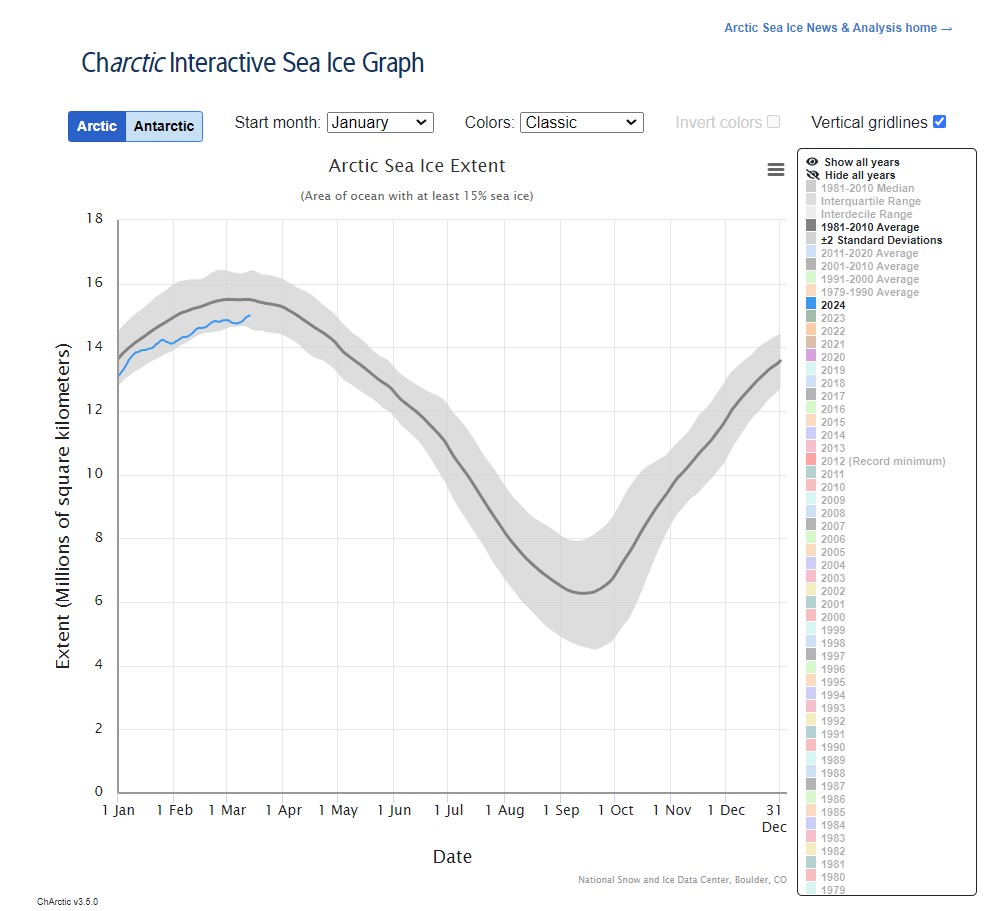
Officially, the maximum winter sea ice extent for 2024 was 15.01 mkm2, reached on 14 March. At an unimpressive “14th lowest” on record, this is astounding news for the winter following the “hottest year on record.” Undeterred, the US government headline writers at the National Snow and Ice Data Center (NSIDC) today went for “Arctic sea ice reaches a below-average maximum.” Note the long-term average (1981-2010) is only 15.65 mkm2 and 15.01 is within 2 standard deviations (see below, screencapped 14 March 2024).
Posted onDecember 9, 2023|Comments Off on Despite hand-wringing about Churchill polar bears this year, 2023 wasn’t their worst summer
For months, the media has been bleating about the poor polar bears of Churchill suffering from lack of sea ice blamed on human-caused climate change during the so-called ‘hottest year’ on record: in April, July, August, November, and December.
From a Churchill Wild report on the condition of WH polar bears, January 2023
However, while breakup of sea ice on Hudson Bay was indeed early this year and freeze-up came later than usual, Western Hudson polar bears apparently spent only the fifth-longest time on land since 1979, according to a polar bear specialist. How is that even possible, given that sea ice conditions should be getting worse and worse as CO2 levels increase and average global temperatures rise? As I’ve pointed out before, it is apparent that Arctic sea ice is not closely coupled to CO2 levels (as the ‘experts’ claim), which makes me wonder if there is any ecologically-relevant correlation between CO2 and sea ice at all.
Money quote from Geoff York, from Polar Bears International: “As of Nov. 28 this year, the bears in western Hudson Bay had spent 164 days on shore, he said. That’s tied for the fifth-longest amount of time the bears have spent off the ice since 1979.” CBC, 9 December 2023 [my bold]
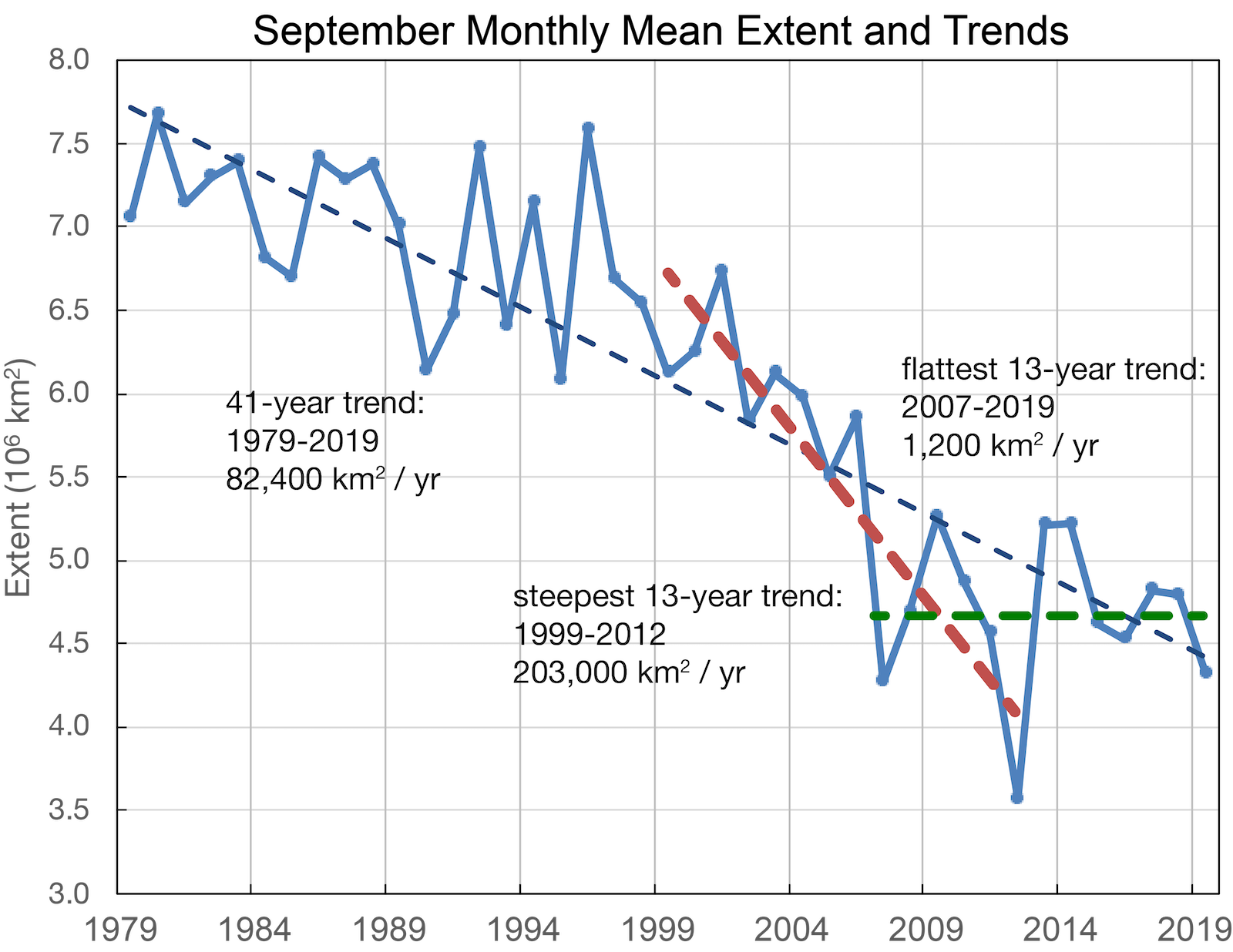
Posted onSeptember 22, 2023|Comments Off on 17 years of near-zero trend in September sea ice demolishes claim that more CO2 means less sea ice
If the hottest year ever can’t precipitate ‘ice-free’ conditions in September, what’s it going to take? Arctic sea ice failed to nose-dive again this year, undoubtedly disappointing expects who have been anticipating a ‘death-spiral’ decline for ages. Arctic sea ice hit its seasonal low sometime around mid-September this year and although the precise value hasn’t been published, the average September ice coverage will likely be about 4.2 mkm2 once it gets announced in early October.
This means we have now had 17 years of a near-zero trend for September sea ice, extending the nearly-flat trend NSIDC sea ice experts acknowledged four years ago. This surely busts a huge hole in the prevailing concept that more atmospheric CO2 causes less summer sea ice. Note that CO2 levels measured in August 2023 were 419.7 parts per million (ppm), compared to 382.2 in August 2007, a rise of 37.5ppm with no corresponding decline in summer sea ice (and vs. 314.2 ppm in 1960). Measured in metric tons, CO2 emissions due to fossil fuels rose from 31.1 billion in 2007 to 37.1 billion in 2021 (last year of data), again with no corresponding decline in summer sea ice.
Watch polar bear habitat reform in the Canadian Arctic: “last 10 days” Canadian Ice Service animation (works anytime) HERE.
See Quote archive for details.







 polarbearscience
You must be logged in to post a comment.