Posted onFebruary 20, 2024|Comments Off on NY Times pushes an implausible story of polar bear evolution and what makes a species
Carl Zimmer over at the New York Times penned a misleading story of speciation, using the polar bear as an example. It explains polar bear evolution based on a genetic interpretation that ignores the fossil record, bear behaviour, and geological history. [h/t Kip Hanson].
In my opinion, this kind of ‘science communication’ is more misleading than enlightening because it fails to alert readers to the fact that the topic is actually more complicated and gives the impression that the author considers readers too stupid to understand a more accurate explanation.
Polar Bear Evolution does a better job for those who are really interested in the process: it doesn’t hide the complicated nature of speciation or polar bear evolution. It doesn’t pretend to present “the truth” but explains how a good scientist gets to a plausible explanation that best fits the evidence.
Posted onNovember 8, 2023|Comments Off on Polar Bear Evolution pre-Christmas book sale: discounts on all formats!
I have reduced prices on all formats of my Polar Bear Evolution book for four weeks starting today (8 November-6 December 2023), in time for holiday gift-giving. The ebook version has the largest price reduction (60% of regular price, to US$17.40) but the other discounts are also substantial. This sale is a time limited offer: don’t miss out! Links below.
The author of Polar Bear Evolution, Susan Crockford, is a good, credentialed scientist. Her writing is clear; her thinking is also. She has a broad understanding of biology and an informed paleo perspective. Crockford condenses a very large literature on polar bear biology and evolution in this book which will help readers understand the science related to the evolution of an Arctic species. Perhaps the most important aspect of this book is its synthesis of information from the fields of wildlife biology, molecular evolution, paleontology, and climate. Her original ideas and hypotheses on thyroid hormone’s role in evolution are very important and add a credible mechanism of phenotypic change which complements the literature on molecular genetic evolution. Polar Bear Evolution is an important contribution to science and its application in evolutionary biology and wildlife biology. Matthew A. Cronin, Ph.D.
Available at the links below (others also available):
Posted onJune 11, 2023|Comments Off on How grizzlies evolved into polar bears: The first book to tell the whole story is now available
Polar Bear Evolution: A Model for How New Species Ariseis the fascinating story of the origin of polar bears. It reveals not just when and where the species came to be, but how it happened and why the bears were able to survive repeated cycles of sea ice change, some of unimaginable severity.
No other book like this exists. Despite decades of serving as an icon for the catastrophic climate change narrative, the polar bear has never had its evolutionary history explained so completely, never mind in a fully-referenced, plain-language style. And I couldn’t have done it without the financial help of my many supporters, so I thank you all again for your assistance in getting this important work completed.
The author of Polar Bear Evolution, Susan Crockford, is a good, credentialed scientist. Her writing is clear; her thinking is also. She has a broad understanding of biology and an informed paleo perspective. Crockford condenses a very large literature on polar bear biology and evolution in this book which will help readers understand the science related to the evolution of an Arctic species. Perhaps the most important aspect of this book is its synthesis of information from the fields of wildlife biology, molecular evolution, paleontology, and climate. Her original ideas and hypotheses on thyroid hormone’s role in evolution are very important and add a credible mechanism of phenotypic change which complements the literature on molecular genetic evolution. Polar Bear Evolution is an important contribution to science and its application in evolutionary biology and wildlife biology. Matthew A. Cronin, Ph.D.
Posted onJune 2, 2023|Comments Off on Grizzlies vs. grizzly X polar bear hybrids by appearance alone: a photo essay
Hybridization with grizzlies comes up repeatedly in genetic studies that aim to zero in on polar bear origins and is one of the issues I explore in detail in my upcoming new book, Polar Bear Evolution: A Model for How New Species Arise. Here is a photo essay to get you thinking about grizzly X polar bear hybrids, because understanding the topic is critical to unravelling the genetic evidence on how polar bears came to be.
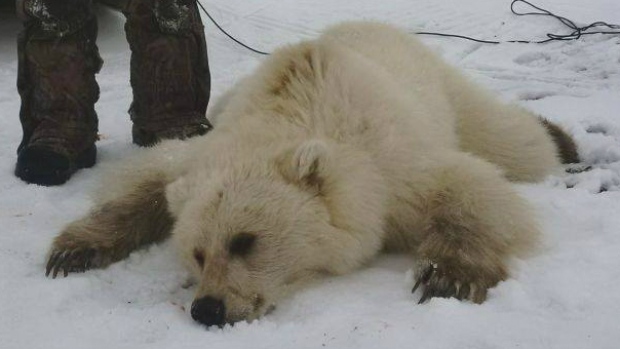
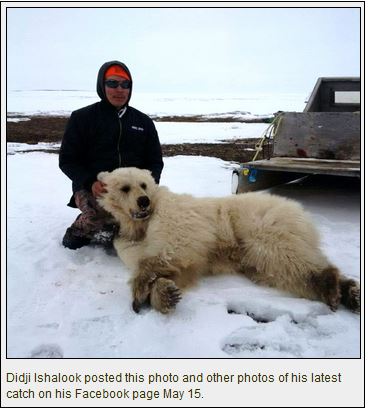
For example, who can forget the hoopla over the bear shot near Arviat on the shore of Western Hudson Bay in 2016 (shown above) that everyone, including polar bear expert Ian Stirling, decided must be a hybrid–but it turned out to be a blonde grizzly.
Explaining all the ins and outs of why hybrids are important to polar bear evolution is an important part of my book.
Posted onMay 30, 2023|Comments Off on The story of polar bear evolution could not be told without discussing climate change
Polar bears arose as a new species because the climate changed and forced some brown bears to colonize the sea ice. Polar bears epitomize the story of how evolution works but perhaps not quite how you imagined it.
Moving from extremes in warmth to extremes in cold characterized the last million years of geological history, as the graph above shows, where odd-numbered Marine Isotope Stages (MIS) are warm interglacials and even-numbered stages along the bottom are cold glacials. MIS 2 was the Last Glacial Maximum.
But where and when during this period of change did polar bears come to be–and how, exactly, did it happen? My new book tells the whole story, which has never been done before. Not long to wait now, the release date is only about a week away (1st week June).
Posted onAugust 21, 2022|Comments Off on Grizzly on the shore of W. Hudson Bay and two tagged polar bears still on sea ice at 17 August
A tundra grizzly was again caught on the live cam set up for polar bears last week (15 August) but was too late for interspecies hankypanky, even as some polar bears lingered on invisible offshore sea ice.
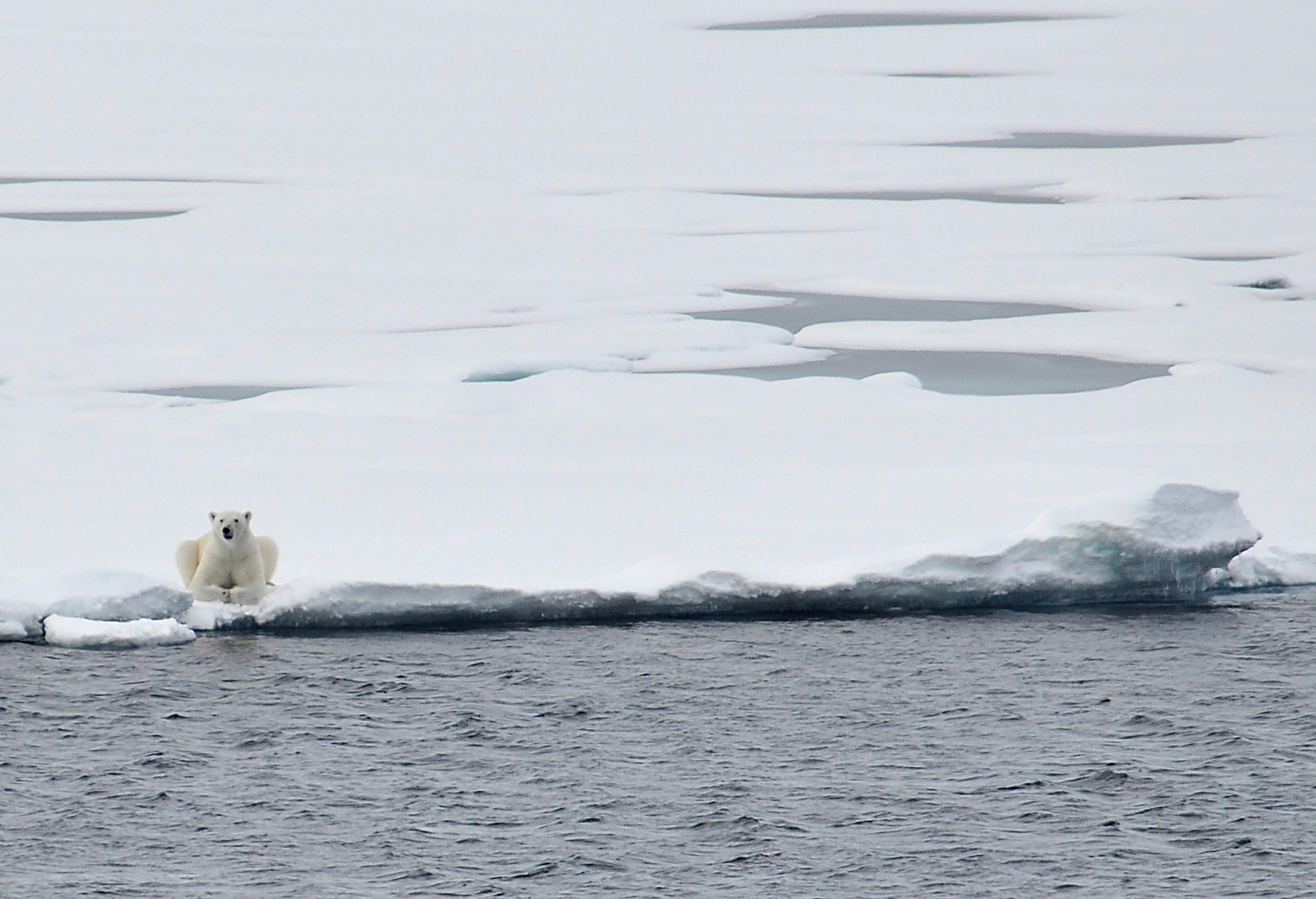
A polar bear rests on the ice Aug. 23, 2009, after following the Coast Guard Cutter Healy for nearly an hour in the Beaufort Sea.
Polar bear specialist Andrew Derocher reported that two of his 23 tagged polar bears were still on the sea ice, a phenomenon that’s been happening since at least 2015 at breakup. Instead of heading to shore when the sea ice concentration dwindles below 50% coverage, some bears are choosing to lounge around on decaying bits of ice, sometimes into late July or well into August, until they must finally swim ashore. There is no evidence that the bears continue to successfully hunt seals under these conditions but no evidence either that their choice to stay on the ice rather than move to land at this time of year has had any negative impact on their health or survival.
Posted onApril 20, 2017|Comments Off on New genetics paper is not about whether climate change causes polar bear hybrids
A new paper on the evolutionary history of bears (Bears breed across species borders: Kumar et al. 2017) has concluded that hybridization is common and natural among all species of ursids. And while some media outlets (e.g. DailyMail) have framed this as surprisingly convincing proof that experts were wrong to claim that climate change is the cause of recent polar bear X grizzly hybrids, definitive evidence against that interpretation has been available for years to anyone who bothered to look: see my recent “Five facts that challenge hybridization nonsense.”
This genetic evidence is just a cherry on top of the rest but will help get the paper the media attention the authors crave.
A polar bear X grizzly hybrid, see Kumar et al. 2017. Photo by A. Derocher.
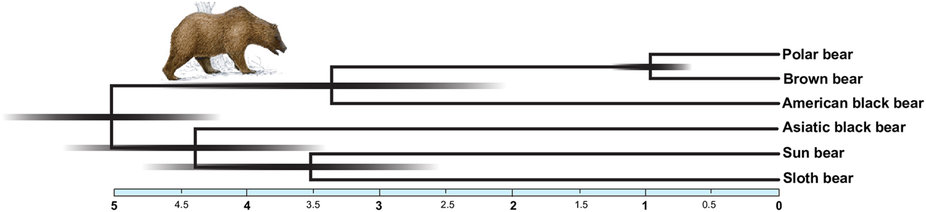
In my opinion, the most important conclusion of this paper is that occasional but widespread hybridization among bears is why it has been so hard to say with confidence when polar bears arose (which I addressed years ago, in my Polar bear evolution series: Part 1, Part 2, and Part 3). You cannot use traditional methods of pinpointing the timing of speciation events from genetic data if one or more of the species have hybridized (traded genes). See the long, fuzzy “divergence times” for bears in the image below from the Kumar paper.
From Kumar et al. 2017, Fig. 5: “The scale bar shows divergence times in million years and 95% confidence intervals for divergence times [speciation events] are shown as shadings.”
Additional details confirm the animal shot was a female, which could account for the fact it was described as “small”. The Nunavut biologist who sent in the sample for testing warned it could also be a blonde grizzly, as I pointed out last week.
UPDATE 24 May 2016: Comments added below from a Toronto Star news report below on the hybrid identity of this animal.
This year, polar bears are virtually the only species that NOAA mentions in their Arctic Report Card – they’ve put all their icon-eggs in one leaky basket [what happened to walrus??]. But polar bears are doing so well that to make an alarming case for polar bears as victims of Arctic warming, many important caveats had to be left out or misrepresented. Some details given are simply wrong.
This year’s polar bear chapter was penned by IUCN Polar Bear Specialist Group chairman Dag Vongraven (you might recall his email to me earlier this year) and a polar bear conservation activist from Polar Bears International (whose battle cry for donations is “Save Our Sea Ice!”), Geoff York.
I challenge their four weak talking points one by one below.
Posted onMay 8, 2014|Comments Off on Ancestor of the polar bear by any name: grizzly vs. brown bear monikers explained
Apparently, all media outlets (exceptFox News) so confused the distinction between the two common names used for the ancestor of polar bears, Ursus arctos, that they got the point of a recent news story totally wrong. An Alaskan journalist explains.
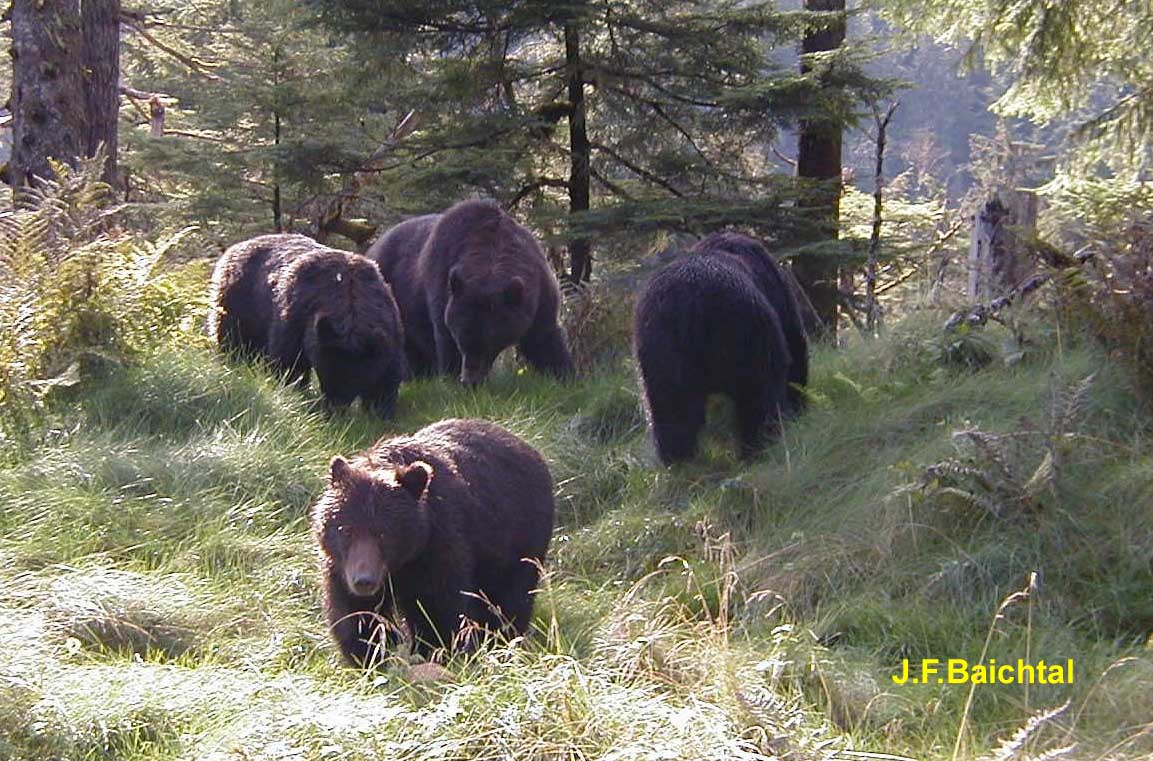
Coastal brown bears from Admiralty Island, southeast Alaska (courtesy Jim Baichtal, US Forest Service, Alaska). See previous post here.
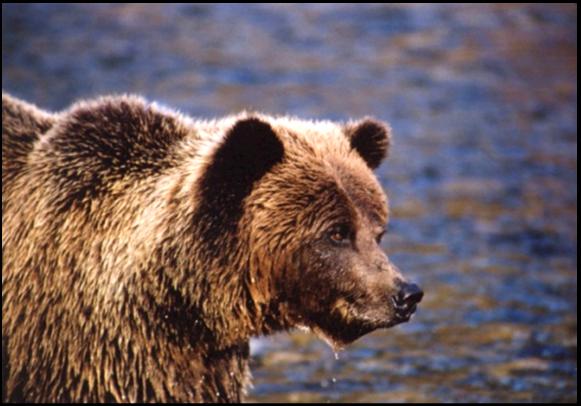
Tundra grizzly bear from the Yukon (courtesy Government of Yukon Territory). These bears also occur across the north slope of Alaska and are the bears that occasionally hybridize with polar bears this time of year, as explained here.
Watch polar bear habitat reform in the Canadian Arctic: “last 10 days” Canadian Ice Service animation (works anytime) HERE.
See Quote archive for details.










 polarbearscience
You must be logged in to post a comment.