Tag Archives: IUCN

Bearded and ringed seals join the polar bear as “threatened” by a computer-modeled future

As I pointed out in Featured Quote #22 (posted on Dec. 23, 2012), bearded and ringed seals have recently joined the polar bear on the American ESA’s list of animals that are “threatened” by computer-modeled predictions of Arctic sea ice declines projected 50-100 years into the future (USFWS 2008, 2012a, 2012b).

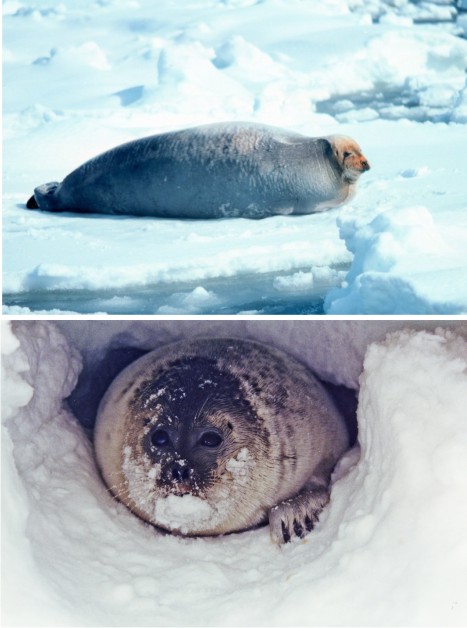
NOAA photos of bearded seal (top) and ringed seal (bottom)

NOAA photos of bearded seal (top) and ringed seal (bottom). The bearded seal is one of the largest Arctic ice seal while the ringed seal is the smallest. Both are eaten by polar bears, although ringed seals are consumed most often.

The decision by NOAA (National Oceanographic and Atmospheric Administration) affects the Arctic subspecies of ringed seal (Phoca hispida hispida) as well as the Okhotsk subspecies (Phoca hispida ochotensis) (in addition to several others) and thus includes all ringed seals off Alaska’s coast in the Beaufort, Chukchi and Bering Seas. The decision also affects two particular subpopulations of bearded seal (Erignatha barbatus): the “Beringia” [Bering Sea/Chukchi] subpopulation (about half of which reside in Alaskan waters), and the subpopulation that lives in the Sea of Okhotsk. (Alaska Fisheries (NOAA) Final Decision). Continue reading

Did the PBSG game the polar bear listing process?

I was in the process of writing about something else last week when I came across a tidbit of information that, on closer examination, turned out to be part of a much bigger issue that I thought should be documented.

The story involves some machinations behind the scenes of the international Polar Bear Specialist Group, the “PBSG,” that you might find rather astonishing – and which may have implications for the various on-going battles about the polar bear’s conservation status.

A lone polar bear walking on ice [Kathy Crane (NOAA) photo].  We'll call this a metaphor for the expulsion of Mitch Taylor from the PBSG after the Group switched from emphasizing unregulated over-hunting as the primary threat to polar bear conservation to global warming.

A lone polar bear walking on ice [Kathy Crane (NOAA) photo].
We’ll call this a metaphor for the expulsion of Mitch Taylor from the PBSG,
after the Group switched from emphasizing unregulated over-hunting
as the primary threat to polar bears to global warming.

Continue reading

‘Species-threatening’ population declines vs. polar bear declines

In 2008, polar bears in the United States were declared ‘threatened’ under the Endangered Species Act (USFWS 2008). The IUCN (to which the Polar Bear Specialist Group (PBSG) belongs) lists the polar bear as “vulnerable” (IUCN Red List 2012). In Canada (where 60% of the world’s polar bears reside), the polar bear is listed as a ‘species of special concern’ (COSEWIC 2008:iii).

As Jonathan Adler pointed out in an excellent article that appeared on the heels of the American ESA listing decision (Adler 2008:112), “Insofar as the listing is based upon climate models, ice-melt projections, and assumptions about the effects of habitat loss on the bear’s prospects for survival in the wild, its scientific basis is quite speculative.” These are also, as I understand it, unprecedented criteria for ESA listing – no other species has been listed as endangered or threatened based on such speculation of future conditions.

So what do actual polar bear population declines look like?

The Western Hudson Bay, Canada (WHB) subpopulation is the only one that has recently declined by a statistically-significant amount. [see previous post here on the status numbers] The WHB polar bear subpopulation makes up 3-5% of the global total for the species, currently estimated at 20,000-25,000 animals.

In this post, I’ll compare the documented WHB population decline to the declines seen in a few truly endangered animals, just to put the much-bandied about numbers into some perspective. Continue reading

Population size estimates for grizzly bears in British Columbia, Canada

This is a follow-up to my last post, which summarized IUCN/SSC Polar Bear Specialist Group (PBSG) polar bear population estimates and status reports, here.

I was interested to see how the PBSG population estimates compared to similar studies in other animals, so I took a look at the official 2012 population estimate for grizzly bears in British Columbia, Canada here. A couple of brief excerpts are provided below.

British Columbia is the western-most province of Canada (Fig. 1). It is roughly half the size of Greenland, while sea ice habitat of polar bears is roughly 6-7x the area of Greenland.

Just nine pages long, this grizzly bear population report is short, clear and unambiguous. While it may perhaps not explain its methods in enough detail for some folks (and it is, admittedly, a small portion of global grizzly bear territory), the report is nevertheless clear about the variations in quality of population estimates over time (which began in the 1970s and so are similar to what we have for polar bears). The report is also clear about how these historical estimates impact the current population status and trend. See Fig. 2 and 3 below for short excerpts.

Continue reading

PBSG polar bear population assessment made simple

[Update: Feb. 10 2013. I have corrected an oversight in the summary tables – the originals neglected to indicate that the Barents Sea subpopulation is shared between Norway and Russia (not controlled by Norway alone). Here is revised Table 1 and revised Table 2. ]

[Update 2: Sept. 26, 2013. See Global population of polar bears has increased by 2,650-5,700 since 2001″ for further insight. I have also made slight corrections to the tables below, now marked Version 3.]

A couple of weeks ago, a news report appeared highlighting an interview with Russian biologist Nikita Ovsyannikov, deputy director of Russia’s polar bear reserve on Wrangel Island in the Chukchi Sea. This is what the news report said:

He [Ovsyannikov] guessed the number of bears around the Chukchi Sea, which also sometimes migrate in small numbers to western Alaska, had dropped over the past three decades from “about 4,000 to no more than 1,700 at best.

See Kelsey’s comments over at Polar Bear Alley and the comment I left there, here and my related previous post here

This media focus on Chukchi Sea polar bear numbers caught my attention because I had recently spent some time going through the 15 Polar Bear Specialist Group (PBSG) meeting reports in an effort to summarize the population estimates they provided. This international group first met in Fairbanks, Alaska in 1965 to advance and coordinate polar bear research and conservation under the auspices of the International Union for Conservation of Nature (IUCN) and the Species Survival Commission (SSC). I knew that according to the PBSG, the population of the Chukchi Sea is zero – that is, no Chukchi bears are included in the official total of 20,000-25,000 bears because no reliable survey had ever been done. Ovsyannikov’s statement to the press encouraged me to finish my summary of the population estimates in the PBSG meeting report tables.

This was not an easy task, in part due to the virtually constant changes in presentation style and format in the tables used to present the data (which appeared first in the 1981 report). For example, even between the 14th (2005) and 15th (2009) meeting reports, the population data table presents the subpopulations in different order and swaps the position of two critical columns (“status” and “observed or predicted trend”), making it extremely difficult for readers to do a quick comparison between years.

So I simplified the 2009 table (the most recent available), leaving out the future predictions as irrelevant to questions about current status. I included some population estimates and status assessments from previous reports to show the changes over time (where available). The full summary table, designated Table 1,  is provided here as a pdf. [update 2013 – this is Version 3]. However, in this format, it still spans two pages, so I composed another  table that contains the 2009 status information only (2009 is the most recent available), see Table 2, version 3 below. Viewing the data this way may surprise you.

continue reading