Tag Archives: Polar Bears International

Churchill polar bear attack shamelessly used to advance global warming agenda

I guess Suzanne Goldenberg, writing for The Guardian, just couldn’t help herself with this latest story (November 4):Polar bear attacks: scientists warn of fresh dangers in warming Arctic. Two people injured in latest attack as hungry bears deprived of access to sea ice increasingly look for food on land.

Reporting on the attack is one thing — several papers covered this over the weekend (see Featured Quote #46, posted yesterday, for links to two of them). However, Goldenberg shamelessly makes this about global warming, aided and abetted by Polar Bears International (PBI) representative Steven Amstrup, a claim that doesn’t hold up to even minor scrutiny.

Continue reading

How and why great news about Chukchi polar bears has been suppressed

A new peer-reviewed report (Rode et al. 2014 [in print] 2013, accepted), released last month (announced here), documents the fact that polar bears in the Chukchi Sea are doing better than virtually any other population studied, despite significant losses in summer sea ice over the last two decades – even though the Polar Bear Specialist Group (PBSG) said this population was declining (Obbard et al. 2010).
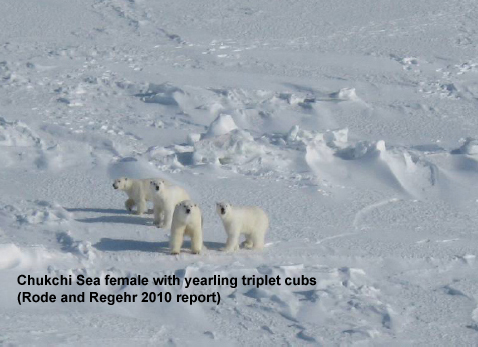
Rode and Regehr 2010_Chukchi_report2010_Fig1_triplets_labelled

Rather than this good news being shouted far and wide, what we’ve seen so far is a mere whisper. The strategy for suppressing the information appears to have several parts: make it hard to find; don’t actively publicize it; down-play the spectacularly good nature of the news; minimize how wrong they were; keep the focus on the future.

Something similar happened with the newly-published paper on Davis Strait bears (Peacock et al. 2013, discussed here and here) but the news there wasn’t quite so shockingly different from expected. The suppression of good news stands in marked contrast to anything with a hint of bad news, which gets reported around the world — for example, Andrew Derocher and colleagues and their prepare now to save polar bears” policy paper in February, 2013.

US Fish & Wildlife biologist Eric Regehr, co-investigator of the Chukchi study and co-author of the newly-published report, wrote an announcement about the paper. It wasn’t a real press release, since it was not actually sent to media outlets. It was a statement, with a brief summary of the paper, posted on a regional US Fish & Wildlife website, with no mention of lead author Karyn Rode. Not surprisingly, lack of active promotion = no media coverage.

The posted announcement also down-played how well the Chukchi bears are doing. In fact, the news documented in the paper is much better than any of them let on: Chukchi polar bears are doing better than virtually all other populations studied.

But Regehr also had to do some damage control to counter the evidence this paper contains of how wrong they had all been — not only about the Chukchi population today but about their predictions for polar bears in the future.

After all, the computer models used to predict a dire future for polar bears combined the Chukchi Sea with the Southern Beaufort, as having similar ice habitats (“ice ecoregions”). The published paper and Regehr’s statement now say these two regions are very different and that polar bear response to loss of sea ice is “complex” rather than a simple matter of less summer ice = harm to polar bears. Regehr goes on to say that polar bear scientists expected this would happen. I call total BS on this one, which I explain in full later (with a map).

Finally, Regehr’s statement emphasizes that good news for 1 subpopulation out of 19 today should not be celebrated because the overall future for polar bears — prophesied by computerized crystal balls — is bleak. Focus on the future, they say. Did they forget that for years they’ve been telling us that polar bears are already being harmed and that this foreshadows what’s to come? Now we have the results of yet another peer-reviewed study showing bears not being harmed by declines in summer ice (see the full list here).

So, in the end, all of this double-talk and contradiction is not just about suppressing this particular paper. There’s much more at stake.

The Rode et al. Chukchi paper is strong evidence that their predictions of a grim future for polar bears – based on theoretical responses to summer sea ice declines that should already be apparent – have been refuted by their own studies. It’s no wonder they want to keep the media away from this story.

Details below.  [Update September 11, 2013: another news outlet picks up the story, see Point 2 below]

Continue reading

Polar bears have not been harmed by sea ice declines in summer – the evidence

PB  logo colouredThe polar bear biologists and professional activists of the IUCN Polar Bear Specialist Group (PBSG) continue to insist that since 1979 increasingly smaller amounts of Arctic sea ice left at the end of summer (the September ice minimum) have already caused harm to polar bears. They contend that global warming due to CO2 from fossil fuels (“climate warming” in their lexicon) is the cause of this decline in summer ice.

In a recent (2012) paper published in the journal Global Change Biology (“Effects of climate warming on polar bears: a review of the evidence”), long-time Canadian PBSG  members Ian Stirling and Andrew Derocher (both of University of Alberta) summarized their position this way:

“Climate warming is causing unidirectional changes to annual patterns of sea ice distribution, structure, and freeze-up. We summarize evidence that documents how loss of sea ice, the primary habitat of polar bears (Ursus maritimus), negatively affects their long-term survival”

I’ve spent the last year examining their evidence of on-going harm, but in addition, I’ve looked at the evidence (much of it not mentioned in the Stirling and Derocher paper1) that polar bears have either not been harmed by less sea ice in summer or have thrived in spite of it.

This is a summary of my findings. I’ve provided links to my original essays on individual topics, which are fully referenced and illustrated. You are encouraged to consult them for complete details. This synopsis (pdf with links preserved, updated; pdf with links as footnotes, updated) complements and updates a previous summary, “Ten good reasons not to worry about polar bears” (pdf with links preserved; pdf with a foreword by Dr. Matt Ridley, with links as footnotes).

Update 8 September 2013: to include links to my post on the recently published Chukchi population report; updated pdfs have been added above.

Update 22 January 2014: added figure comparing March vs. September sea ice extent using the same scale, from NOAA’s “2014 Arctic Report Card,” discussed here.
Continue reading

Ian Stirling’s latest howler: “the polar bear who died of climate change”

Will wildlife biologist and Polar Bear Specialist Group member Ian Stirling now say anything – no matter how unscientific – to garner more sympathy and media attention for polar bears? It appears so.  [see followup post published Aug. 11, here]

A tabloid-style picture-is-worth-a-thousand-words article appeared in the environment section of the UK newspaper The Guardian yesterday (August 6, 2013) with a picture of a dead polar bear meant to wring your heart. The picture is a vehicle for statements from Ian Stirling and others that this polar bear died from climate change. A longer article was alongside.

The caption below the photo of a dead polar bear (animal tragedy porn) is this:

This 16-year-old male polar bear died of starvation resulting from the lack of ice on which to hunt seals, according to Dr Ian Stirling.”

Many folks have been asking questions about this and so have I.

I suggest this is what really happened: the polar bear biologists working in Svalbard earlier this year knew this bear was going to die back in April when they captured him – they simply waited, with a photographer on hand, until he died. It was an orchestrated photo-op.

[Update, Aug. 8, 2013: I suggest it was not necessary for anything more to happen to “orchestrate” this photo than for the researchers who captured the bear in April to tell colleagues and local tour boat operators (who always have avid photographers on board) to “keep an eye out for a dead bear, we don’t think this guy is going to make it.” However, very little real information is provided. Who knows when (or from whom) we’ll get the whole story — if ever? That’s why anecdotal accounts like these aren’t “evidence” of anything, in the scientific sense. That’s the real take-home message here.  If this dead bear was being presented as scientific evidence, we’d have been given all the details, including necropsy results, local ice conditions, precise dates, locations, and photos of any other bears that were seen that were in poor condition. In other words, a proper scientific report. ]

Continue reading

Polar Bear Specialist Group adds WWF and PBI activists as full voting members

In a previous post I noted:

In 2009, for the first time, the polar bear biologists that make up the IUCN’s Polar Bear Specialist Group (PBSG) invited four professional advocates – not one or two, but four – to their exclusive, once-every-four-years meeting of top polar bear biologists (called “delegates”) from the world’s Arctic nations (Canada, Russia, USA, Greenland/Denmark and Norway) – two from World Wildlife Fund (WWF) and two from Polar Bears International (PBI).

In that post, I mentioned that there was an “exclusive members-only meeting” scheduled for October 24-27, 2013.

Well, I just came across a notice on the PBSG website that tells us what went on at that meeting.

The Polar Specialist Group (PBSG) voted unanimously to embrace World Wildlife Fund activist Geoff York and Polar Bears International activist Steve Amstrup as delegates with full voting rights until 2016. This is a first: never before have employees of activist organizations been made full member-delegates of this formerly exclusive organization.

With this move, the PBSG are telling the world that they are an advocate association first and a scientific organization second.

Continue reading

Cannibalism in polar bears: spin and misrepresentation of fact galore

In my next to last post, I discussed some of the anecdotal reports of den collapses included in the peer-reviewed summary of facts presented by biologists Ian Stirling and Andrew Derocher (2012) that supposedly support the premise that global warming is already having an impact on polar bear populations (discussed previously here, here, and here), prophesied to be even greater in the future. While they admit that such reports are not based on scientific studies, they nevertheless include them in their published list of global warming impacts, and not surprisingly, that is how others have interpreted them.

The same is true for their treatment of the phenomenon of cannibalism in polar bears. In that same paper, Stirling and Derocher (2012:2701) have a section called “Anecdotal observations consistent with predictions of the effects of climate warming.” This section begins with a discussion of cannibalism:

“There have been several well-publicized observations that are consistent with predictions of the effects of climate warming on polar bears, but cannot be statistically linked. For example, intraspecific aggression and cannibalism were predicted to increase in polar bears with climate warming (Derocher et al. 2004, Table 1). Observations of infanticide and cannibalism by thin adult males on land during the open water period have been documented (e.g., Lunn & Stenhouse, 1985; Derocher & Wiig, 1999; Amstrup et al., 2006; Stone & Derocher 2007). Such events have been known to occur for many years and, although their significance is unclear, there is some evidence suggesting the frequency of occurrence is increasing in areas where bears fast on land for extended periods. ” [my bold]

And this is the evidence for the supposed increase in occurrence:

“For example, in late summer and autumn 2010 [sic], there were eight observations of cannibalism on the western coast of Hudson Bay compared to one or two in the previous 5 years (I. Stirling, unpublished data).” [my bold; 2010 should be 2009 – more on this later.]

Were these observations of cannibalism made by polar bear researchers or someone else? Were there as many observers in the area in each of the five years prior to the year they occurred, as there were when these incidents were observed? We don’t know, because it’s unpublished data.

Stirling and Derocher have again included critical information in their list of facts that has not been published. I guess I’ll have to add “evidence for cannibalism” to my previous list of “Critical evidence on polar bears in W. Hudson Bay is unpublished” (see also “Stirling and Derocher’s sea ice trick) [there is more information available, but it’s not from peer-reviewed sources – more on this below]

In this post, I take a look at some of the evidence that is published, some of the media interviews and reports that followed, and the information that came from a press release issued by an advocate group. I’ve made a table summarizing the details of all recent papers and reported incidents, and some of them are described in more detail. In a footnote, I have a brief summary of why polar bears kill and eat each other.

These details reveal some rather shocking evidence of scientists misrepresenting evidence – in their peer-reviewed papers and in interviews with the media – and bathing their global warming prophesies in the blood-lust of cannibalism. It’s past time to shine a big bright light on the cannibal issue, so pardon the length of this post.

[See followup post April 19 here]

Continue reading

PBSG invited WWF and PBI advocates to its last polar bear experts meeting

In 2009, for the first time, the polar bear biologists that make up the IUCN’s Polar Bear Specialist Group (PBSG) invited four professional advocates – not one or two, but four – to their exclusive, once-every-four-years meeting of top polar bear biologists (called “delegates”) from the world’s Arctic nations (Canada, Russia, USA, Greenland/Denmark and Norway) – two from World Wildlife Fund (WWF) and two from Polar Bears International (PBI).

[Recall that 2009 was also the year that PBSG Chairman Andrew Derocher stripped veteran Canadian polar bear biologist and long-time PBSG member Mitch Taylor of his delegate attendee status because he did not have the appropriate attitude to global warming (see previous post here). Update – just to be clear, Mitch had retired from his government polar bear research job (a valid reason for not being included as a delegate) but with more than 30 years experience and his vast publication record on polar bears – as well as his long association with the PBSG as a delegate – he certainly should have qualified as an “invited specialist” at the 2009 meeting]

I expect Canadian journalist and author Donna LaFramboise would call this inclusion of WWF and PBI advocates in an otherwise exclusive meeting of polar bear biologists a behind-the-scenes lobbying opportunity,” similar to the inclusion of WWF personnel in the IPCC review process (see original article here and email interview here and “WWF infiltrates UK gov’t” here).

WWF and PBI are organizations devoted to changing public policy to suit their idea of how the world should be – whether others agree or not. They are passionate lobbyists with money behind them and they use their influence to pressure politicians – and now, supposedly impartial scientific organizations – to make decisions that fit their agenda.

Continue reading


