Tag Archives: threatened

Canada again under international pressure to list polar bears as threatened

There was a story in The Guardian on Friday (November 21) about an issue I covered earlier this year (in January): Canada under international pressure to list polar bears as threatened, so far holds out.

This time, Suzanne Goldenberg’s headline proclaims “Canada’s refusal to protect polar bears comes under scrutiny.

The story is all about a petition filed by the ever-litigious Center for Biological Diversity (CBD) to the North American free trade organization, the Commission for Environmental Co-operation (CEC), pdf here. The CEC, it seems, has now agreed to investigate the CBD claims.

At issue here is the fact that Canada hasn’t done exactly what the US has done in terms of enacting formal legislation to protect polar bears. Canada, home to 2/3’s of the worlds polar bears (as well as a relatively large Arctic human population) vs. the USA, with the fewest bears in the world but perhaps the loudest, “we know best” attitude. Canada has not declared polar bears to be a species threatened with extinction but the Center for Biological Diversity not only thinks otherwise but thinks someone should force Canada to change its opinion.

It’s more of the same bullying of governments by environmental groups that we’ve come to expect, aided and abetted by activist polar bear biologists.

That said, I suggest you brace yourselves: it’s only going to get worse. We can expect even more of this over the next few weeks, because an important international polar bear meeting is coming up in early December. I expect that the propaganda, aided by an all-too-willing-media, is going to get intense.  Continue reading

Eemian excuses: the warm was different then, polar bears were fine

Today I’ll discuss the response by Polar Bears International representative Steven Amstrup to a comment submitted during their recent “webchat” at The Guardian (Wednesday, November 6), which had to do with the fact that polar bears survived warm periods in the geological past, particularly interglacials.

[Here’s a pdf file of all the questions that were answered by PBI staff: PBI webchat Q&A, also available here]

This is the comment (the first portion of #4 on my list), submitted by MarkBLR:

There was a paper in Science magazine last year (link …) indicating that polar bears became a distinct species about 600kya (+/- 300k years).

This means that they have survived at least two (and possibly eight) previous inter-glacials, in particular the Eemian (130kya to 110kya), when temperatures in the Arctic were 5 to 8 degrees Celcius warmer than current temperatures for several thousand years.

Note that their numbers apparently decreased significantly during the Eemian, and slowly increased as temperatures cooled, but “climate change” was not enough on its own to make them extinct. [my bold]

[We can perhaps forgive Mark for not being able to spell “Celsius” correctly, but Amstrup (see below) has no excuse. The paper in Science Mark refers to is Hailer et al. 2012, discussed in a previous post here. Note that the actual question Mark asked is not included here because Amstrup responded to this portion of his comment only]

Amstrup tries to convince Mark and other readers that polar bear resilience through Eemian warming is irrelevant to the issue of future survival, which I’ll demonstrate is not the case at all.

Here is what Amstrup had to say:
Continue reading

The two faces of polar bear biologists – Zac Unger interviews Amstrup and Stirling

Former firefighter Zac Unger has been in the news quite a lot over the last few months, promoting his new book, “Never Look a Polar Bear in the Eye” (see Zac’s website here, where you’ll find a list of some of the articles he’s written; the Canadian Geographic one is very good (“The truth about polar bears”) and was the one that originally caught my attention in early December 2012. One article that I’ve read is missing from that list, “Are Polar Bears Really Disappearing?” (Wall Street Journal, Feb. 8, 2013). There is a book review in the Winnipeg Free Press here (Feb. 2, 2013) and on climate scientist Judith Curry’s blog (Dec. 21, 2012), and an interview with Globe and Mail columnist Margaret Wente here from Feb. 23, 2013).

I’ve mentioned bits from some of these articles previously: Featured Quote #32 (Feb. 23, 2013) and in my Dec. 16, 2012 post, ‘Species-threatening’ population declines vs. polar bear declines.

In my last post, I promised a follow-up discussion on cannibalism in polar bears, as it has been promoted by polar bear biologists. I recalled a discussion of this by Unger, which I think makes a nice lead-in for my own essay, which I should have up in a few days.

Here is the money quote from Unger (with a link to the NBC interview with Amstrup and Stirling he is talking about). A lengthy excerpt from the article is below, for the context – it’s well worth a read:

[In 2008, after watching polar bear biologist Dr. Steve Amstrup give an interview on NBC News explaining “the evidence behind the decision to list the polar bear as threatened. Evidence like cannibalism.”] “Wait a second. Hadn’t Amstrup just finished telling me that the cannibalism thing was getting too much play by a bloodthirsty media?” Zac Unger, PS Magazine, Dec. 17, 2012 [2:40 min. NBC News video here]

Continue reading

Collapse of polar bear snow dens – Stirling and Derocher’s anecdotal evidence

In their summary of facts supposedly supporting the premise that global warming is already having an impact on polar bear populations (discussed previously here, here, and here), biologists Ian Stirling and Andrew Derocher (2012:2700) include a list of incidents of warm winter weather and/or “rain on snow events” that have led to the collapse of polar bear maternity dens and ringed seal birthing lairs.

Stirling and Derocher state that both polar bears and ringed seals (their primary prey) have a demonstrated

high vulnerability …to increased mortatily resulting from warm temperatures and rain. Such rain on snow events are predicted to increase as the climate warms in the Arctic (Hansen et al. 2011).”[my bold]

However, their so-called evidence for polar bears and ringed seals having a proven vulnerability to these events comes not from scientific studies but what they admit outright are anecdotal reports.

They describe four incidents, including one case of a maternity den collapse (involving a 6 yr old, probably first-time mother and two, 3-4 week old cubs) in the southern Beaufort in 1989, apparently caused by a bit of warm weather followed by heavy snow in late January (a picture of the dead bear is included, see below, just so we don’t forget that a bear died).

Continue reading

Ten good reasons not to worry about polar bears

IMPORTANT UPDATE March 13, 2013 Benny Peiser over at the Global Warming Policy Foundation has just posted an essay by well-known author Matt Ridley, entitled “We should be listening to Susan Crockford” which is included as a foreword to a pdf of this very post (“Ten good reasons not to worry about polar bears”), suitable for sharing. I encourage you to have a look.

[Update September 28, 2013: See also this follow-up post “Polar bears have not been harmed by sea ice declines in summer — the evidence.”]

Polar Bear-Cubs-Canada_Wallpaper

PB  logo colouredThis year marks the 40th anniversary of the signing of an international agreement to protect polar bears from commercial and unregulated sport hunting. The devastating decades of uncontrolled slaughter across the Arctic, including the Bering Sea, finally came to an end. And so in honor of International Polar Bear Day (Wed. February 27) – and because some activists are calling 2013 The Year of the Polar Bear – I’ve made a summary of reasons not to worry about polar bears, with links to supporting data. I hope you find it a useful resource for tuning out the cries of doom and gloom about the future of polar bears and celebrating their current success.

Continue reading

Andrew Derocher refuses to accept that polar bears have been saved

Andrew Derocher, an known polar bear advocate, has been making headlines again, this time promoting a new “policy paper” he is lead author on that has just been accepted for publication. He and his colleagues simply refuse to accept that the polar bear has been saved (population numbers have rebounded dramatically since protective legislation was introduced in 1973) and it seems all they can think of to do now is press for ever more restrictive regulations.

The timing of the release of this paper is very convenient: Fish and Wildlife biologists and polar bear activists worldwide are actively campaigning to get CITES, at their meeting next month, to make it illegal to trade in legally harvested polar bear parts (see previous post here). Canada is also under international pressure to up-list the status of the polar bear to “threatened,” see post here.

The article itself is behind a paywall (abstract and co-author list below), so it is unlikely that many people outside the choir of conservation advocate subscribers of the journal will ever read it, so Derocher is talking it up big time, with the help of his university PR department. Timely indeed. [h/t WUWT]

Update Feb 12, 2013 – I now have a copy of the Derocher et al in press paper. If anyone would like to see it, please send me a note via the “Commments-Tips” page above

Update October 20, 2013 – the Derocher et al. paper is now in print and I’ve updated the citation information below

Continue reading

Bearded and ringed seals join the polar bear as “threatened” by a computer-modeled future

As I pointed out in Featured Quote #22 (posted on Dec. 23, 2012), bearded and ringed seals have recently joined the polar bear on the American ESA’s list of animals that are “threatened” by computer-modeled predictions of Arctic sea ice declines projected 50-100 years into the future (USFWS 2008, 2012a, 2012b).

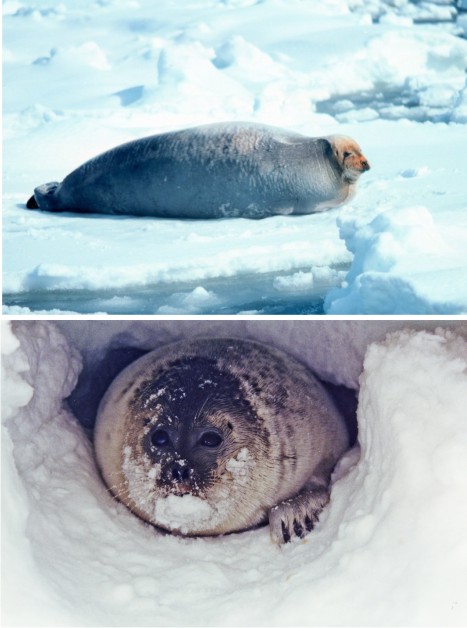
NOAA photos of bearded seal (top) and ringed seal (bottom)

NOAA photos of bearded seal (top) and ringed seal (bottom). The bearded seal is one of the largest Arctic ice seal while the ringed seal is the smallest. Both are eaten by polar bears, although ringed seals are consumed most often.

The decision by NOAA (National Oceanographic and Atmospheric Administration) affects the Arctic subspecies of ringed seal (Phoca hispida hispida) as well as the Okhotsk subspecies (Phoca hispida ochotensis) (in addition to several others) and thus includes all ringed seals off Alaska’s coast in the Beaufort, Chukchi and Bering Seas. The decision also affects two particular subpopulations of bearded seal (Erignatha barbatus): the “Beringia” [Bering Sea/Chukchi] subpopulation (about half of which reside in Alaskan waters), and the subpopulation that lives in the Sea of Okhotsk. (Alaska Fisheries (NOAA) Final Decision). Continue reading

‘Species-threatening’ population declines vs. polar bear declines

In 2008, polar bears in the United States were declared ‘threatened’ under the Endangered Species Act (USFWS 2008). The IUCN (to which the Polar Bear Specialist Group (PBSG) belongs) lists the polar bear as “vulnerable” (IUCN Red List 2012). In Canada (where 60% of the world’s polar bears reside), the polar bear is listed as a ‘species of special concern’ (COSEWIC 2008:iii).

As Jonathan Adler pointed out in an excellent article that appeared on the heels of the American ESA listing decision (Adler 2008:112), “Insofar as the listing is based upon climate models, ice-melt projections, and assumptions about the effects of habitat loss on the bear’s prospects for survival in the wild, its scientific basis is quite speculative.” These are also, as I understand it, unprecedented criteria for ESA listing – no other species has been listed as endangered or threatened based on such speculation of future conditions.

So what do actual polar bear population declines look like?

The Western Hudson Bay, Canada (WHB) subpopulation is the only one that has recently declined by a statistically-significant amount. [see previous post here on the status numbers] The WHB polar bear subpopulation makes up 3-5% of the global total for the species, currently estimated at 20,000-25,000 animals.

In this post, I’ll compare the documented WHB population decline to the declines seen in a few truly endangered animals, just to put the much-bandied about numbers into some perspective. Continue reading