Author Archives: susanjcrockford

Polar bears are distributed throughout their available habitat

All Arctic sea ice habitats that are currently suitable for polar bears have polar bears living in them 1 – even the southern-most regions of Hudson Bay that are well below the Arctic Circle (see previous post on polar bear numbers here).

Have a look at the maps below and see how well the current maximum extent of sea ice correlates with the present range of polar bears around the Arctic.

Fig. 1. Sea ice extent at April 25, 2012, from NSIDC (the winter maximum). Note that although there is sea ice in the Sea of Okhotsk (top right of the map), polar bears do not currently live there nor is there any evidence they ever did1.
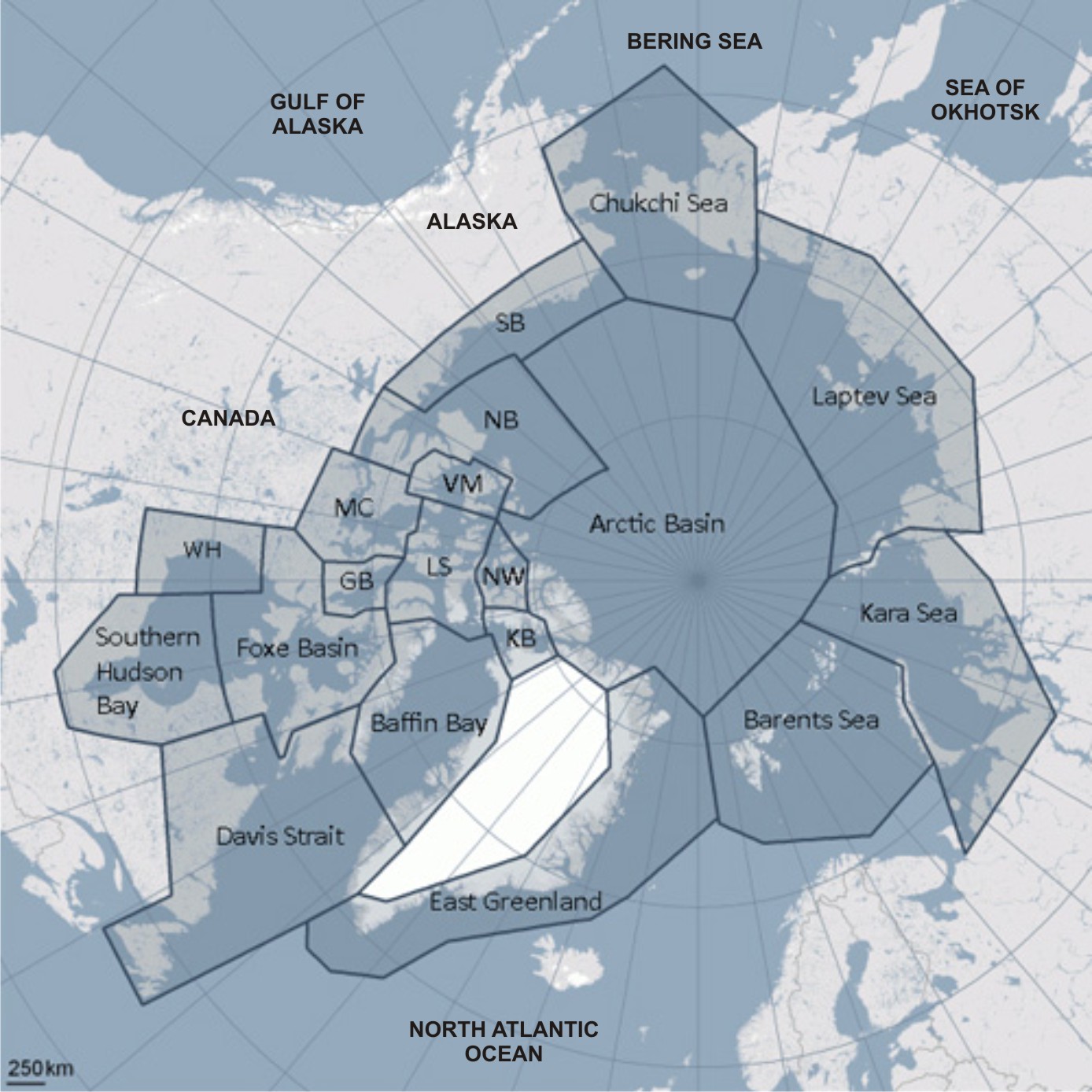
Compare to the polar bear’s official range below.

Fig. 2. The global range of the polar bear, showing the 19 regional subpopulations. Map from Polar Bear Specialist Group (PBSG), with a few extra labels added.

Continue reading

Ancient Polar Bear Remains of the World

How does the ancient distribution of polar bears – based on finds of natural-death remains (“fossils”) and bones found in archaeological sites – compare to the modern distribution of polar bears?

[Note: this post was updated 16 Feb. 2026 to indicate that an updated, published version of the data provided below is now available, and links are provided to my 2023 book on polar bear evolution that also includes more up-to-date information]

I have pulled together information from all of the reports I could find that listed ancient polar bear remains and summarized them into one table and one map. A low resolution copy of the map and a simplified version of the map notes are embedded in this post but a higher resolution version of the map and map notes (with pertinent details, including references) is available as a pdf. This document has been assigned an ISBN number (which means it is copyrighted and filed at Library and Archives Canada). The pdf can be downloaded below and will also be available on the PolarBearScience “references” page.

DOWNLOAD HERE: Ancient Polar Bear Remains_Crockford 2012
[small error fixed in yesterday’s version]

CITATION HERE:
Crockford, S.J. 2012. Annotated Map of Ancient Polar Bear Remains of the World. Electronic resource available at http://polarbearscience/references ISBN 978-0-9917966-0-1.

CITATION for the updated published version is below, announced and discussed in this blog post, which includes an updated copy of the map shown below: Ancient polar bear remains explained by sea ice and polynyas: my peer-reviewed paper, 6 May 2022. 

Crockford, S. J. 2022. Polar bear fossil and archaeological records from the Pleistocene and Holocene in relation to sea ice extent and open water polynyas. Open Quaternary 8(7): 1-26. https://doi.org.10.5334/oq.107  [Open Access]

See also my polar bear evolution book published in 2023:

Crockford, S.J. 2023. Polar Bear Evolution: A Model for How New Species Arise. Amazon Digital Services, Victoria.  https://www.amazon.com/dp/1778038328  Discussed here and here.

See map notes on pdf below for more details. Click to enlarge.

Continue reading

The sea ice is back and polar bears are heading out

It appears from the ice maps that most of the polar bears throughout the world that have chosen to remain on land during the late summer and fall (about July/August through October/November) can now return to the ice.

I can tell most of this tale with maps, so I will.

Continue reading

How long have polar bears lived in Hudson Bay?

The unique geographical position and oceanographic properties of Hudson Bay make it very different from other Arctic regions that polar bears inhabit.

Hudson Bay is a large shallow basin that freezes over every winter – somewhat like an enormous salt-water lake. This ice cover melts completely every summer, in part because it is well south of other truly “arctic” regions. As a consequence, while Hudson Bay offers excellent seal-hunting conditions for polar bears from winter through early summer, the long ice-free period with no or few feeding opportunities presents a unique challenge that polar bears elsewhere do not routinely encounter (see previous posts here, here and here).

Modern polar bears on the sea ice of Hudson Bay (Wikipedia photo and map).

But Hudson Bay also has a unique geological history. Since the end of the last ice age Hudson Bay has been available as polar bear habitat about half as long as other Arctic regions. This phenomenon is rarely discussed in the polar bear literature (although Andrew Derocher, in his new book [reviewed here] does mention it). In this post, I’ll summarize the geological history of Hudson Bay over the last 30 thousand years, as it pertains to polar bear habitat.

Continue reading

Population size estimates for grizzly bears in British Columbia, Canada

This is a follow-up to my last post, which summarized IUCN/SSC Polar Bear Specialist Group (PBSG) polar bear population estimates and status reports, here.

I was interested to see how the PBSG population estimates compared to similar studies in other animals, so I took a look at the official 2012 population estimate for grizzly bears in British Columbia, Canada here. A couple of brief excerpts are provided below.

British Columbia is the western-most province of Canada (Fig. 1). It is roughly half the size of Greenland, while sea ice habitat of polar bears is roughly 6-7x the area of Greenland.

Just nine pages long, this grizzly bear population report is short, clear and unambiguous. While it may perhaps not explain its methods in enough detail for some folks (and it is, admittedly, a small portion of global grizzly bear territory), the report is nevertheless clear about the variations in quality of population estimates over time (which began in the 1970s and so are similar to what we have for polar bears). The report is also clear about how these historical estimates impact the current population status and trend. See Fig. 2 and 3 below for short excerpts.

Continue reading

PBSG polar bear population assessment made simple

[Update: Feb. 10 2013. I have corrected an oversight in the summary tables – the originals neglected to indicate that the Barents Sea subpopulation is shared between Norway and Russia (not controlled by Norway alone). Here is revised Table 1 and revised Table 2. ]

[Update 2: Sept. 26, 2013. See Global population of polar bears has increased by 2,650-5,700 since 2001″ for further insight. I have also made slight corrections to the tables below, now marked Version 3.]

A couple of weeks ago, a news report appeared highlighting an interview with Russian biologist Nikita Ovsyannikov, deputy director of Russia’s polar bear reserve on Wrangel Island in the Chukchi Sea. This is what the news report said:

He [Ovsyannikov] guessed the number of bears around the Chukchi Sea, which also sometimes migrate in small numbers to western Alaska, had dropped over the past three decades from “about 4,000 to no more than 1,700 at best.

See Kelsey’s comments over at Polar Bear Alley and the comment I left there, here and my related previous post here

This media focus on Chukchi Sea polar bear numbers caught my attention because I had recently spent some time going through the 15 Polar Bear Specialist Group (PBSG) meeting reports in an effort to summarize the population estimates they provided. This international group first met in Fairbanks, Alaska in 1965 to advance and coordinate polar bear research and conservation under the auspices of the International Union for Conservation of Nature (IUCN) and the Species Survival Commission (SSC). I knew that according to the PBSG, the population of the Chukchi Sea is zero – that is, no Chukchi bears are included in the official total of 20,000-25,000 bears because no reliable survey had ever been done. Ovsyannikov’s statement to the press encouraged me to finish my summary of the population estimates in the PBSG meeting report tables.

This was not an easy task, in part due to the virtually constant changes in presentation style and format in the tables used to present the data (which appeared first in the 1981 report). For example, even between the 14th (2005) and 15th (2009) meeting reports, the population data table presents the subpopulations in different order and swaps the position of two critical columns (“status” and “observed or predicted trend”), making it extremely difficult for readers to do a quick comparison between years.

So I simplified the 2009 table (the most recent available), leaving out the future predictions as irrelevant to questions about current status. I included some population estimates and status assessments from previous reports to show the changes over time (where available). The full summary table, designated Table 1,  is provided here as a pdf. [update 2013 – this is Version 3]. However, in this format, it still spans two pages, so I composed another  table that contains the 2009 status information only (2009 is the most recent available), see Table 2, version 3 below. Viewing the data this way may surprise you.

continue reading

Good news study on Chukchi polar bears is unpublished

This article from yesterday (Oct 09, 2012) caught my eye: How many polar bears live in the Arctic? by Jill Burke

Buried deep within this article (page 3, in the default format) is this statement by US Fish & Wildlife polar bear biologist Eric Regehr:

“In 2009, when the PBSG [Polar Bear Specialist Group] issued its population status reports, it listed the Chukchi Sea population, which Alaska shares with Russia, as being of unknown size, but one thought to be in decline because of anecdotal reports about possible over-harvesting in Russia. But now, newer research yet to be published has scientists reconsidering the status designations of the Chukchi population, Regehr said. It appears the bears in this area are reproducing well and maintaining good body condition.

[Indeed, the latest PBSG report (Obbard et al. 2010:63) lists the Chukchi subpopulation status as “reduced” and current trend as “declining” even though the population size is “unknown.” It also states that “The trend is believed to be declining and the status relative to historical levels is believed to be reduced based on legal/illegal harvest levels that were thought to be unsustainable. Sea ice loss is one of the highest levels in the Arctic.”]

So, it turns out that what these expert polar bear biologists “believed” to be the case – without any data to back it up – is not actually true. Even with “sea ice loss [at] one of the highest levels in the Arctic,” polar bears are doing just fine. Sort of makes you wonder what else polar bear experts “believe” to be true but actually isn’t.

However, what really popped out at me was the tossed-off comment that the results of this potentially game-changing study for US polar bears (since the Chukchi subpopulations is shared between the US and Russia) have not yet been published. Nor are we told who did the study or when, even though it is complete enough for Regehr to be discussing the results with a journalist.

Finally, some good news to report, but no peer-reviewed study to quote or examine.

Again, results are in but we are not allowed to see the data. Sound familiar? See my earlier post on the critical evidence for western Hudson Bay polar bears that is also unpublished.

Really makes me wonder how many polar bears live in the Chukchi Sea? Sounds to me like they still don’t have an estimate but I suspect when they get one, we might be surprised by how big it is.

Reference
Obbard, M.E., Theimann, G.W., Peacock, E. and DeBryn, T.D. (eds.) 2010. Polar Bears: Proceedings of the 15th meeting of the Polar Bear Specialists Group IUCN/SSC, 29 June-3 July, 2009, Copenhagen, Denmark. Gland, Switzerland and Cambridge UK, IUCN.

Western Hudson Bay polar bears are not like the others – Part 2

In Part 1 of the Western Hudson Bay (WHB) polar bear story, I promised to explore the idea that rather than declining due to the effects of global warming, WHB polar bear populations may simply be returning to ‘normal’ after the rapid population increase that followed the intense over-harvests that occurred between 1890 and 1930 and again from 1945 to 1970.

Derocher and Stirling (1995:1664) had this to say about the life history features (like incidence of triplets and age of weaning) that made the polar bears of WHB unique:

The results of our analyses suggest that the unique reproductive characteristics of polar bears in western Hudson Bay in the 1960s and 1970s were either a function of a population increasing from a depleted state and feeding on a relatively abundant prey base, or density-independent fluctuations in prey population size, or availability due to sea ice variation.

In my last post, I discussed some of the evidence for how polar bear reproductive characteristics had changed since 1985. But how different were WHB polar bears, before and after 1985, from the other populations that had been dramatically reduced between 1890 and 1970, such as those in Svalbard/Barents Sea and Davis Strait?

There are two factors to consider in this recovery from over-harvest: population size changes and reproductive characteristics. Turns out, we don’t know much about the Davis Strait subpopulation but we do know a bit about Svalbard/Barents Sea bears since the 70s. And the Svalbard/Barents Sea vs. WHB comparison is a bit of an eye-opener.
continue reading

Fat polar bears chew on whale bones, chase dog

Brief interlude from Western Hudson Bay. My fascination with Arctic dogs and polar bears collides in Alaska!

BILL HESS / logbookwasilla.com

A string of remarkable photos of polar bears at the Kaktovik whale carcass dump (leftovers from subsistence whaling) on Barter Island on the north slope of Alaska and a dog having some fun, by Wasilla photographer Bill Hess, posted at this blog hereGo have a look. Note the condition of the bears, nice and fat from the look of it. Maps below to get you oriented geographically.

I had a Malamute years ago who played like this with horses…whole different game when played with polar bears!

From Anchorage Daily News feature from a few days ago. continue reading

Critical evidence on polar bears in W. Hudson Bay is unpublished

In my last post, Western Hudson Bay polar bears are not like the others – Part 1 I stopped at the point where the following question arose: “The documented decline in cub survival and condition of females documented above occurred between 1985 and 1992 – what about now?

I promised to address that question in a separate post because it revealed some interesting issues that deserve star billing.

What I found might surprise you: apparently, virtually all of the data supporting a decline in the western Hudson Bay polar bear population since 1985 has been collected but has not been published. This revelation came from none other than the 2012 summary by Ian Stirling and Andrew Derocher that I’ve mentioned before here.

[updated Sept. 28, 2012 – reference added, see below]

continue reading