Category Archives: Life History

Expert admits polar bears in Svalbard are thriving despite the greatest loss of sea ice in the Arctic

In an article published last week, polar bear specialist Jon Aars is quoted as saying that Svalbard bears are “unexpectedly” thriving. However, he fails short of admitting that the bears don’t really need summer ice as long as they are well-fed in spring, which they have been for the last two decadesthis year included.

Aars said the sea ice in this area is declining more than twice as fast as anywhere else in the Arctic. But the polar bears here — unexpectedly — are thriving. [E. Haavik, Svalbard’s polar bears persist as sea ice melts — but not forever, 21 July 2022; my bold]

Spring 2018, Barents Sea

The suggestion by Aars that the Svalbard archipelago could one day be ice-free for the entire year is speculative hyperbole but even if that were to happen, it would only mean the permanent movement of 300 or so Svalbard bears to Franz Josef Land (still within the Barents Sea) where ice conditions are less volatile.

Continue reading
Some of the first polar bears onshore in Western Hudson Bay are in excellent condition

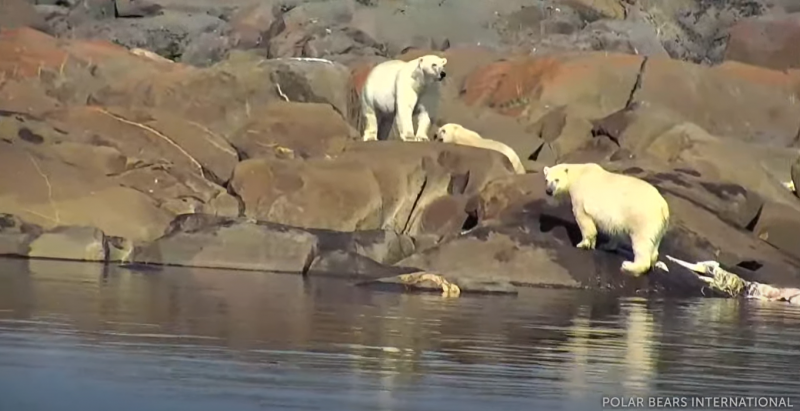
From the live cams installed on beluga tour boats running near the Churchill River, we have some good photos of a few fat polar bears onshore in Western Hudson Bay.

These bears were attracted to the remnants of a beluga carcass with nothing much left on it (lower right in the photo) and stayed around for at least a few days. The female with her cub-of-the-year was remarkably tolerant of an adult male nearby.

Continue reading

Arctic sea ice still quite abundant for early summer

Despite rhetoric to the contrary, there is still plenty of sea ice over Arctic regions this summer, supplying feeding platforms for polar bears, ice-dependent seals, and walrus cows nursing their young calves. Forget about whether the numbers are below or above some short-term average, there is no catastrophe in the making for marine mammals in the Arctic at this time.

Remember, by early summer, young seals have left the surface of the ice and are in the water feeding; predator-savvy adults and subadults are hauled out on broken chunks of ice moulting their hair-coat. They may look like sitting ducks but polar bears have a hard time catching them because the seals are vigilant and have many escape routes available (due to all the open water). Most polar bears in Hudson Bay are still on the ice (you’ll see why below): the live cams near Churchill set up to watch polar bears are presently showing images of ravens with sea ice in the background, not bears.

This post is predominantly sea ice charts for mid-July, what we in the science field call observational evidence, aka ‘facts’. Keep in mind that satellites used to produce these images have an especially hard time distinguishing ice topped with melt water from open water, which means much more ice useful to these marine mammals is almost certainly present than is shown in the charts (as much as 20% more in some regions).

Continue reading

First tagged W Hudson Bay polar bear comes ashore

On the 8th July, the first of almost two dozen tagged or collared polar bears came ashore in Western Hudson Bay (WH) under unusual sea ice conditions. How does this compare to previous years?

Image above is from last year (6 July 2021): we haven’t yet had a sighting from the live cams on the shore of Wapusk National Park near Churchill reported at Explore.org.

Continue reading

Hudson Bay polar bears still have lots of ice at July 1

Although some have come ashore in the north around Arviat, most polar bears are still on the ice. Disaster averted for another season as predictions of doom fail to meet reality.

24 June 2022, courtesy Gordy Kidlapik at Arviat (via twitter).

Sea ice on Hudson Bay is still abundant in the southwest sector, including around Churchill, and much of that is still thick first year ice (>1.2m thick, dark green on the ‘stage of development’ charts).

Continue reading

Claim: data exists showing polar bear body condition improves over summer on sea ice

Do polar bears increase their body condition if they stay on the sea ice over the summer? Do they continue to hunt successfully from broken ice in July and early August in areas like Hudson Bay where ice eventually melts out completely? There seems to be an assumption that they do but one polar bear specialists repeatedly claims there is data showing this is the case.

A polar bear breaks through thin Actic Ocean ice Aug. 23, 2009.

Anyone saying sea ice at this time of year doesn’t affect polar bears is ignoring research showing their body condition continues to increase through summer if they’re out on the ice.” [Andrew Derocher 28 June 2022]

I would seriously like to know which paper or papers this data appears in but of course, he doesn’t provide that information. Instead, it’s ‘trust me, I’m the expert’.

Continue reading

New polar bear subpopulation update: more background facts and details from the paper

Here are the facts you need to put into context the claim that the estimated 234 polar bears recently discovered in SE Greenland have been living ‘without sea ice‘.

The unique genetic isolation of this new subpopulation makes it one of the most interesting discoveries about polar bears we’ve seen in decades, yet the media were primed by a press release loaded with dooms-day climate rhetoric to focus exclusively on the model-predicted precarious future of the species, like this gem from the lead author:

“In a sense, these bears provide a glimpse into how Greenland’s bears may fare under future climate scenarios,” Laidre said. “The sea ice conditions in Southeast Greenland today resemble what’s predicted for Northeast Greenland by late this century.”

As a consequence, the media have been trying to out-do each other with the most over-the-top climate catastrophe headlines, see here and here. The authors of paper itself and a companion piece do the same: instead of focusing on the exciting scientific implications of the genetically isolated population they discovered, they promote the preferred narrative that polar bears have a bleak future and lecture the public (yet again) about the need for limiting CO2 emissions (Laidre et al. 2022; Peacock 2022).

Continue reading

Newly-discovered SE Greenland polar bear subpopulation: another assumption proven false

Researchers have discovered that the 300 or so polar bears living in SE Greenland (below 64 degrees N) are so genetically distinct and geographically isolated that they qualify as a unique subpopulation, adding one more to the 19 subpopulations currently described by the IUCN Polar Bear Specialist Group.

NASA photo, SE Greenland glacier-front habitat with a polar bear and two cubs.

Previously, polar bear researchers simply assumed all of the bears in East Greenland were part of the same subpopulation but no field work had been conducted in the extreme southern area until 2015-2017. When they included this region, they got a big surprise: now they are spinning it as significant for polar bear conservation (Laidre et al. 2022).

Continue reading

Polynyas are critical for polar bear spring feeding

Areas of open water or thin ice in spring are essential for the survival of Arctic species, as I emphasized in my recent peer-reviewed paper on polar bear ecology. Sea ice is still abundant in spring (April-June), which is the critical feeding period for polar bears: they must consume about 2/3 of the total calories they need for the entire year. Most of those calories come from newborn seals (ringed, bearded, and harp).

In southern areas, such as Hudson Bay and Davis Strait, virtually all of this feeding is completed by the end of May, making June a time of opportunistic hunting for most bears: if they find a seal, they will kill and eat it but if not, they can do without. That’s not just my opinion but the reason given by polar bear specialists themselves to explain why Southern Hudson Bay polar bear numbers had not declined in the 2000s despite a sudden increase in the ice-free season:

…even though break-up has advanced by up to 3-4 weeks in portions of Hudson Bay it still occurs no earlier than late June or early July so does not yet interfere with opportunities to feed on neonate ringed seal pups that are born in March-April in eastern Hudson Bay. Therefore, losing days or weeks of hunting opportunities during June and July deprives polar bears of the opportunity to feed on adult seals, but does not deprive them of the critical spring period when they are truly hyperphagic. [Obbard et al. 2016:29]

Continue reading

Fat polar bear killed on the south shore of the Gulf of St. Lawrence on the Gaspé Peninsula

A fat polar bear was killed early this morning (Sunday 1 May 2022) near a small town on the north shore of the Gaspé Peninsula, the portion of Quebec that New Brunswick in the Gulf of St. Lawrence after being tracked by wildlife conservation officers since yesterday. Two other sightings were reported in the Gulf earlier in April on the opposite shore, which could possibly have been the same bear.

This is why there are polar bears in my recent sea ice tsunami novel set in Cape Breton, Nova Scotia in March 2026. Davis Strait polar bears are thriving, having increased in number dramatically since the 1970s, due to hunting bans and abundant harp seals. Until the last few years, Davis Strait polar bears haven’t been spotted this far south in the spring since 1849 (with a few other historical reports even further south in the 1500s). The last time a polar bear was spotted onshore in the Gulf area (and got this much attention) was in late March 2017.

These recent polar bear sightings in the Gulf of St. Lawrence likely reflect a population that’s at its peak size or still increasing. The photo above shows the bear was in excellent condition after feeding heavily on harp seal pups. Unfortunately, from where it ended up, it likely wouldn’t have made it back to the receding pack ice off Labrador in time to return to Davis Strait for the summer.

Excerpt below from the CBC story (‘Polar bear spotted on Gaspé peninsula killed by wildlife officers‘; 30 April 2022), but first you’ll need the map of the area. Charts for sea ice conditions at the time follow.

Continue reading