Posted onAugust 31, 2021|Comments Off on Polar Bear Facts & Myths for young readers in Portugal and Brazil
Due to the efforts of Thiago Maia and his team of assistants (Igor Vaz Maquieira and Márcio Calixto), I can now offer a Portuguese translation of my popular Polar Bear Facts & Myths science book for young readers in Brazil and Portugal.
Posted onAugust 27, 2021|Comments Off on No updates from Churchill polar bear alert program since July 12
What the heck is happening in Churchill? Either the Polar Bear Alert Program has produced no reports or they have simply not been posted. It’s been more than 6 weeks since the last published report.
Posted onAugust 22, 2021|Comments Off on Western Hudson Bay fat polar bear video from the shore of Wakusp National Park
Here is a short video from last week on the shore of Wapusk National Park of a fat sow and her fat cub. At this time of year, the Cape Churchill caribou herd (population ca. 3,000) is wandering by with their new calves. Unlike deer, both male and female caribou have antlers. The bears and the caribou simply ignore each other most of the time. Very rarely, a bear will chase one and even more rarely, catch one. However, the bears will scavenge caribou kills made by wolves, which are their primary predator.
Posted onAugust 20, 2021|Comments Off on Polar bear habitat update at mid-August
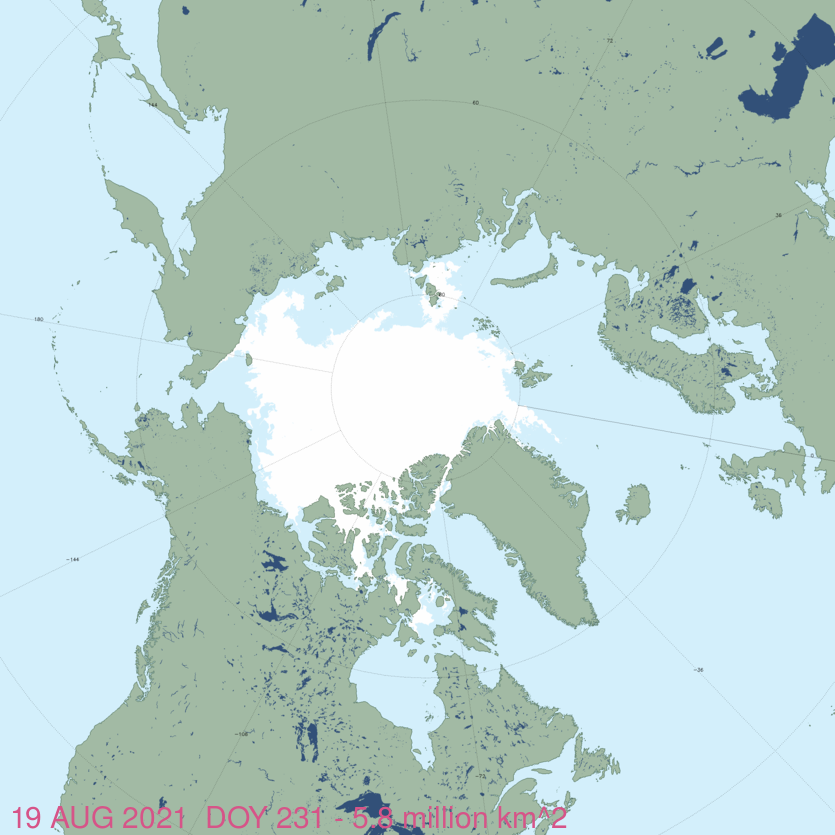
Oddly, after light winter ice coverage on Canada’s east coast and a slightly earlier sea ice breakup on Hudson Bay, the Arctic melt season has stalled. That’s not my opinion but the observation of the sea ice experts at the National Snow and Ice Data Center (NSIDC):
Sea ice loss during the first half of August stalled, though ice in the Beaufort Sea is finally starting to weaken. The Northern Sea Route appears closed off in 2021, despite being open each summer since 2008.
Overall, ice coverage is well above what it was in 2012 (the lowest September extent since 1979) and many years since:
Posted onAugust 17, 2021|Comments Off on Foxe Basin polar bear attack victim recalls repeated attacks and being bitten on the neck
A few more details have emerged on the polar bear attack in Foxe Basin last week (Tuesday 10 August) in which three Inuit residents were mauled near the community of Sanirajak, Nunavut (formerly Hall Beach) and had to be airlifted to hospital.
One of the victims, Elijah Kaernerk, has finally recovered enough to explain what happened: he surprised the bear feeding on a carcass of something near his cabin and it came after him. The other two, both women, must have come to see what the noise was about and the bear went after them too. The bear was apparently shot by other members of the community after the attack but no mention was made of its condition, which leads me to believe it was probably not starving.
Posted onAugust 11, 2021|Comments Off on Foxe Basin polar bear attack leaves three people seriously mauled, airlifted to hospital
The attack happened yesterday afternoon (10 August) about 2:30 PM local time near the community of Sanirajak (listed as Hall Beach on ice charts), which is in Foxe Basin, Nunavut (population about 800). There are few details yet on the human victims of the mauling other than that they were two women and a man. All three were badly injured. They are now in hospital and expected to survive.
It appears the bear died as a consequence of the attack but there has been no mention of its condition, age, etc., or the circumstances of the attack. There is no ethical reason for blaming this broad-daylight attack on lack of sea ice (although some will try), since there is abundant ice in the region at the moment, as the charts below show. Expect an update as the story unfolds.
Posted onAugust 9, 2021|Comments Off on Tipping points, Attenboroughesque narratives of climate doom and dying polar bears
Outlandish ‘tipping point’ rhetoric is about to be regurgitated once again during the promotion of the latest IPCC report, due today. Tipping points are those theoretical climate thresholds that, when breeched, cause widespread catastrophe; they are mathematical model outputs that depend on many assumptions that may not be plausible or even possible.
Tipping points are not facts: they are scary stories made to sound like science.
This is why Sir David Attenborough has totally embraced the tipping points narrative. He even made a movie fully devoted to them, called, Breaking Boundaries – The Science of Our Planet. Tipping points are the animal tragedy porn of mathematical models and Attenborough has adopted them both.
Posted onAugust 4, 2021|Comments Off on Polar bear attack in Greenland gratuitously blamed on recent ‘heat wave’
A polar bear bit the hand of a member of a film crew near the Danish military base of Daneborg in East Greenland on Monday (2 August) and predictably, this has been blamed on recent warm temperatures in the region. There is no specific evidence of cause and effect, of course. The news outlet reporting the incident cites some non-specified ‘experts’ as providing the generic ‘warming makes polar bears starve or behave badly’ excuse that makes no sense in this particular instance.
Here is what the news report had to say (3 Aug), my emphasis:
Early on Monday, while the sun does not set in summer at this latitude, the bear poked his head through a poorly closed window of a research station where the documentary team was staying about 400 metres from the small base of Daneborg.
A Danish Arctic military unit based in Greenland said the bear bit the hand of one of the three male team members before they used warning pistols to force the animal to flee.
Transported first to Daneborg, the injured documentary maker had to be evacuated to Akureyri, a town in Iceland.
Already blamed for five incidents until now, the bear returned again later in the morning and then again overnight Monday to Tuesday when it broke a window of the research station before fleeing.
“The local authorities have from now on categorised the bear as ‘problematic,’ which allows for it to be shot dead, if it returns,” the Danish military unit said.
Any bear causing problems in this region would have just come off the ice, since three weeks ago there was plenty of ice available offshore a bit to the north (see chart below for 7 July). Virtually all bears are at their best condition at this time of year, except for young, inexperienced bears or those that are sick or injured. Warm temperatures would not be causing any bear to be desperately looking for food unless it was desperate for some other reason (sick, injured, or an under-nourished young bear). However, nothing is stated in this report about the physical condition of the bear, its approximate age or its sex, even though it has been seen multiple times. Young male bears, for example, are far more likely to become problems near communities than any other age class (Wilder et al. 2017), because these bears have to compete with older, larger bears to keep whatever seals they manage to kill.
Note the reliance on un-named ‘experts’ at the end of the same news report:
Experts say the retreat of the ice pack, the hunting ground of the polar bear, forces them to stay on land more often and they find it harder to find food and sustain a species already considered vulnerable.
Although still rare, the close encounters with humans are increasing as bears more frequently approach inhabited areas in their search for food, environmental protection officers say.
What generic pap! The community has a problem bear on its hands, a situation which northern communities across the Arctic must contend with on a continual basis. Even if there was ice offshore, there would be the possibility of bears coming ashore and causing problems.
Wilder, J.M., Vongraven, D., Atwood, T., Hansen, B., Jessen, A., Kochnev, A., York, G., Vallender, R., Hedman, D. and Gibbons, M. 2017. Polar bear attacks on humans: implications of a changing climate. Wildlife Society Bulletin, in press. DOI: 10.1002/wsb.783 http://onlinelibrary.wiley.com/doi/10.1002/wsb.783/full
Comments Off on Polar bear attack in Greenland gratuitously blamed on recent ‘heat wave’
Posted onJuly 29, 2021|Comments Off on Polar bear habitat update for end July 2021 compared to previous years
Here’s a trip down memory lane for Arctic sea ice at the end of July, which as far as I can see provides no evidence that a very low sea ice disaster is in the cards for polar bears this year.
Posted onJuly 27, 2021|Comments Off on A literary review of my polar bear attack thriller, with all the condescending attitude you’d expect
For your amusement, I present a book review of Eaten from an Austrian academic specializing in contemporary literature by the name of Michael Fuchs. I came across his book chapter last week, buried deep within Google offerings, while looking for something else. I laughed all the way through it.
Here is the abstract:
“This chapter draws on Margaret Atwood’s vision of Canada as a Gothic space, examining how contemporary texts continue to invoke imagery of human and animal as antagonists competing for the same space. Fuchs analyzes a corpus of three “bear horror” fictions, the horror film Backcountry (2014) and two novels, The Bear (2014) by Claire Cameron and Susan J. Crockford’s near-future polar bear-themed Eaten (2015). It argues that animal predation on humans provides a powerful symbolic vehicle for bridging the human–animal divide, as it overrides the theory of human exceptionalism, offering a critical view of the entanglement of humans and nonhumans in the Anthropocene.”
A friend that I shared the essay with commented:
“My favourite sentence (new word of the day, class, please use “diegetic” in a sentence):
“These constant slippages between ontological levels puzzle the reader in ways similar to how Anna is confused by the goings-on in the diegetic reality.” [pg. 263]
Watch polar bear habitat reform in the Canadian Arctic: “last 10 days” Canadian Ice Service animation (works anytime) HERE.
See Quote archive for details.













 polarbearscience
You must be logged in to post a comment.