Sea ice extent for Svalbard was above average yesterday and has been since 17 July, despite “record-breaking” sea surface temperatures in June.
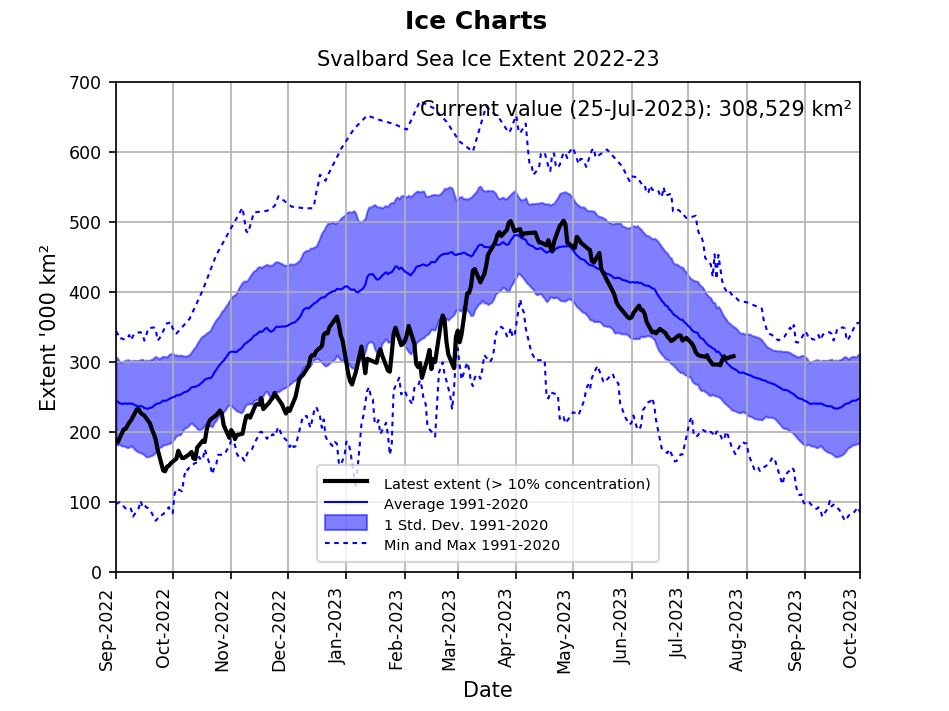

Sea ice extent for Svalbard was above average yesterday and has been since 17 July, despite “record-breaking” sea surface temperatures in June.
Comments Off on Polar bear habitat around Svalbard Norway above average despite high temps in N. Atlantic
Posted in Sea ice habitat
Tagged Barents Sea, polar bear, sea ice, sea surface, Svalbard
Despite more CO2 in the atmosphere (424 vs. 392, for June), there was more sea ice cover in the Barents Sea at mid-July this year than there was in 2012.
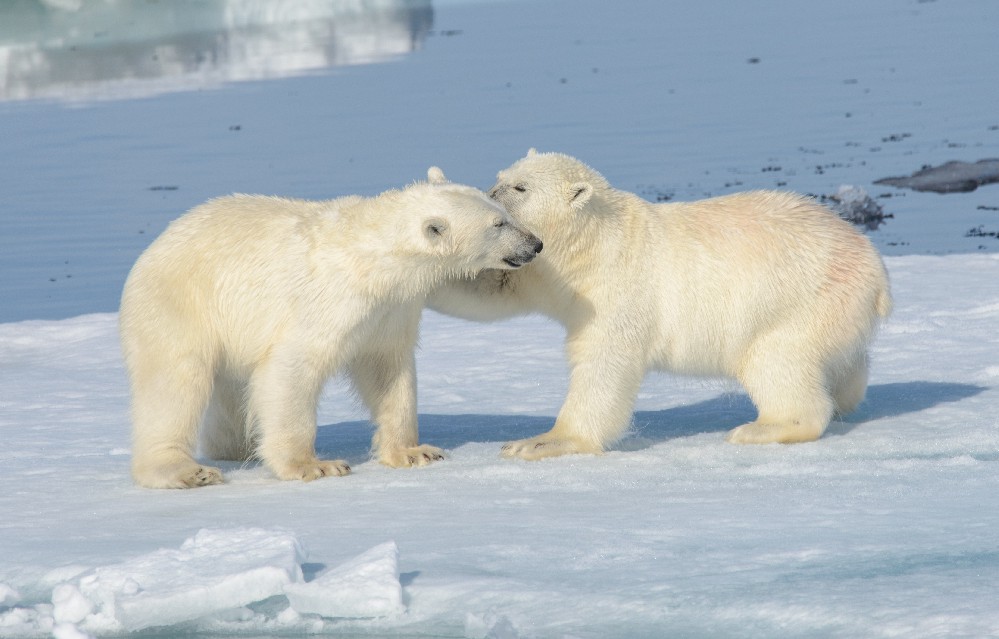
This region has seen about 6 times the amount of summer sea ice loss as any other region of the Arctic (Regehr et al. 2016): Barents Sea bears now have a longer ice-free season than the famous Western Hudson Bay bears that we hear so much about.
Yet contrary to predictions, which insisted that protracted poor ice conditions in summer would inevitably result in catastrophic rates of starvation and death (Amstrup et al. 2007; Crockford 2017, 2019), polar bears in the Svalbard region have so far not had any documented any harm to their health or population size. In fact, field data show bears in Svalbard are in better condition than they were in the late 1990s (Lippold et al. 2019), almost certainly due to the documented increase in primary productivity that has resulted from longer ice-free summers since 2003 (Frey et al. 2022; Crockford 2023).
Continue readingComments Off on More Barents Sea polar bear habitat at mid-July 2023 than in 2012 despite more atmospheric CO2
Posted in Conservation Status, Population, Sea ice habitat
Tagged Barents Sea, climate change, food chain, global warming, polar bear, primary productivity, sea ice, survival, Svalbard
This is an early breakup year for Hudson Bay but sea ice loss has not been accelerating. While some Western Hudson Bay bears have been on land for weeks, others are still out on melting remnants of sea ice, much of it invisible to satellites. This is only the third year since 2014 that the bay has had less than usual amounts of ice, which means most years since then have had normal or nearly normal ice coverage, similar to the 1980s. Hardly the ever-worsening catastrophe of sea ice loss story being spun in the media for Western Hudson Bay polar bears.

From the tracking map above, out of the 38 visible tags or collars on bears at 11 July 2023, 16 bears (42%) were on land and 22 (58%) were still out on the sea ice. That’s virtually identical to the 40/60 percent split last week when there was even more ice.
Continue readingComments Off on Hudson Bay sea ice loss has not accelerated since 2014: in fact, summer ice cover has improved
Posted in Advocacy, Life History, Sea ice habitat
Tagged Arctic, breakup, early, melting, onshore, polar bear, sea ice, western hudson bay
Hudson Bay in early July this year is a mosaic of more-than-average and less-than-average sea ice coverage but apparently, only the less-than-average ice areas constitute the “early breakup” caused by climate change, and only “deniers” would say otherwise.

I say some folks are cherry picking the ice conditions that support a story line they prefer, forgetting that polar bears know better than they do when to come in off the ice.
Continue readingComments Off on Natural flexibility explains W Hudson Bay polar bear movements at breakup better than climate change
Posted in Evolution, Life History, Sea ice habitat
Tagged breakup, climate change, Derocher, evolution, ice charts, melt ponds, polar bear, sea ice, western hudson bay
This reminds me of descriptions of grizzly sows defending their young, who seem intent on scaring the sh*t out of attack victims rather than killing them, which they could easily do (Shelton 1997, 1998, 2001). This video of a terrifying attack on a runner near Provo, Utah is from two years ago but I missed it when it came out.
“I found what I thought were bobcats on the trail during a run. Turns out they were cougar cubs and their mother was not happy to see me. She escorted me for over six minutes to get me away from her cubs. Although she was acting very aggressive, the cougar had no intent on hurting me. The mother cougar was most likely caught off guard and did what she had to do to protect her cubs. Mama, cubs, and I are safe.” [Cougarkyle, 12 October 2020]
Continue readingComments Off on Impressive cougar attack in Utah caught on film
Posted in Polar bear attacks
According to Polar Bears International, the “3rd-earliest” breakup date for Western Hudson Bay was caused by a “record breaking” heat wave in May. Western Hudson Bay sea ice hit the 30% coverage threshold used by PBI to define “breakup” on 17 June this year, prompting speculation about potential future impacts on polar bear survival should breakup come even earlier.
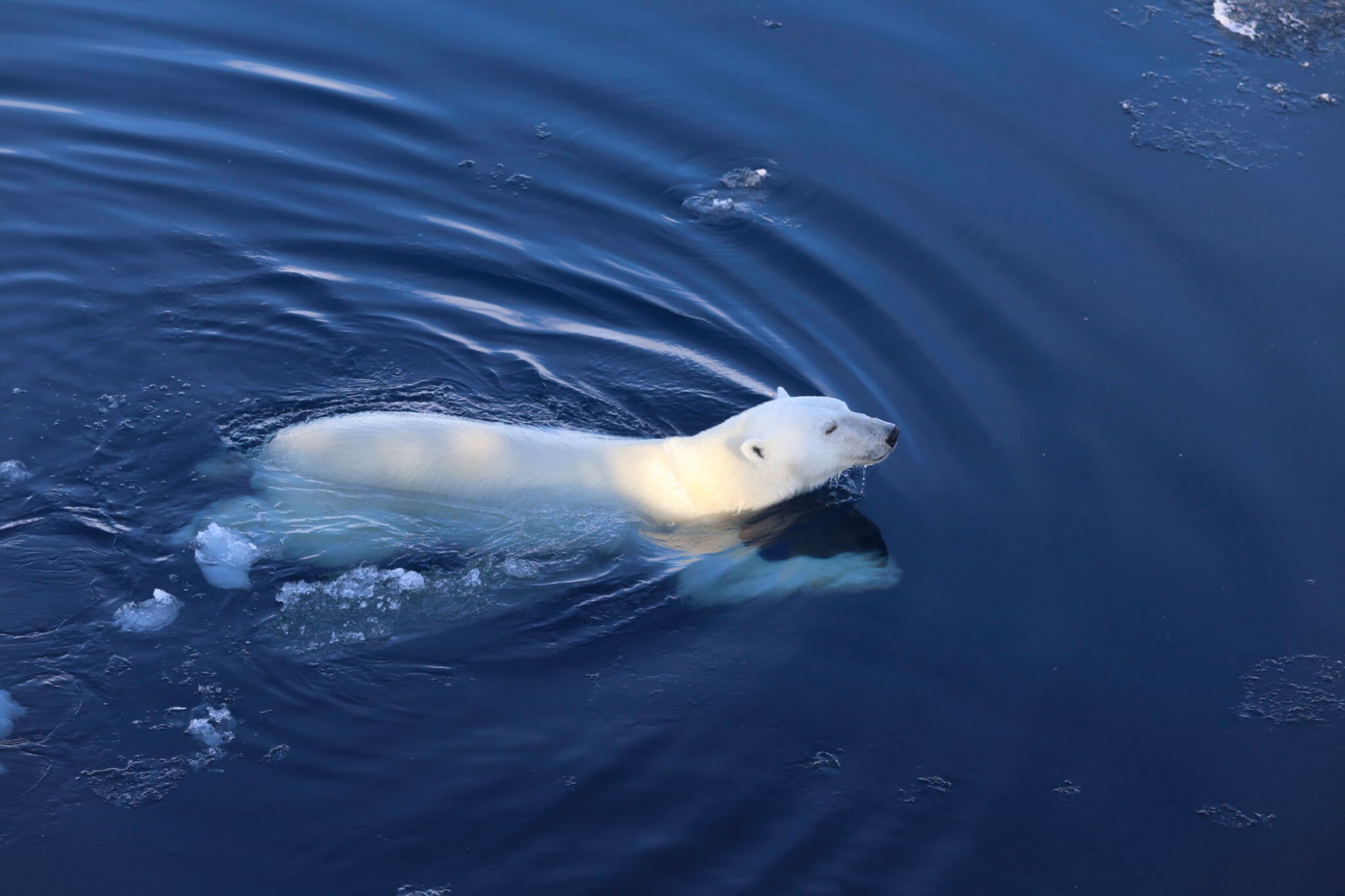
“This year’s break-up date of June 17 is the 3rd earliest in the 45 years of satellite-based sea ice data from Western Hudson Bay, after 2015 and 2003.” [Flavio Lehner, PBI]
17 June 2023 is day 168 on the Julian calendar used to graph the data in the image included in the PBI essay (see copy below). However, the data point for 2003 is about three days earlier, on day 166 (14 June) and the point for 2015 is on day 152 (1 June).
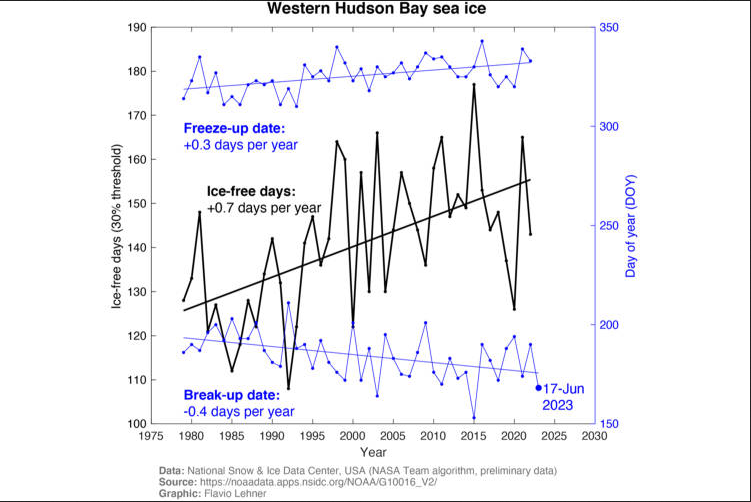
If “record-breaking” heat caused this year’s early ice retreat, what caused the ice to retreat more than two weeks earlier in 2015? May was warm that year along the west coast as well but obviously not “record-breaking” warmth, because the records were broken this year. In fact, whatever warmth that occurred only affected ice melt in the western sector, while very thick ice over the rest of the bay resisted melt and allowed bears to stay out many weeks later than usual.
Continue readingComments Off on Early sea ice breakup in W Hudson Bay caused by “record breaking” warmth in 2023 but not 2015?
Posted in Life History, Sea ice habitat
Tagged breakup, Churchill, Derocher, polar bear, predictions, satellite collars, sea ice, tagged bears, western hudson bay
Is evolution primarily fast or slow? Does it take hundreds of thousands of years or a few generations to produce a new species? Ignoring vast evidence to the contrary, most geneticists insist that evolutionary change is imperceptibly slow and one of them is using this misconception to support the human-caused climate change narrative.

For polar bears, the question is this: could brown bears (aka grizzlies) have survived for hundreds of thousands of years living in a completely different habitat–the perpetually-frozen world of Arctic sea ice–before significant biological changes took place? I contend the answer is no. Moreover, if I am correct that polar bears arose ca. 140,000 thousand years ago (140kya) during the height of an extreme glacial period, the fossil evidence concurs. Analysis of fossil remains show that by about 115-130kya at the latest (after perhaps 10k years), polar bears were primarily eating seals as their modern counterparts do and their bones had lost the distinctive features of their grizzly ancestors.
But that’s the maximum time frame: research on other animals indicate that such critical changes almost certainly took place long before that, within the first few generations of life on the sea ice. If coordinated changes had not taken place very quickly, within ecological time, brown bears would simply not have survived the harsh life on Arctic sea ice.
Continue readingComments Off on No evidence polar bears survived Eemian warmth because they were not yet fully ice-dependent
Posted in Book promotion, Evolution, Sea ice habitat
Tagged ecology, Eemian, food chain, fossil record, genetics, rate of change, speciation, Species Problem
One big question I asked before writing my book on polar bear evolution was this: did interbreeding with grizzlies, aka brown bears, profoundly impact polar bear history, as geneticists insist? Or is something else going on?

Virtually all genetic studies done in recent years, which I review in my book, conclude that hybridization with grizzlies has happened to various degrees over the course of polar bear history (e.g. Cahill et al. 2013, 2018; Cronin et al. 1991; Edwards et al. 2011; Hailer 2015; Kumar et al. 2017; Miller et al. 2012). Two of the most recent studies claim the most complicated hybrid ancestry for polar bears yet, invoking tales of “extensive” past hybridization events between the two species (Lan et al. 2022; Wang et al. 2022).
But does their interpretation of the genetic data represent reality or does it simply fit the authors’ preferred but false narrative that climate change is to blame for recent hybridization events and therefore likely to happen more often in a warmer world? And if, as I argue in my book, grizzly hybridization isn’t needed to explain polar bear evolutionary history, what does that say about similar claims that there has been a significant amount of Neanderthal interbreeding with humans in our past? Put another way, are geneticists everywhere going overboard with claims of interspecies hanky-panky?
Continue readingComments Off on Claims of interspecies hanky-panky have unfairly sullied polar bear & Neanderthal reputations
Posted in Advocacy, Book promotion, Evolution, Hybridization
Tagged ABC bears, hybrids, interbreeding, introgression, Neanderthal, preferred narrative, shared common ancestry
New evidence indicates that Arctic areas with the thickest ice today probably melted out every year during the summer for about 1,600 years during the early Holocene (ca. 11.3-9.7k years ago), making the Arctic virtually ice-free. As I argue in my new book, this means that polar bears and other Arctic species are capable of surviving extended periods with ice-free summers: otherwise, they would not be alive today.

Money quote: Here we show marine proxy evidence for the disappearance of perennial sea-ice in the southern Lincoln Sea during the Early Holocene, which suggests a widespread transition to seasonal sea-ice in the Arctic Ocean. [Detlef et al. 2023: Abstract]
Continue readingComments Off on New evidence that polar bears survived 1,600 years of ice-free summers in the early Holocene
Posted in Conservation Status, Evolution, Sea ice habitat
Tagged climate change, Eemian, evolution, extinction, Holocene, ice-free summer, Last Ice Area, perennial ice, seasonal ice
Polar Bear Evolution: A Model for How New Species Arise is the fascinating story of the origin of polar bears. It reveals not just when and where the species came to be, but how it happened and why the bears were able to survive repeated cycles of sea ice change, some of unimaginable severity.

No other book like this exists. Despite decades of serving as an icon for the catastrophic climate change narrative, the polar bear has never had its evolutionary history explained so completely, never mind in a fully-referenced, plain-language style. And I couldn’t have done it without the financial help of my many supporters, so I thank you all again for your assistance in getting this important work completed.
One Amazon reviewer said this about Polar Bear Evolution:
The author of Polar Bear Evolution, Susan Crockford, is a good, credentialed scientist. Her writing is clear; her thinking is also. She has a broad understanding of biology and an informed paleo perspective. Crockford condenses a very large literature on polar bear biology and evolution in this book which will help readers understand the science related to the evolution of an Arctic species. Perhaps the most important aspect of this book is its synthesis of information from the fields of wildlife biology, molecular evolution, paleontology, and climate. Her original ideas and hypotheses on thyroid hormone’s role in evolution are very important and add a credible mechanism of phenotypic change which complements the literature on molecular genetic evolution. Polar Bear Evolution is an important contribution to science and its application in evolutionary biology and wildlife biology. Matthew A. Cronin, Ph.D.
Continue readingComments Off on How grizzlies evolved into polar bears: The first book to tell the whole story is now available
Posted in Book promotion, Evolution
Tagged domestication, evolution, Extended Evolutionary Synthesis, hybridization, Island Syndrome, polar bear origins, speciation, Species Problem




 polarbearscience
You must be logged in to post a comment.