Tag Archives: Amstrup

Five facts that challenge polar bear hybridization nonsense

It was inevitable, I suppose, that the putative hybrid shot in Arviat, Nunavut last week (see my post here) would initiate the global warming blame game.

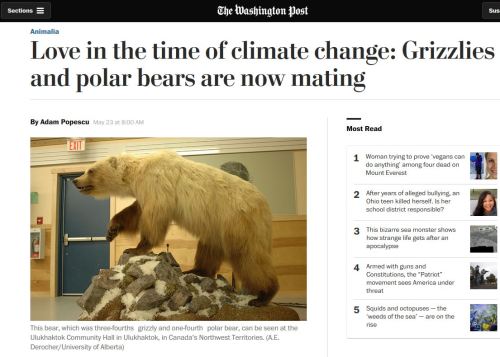
Hybrids again_Washington Post 23 May 2016_title screencap

Washington Post, 23 May 2016, Adam Popescu: “Love in the time of climate change: Grizzlies and polar bears are now mating

Here are the five points you need to know about polar bear hybridization, as there are several nonsense statements contained in this Washington Post article.

UPDATE 24 May 2016: References adding below regarding grizzly sightings south of Churchill on the west coast of Hudson Bay (H/T Doug Clark).

UPDATE 28 May 2016: See this 27 May 2016 follow-up post (Most polar bear hybrids said to exist have not been confirmed by DNA testing) for details on unconfirmed sightings or reports of hybrids.

Continue reading

Climate Hustle knows: Ten dire predictions that have failed as global polar bear population hits 22-31k

[Reposted today from earlier this year in support of the 2 May release of the intentionally funny documentary, Climate Hustle (across the US and a few Canadian locations) because host Marc Morano knows that polar bear numbers have not declined as people have been led to believe, see the trailer below]

Climate Hustle_May 2 2016

Grim predictions of the imminent demise of polar bears – their “harsh prophetic reality” as it’s been called – have been touted since at least 2001. But such depressing prophesies have so widely missed the mark they can now be said to have failed.

While polar bears may be negatively affected by declines in sea ice sometime in the future, so far there is no convincing evidence that any unnatural harm has come to them. Indeed, global population size (described by officials as a “tentative guess“) appears to have grown slightly over this time, as the maximum estimated number was 28,370 in 1993 (Wiig and colleagues 1995; range 21,470-28,370) but rose to 31,000 in 2015 (Wiig and colleagues 2015, pdf here of 2015 IUCN Red List assessment; range 22,000-31,000).

Here are the failed predictions (in no particular order, references at the end):
Continue reading

Polar bear capital of the world stuck between fear-mongering and science

CBS News published a predictably one-sided “Cover Story” this morning (14 February 2016) about Churchill, Manitoba – the self-proclaimed Polar Bear Capital of the World. 

This is the online version of a Sunday morning TV special that’s not available where I live. It’s yet another example of how the media feeds the politics of polar bears and prevents the advancement of science. Here’s my take on this CBS effort.

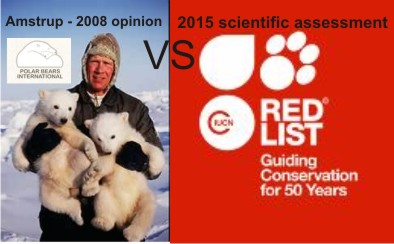
Amstrup vs IUCN science_Feb 14 2016_PolarBearScience

Continue reading

IUCN Red Book officials forced scientific standards on polar bear predictive models

As I reported Thursday, the IUCN announcement of a new Red List assessment for polar bear got the usual overwrought attention from international media outlets. However, not one of these contained a quote from a polar bear biologist.

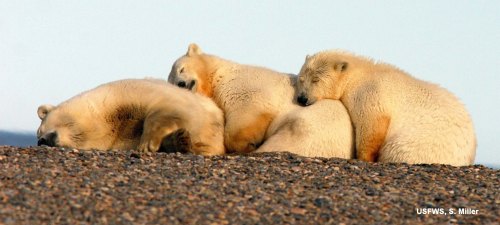
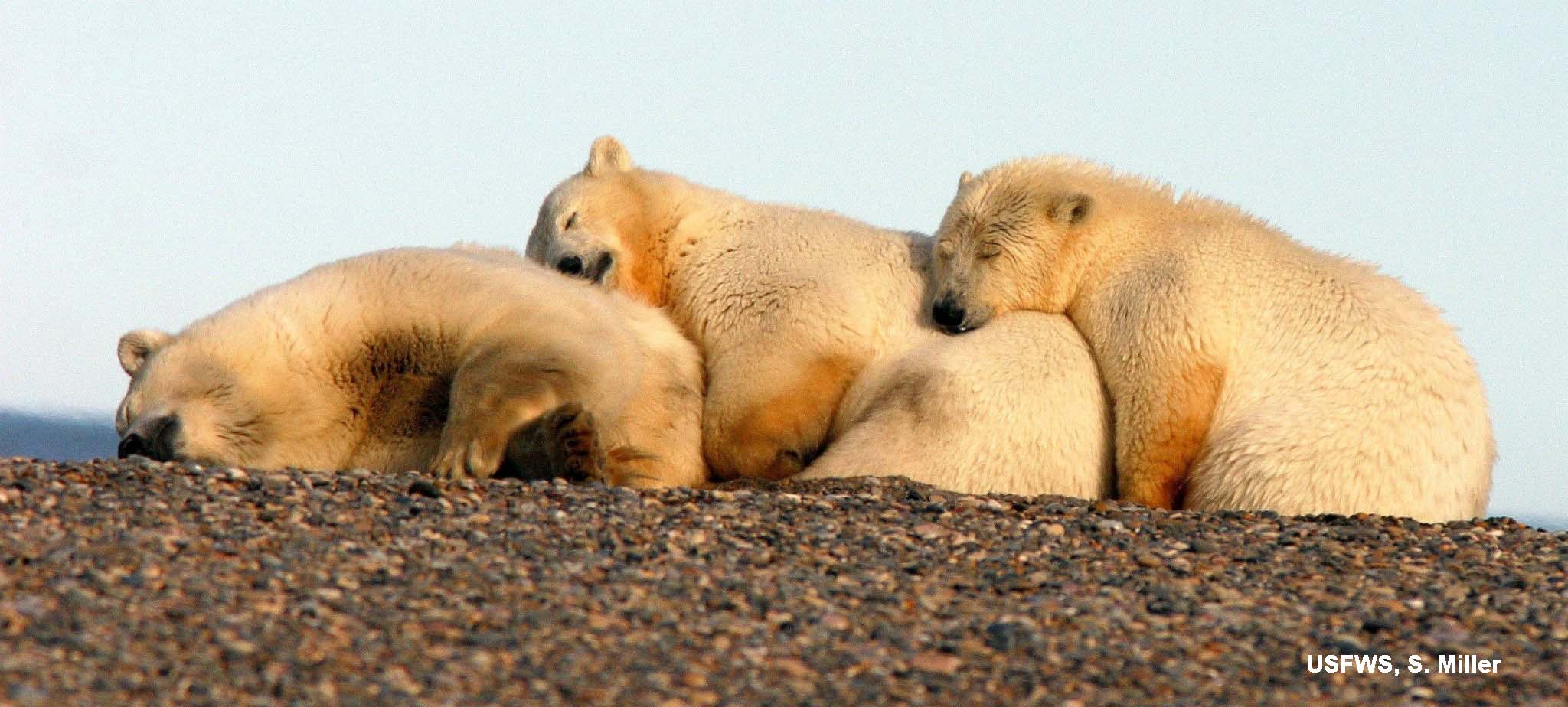
polarbears-arcticnatlwildliferefuge-suzannemiller-usfws_labeled_sm

Steven Amstrup, science spokesperson for activist conservation organization Polar Bears International, has so far had nothing to say to the media. Yet, Amstrup was a co-author of the IUCN Red List report. Not until late in the day following the release of the report did his his organization’s website post a short, bland news report (“Climate Change Still Primary Threat to Polar Bears”).

Similarly, Ian Stirling, Andrew Derocher, Nicholas Lunn (also a co-author of the IUCN Red List report), and former WWF employee Geoff York – who are usual go-to guys for polar-bears-are-all-going-to-die media frenzies – have so far been silent and invisible on this issue.

In addition, while the IUCN press release [backup here: 2015 IUCN Red List press release_Nov 19 2015] included a quote from IUCN Polar Bear Specialist Group (PBSG) chairman Dag Vongraven, as of this morning (21 November, PST), the website of the PBSG contains no mention of this decision – no item in the “News” category  and, more importantly, no update of the status table  or global estimates to reflect the changes contained in the report  (even though they obviously knew it was coming months ago: the report was submitted to the IUCN Red List 27 August 2015).

In my opinion, this silence says it all: polar bear specialists know this assessment is a severe de facto critique of their 2008 assessment (as well as Amstrup’s predictive models) and it’s a big step backwards for their conservation activism. I expect they are silent because they are royally pissed off.

However, this assessment is good news because finally, some standards of scientific rigor have been applied to polar bear predictive models – even though the PBSG were still been allowed to pretend that summer sea ice coverage is critical to polar bear health and survival (Crockford 2015).  Continue reading

Discovery News spreads old misinformation about W. Hudson Bay polar bears

In a just-released Discovery News piece, Kieran Mulvaney (4 November 2015, “In the polar bear capital, an uncertain future) repeated three misleading statements about Western Hudson Bay polar bears that keep making the rounds, despite the fact they have been laid to rest by the latest scientific reports on  (Lunn et al. 2013, 2014; Stapleton et al. 2014). I reviewed these just a few weeks ago.
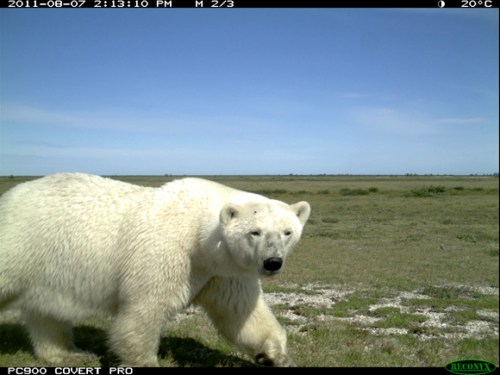
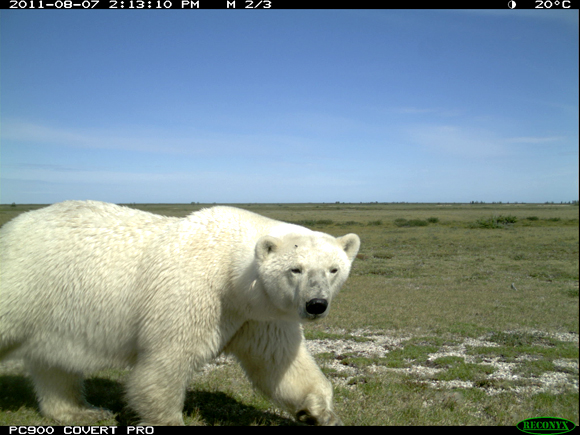
Western Hudson Bay bear, Wakusp National Park, August 2011.

Western Hudson Bay bear, Wakusp National Park, August 2011.

1) “Climate change is causing the bay’s ice to melt earlier and freeze later, causing bears to spend longer a shore.”

Not true. Lunn and colleagues stated explicitly that there has been no trend in either break up or freeze-up of WHB sea ice since 2001. Although there has been large variability in dates, that lack of trend that has continued to this year.

2 & 3) “As a consequence, Churchill’s polar bears are decreasing in number (from approximately 1,350 three decades ago to roughly 900-1,000 now) and in physical condition.”

This deliberately misleading statement avoids the fact that the latest surveys found roughly the same number of bears in 2011 as in 2004 (the estimate used by the IUCN Polar Bear Specialist Group for WHB is 1030) when different counting methods were taken into account. The ~900 bear estimate came from the mark-recapture survey, which left out a portion of the range that the aerial survey covered, hence the official estimate of 1030.

In addition, there has been no scientific assessment of body condition or cub survival since before the last population estimate in 2004 – polar bear “experts” keep telling journalists there are declines but have yet to produce any data to support those claims. The latest surveys did not collect data on body condition or cub survival.

Mulvaney’s misinformation is almost certainly the result of spending time in Churchill with activist Polar Bears International spokesperson Steve Amstrup and activist climate scientist Katherine Hayhoe doing webcasts (e.g. “Challenges of communicating climate change”).  

Mulvaney is clearly not a journalist or a science writer: if he was, he would do some research of his own and stop believing as gospel every word that activist scientists feed him. They are using him as a mouth-piece and sadly, Discovery News is buying it all and presenting it as science.

[Hayhoe, by the way, blocked me on twitter earlier this morning for making one observational comment, my first-ever to her account, in response to a conversation about polar bear population numbers. This is what I said that Hayhoe does not want her followers to know:

“Stop wanton slaughter, #’s go up, works for all species. S Beaufort #polarbear #s dipped due to thick spring #seaice”

Both statements are true and supported by scientific literature. But Hayhoe is all about “climate communication” which appears not to allow science to intrude.]

References
Lunn, N.J., Regehr, E.V., Servanty, S., Converse, S., Richardson, E. and Stirling, I. 2013. Demography and population assessment of polar bears in Western Hudson Bay, Canada. Environment Canada Research Report. 26 November 2013. PDF HERE

Lunn, N.J., Servanty, S., Regehr, E.V., Converse, S.J., Richardson, E. and Stirling, I. 2014. Demography and population assessment of polar bears in Western Hudson Bay, Canada. Environment Canada Research Report. July 2014. PDF HERE [This appears to be the version submitted for publication]

Stapleton S., Atkinson, S., Hedman, D., and Garshelis, D. 2014. Revisiting Western Hudson Bay: using aerial surveys to update polar bear abundance in a sentinel population. Biological Conservation 170:38-47. http://www.sciencedirect.com/science/article/pii/S0006320713004618#

New paper finds experts were wrong: polar bears are not “walking hibernators”

A polar bear paper just out in Science concludes the experts were wrong, polar bears are not “walking hibernators” – in summer, they slow down and live off their accumulated fat just like other mammals. Take home message: experts are not infallible and spring fat is critical for polar bear survival over the summer.

polarbears-arcticnatlwildliferefuge-suzannemiller-usfws_labeled_sm

This paper presents no compelling evidence that Southern Beaufort polar bears, or those in any other region, lack the ability to survive predicted summer sea ice declines in future decades – although they claim it does. See what you think.
Continue reading

USGS promotes another flawed polar bear model: GHG emissions still “primary threat”

It’s still based on the same flawed ecological premise as all previous models – it assumes that sea ice was a naturally stable habitat until human-caused global warming came along. It also uses slight-of-hand maneuvers to correlate declining summer sea ice and declining polar bear population numbers.

PolarBearCV1_USGS_2009

Just because they keep repeating the same hype doesn’t make it true.
Continue reading

Polar bear consumption of terrestrial foods – new paper misses the point

A new paper by polar bear biologists (Rode et al. 2015) argues that terrestrial (land-based) foods are not important to polar bears now and will not be in the future – a conclusion I totally agree with – but they miss the point entirely regarding the importance of this issue.

Fat bears on land in the Southern Beaufort, Sue Miller photo, well-prepared for a brief summer fast.

Whatever food polar bears consume in the summer – whether they are on land or on the ice – doesn’t really matter. What matters is how many fat-rich seals they can consume between March and June each year. The fat put on in late winter/spring from gorging on baby seals carries polar bears over the summer, no matter where they spend it.

USGS polar bear biologist Karyn Rode and colleagues (press release here) have tried to frame this issue as one about future survival of polar bears in the face of declining sea ice. However, the fact that polar bears in the Chukchi Sea and Southern Davis Strait are thriving despite dramatic declines in summer sea ice (aka an extended open-water season), proves my point and disproves their premise. Bears in these regions are doing extremely well – contrary to all predictions – because they have had abundant baby seals to eat during the spring (see here and here).

Continue reading

US biologists used same flawed models for listing walrus and polar bears as ‘threatened’

More bad science: US biologists successfully used a scientifically flawed model to get polar bears listed as ‘threatened’ and thus emboldened, went on to do the same for walrus.

Walruses_USFWS photo_030515_March 2015

The intricate US Geological Survey model of ‘expert opinion’ that was used to support the listing of polar bears as ‘threatened’ under the US Endangered Species Act (ESA) has been soundly rejected by the world’s leading conservation organization, the IUCN,1 which has has tightened its rules for using “future conditions” (e.g., effects of global warming) in generating Red List assessments. That IUCN condemnation means the USGS model was never “the best available science” for evaluating the status of polar bears  ̶  it was (and still is) substandard, inadequate science that makes a mockery of serious conservation efforts.

However, not only has this flawed model continued to be used by the USGS for polar bears, it has also been used to assess the conservation status of Pacific walrus, which are now officially “candidates” for being listed as ‘threatened’ (US Fish and Wildlife Service 2011).2

Continue reading

PolarBearScience has been ‘Carbon Briefed’ – success at last!

Not just anyone warrants the attention of the European rapid response team: only those who get media attention and refuse to stay ‘on message’ about global warming issues get the Carbon Brief treatment.

Pidcock tweet on polar bears at 5 March 2015 6_20PM Pacific

After years of being ignored, I have finally been acknowledged as a worthy adversary [a force to be reckoned with] by those who spin the science of polar bears.

Carbon Brief folks got their knickers in a knot over my “Twenty Good Reasons Not to Worry about Polar Bears” blog post that the Global Warming Policy Foundation released as a Briefing Paper (pdf here). All timed for release on International Polar Bear Day (27 February 2015), which got mainstream media attention galore in the UK.
Continue reading