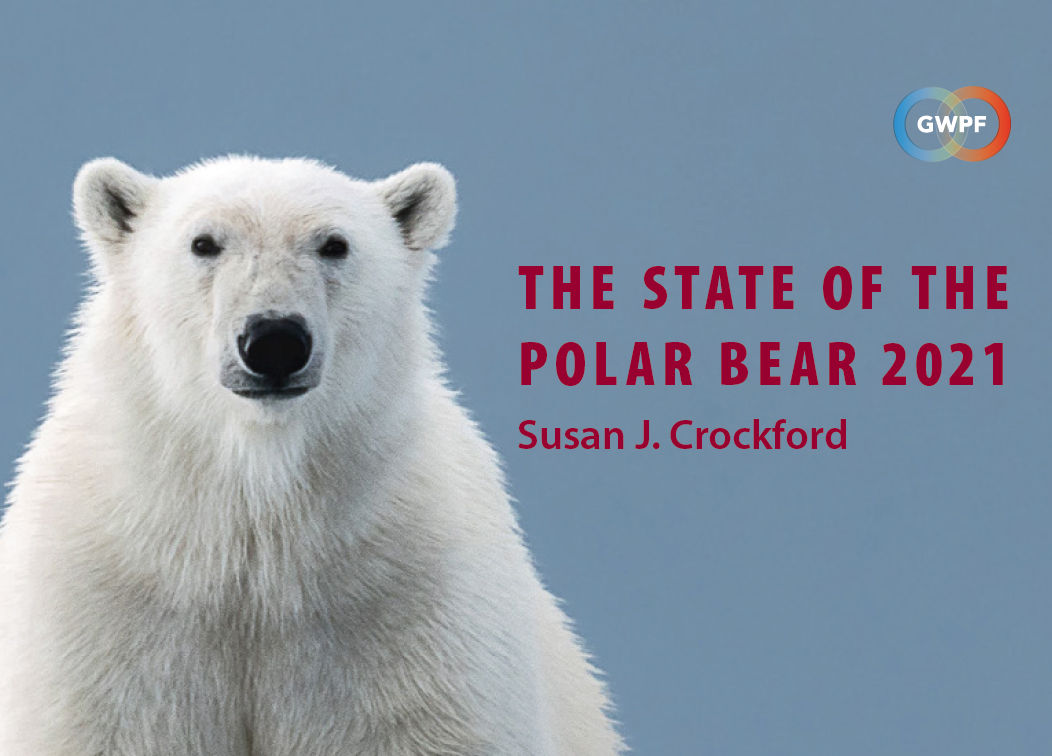
The current health and abundance of polar bears continues to be at odds with predictions that the species is suffering serious negative impacts from reduced summer sea ice blamed on human-caused climate change.

The current health and abundance of polar bears continues to be at odds with predictions that the species is suffering serious negative impacts from reduced summer sea ice blamed on human-caused climate change.
Comments Off on State of the Polar Bear 2021: polar bears continued to thrive
Posted in Advocacy, Conservation Status, Polar bear attacks, Population, Sea ice habitat, Summary
Tagged attacks, Chukchi Sea, Davis Strait, Dyck, population size, recovery, surveys
When I came across this fascinating National Film Board video from 1949 on how to build an igloo, it reminded me of a conversation I had with a colleague about whether the design of the Inuit snow house was originally developed in part as protection against marauding polar bears?
Such a dome of tightly-fitted snow blocks, when properly consolidated with a thin layer of ice inside, must have been virtually impenetrable to even the hungriest bears – and defendable at the narrow entrance tunnel. The image below is from Frobisher Bay, Baffin Island around 1865, which lies within the boundaries of the Davis Strait subpopulation of polar bears.

A link to ‘How to Build an Igloo‘ is included in my free ‘Arctic Sea Ice Ecosystem Teaching Guide‘ for home schooling found here. The igloo film is 10 minutes long and suitable for all ages.
Continue readingComments Off on How to build an igloo: was the snow house designed in part to protect against polar bears?
Posted in Book promotion, home schooling, Polar bear attacks
Tagged Arctic, attacks, attractants, dwellings, igloo, polar bear, semi-subterranean houses
A couple weeks ago I had a fabulous chat with Daniel Vitalis from Wildfed about a wide range of topics, including my work on polar bears and domestication as a process of speciation. The podcast went live this morning – have a listen here (also copied below), I think you’ll enjoy it. One hour, 36 minutes.
Comments Off on Podcast with WildFed about polar bears and domestication as speciation
Posted in Summary
Tagged academic freedom, attacks, domestication, hunting, interview, podcast, polar bear, sea ice, speciation, thyroid hormone
If you thought polar bears were only a danger to people in summer when sea ice is low, think again. Bears do occasionally come ashore early to mid-winter looking for food because hunting is difficult and they are approaching their leanest time of year. They simply walk from the ice onto land – often close to communities – because many things associated with modern human living are food attractants for polar bears.

This tracking map of Western Hudson Bay bears (females with collars) 11 January 2021 (courtesy Andrew Derocher) shows a bear just offshore near the community of Whale Cove on the northwest coast – close enough to come ashore if she decides that could be in her best interests:
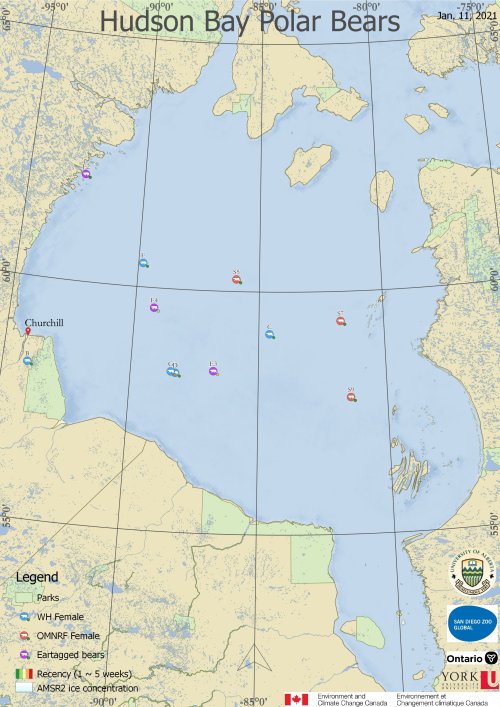
Derocher had this to say about the location of this bear (12 Jan 2021):
It may be ‘odd’ for a bear to be so close to shore in winter but since we know that polar bears do come ashore in winter, it isn’t rare but ‘uncommon’. Most of the trouble with bears ashore seems to come in March/April on the coast of Labrador and Newfoundland when sea ice is more extensive and where 2017 was an exceptional year.
2019 Labrador, Bears reported onshore in Labrador (January 2)
2019 Labrador, Bears onshore in Labrador causing problems (February 1)
2019 Alaska, Polar bear attack hundreds of miles from shore (January 15)
2016 Labrador, Bears onshore in Labrador (7 February)
2016 Summary of prior incidents and attractants (19 March)
Below: Sea ice conditions at 13 January 2021, North America compared to 2020 and 2019, showing how extensive the ice was in 2019 (and accounting for bears ashore at Labrador and Newfoundland in early January):
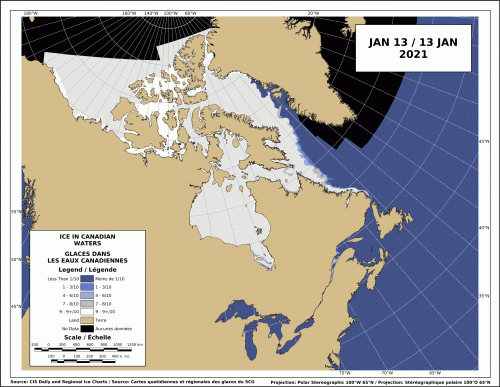
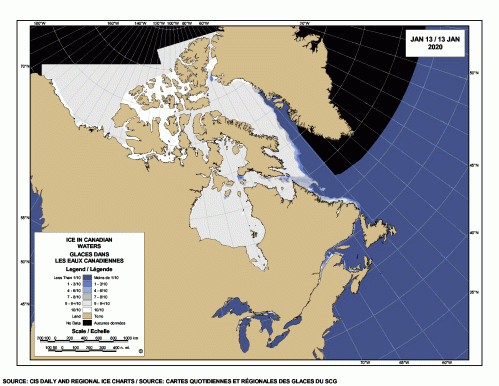
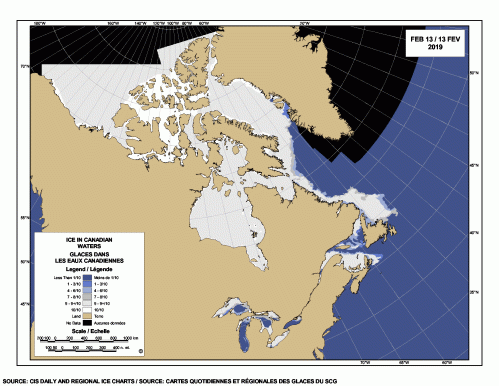
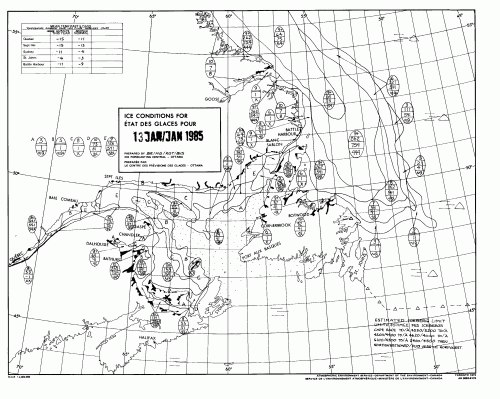
Below is a chart from 1985, when sea ice off Labrador and Newfoundland was as thick in mid-January as it was in 2019, yet as far as I know, there were no reports of bears ashore in Labrador or northern Newfoundland. This difference is almost certainly because the population size of Davis Strait bears had not yet recovered from previous centuries of overhunting and harp seals numbers were still quite low compared to what they rose to over the next three decades: currently, both Davis Strait polar bears and harps seals are abundant (DFO 2012, 2014, 2020; Peacock et al. 2013) and numbers could still be climbing, although the results of a recent bear survey in the region has not yet been published.
Department of Fisheries and Oceans Canada (DFO) 2012. Current status of northwest Atlantic harp seals (Pagophilus groenlandicus). Science Advisory Report 2011/070.
Department of Fisheries and Oceans Canada DFO. 2014. Status of Northwest Atlantic harp seals, Pagophilus groenlandicus. DFO Can. Sci. Advis. Sec. Sci. Advis. Rep. 2014/011.
DFO. 2020. 2019 Status of Northwest Atlantic Harp Seals, Pagophilus groenlandicus. DFO Can. Sci. Advis. Sec. Sci. Advis. Rep. 2020/020. http://www.isdm-gdsi.gc.ca/csas-sccs/applications/Publications/result-eng.asp?params=0&series=7&year=2020 PDF here.
Peacock, E., Taylor, M.K., Laake, J., and Stirling, I. 2013. Population ecology of polar bears in Davis Strait, Canada and Greenland. Journal of Wildlife Management 77:463–476. http://onlinelibrary.wiley.com/doi/10.1002/jwmg.489/abstract?deniedAccessCustomisedMessage=&userIsAuthenticated=false
Comments Off on Polar bears can come ashore any time of year and cause trouble: a timely reminder
Posted in Polar bear attacks, Sea ice habitat
Tagged attacks, attractants, Labrador, polar bear, problem bear, sea ice, winter
In Svalbard, Norway, it is routine practice to chase polar bears away from settlements with snow machines and helicopters, then tranquilize and relocate them if necessary but in late January this approach led to the death of a young male bear.

Necropsy results released 26 March 2020 revealed that the two year old bear, who had wandered into and around Longyearbyen multiple times in late January, was captured after a prolonged helicopter chase but died enroute as it was flown north to Nordaustlandet (see map below) from circulatory failure due to administering anesthesia after the prolonged stress of being chased.
Video here of the bear being chased out of Longyearbyen by helicopter (photo above is of the New Year’s bear). Longyearbyen has had more problems than usual with polar bears this winter due to the unusually extensive sea ice off the west coast of Svalbard. Polar bears are particularly dangerous in winter and with the abundance of bears in recent years many Arctic communities are at risk with each having to find their own solutions.
In the wee hours of New Years Day 2020 a fat Svalbard polar bear was shot because of persistent visits to downtown Longyearbyen and the public was outraged. A few weeks later a bear attacked a dogsled loaded with tourists. The death of the young bear in late January in the course of removing it (rather than shooting it) is a reminder that tranquilizing a polar bear, especially after a prolonged chase, can be as lethal as shooting it.
Comments Off on Svalbard finds tranquilizing & removing problem polar bears comes with risks to bears
Posted in Polar bear attacks, Sea ice habitat
Tagged Arctic, attack, attacks, polar bears, problem, safety, sea ice, self-defense, tranquilizer drugs
On Tuesday 17 March 2020, several polar bears were reported in and around the community of St. Anthony on the Northern Peninsula of Newfoundland, adding another threat on top of coronavirus concerns in the province. The photo below is from a 2018 Newfoundland sighting from the same region: none are available for the current report.

There have been no reports of trouble but locals will have to stay vigilant to remain safe, which since 2008 has been a common concern from late winter to early spring. In 2012 in this area, a bear was shot after it destroyed homes and attacked livestock; another bear was shot the next week in the same area. And in 2016 and 2017, a bear had to be shot to protect residents. Bears at this time of year are in hunting mode, which is why my polar bear attack thriller novel, EATEN, is set in March.

Current sea ice conditions below.
UPDATE 22 March 2020: “Just after 1 p.m. on March 21, the RCMP St. Anthony advised they blocked off Goose Cove Road, St. Anthony, as a polar bear has been sighted in the area. Wildlife is en route to assess the situation. In the interest of public safety residents are asked to stay away from this area.” From Saltwire here. Another report on the same sighting here.
Comments Off on Polar bears prowling Newfoundland come on top of coronavirus fears
Posted in Life History, Polar bear attacks, Sea ice habitat
Tagged attacks, coronavirus, feeding, harp seal, hunting, Newfoundland, polar bear, sea ice, sightings
It’s week 7 of the Churchill polar bear season that began in early July and it’s been remarkably quiet: compared to 208 and 2016, there were half as many problem bear incidents in 2019. A few bears have come off the ice near the community and they’ve been in good shape, as are the bears to the east at Cape Churchill (see one captured on live cam 23 August shown below) and the north at Seal River.
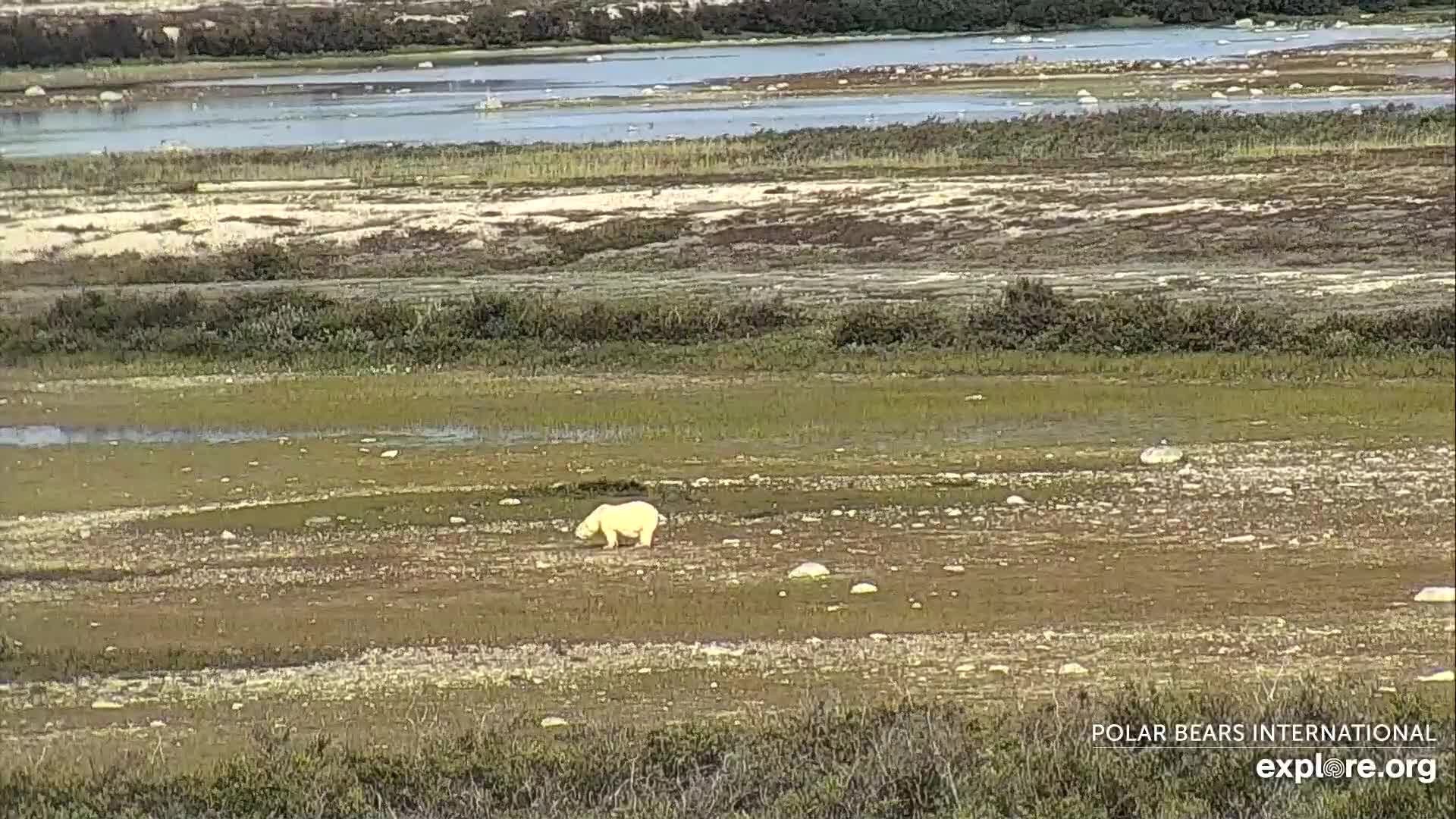
But it looks like many more bears than usual may have decided to ride out the slow-melting ice that lingered well past the first week of August and came ashore further south, towards the Manitoba/Ontario border.
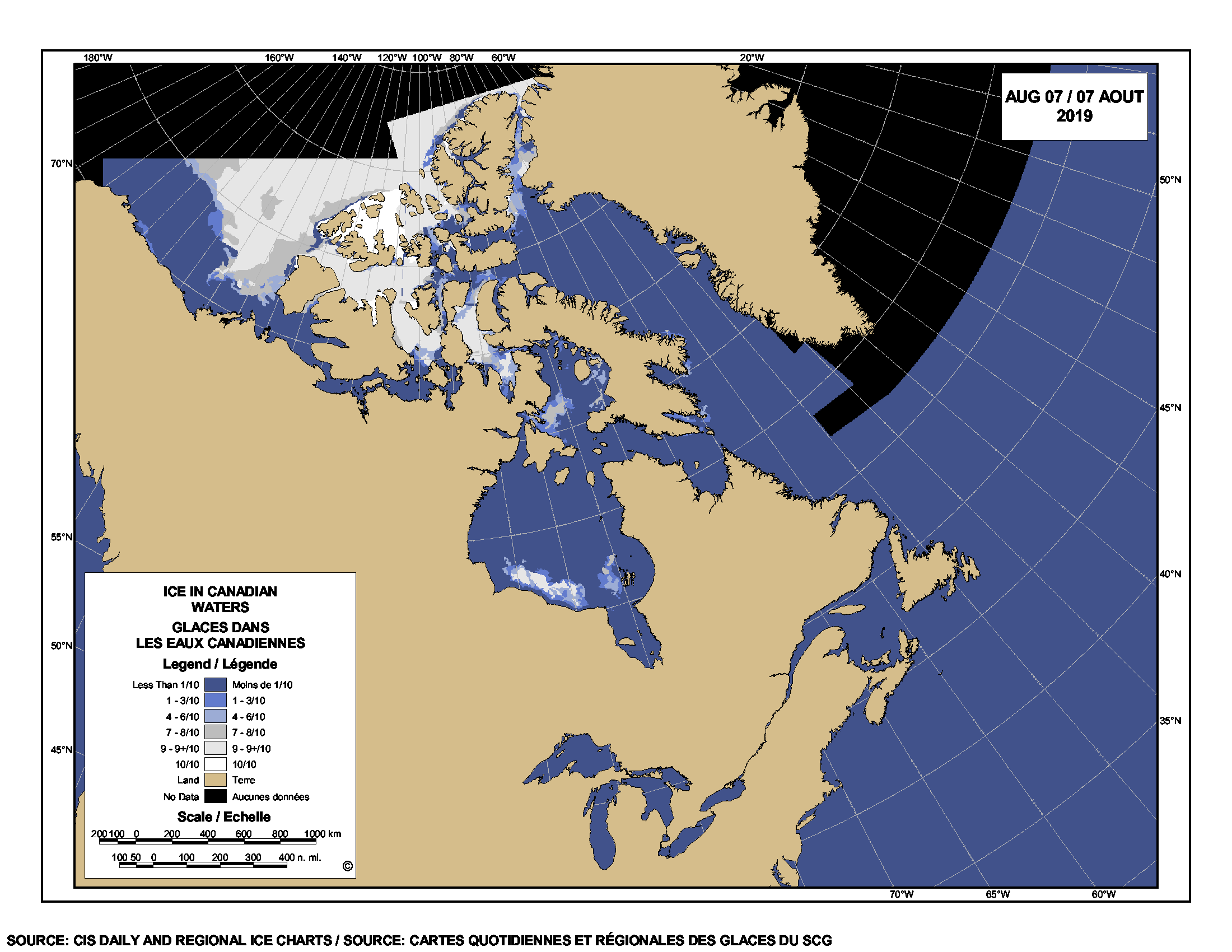
If so, these bears will have to make their way north over the summer so they can intercept the first ice forming along the northwest coast off Wapusk National Park near Churchill. That’s why Western Hudson Bay bears are said to undergo a migration: no matter where they leave the ice in summer, most bears head to areas around Churchill so that they can resume seal hunting on the early fall ice.
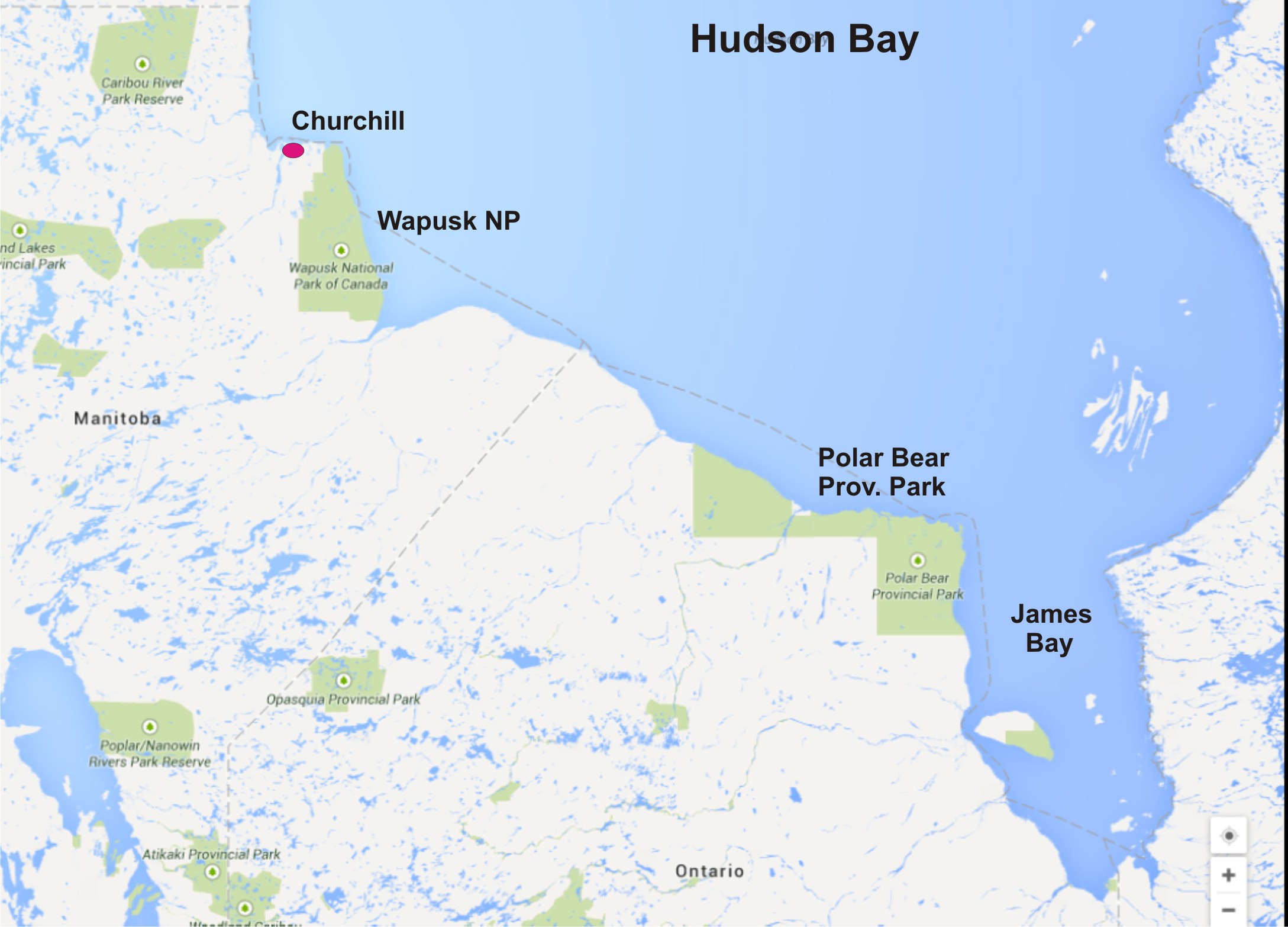
A paucity of bears around Churchill in late summer/early fall is not unprecedented, however. Stirling and colleagues pointed out that in 1972 and 1973, for reasons they could not explain, there had been fewer bears than usual around Churchill well before freeze-up and therefore, fewer problem bears (Stirling et al. 1977:17).
Below is a comparison of the Polar Bear Alert Program report for last week (Week 7, Aug 19-25) to previous years.
Comments Off on Churchill polar bear activity report for week 7 shows oddly few problems so far
Posted in Life History, Polar bear attacks, Sea ice habitat
Tagged attacks, Churchill, migration, polar bear, polar bear alert, problem bears, sea ice
The standoff between Inuit and polar bear specialists regarding the status of polar bears in Canada is not going to end until someone in authority demands to see the data scientists insist contradict Inuit knowledge.
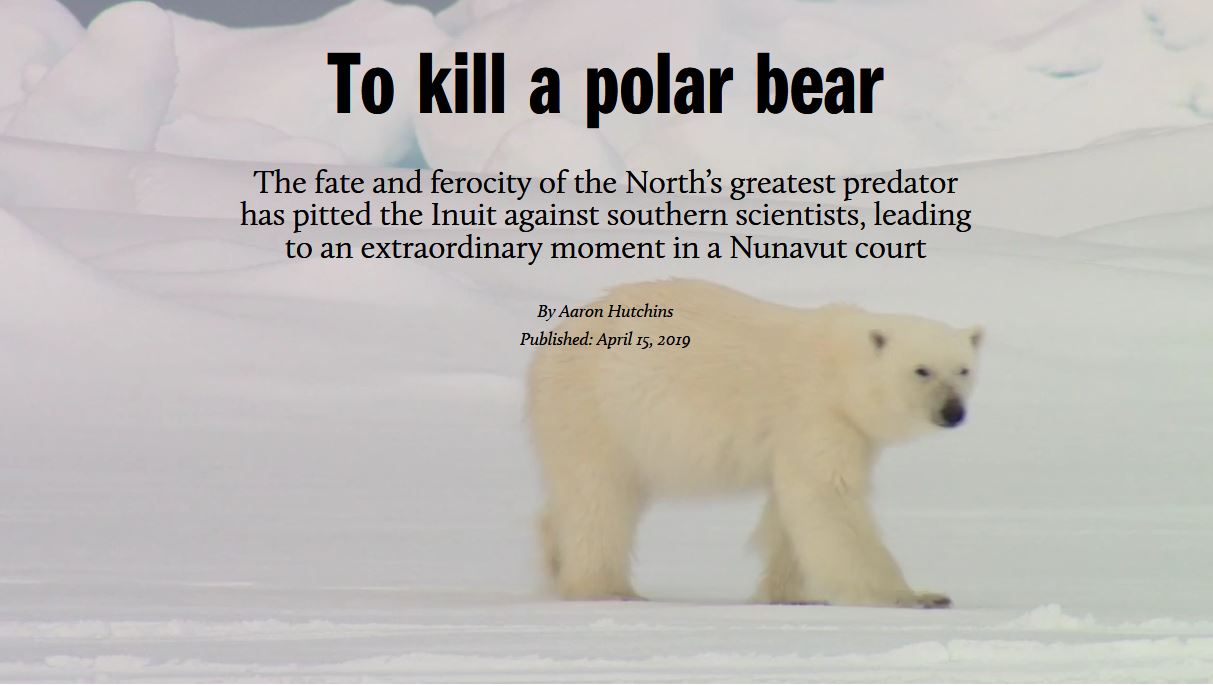
An article in Maclean’s Magazine (15 April 2019), entitled “To Kill a Polar Bear”, explores some of the feelings and opinions of folks involved but fails to ask whether the data support the rhetoric advanced by scientists. Author Aaron Hutchins takes the scientists at their word, that seeing more bears than 20 years ago is all because of lack of sea ice. However, from what I’ve seen, he might as well trust a fox in a hen house.
Ian Stirling is quoted by Hutchins insisting that polar bears in Western Hudson Bay continue to suffer from the effects of declining sea ice, without mentioning that ice cover has been essentially static on Hudson Bay since at least 2001 (Castro de la Guardia et al. 2017; Lunn et al. 2016) and fall freeze up dates for the last two years were earlier than most years in the 1980s:
“This year saw the seventh-lowest Arctic sea ice levels since the National Snow and Ice Data Center first started gathering satellite data 40 years ago, with the long-term trend clearly downwards. And the negative effects on polar bears can be clearly seen in the science, says Stirling, pointing to the closely studied subpopulation along western Hudson Bay: “They’re losing body condition. Reproductive rates have dropped. Survival rates of young have plummeted. Every indication you would expect from a declining population is there.”
However, as I’ve pointed out previously (last year and in 2012), there are no recent data published that support these claims: the only information that exists is at least 25 years old. And the fact that no such data have been published suggests strongly that it either does not exist or does not show what Stirling claims it shows.
Yet, the government of Canada is willing to bet the lives of Inuit on their belief that polar bear specialists would never stretch the truth to qualify for government grants.
Comments Off on Even with Inuit lives at stake, polar bear specialists make unsupported claims
Posted in Advocacy, Conservation Status, Polar bear attacks, Population, Sea ice habitat
Tagged attacks, conservation, declining, fatalities, government, Inuit, Maclean's, polar bear, problem bears, scientists, sea ice, status, too many bears
On sale at Amazon today, my new full-length science book, The Polar Bear Catastrophe That Never Happened, published by the Global Warming Policy Foundation.
Paperback and ebook versions are available. See the GWPF press release here.
The official book launch is 10 April in Calgary, details below.
 The Polar Bear Catastrophe That Never Happened explains why the catastrophic decline in polar bear numbers we were promised in 2007 failed to materialize. It’s the layman’s story of how and why the polar bear came to be considered `Threatened’ with extinction and tracks the species rise and fall as an icon of the global warming movement. The book also tells the story of my role in bringing that failure to public attention – and the backlash against me that ensued.
For the first time, you’ll see a frank and detailed account of attempts by scientists to conceal population growth as numbers rose from an historical low in the 1960s to the astonishing highs that surely must exist after almost 50 years of protection from overhunting. There is also a discussion of what thriving populations of bears mean for the millions of people who live and work in areas of the Arctic inhabited by polar bears.
Title: The Polar Bear Catastrophe That Never Happened
Author: Susan J. Crockford
Publisher: Global Warming Policy Foundation
Publication date: 17 March 2019
Distrbutor: Amazon
Formats: Papberback and Ebook
Number of pages: 209
Order it here.
Continue reading
Comments Off on The Polar Bear Catastrophe That Never Happened is now for sale
Posted in Book review, Polar bear attacks, Population, Sea ice habitat, Summary
Tagged attacks, extinction, facts, models, number of bears, polar bear, population size, predictions, science, sea ice, threatened
In case you missed it back on 27 Februrary 2019. See the original here (with photos).**

Comments Off on My International Polar Bear Op-Ed at the Financial Post on 27 February 2019
Posted in Advocacy, Conservation Status, Polar bear attacks, Population, Summary
Tagged attacks, Churchill, essay, fatal, Novaya Zemlya, Nunavut, opinion, polar bear, problem, sea ice





 polarbearscience
You must be logged in to post a comment.