Tag Archives: Barents Sea

Late winter surge in sea ice habitat and the resilience of Svalbard polar bears

The Barents Sea – and Svalbard in particular – has had very little sea ice this winter but recent evidence suggests pregnant females adapted by moving east to Franz Josef Land to have their cubs. The surge in ice that’s come over the last few weeks will, however, be welcome habitat for the critical hunt of fat newborn seals that takes place primarily in April and May.

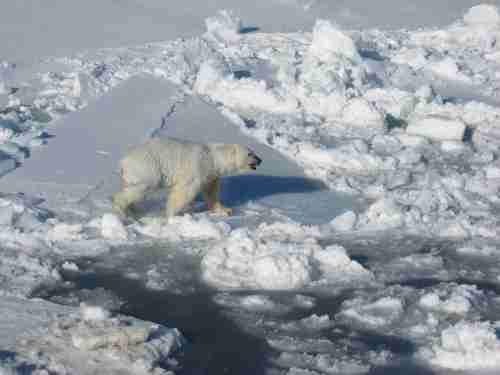
Svalbard polar bear_NP015991-isbjorn-JA

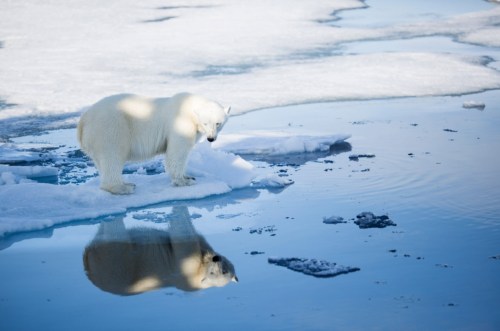
It was only last fall that Norwegian biologist Jon Aars (photo above taken by him in August 2015) was touting the fat condition of Svalbard-area polar bears he and his team saw in August and admitted the population had increased by a whopping 42% since 2004 – despite dire predictions of a drastic decline. In fact, 2014/2015 was a great year for the area’s polar bears.

However, in the fall of 2015 sea ice was so late forming around Svalbard that it seemed impossible that any females would get to traditional denning grounds on the east coast in time to give birth. There was no sea ice to speak of until late December, so it seemed virtually certain that all females had gone to Franz Josef Land further east (in Russia) – as they are known to do – to utilized its alternative denning sites.

It’s called resilience – the ability to shift behaviour in response to changing conditions. In this case, all indications are that shifting den locations to Franz Josef Land is a long-standing response of Svalbard area polar bears to low ice conditions. This shift does not even require a movement outside their subpopulation boundaries, let alone a movement outside the ill-defined “sea ice ecoregions” originally defined by Steven Amstrup and colleagues (2008) to support their prediction that polar bears will likely be extinct by 2100, taken up later by others since.

Some polar bear specialists appear to believe that if Barents Sea conditions are not precisely what they were in the 1980s (examples here and here), polar bears cannot possibly survive. But the bears are showing them otherwise – and demonstrating how they likely survived previous warm periods like the Holocene Optimum ~9,000 years ago and the Eemian Interglacial ~115,000-130,000 years ago (CERQA 2014:66) without population numbers getting anywhere near extinction levels.
Continue reading

Polar bear habitat update: Labrador sea ice highest in 20 years

Sea ice off the southern Labrador coast hasn’t been this high for this date in 20 years: that’s great news for the harp and hooded seals that will give birth at the Front in another few weeks – for a while anyway, because a bumper crop of baby seals is also good news for the polar bears who gather there to eat them.

Sea_ice_near_coast_of_Labrador_-a_wikipedia sm

So brutal, but true. The polar bear must gorge over the short Arctic spring and early summer to survive the rest of the year.

Continue reading

Polar bear habitat at 26 January 2016

There is still below average ice extent in the Barents Sea but there is no data whatsoever to indicate that this situation poses a problem for polar bears, given that as far as researchers know, polar bears eat little or nothing during the winter. That’s why the bears are at their leanest at the end of winter and why seal pups born in early spring are such a critical food source.

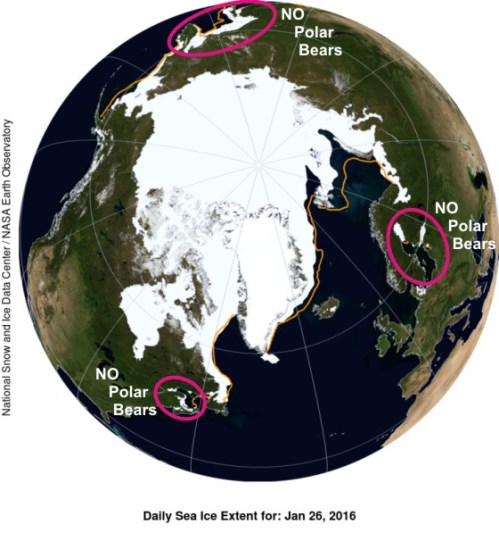
Note on map below (from WUWT Sea Ice Page, marked; original here) that polar bears are not found in three areas that are included in the total Arctic ice extent figures: below-average or above-average ice in the Sea of Okhotsk, Baltic Sea, and Gulf of St. Lawrence have no impact on polar bear health and survival.


Polar bear habitat at 26 Jan 2016_no bears marked_PolarBearScience_sm

Additional ice maps below. Continue reading

Polar bear survival: habitat 2013 vs. 2016 for 22 January

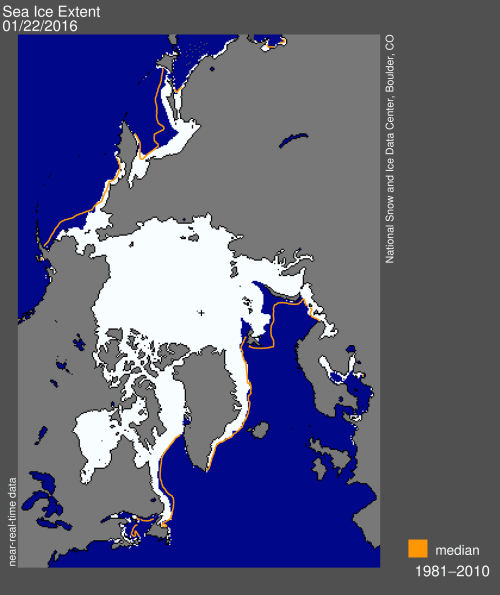
Using sea ice maps issued by the National Sea Ice Data Center (NSIDC), it’s interesting to compare these two years with respect to polar bear health and survival (keeping in mind that no polar bears live in what I like to call the armpits of the Arctic – the Sea of Okhotsk, the Baltic Sea or in the Gulf of St. Lawrence)1:

22 January 2016

Sea ice extent 2016 Jan 22 NSIDC

Continue reading

Survey Results: Svalbard polar bear numbers increased 42% over last 11 years

Results of this fall’s Barents Sea population survey have been released by the Norwegian Polar Institute and they are phenomenal: despite several years with poor ice conditions, there are more bears now (~975) than there were in 2004 (~685) around Svalbard (a 42 30% increase) and the bears were in good condition.

Svalbard polar bear fall 2015_Aars

Oddly, in a September report right after the count, biologist Jon Aars reported them in “excellent” condition, with some of them “as fat as pigs.” I guess “good” is the same as “excellent.”

Bears in the Russian portion of the Barents Sea were not counted this year because the Russians would not allow it; the previous total count, from 2004, was 2,650 (range ~1900-3600) for the entire region.

map-BarentsSea

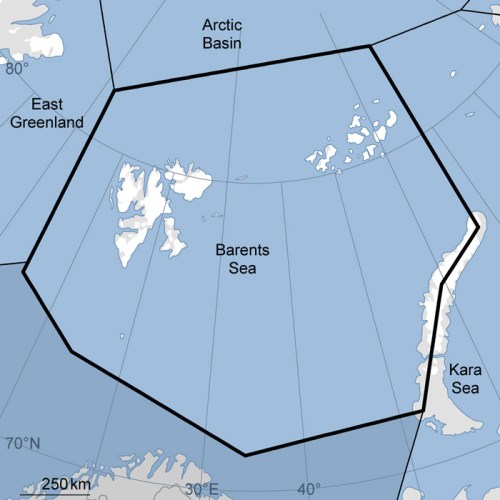
In the map above (courtesy the IUCN Polar Bear Specialist Group), the Svalbard archipelago is on the left (Norwegian territory) and the archipelagos of Franz Josef Land and Novaya Zemlya on the right (Russian territory).

Oddly, the comments made by lead researcher Jon Aars to a Norwegian newspaper (in English), which picked this up yesterday (“Polar bears make a comeback” ), were far more positive than those in the press release (which is likely all that western media will see).

UPDATE 24 December 2015: The new population survey number for Svalbard is actually a 42% increase over the 2004 number. Thanks to Arvid Oen, a WUWT reader, for alerting Anthony Watts to the error, and to Anthony for passing it along. Title and text fixed accordingly, apologies to any others who have picked this up. Cheers and Merry Christmas.

Continue reading

Barents Sea polar bears adapt to changing sea ice conditions

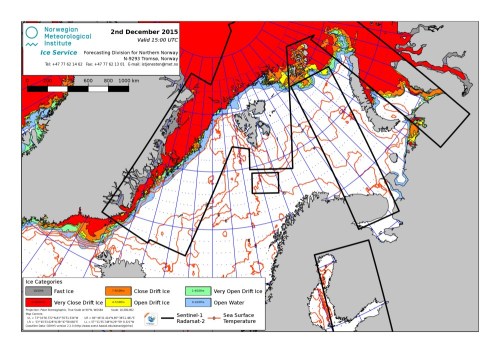
Sea ice development in eastern Svalbard this fall is lagging well behind the rest of the Arctic. Several polar bear researchers (e.g., Andrew Derocher here and here) have recently been raising the alarm that this might be devastating for Barents Sea females looking for suitable denning sites.

Barents Sea ice 2015 Dec 2_NIS_sm

The implication is that pregnant polar bear females are inflexible – so fixated on one location to give birth that they are unable or unwilling to choose an alternative if conditions preclude using their preferred location this year. However, the available facts do not support such a pessimistic attitude.
Continue reading

Polar bear habit update – day 333 Arctic sea ice hits 11.1 mkm2

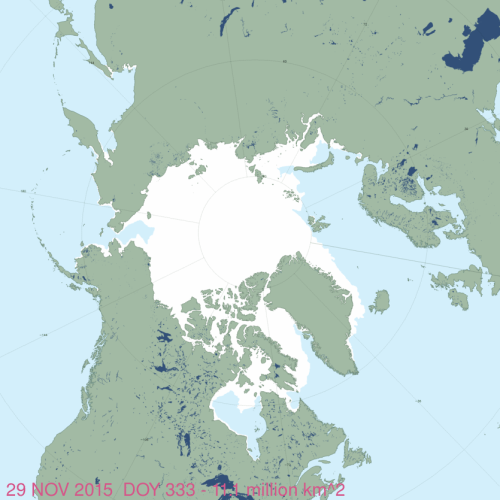
It’s just past the height of fall in the Arctic (Oct-Dec) and polar bear habitat is expanding day by day: according to NSIDC Masie ice charts, the ice has now surpassed 11 mkm2 in extent. Fall is the second most important feeding period for polar bears after spring.

masie_all_zoom_4km 2015 day 333_Nov 29

Only the Barents and Kara Seas (north of Norway and western Russia) are short of ice right now, similar to conditions seen in the fall of 2013. Last fall (2014), conditions were much better and as a consequence, researchers saw a lot of females with healthy cubs in the spring of 2015.

Continue reading

Winter returns to the Arctic – freeze-up 2015 at October 20 expands polar bear habitat

Fall is the season when polar bears that have spent the summer fasting can return to the refreezing sea ice to resume successful hunting. For polar bears, fall is the second-most important time of year for hunting, after spring.

masie_all_zoom_4km_2015 Oct 20

The date when freeze-up occurs across the Arctic varies from place to place and year to year, but the process is well underway this year. The US National Snow and Ice Data Center’s MASIE map for 20 October 2015 (above) shows 7.7 mkm2 of sea ice, up from the annual low of 4.41 mkm2 almost 6 weeks ago.

Continue reading

Barents Sea polar bears in excellent condition say Norwegian biologists

Conditions this year (2015) in the Barents Sea were excellent according to the polar bear researchers who work there (“Polar bears were as fat as pigs”).

Barents Sea bear 2015 August Cobbing_NPI
A new survey just completed for a population count showed the bears were are in excellent condition – except the injured ones, of course, which some news organizations are promoting as evidence of harm from global warming-induced sea ice changes because an activist photographer  – not scientists – said so.

Continue reading

Polar bear habitat update – more ice than 2012 when all the bears didn’t die

Overall, the situation is better than many recent years – lower than average but higher than even 2012 and 2007, when all the polar bears didn’t die despite record-low extents for September. In several areas of the Eastern Arctic, sea ice levels continue to run higher than average. There is plenty of ice in the Arctic Basin for polar bears spending the summer under the midnight sun.

masie_all_zoom_v01_2015237_4km

According to NSIDC MASIE (see map above):

2007 at 25 August – 5.2 mkm2
2012 at 25 August – 4.9 mkm2
2015 at 25 August – 5.3 mkm2
Continue reading