Tag Archives: breakup

Churchill seemingly unworried about polar bears, fails to post problem bear reports on social media

We know transparency’s gone out the window for many public officials, but still: Since early August, I’ve been checking daily for Problem Polar Bear Reports issued by the Churchill Polar Bear Alert Program managed by Manitoba Conservation. This morning (12 September), five reports were posted at once on the Town of Churchill website, dating back to first of the season for the week of August 5-11, see image below.
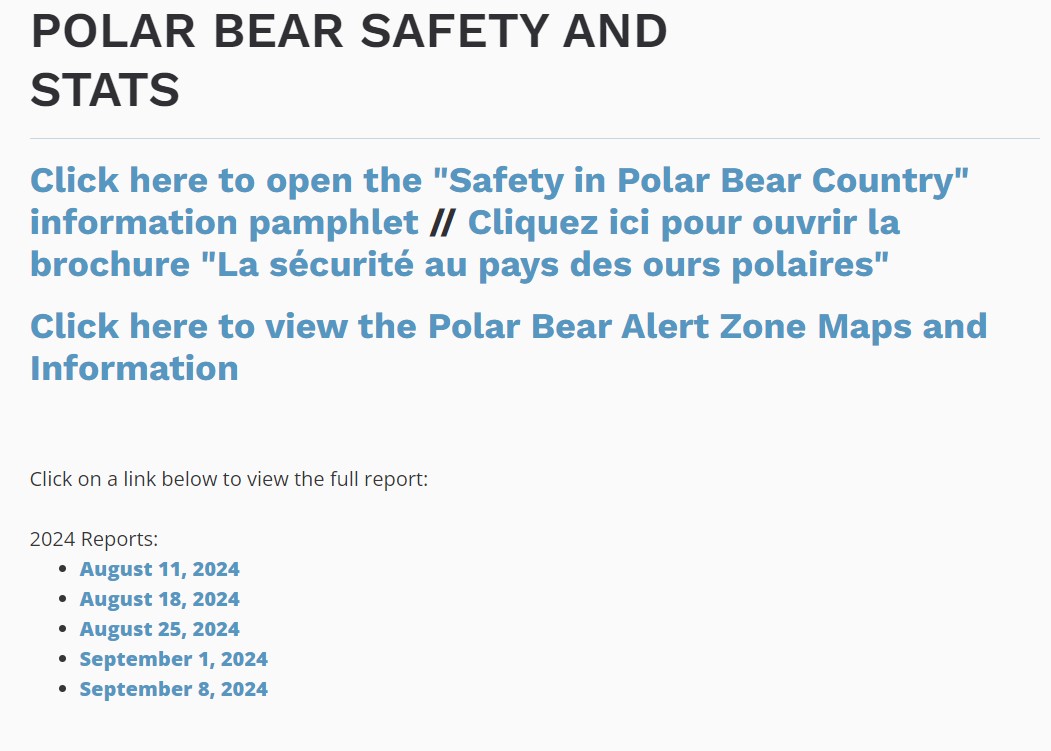
It’s apparent that the intent of these reports is in part public safety: to raise awareness of the potential threat of wandering polar bears around the town of Churchill because of the language that appears on virtually every report: “stay vigilant”, “be bear smart,” “be bear aware,” etc.

However, the X account for Town of Churchill seems to have been abandoned (last post 19 April 2024), which suggests the town is confident no residents or tourists would benefit from Alerts on X that polar bears are ashore:

The town’s Facebook account seems to be their only method of public communication yet even there, there have been no Polar Bear Alert reports posted this summer.

Oddly, even though it is now apparent from the just-released reports that one bear got so close to town that it had to captured and put in the ‘polar bear jail’ the week of 5-11 August — for the public’s safety — the only safety announcement the town issued that week was a ‘heat warning’ on 12 August:

I guess we are to assume that whoever is running this account – or the town council, or the mayor – believes that a day or two of hot weather (which Churchill gets regularly most years) is more dangerous to public safety than a massive predator wandering around town.

I can only conclude that keeping residents and tourists in the dark about potential threats from local polar bears is one way that Churchill is now adapting to climate change (from CBC News, 10 September 2024):

Bears Onshore and Effective Sea Ice Breakup dates

It is apparent from the wording of the Churchill reports that even by the last week of August this year, all bears were not yet off the ice, since they say only that “most bears” were on shore the week of 26 August to 1 September (see next section).

That suggests the last bears came ashore this year at least a week later than they did in 2020 (at 21 August), which at the time polar bear specialist Andrew Derocher presented as an anomaly (see tweet below). Compare to the situation last year here.

The last report I’ve seen from Derocher (via X) for 2024 on the status of his teams’ tagged females is that many of them (11/29 or 38%) were still on the ice as of 8 August (posted 11 Aug):

Derocher referring to this an “amazing” year that’s “similar” to the 1980s probably doesn’t tell the half of it, since he hasn’t posted any maps since then (as of noon, 12 September).

This effectively keeps secret the date when the last of these females bears actually came ashore, which is in any case a biased microcosm of the entire subpopulation. In other words, we can expect that if 40% of tagged female were still on bits of remnant ice at 8 August, there will have been many more bears, especially males, out there as well – which of course he never mentions.

He also never mentions that satellites under-report the amount of ice at this time of year by as much as 20% because of the effects of melt-water sitting on ice, but we’ve come to expect that.

Oddly, a recent study tried to explain the importance to survival of the recent phenomenon (since about 2015 or so) of bears staying out on melting bits of remnant ice rather than heading immediately to shore when the ice coverage over Western Hudson Bay drops below 50%. They suggested this behaviour was largely confined to male bears because they had to make up for feeding missed during the breeding season (McGeachy et al. 2024).

Females, alternatively, appear to respond to break-up in WH by coming onshore approximately 3 weeks after the mean ice concentration in WH reached 50%, … However, suitable habitat was still present elsewhere in the Bay and appeared to be used by a portion of WH prime age males. [McGeachy et al. 2024: 494, where “prime age males” are aged 5-19 years.]

However, these authors never mention the data reported by Derocher every year showing fairly significant numbers of tagged females lingering on tiny chunks of ice well into August, even though Derocher is a co-author. Funny, that.

Problem Bear Reports 2024, Weeks 1-5

Week 1, 5-11 August

Week 2, 12-18 August

Week 3, 19-25 August

Week 4, 26 August-September 1

Week 5, 2-8 September

References

McGeachy, D., Lunn, N.J., Richards, E.S. and Derocher, A.E. (2024). Sea ice influence on male polar bear survival in Hudson Bay. Arctic Science 10, 483-498. https://doi.org/10.1139/as-2023-004 Open access.

Western Hudson Bay sea ice breakup for polar bears like the 1980s for 3 of the last 5 yrs

The 1980s and early 1990s are said to have been the “good old days” for sea ice conditions and polar bears in Western Hudson Bay, with all tagged bears usually ashore by mid-to-late August. Then an abrupt step-change in sea ice breakup dates brought polar bears to shore an average of two weeks earlier in the late 1990s. From then until 2019, the only significant outlier to all tagged bears being ashore by about late July was 2009, which was such an unusually cold year that the last bears came ashore about August 20.

That pattern changed in 2020, when the last bears came off the ice as late as they had in 2009, on August 21. Something similar happened in 2022, when the last bears came off a small remnant of ice even later, about August 26. And this year, the bears may be moving ashore even later: there is even more ice remaining off WH and much of it is thick compacted ice that hasn’t melted much over the last few weeks, which means bears have been as late onshore as the 1980s for three out of the last five years.

Continue reading

Last month of Arctic spring fails to bring sea ice to its knees, even in Southern Hudson Bay

Polar bear habitat for June — the last month of spring in the Arctic — is still within 2 standard deviations of the long-term average despite sea ice experts’ predictions that catastrophic declines can be expected any year now.

The Arctic sea ice cover in June 2024 retreated at a below average pace, leading to a larger total sea ice extent for the month than in recent years. NSIDC, 3 July 2024

Oddly, the National Snow and Ice Data Center (NSIDC) employees who wrote up the sea ice summary for June felt it appropriate to bring up a recently-published prediction of impending doom for Southern Hudson Bay polar bears based on a sea ice prediction (Stroeve et al. 2024), which I covered here. The inclusion of this topic is a naked promotion of the Stroeve sea ice modelling paper which not only doesn’t fit the reality of this year’s sea ice conditions but their discussion doesn’t include a single piece of evidence that Southern Hudson Bay polar bears came off the ice earlier than usual.

Continue reading

Arctic sea ice at the summer solstice: more polar bear habitat than 2022 after hottest year on record

We are just into the 2024 sea ice melt season in the Arctic with no signs of any big, dramatic changes despite claims that 2023 was the warmest year on record (since 1850). There is still abundant sea ice habitat for polar bears ahead of the summer months (July-September) when Arctic ice melts back considerably.

Polar bears in Western Hudson Bay are still on the ice despite vast open water levels normally signaling “breakup” has happened: the wind-driven ice is packed tight against the western shore and the bears are still on it.

Continue reading

When polar bears die, they die of starvation: new Nature paper is propaganda, not news

Is it a coincidence that a paper reporting the results of a no-news study on polar bears, but which predicts future starvation due to climate change, was published two weeks to the day ahead of a climate change marketing event made up by the activist organization Polar Bears International? I doubt it.

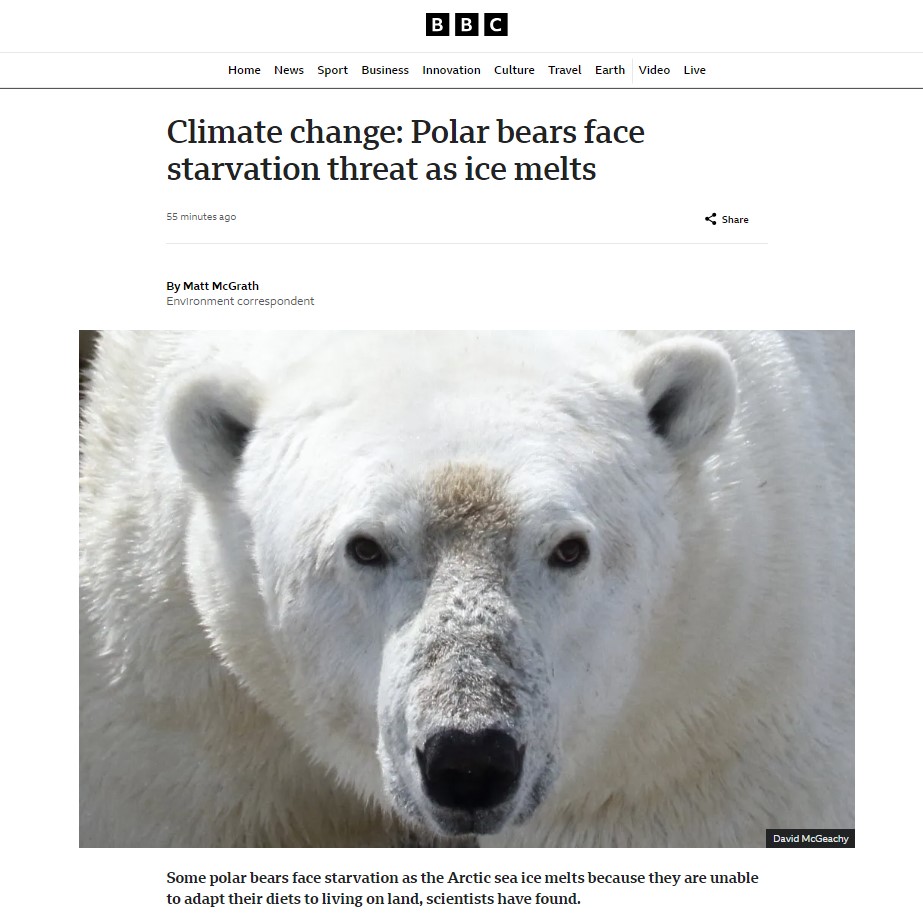
And do I think the high-profile journal Nature Communications would not only agree to publish such a useless bit of propaganda but also rig the timing to advance the climate change emergency narrative? Silly question. And the media worldwide are of course lapping it up, happy for an excuse to promote the perils of climate change, see here, here, and here using images of fat polar bears. Image above is from the BBC headline, 13 February 2024.

They believe this strategy is effective because they think the public is stupid, but they are deluding themselves. Most people are now laughing at their obvious acts of desperation.

Continue reading

Polar bears and sea ice fail to implode in 2023 as predicted, with special thanks for your support

As this year draws to a close, it is worth noting that over the last 12 months — and contrary to predictions and headlines, including claims about “the warmest year ever” — polar bears have not been reported dying, starving, or eating each other in large numbers, or relentlessly attacking people. On top of that, summer sea ice coverage in the Arctic has stalled for the last 17 years, not melted out in a death spiral of rotten ice.

Except for the lying and obfuscation that most of us have come to expect, I’ve mostly been left to reiterate that polar bears are not “canaries in the coal mine” indicators of climate change and to point out that Arctic sea ice extent and polar bear survival are not inextricably tied. For example, in some specific areas of interest, like Western Hudson Bay, there has not been a consistent decline in sea ice over the last few decades and bears are not attacking people at increased rates because they are desperately hungry. In other areas, like the Svalbard area of the western Barents Sea, sea ice has declined dramatically in recent years yet polar bears have not been attacking people more than usual.

Contradictions and failed predictions abound.

All in all, a rather boring year for the anticipated implosion of polar bear health and survival, despite my constant tracking of publicly-available information. That said, I would like to take this opportunity to thank you all again for your continued support, and especially those who have donated hard-earned cash over the last few months: your support makes it possible for me to continue my work keeping polar bear science honest. Together, we have made a difference and I know it’s worth the fight. Because if we let evidence-based science die without challenge, we lose our ability to make sense of the world.

All the best for 2024 to you all.

Continue reading

Despite hand-wringing about Churchill polar bears this year, 2023 wasn’t their worst summer

For months, the media has been bleating about the poor polar bears of Churchill suffering from lack of sea ice blamed on human-caused climate change during the so-called ‘hottest year’ on record: in April, July, August, November, and December.

From a Churchill Wild report on the condition of WH polar bears, January 2023

However, while breakup of sea ice on Hudson Bay was indeed early this year and freeze-up came later than usual, Western Hudson polar bears apparently spent only the fifth-longest time on land since 1979, according to a polar bear specialist. How is that even possible, given that sea ice conditions should be getting worse and worse as CO2 levels increase and average global temperatures rise? As I’ve pointed out before, it is apparent that Arctic sea ice is not closely coupled to CO2 levels (as the ‘experts’ claim), which makes me wonder if there is any ecologically-relevant correlation between CO2 and sea ice at all.

Money quote from Geoff York, from Polar Bears International: “As of Nov. 28 this year, the bears in western Hudson Bay had spent 164 days on shore, he said. That’s tied for the fifth-longest amount of time the bears have spent off the ice since 1979.CBC, 9 December 2023 [my bold]

Continue reading

Churchill so far has few problems with polar bears despite predictions of a record bad year

Despite misleading warnings in mid-August that a record number of incidents had already taken place, and that Churchill was on track for a record-number of bear problems this fall, the number of incidents and bears captured so far have been well below other years after the same number of weeks ashore. And while this is shaping up to be the longest ice-free season on record for Western Hudson Bay bears, it may not be a record year for problem bears in Churchill.

On average, officers receive around 250 calls from residents and detain around 50 bears every year, according to statistics provided to Live Science by the Manitoba government. The record number of bears captured in a single year was 176, in 2003.” LiveScience, 16 August 2023

Pro

W. Hudson Bay polar bear numbers declined 27% in 2021 but not because of missing ice: secret paper

As will become apparent tomorrow, Western Hudson Bay polar bear numbers apparently declined 27% between 2017 and 2021 but not because of sea ice loss. This fact, gleaned from a secret government report leaked to the media, emerged just before Christmas last year and spread around the world. I commented on it here at the time.

It will also be apparent tomorrow why that government report is still unavailable. Thursdays are when the big two science magazines publish their papers, which means associated news stores promoting preferred narratives are embargoed until then. Stay tuned.

Continue reading

Conservation officers misleading the public about polar bear problems in Churchill

Canadian government-funded media outlet CBC ran a story this morning about problem polar bears in the town of Churchill, Manitoba, the self-described “Polar Bear Capital of the World” that contains some very misleading statements from Manitoba Conservation officers.

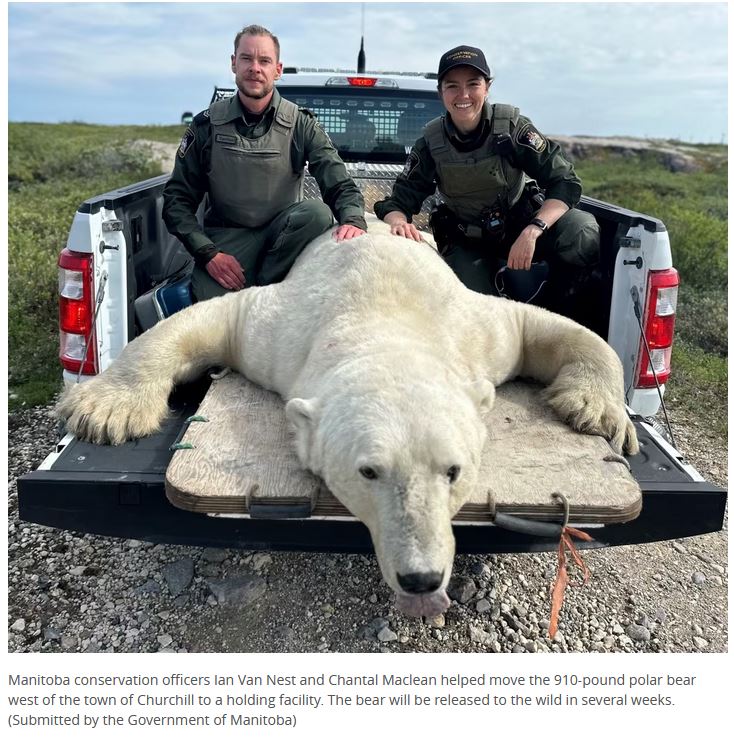
Breakup of sea ice on Hudson Bay was earlier this year than it has been in more than a decade (17 June) and some people are trying to hype the significance of this phenomenon to support a tenuous link to human-caused climate change, even though bears out on the ice this spring were reportedly in good condition and one of the problem bears captured on 8 August was also in good condition (a male weighing 910 lbs, photo above). Unfortunately, reports for similar early breakup years in the early 2000s have not been made public. However, I’ve been keeping track of these Polar Bear Alert Program Reports since 2015 and have read the available literature about their history: these records simply do not corroborate the statements in this CBC account.

Continue reading