Tag Archives: breakup

Hudson Bay sea ice loss has not accelerated since 2014: in fact, summer ice cover has improved

This is an early breakup year for Hudson Bay but sea ice loss has not been accelerating. While some Western Hudson Bay bears have been on land for weeks, others are still out on melting remnants of sea ice, much of it invisible to satellites. This is only the third year since 2014 that the bay has had less than usual amounts of ice, which means most years since then have had normal or nearly normal ice coverage, similar to the 1980s. Hardly the ever-worsening catastrophe of sea ice loss story being spun in the media for Western Hudson Bay polar bears.

From the tracking map above, out of the 38 visible tags or collars on bears at 11 July 2023, 16 bears (42%) were on land and 22 (58%) were still out on the sea ice. That’s virtually identical to the 40/60 percent split last week when there was even more ice.

Continue reading
Natural flexibility explains W Hudson Bay polar bear movements at breakup better than climate change

Hudson Bay in early July this year is a mosaic of more-than-average and less-than-average sea ice coverage but apparently, only the less-than-average ice areas constitute the “early breakup” caused by climate change, and only “deniers” would say otherwise.

I say some folks are cherry picking the ice conditions that support a story line they prefer, forgetting that polar bears know better than they do when to come in off the ice.

Continue reading

Early sea ice breakup in W Hudson Bay caused by “record breaking” warmth in 2023 but not 2015?

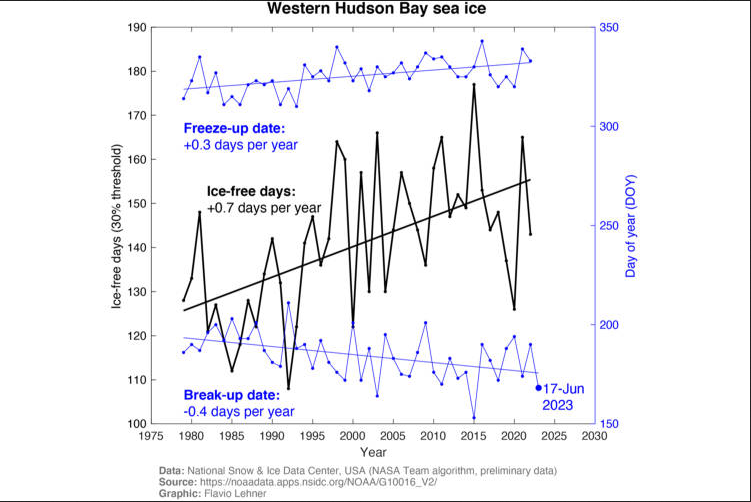
According to Polar Bears International, the “3rd-earliest” breakup date for Western Hudson Bay was caused by a “record breaking” heat wave in May. Western Hudson Bay sea ice hit the 30% coverage threshold used by PBI to define “breakup” on 17 June this year, prompting speculation about potential future impacts on polar bear survival should breakup come even earlier.

This year’s break-up date of June 17 is the 3rd earliest in the 45 years of satellite-based sea ice data from Western Hudson Bay, after 2015 and 2003.” [Flavio Lehner, PBI]

17 June 2023 is day 168 on the Julian calendar used to graph the data in the image included in the PBI essay (see copy below). However, the data point for 2003 is about three days earlier, on day 166 (14 June) and the point for 2015 is on day 152 (1 June).

If “record-breaking” heat caused this year’s early ice retreat, what caused the ice to retreat more than two weeks earlier in 2015? May was warm that year along the west coast as well but obviously not “record-breaking” warmth, because the records were broken this year. In fact, whatever warmth that occurred only affected ice melt in the western sector, while very thick ice over the rest of the bay resisted melt and allowed bears to stay out many weeks later than usual.

Continue reading

Polar bears in W. Hudson Bay are in good shape, says researcher. So are numbers really falling?

We’ve got ourselves another round of field data–i.e., facts–not fitting the polar-bears-are-starving-to-death narrative. According to polar bear specialist Andrew Derocher, Western Hudson Bay polar bears his team saw in April while installing collars and ear tags were in good shape this year, as he said they were last year. There was no spring field work in 2021 and 2020 but in 2019, he also said the bears he saw were in good condition.

Andrew Derocher 4 May 2023, reporting on Western Hudson Bay field work

Two years in a row of bears in good condition in spring–with no mention of starving bears–does not fit the picture of a population supposedly declining due to starvation. The most recent population count for WH, which garnered wide-spread media attention just before Christmas last year, claims that a 27% decline in numbers took place between 2017 and the fall of 2021 even though sea ice conditions had been good during those five years as well. It’s a perplexing situation. Makes me really wonder what that survey report actually says, but it still hasn’t been released, five months after the results made news around the world.

Continue reading

Last WH polar bears ashore even later than 2009 as Hudson Bay finally becomes ice-free

According to Andrew Derocher this morning, the last of his teams’ tagged polar bears have come ashore in Western Hudson Bay, in the last week of August. That makes two years out of the last three when the tagged WH bears came ashore as late, or later than, they had done in 2009 (a very cold year when they were onshore by about 20/21 August), something Derocher failed to mention during a CBC Radio interview also published today.

Don’t forget: this is the subpopulation that polar bear specialists use to model the future of all bears, everywhere in the Arctic but only use stale data from the 2000s because including more recent information would give a much more optimistic picture.

Meanwhile, no further reports from Churchill about problem bears: the last one issued was for the first week in August. Time will tell at freeze-up whether this will be yet another very good year for Western Hudson Bay bears.

Continue reading

Grizzly on the shore of W. Hudson Bay and two tagged polar bears still on sea ice at 17 August

A tundra grizzly was again caught on the live cam set up for polar bears last week (15 August) but was too late for interspecies hankypanky, even as some polar bears lingered on invisible offshore sea ice.

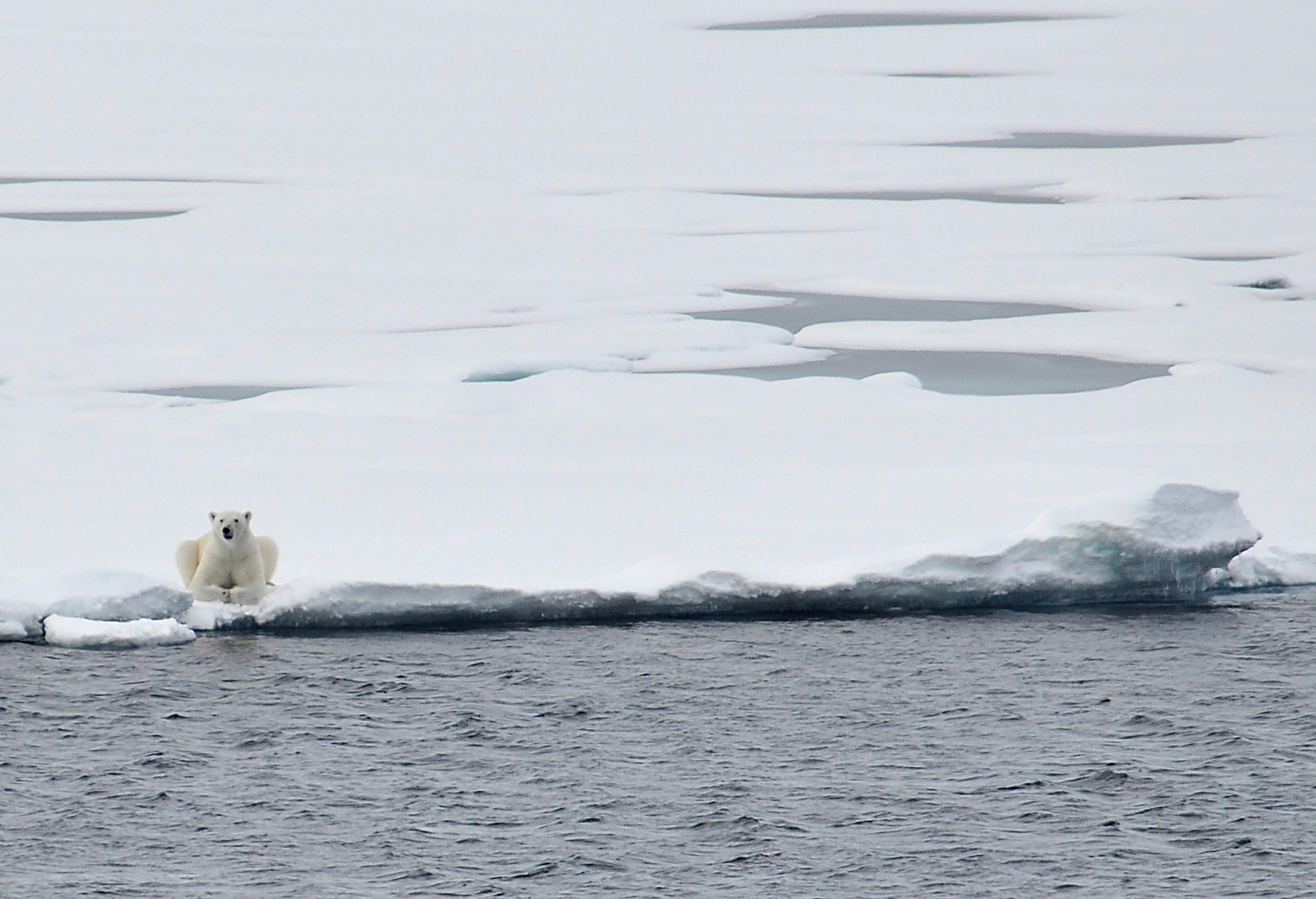
A polar bear rests on the ice Aug. 23, 2009, after following the Coast Guard Cutter Healy for nearly an hour in the Beaufort Sea.

Polar bear specialist Andrew Derocher reported that two of his 23 tagged polar bears were still on the sea ice, a phenomenon that’s been happening since at least 2015 at breakup. Instead of heading to shore when the sea ice concentration dwindles below 50% coverage, some bears are choosing to lounge around on decaying bits of ice, sometimes into late July or well into August, until they must finally swim ashore. There is no evidence that the bears continue to successfully hunt seals under these conditions but no evidence either that their choice to stay on the ice rather than move to land at this time of year has had any negative impact on their health or survival.

Continue reading

Hudson Bay sea ice update: many polar bears are still on low concentration ice offshore

Almost half of all tagged Western Hudson polar bears are still out on the ice of Hudson Bay, even though much of it is broken up in pieces: as of yesterday, 10 out of 22 bears were still offshore.

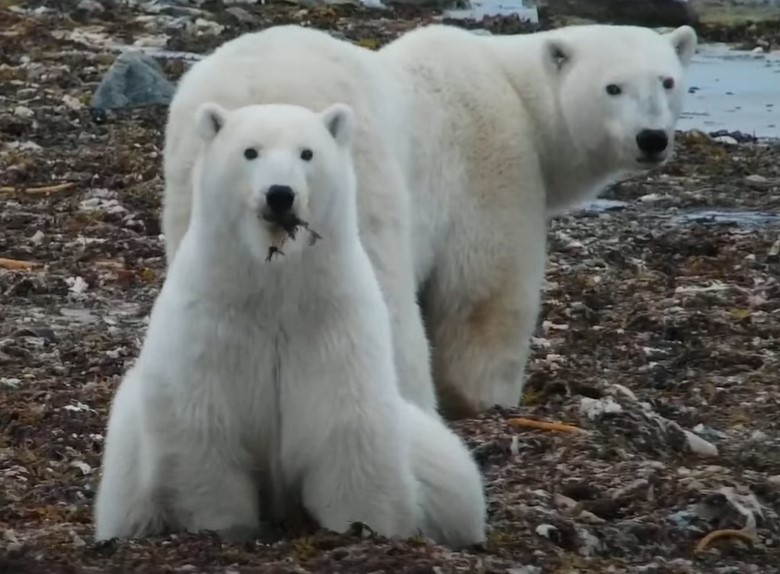
Mother and cub near Churchill last year, 30 October 2021.

This is shaping up to be a great year for Hudson Bay bears!

It also appears none of the bears onshore are causing problems in Churchill, as the Polar Bear Alert Program weekly reports for Churchill have not yet begun. Last year the first report was issued for the first week of July, while in 2020 the first report didn’t come out until the end of August.

Continue reading

Most Hudson Bay polar bears are still offshore, excellent ice conditions for late July

With only a few days until the end of July, most Western Hudson Bay polar bears are still on a thick band of thick first year ice that remains close to shore. The few bears that have come off the ice appear to be nice and fat, indicating they had good spring feeding conditions.

Untagged bear with cub, near Churchill River, 18 July 2022

We’ll have to wait a few more weeks to see if this year shapes up as it did in 2020, when the last of bears didn’t come ashore until the third week of August, despite there being very little visible ice. Last year, most of the bears were ashore by the end of July.

Continue reading

Some of the first polar bears onshore in Western Hudson Bay are in excellent condition

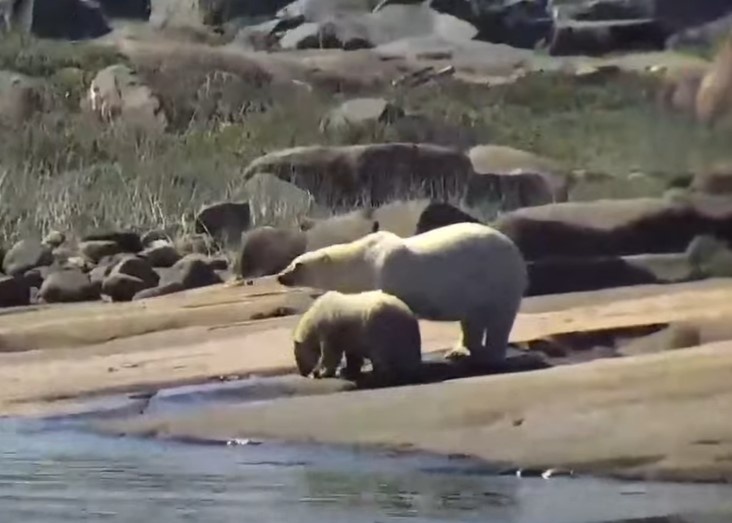
From the live cams installed on beluga tour boats running near the Churchill River, we have some good photos of a few fat polar bears onshore in Western Hudson Bay.

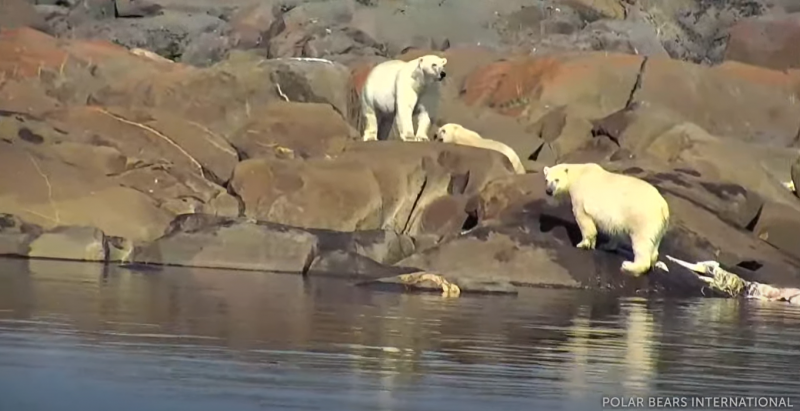
These bears were attracted to the remnants of a beluga carcass with nothing much left on it (lower right in the photo) and stayed around for at least a few days. The female with her cub-of-the-year was remarkably tolerant of an adult male nearby.

Continue reading

Arctic sea ice still quite abundant for early summer

Despite rhetoric to the contrary, there is still plenty of sea ice over Arctic regions this summer, supplying feeding platforms for polar bears, ice-dependent seals, and walrus cows nursing their young calves. Forget about whether the numbers are below or above some short-term average, there is no catastrophe in the making for marine mammals in the Arctic at this time.

Remember, by early summer, young seals have left the surface of the ice and are in the water feeding; predator-savvy adults and subadults are hauled out on broken chunks of ice moulting their hair-coat. They may look like sitting ducks but polar bears have a hard time catching them because the seals are vigilant and have many escape routes available (due to all the open water). Most polar bears in Hudson Bay are still on the ice (you’ll see why below): the live cams near Churchill set up to watch polar bears are presently showing images of ravens with sea ice in the background, not bears.

This post is predominantly sea ice charts for mid-July, what we in the science field call observational evidence, aka ‘facts’. Keep in mind that satellites used to produce these images have an especially hard time distinguishing ice topped with melt water from open water, which means much more ice useful to these marine mammals is almost certainly present than is shown in the charts (as much as 20% more in some regions).

Continue reading