Tag Archives: global warming

Tracking polar bears in the Beaufort Sea – May 2014 map and USGS video footage

Here is the May 2014 follow-up to my post on the July 2013 track map for female polar bears being followed by satellite in the Beaufort Sea by the US Geological Survey (USGS) – “Ten out of ten polar bears being tracked this summer in the Beaufort Sea are on the ice.”

See that post for methods and other background on this topic, and some track maps from 2012 (also available at the USGS website here).

The USGS track map May 2014 is copied below (Fig. 1).

Compare this to April’s map (Fig. 2) – the 24 bears from April are down to 20 and the bears are spreading out a bit from the area on the central Alaskan coast where they were originally tagged. Fifteen of these bears have satellite collar transmitters [and therefore are females] and 5 of these bears have glue-on satellite transmitters [either males or subadult animals].

Some comments on the polar bear video cam footage released June 6 by USGS and stories on it run by the media follow.

Continue reading

Barents Sea polar bear cubs – new data for 2014 made to sound ominous

Last week, Damian Carrington (May 28, 2014) at The Guardian offered a scary-sounding polar bear story, based on the work of Jon Aars and colleagues from the Norwegian Polar Institute (Fewer polar bear cubs are being born in the Arctic islands, survey finds). As often is the case however, once you see the scientific data, you will sleep better.

[Dr Aars also gave a radio interview with CBC Canada (May 29): Is climate change the cause of lower polar bear birth rates in Norway?”; audio available]

[Update June 24, 2014 — see below]

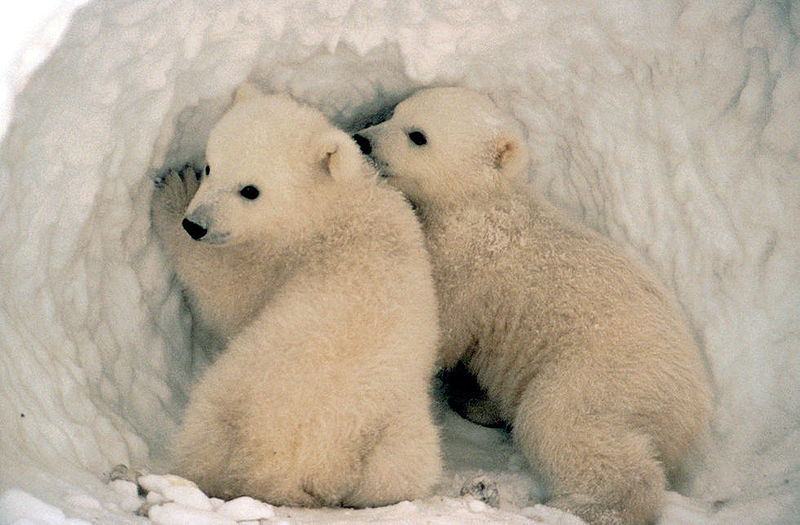
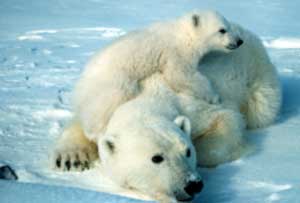
Female polar bear with cubs. (U.S. Fish & Wildlife Service/AP)

Female polar bear with cubs. (U.S. Fish & Wildlife Service)

Continue reading

Climate bullying echoes the expulsion of Mitch Taylor from Polar Bear Specialist Group

A lone polar bear walking on ice [Kathy Crane (NOAA) photo].  We'll call this a metaphor for the expulsion of Mitch Taylor from the PBSG after the Group switched from emphasizing unregulated over-hunting as the primary threat to polar bear conservation to global warming.

Kathy Crane (NOAA) photo

Swedish meteorologist Lennart Bengtsson today declared his resignation from the Academic Advisory Board of the Global Warming Policy Foundation (GWPF), which he joined only three weeks ago, because of bullying by his colleagues. His email letter reads, in part:

“I had not expecting such an enormous world-wide pressure put at me from a community that I have been close to all my active life. Colleagues are withdrawing their support, other colleagues are withdrawing from joint authorship etc. I see no limit and end to what will happen. It is a situation that reminds me about the time of McCarthy. I would never have expecting anything similar in such an original peaceful community as meteorology.”

See WUWT for the email in its entirety, GWPF response, and other reactions (and more here).

Absolutely shameful. Alas, the reprehensible behaviour displayed by Bengtsson’s colleagues also goes on within the polar bear research community: those that refuse to parrot the “consensus” are quickly punished.

Remember Mitch Taylor and his expulsion in 2009 from the IUCN Polar Bear Specialist Group? His “crime” was objecting to the PBSG using weak evidence about future threats of global warming to have the conservation status of polar bears changed to ‘threatened’ even though populations were currently healthy. Details below for those who don’t know the story, or have forgotten.

Continue reading

Amstrup grasps at straws to defend his polar-bears-are-doomed computer model

Polar bear activist Steven Amstrup made an astonishing statement in an interview earlier this week — he insisted that the current rate of warming in the Arctic is greater than anything polar bears have lived through before. He also said that optimistic comments on the future of polar bears made by geneticist Matt Cronin a few weeks ago were “incautious” and “misleading.”

Polar bear cubs in den wikipedia

Previously, I described how a new paper by Cronin and colleagues confirmed that genetic evidence indicates polar bears have been around long enough to have survived several past Interglacial periods that were warmer than today (and therefore, would have had virtually no summer ice). Cronin, not unreasonably, had some critical things to say about computer modeled predictions that polar bears could not survive in an Arctic without summer sea ice.

On Monday, the Anchorage Daily News gave Amstrup a forum to rebuke Cronin for his comments. A similar story was also carried by the Washington Post. [In the same ADN article, geneticist Charlotte Lindqvist, offered an outdated argument against future polar bear survival that I’ll deal with later]

Today, I’ll address Amstrup’s ridiculous assertion that the current rate of warming, attributed by him primarily to human activities rather than natural variation, is something polar bears have never experienced in their evolutionary history (a period of more than 400,000 years!).

Let’s start with the offending portion of the news item (published March 31, 2014):

Continue reading

New genetic study confirms polar bears survived several warm Interglacials

There is a new polar bear genetics paper out in the Journal of Heredity, by University of Alaska Fairbanks genetics professor Matt Cronin and colleagues. Matt Cronin, in case you didn’t know, was the first to pick up the close genetic relationship between polar bears and grizzlies, as a result of research he and colleagues did back in the early 1990s (Cronin et al. 1991).

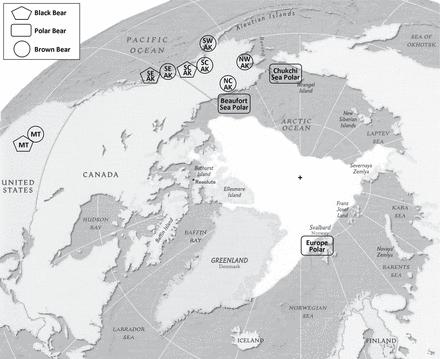
Figure1 from Cronin et al. 2014 (in press) showing the locations of bear samples used in their genetic study. MT, Montana; AK, Alaska; Polar bear samples were from the Chukchi, Beaufort and Barents Sea populations.

Figure 1 from Cronin et al. 2014 (in press) showing the locations of bear samples used in their genetic study. MT, Montana; AK, Alaska; Polar bear samples were taken from the Chukchi, Beaufort and Barents Sea populations.

While no earth-shattering new information was revealed in this new study, reported over the weekend by the Alaska paper SitNews (March 15), it used a more detailed method to confirm the results of previous work – that polar bears have been around long enough to have survived several past Interglacial periods that were warmer than today (with less ice in the Arctic) and are genetically distinct from grizzlies.

A feature that really set this work apart was how it was promoted.
Continue reading

Amstrup’s comment on his starving polar bear article and my response

Steve Amstrup has left a comment below his January 20, 2014 “starving polar bears’ article at The Conversation, which I discussed in my last post.

I’ve copied his comment below and the response to his comment that I left this morning, which is copied below his. See the entire comment sequence here.
Continue reading

Amstrup repeats starving polar bear nonsense, features “Ursus bogus”

As if on cue just before an important polar bear announcement, Steven Amstrup, full time employee of Polar Bears International (PBI), is crying “starving polar bears” yet again, with a laughable twist.

Over at “The Conversation” (a university supported forum for academics), in a piece titled “Cold weather in the US no solace for starving polar bears,” Amstrup uses his adjunct affiliation at University of Wyoming to unleash a bit of unpaid advertising for PBI’s alarmist message (I put it this way because while Amstrup  does disclose his affiliation at PBI, he is more than just an affiliated member, he is their paid spokesperson).

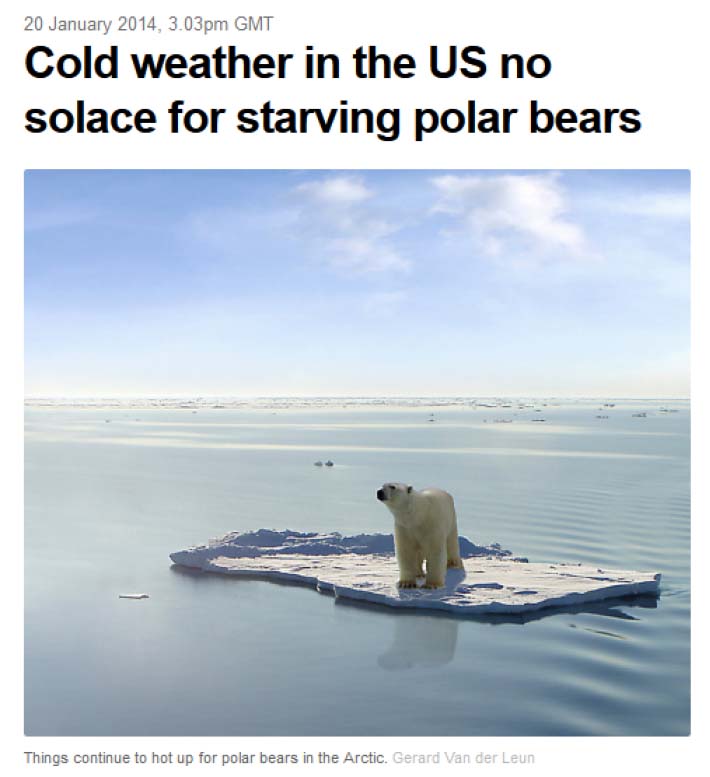
Ironically, the headline photo (Fig. 1) is the notorious “Ursus bogus,” the photoshopped image used by the journal Science back in May 2010 to feature an article on the integrity of science, It was quickly exposed by Tim Blair at The Telegraph (also covered at WUWT), and the journal was obliged to acknowledge the error, replace the image and issue a correction.

In this case, commenter Brad Keyes at The Conversation defends the use of the “Ursus bogus” image with this astonishing statement [UPDATE Jan. 25/14: it has since transpired that this was almost certainly meant to be satire]:

The problem is, only sensational exaggeration makes the kind of story that will get politicians’—and readers’—attention. So, yes, climate scientists might exaggerate, but in today’s world, this is the only way to assure any political action and thus more federal financing to reduce the scientific uncertainty.

Figure 1. The headline photo from Steven Amstrup’s article at The Conversation. This infamous “Ursus bogus” image (for sale at IStock photos, listed under “Global warming images”), says “This image is a photoshop design. Polarbear, ice floe, ocean and sky are real, they were just not together in the way they are now.”

Figure 1. The headline photo from Steven Amstrup’s article at The Conversation. This infamous “Ursus bogus” image (for sale at IStock photos, listed under “Global warming images), says “This image is a photoshop design. Polarbear, ice floe, ocean and sky are real, they were just not together in the way they are now.”

However, we now know that Amstrup is crying wolf — summer sea ice has been declining despite a hiatus in global warming and unusual numbers of polar bears are not starving. He seems to think that if he keeps repeating his Chicken Little message (with nary a recent photo of an actual starving polar bear) he will convince more people to believe him and donate to PBI. It’s his job to do so of course, so he’s not likely to stop. [pardon my mixed metaphor – Amstrup, if you recall, prefers a Titanic metaphor]
Continue reading

Nature acknowledges warming hiatus, but does not explain continued declines in Arctic sea ice

Although there have been jumps and dips, average atmospheric temperatures have risen little since 1998, in seeming defiance of projections of climate models and the ever-increasing emissions of greenhouse gases.” Jeff Tollefson, January 15, 2014, Nature. [open access]

The eminent science journal Nature has finally acknowledged that global average temperatures have not behaved as predicted by climate models over the last 16 years. [h/t A. Watts]

Note that predictions of future sea ice declines and associated predictions of future polar bear declines are totally dependent on these climate models.

Here’s my question: if global temperatures have basically flat-lined since 1998, why has Arctic sea ice continued to decline?

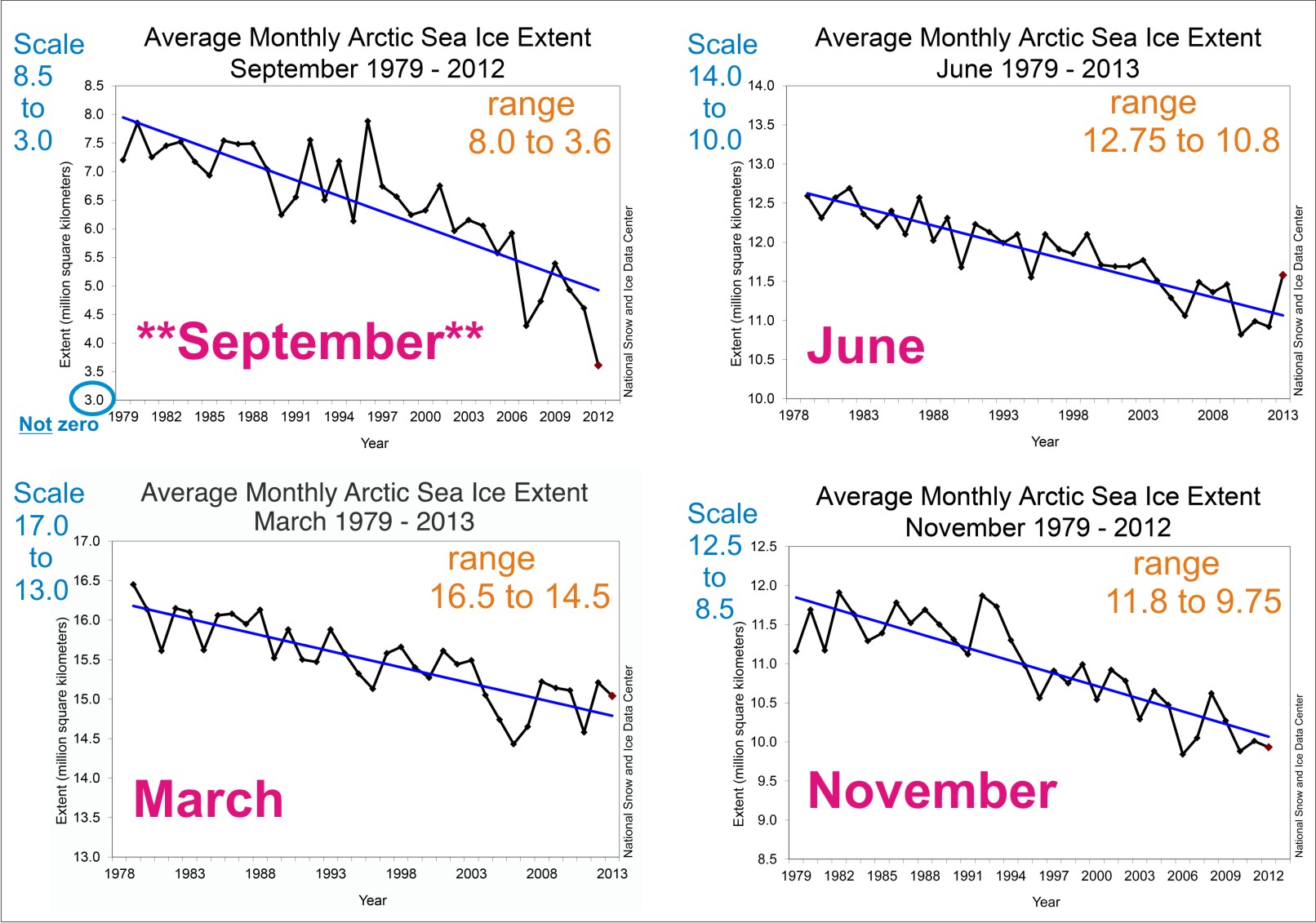
If average global temperatures govern Arctic sea ice behavior, why was 1998 (or the year after) not the lowest September sea ice extent reached over the last 30 years? Oddly, 2012 was the lowest September extent (see graphs below, from NSIDC).

Paradoxically, not only has sea ice continued to decline since 1998 – despite the hiatus in global warming – but since 1998, all but one polar bear populations have either increased in size, not declined, or are doing very well by other measures (see previous summary post, Polar bears have not been harmed by sea ice declines).

Sea ice extent graphs for September (which all the hysteria is about) compared to selected months from March, June and November. Ranges given are approximate; note the differences in scale for each graph. NSIDC graphs, colored labels added.

Sea ice extent graphs for September (which all the hysteria is about) compared to selected months from March, June and November. Ranges given are approximate; note the differences in scale for each graph. NSIDC graphs, colored labels added.

Continue reading

Another unsupported claim of starving polar bears in Western Hudson Bay

This time it was Steven Amstrup of Polar Bears International (PBI), via a radio interview on Saturday December 28 “A Scientist’s New Job: Keeping The Polar Bears’ Plight Public.

Amstrup – co-author of the models that predict the extinction of polar bears by the end of this century – had this to say about the polar bear situation in Hudson Bay:

This year, the ice was frozen longer, so he says the bears seem to be in pretty good shape.

“But over the last two or three years, my impression has been, ‘Man, there’s a lot of skinny bears out here.’ “

On average, the sea ice in the Hudson Bay is frozen about a month less per year than it was 30 years ago. Amstrup says bears don’t eat much on land, so they lose about 2 pounds of body fat every day they’re off the ice.

“They’re 60 pounds lighter now than they might have been at this time of year 30 years ago,” he says.” [my bold]

For the last two or three years Amstrup has been seeing “a lot of skinny bears” but hasn’t taken a single photograph that he’s offered for publication or posted at PBI? Makes you wonder, doesn’t it – where are the photos of all the starving bears these guys keep talking about?

Here is a picture of a polar bear that was spending the summer on the shore of Western Hudson Bay 30 years ago, taken in July [bears were on the shore in July this year as well]. Continue reading

Churchill polar bear attack shamelessly used to advance global warming agenda

I guess Suzanne Goldenberg, writing for The Guardian, just couldn’t help herself with this latest story (November 4):Polar bear attacks: scientists warn of fresh dangers in warming Arctic. Two people injured in latest attack as hungry bears deprived of access to sea ice increasingly look for food on land.

Reporting on the attack is one thing — several papers covered this over the weekend (see Featured Quote #46, posted yesterday, for links to two of them). However, Goldenberg shamelessly makes this about global warming, aided and abetted by Polar Bears International (PBI) representative Steven Amstrup, a claim that doesn’t hold up to even minor scrutiny.

Continue reading