Tag Archives: global warming

Climate change not forcing polar bears to hunt humans but lack of baby seals might

At least a dozen polar bears that besieged a remote Russian weather station on an island in the Kara Sea during the first two weeks of September prompted a few media pundits to suggest that loss of summer sea ice due to global warming may be forcing polar bears to hunt humans for food. Headlines like the one below, from the IB Times, fueled such notions:
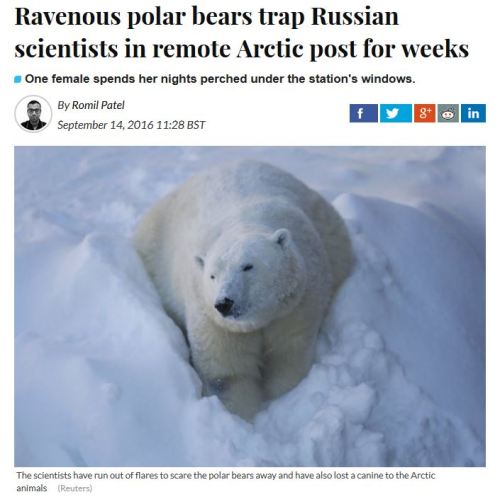
russian-scientists-trapped-by-polar-bears-14-sept-2016_ib-times

Eye-catching though such headlines might be, this is more sensationalism than reality.  These particular bears have been onshore since early July this year (about the time some Western Hudson Bay bears come ashore) and sea ice conditions have been similar this time of year since 2007. In other words, despite what some writers are claiming, sea ice conditions this year are nothing new.

A few bears usually visit this station each summer when the sea ice leaves – but this year there were more than a dozen bears rather than a few. My opinion as a scientist is that more bearsmore bears that are increasingly unafraid of people – are likely the cause of the sudden increase in numbers of bears being a problem at this location. Note that of the 14 bears, four were cubs, which is a good crop of youngsters.

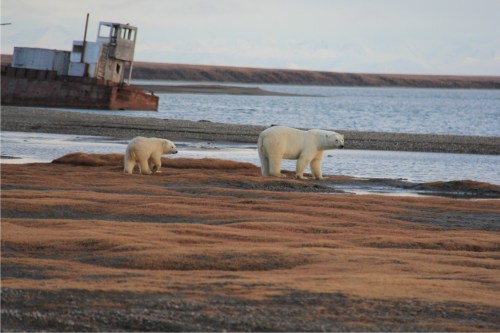
In addition, hunting polar bears is banned in Russia and this incident shows to what lengths people must go to avoid killing them – the population must be booming and may be higher yet than the last population count (in 2013) of about 3,200 bears. More bears means more competition for food, which means more assertive bears get the goods. None of these bears were described as thin or starving – see more photos, like the one below, from the Russian weather station (Daily Mail, 18 September 2016).
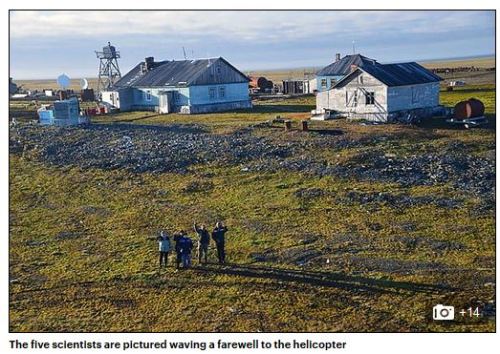
russian-weather-station-troynoy-island_mailonline-18-sept-2016

While polar bears are always on the look-out for food (and thus always a potential threat to humans), they are most apt to be truly dangerous in winter (when they are at their lowest body weight)  and in spring if seals are in short supply.

That’s why my new polar bear attack thriller EATEN is set in early spring, in a year when seals happen to be scarce. Imagine the damage those Russian polar bears could have done if they’d been truly desperate for food – a mere door or window would not have stopped them.

Imagine if dozens of truly ravenous polar bears stalk and ambush people across a great frozen landscape, taking them by complete surprise because no one considers a bear attack in spring to be a real possibility. What if dozens of people have been killed and eaten by hungry polar bears and there is no end in sight? That is the premise of EATEN – a science-based novel set in Newfoundland that will scare your pants off.

This is a great read for fall, when polar bear encounter stories abound. Hopefully the reports this year won’t include the kind of serious mauling that happened in 2003.
sept-reading-promo_eaten
Continue reading

Columnist admits video on polar bears and global warming contained a serious error

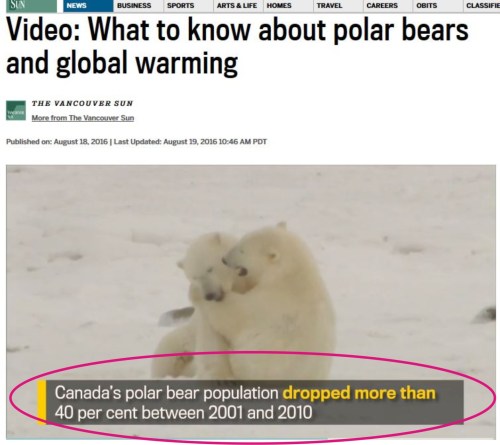
Since mid-August,  Vancouver Sun columnist Daphne Bramham has been filing a series of articles from an expedition cruise through the Northwest Passage for a feature called “Above the Arctic Circle”. One of these appeared on August 18, along with a video called “What to know about polar bears and global warming” and it contained an egregious error that should have stood out to any educated person as being wrong by several orders of magnitude:

What to know about pbs GW_Video_screencap 2_SUN_18 Aug 2016 marked

We are not talking about a difference of opinion or interpretation but a simple fact that was outrageously wrong by a wide margin. You see it, don’t you? Continue reading

Narwhal and beluga ice entrapment is natural – not caused by global warming

A part-time Arctic researcher eager for media attention suggested earlier today that the ice entrapment of narwhals in 2008 and again in 2015 at Pond Inlet (that made headlines around the world) was the result of “sudden changes in temperature” caused by climate change. This grossly misleading claim ignores the facts: ice entrapment of narwhals is an entirely natural feature of the Arctic that has been known about for hundreds of years.

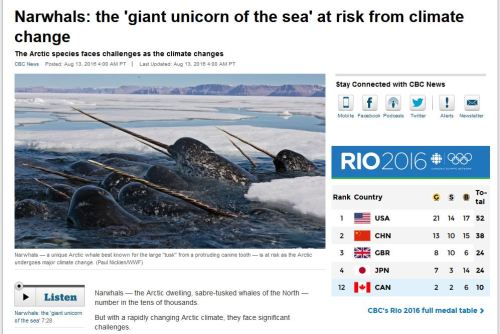
Narwhals_at risk from climate change_CBC 13 Aug 2016 headline

Narwhals: the ‘giant unicorn of the sea’ at risk from climate change” (CBC, 13 August 2016), a print version of a CBC Radio interview with Clint Wright that aired 8 August 2016. Wright is the general manager at the Vancouver Aquarium and apparently has “joined a team of researchers to tag and study” narwhals for several years – but does not seem to know much about the history or circumstances of natural ice entrapment.

Ice entrapment of small whales is nothing new. The first formally documented incident – in English – occurred in 1915 (Porsild 1918) and the phenomenon has probably occurred as long as there has been ice in the Arctic (millions of years).

Animals routinely become trapped in a few specific areas due to local geography: when ice that forms in the north moves south quickly, it blocks the entrances to inlets or coastal bays that still have open water. The presence of the pack ice causes nearby  temperatures to drop quickly. Rapid development of ice on the bay proceeds from the mouth toward the head of the bay. Any whales present cannot escape to open water and will eventually die or be eaten.

Pond Inlet at the north end of Baffin Island is one such place but Disko Bay in western Greenland is another. In fact, Pond Inlet and Disko Bay are almost identical in geographic layout even though they lie on opposite sides of Baffin Bay, so it’s not surprising that both are locations of repeated entrapment events.

Three highly informative journal articles on the phenomenon of ice entrapment of narwhals and beluga are open access documents that reveal some fascinating details of such incidents, including polar bear predation on trapped whales. h/t T. Nelson Continue reading

USGS report on history of walrus haulouts leaves out correlation with population size

Walrus researchers from the US Geological Survey have a new report on the history of walrus haulouts in the Chukchi and Bering Seas – yet their media efforts (via press release and interviews) fail to mention the relationship between fluctuating size of walrus haulouts and fluctuating walrus population size that is evident in that history. In fact, overall population size is not mentioned at all.

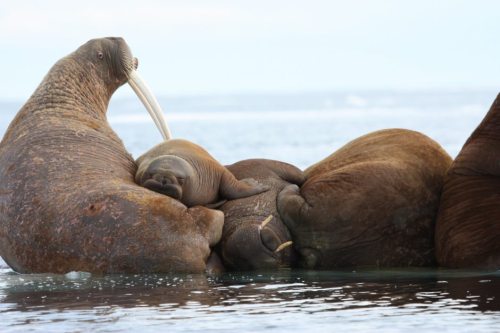
Walrus 2012 July USGS

Two articles came out over the weekend that announced the results of this new joint US-Russian initiative [PBS, Walrus beaching in Alaska might not be as harmful as it looks. Here’s why – 31 July 2016 and ADN, Alaska and Russia join forces to create 160-year database of walrus haulouts – 31 July 2016]

But neither articles nor the new USGS paper they are touting (Fischback et al. 2016) mention the huge summer/fall haulouts of females, calves, and juveniles that were documented in the 1970s that coincided with the huge population size at that time, which crashed in the 1980s.

Only now has the population grown (to at least 200,000) to the point that huge haulouts are again being reported – conservation has done it’s job. But when walrus numbers get too high the animals out-strip their food source and numbers plummet, as they did in the 1980s (Fay et al. 1989; Garlich-Miller et al. 2011). See my fully referenced summary paper, Crockford 2014 (On The Beach: Walrus Haulouts are Nothing New).

Here’s the concern: When (not if) a population crash happens again, will it be blamed on global warming rather than natural causes? According to the PBS article:

“The database is supposed to help federal officials with conservation, especially as more ships start sailing through the newly open waters. The U.S. Fish and Wildlife Service is determining whether walrus should be listed as a threatened species.[my bold]

My GWPF video on the issue (The Walrus Fuss) below:

See excerpts from the USGS database below, with a map:

Continue reading

USGS polar bear researchers publish their rebuttal to 2015 IUCN Red List assessment

Surprise! US Geological Survey polar bear specialists have just published another opinion-based model that concludes – yet again – that there is no hope for polar bears of the future unless the world drastically reduces fossil fuel use. This appears to be the Amstrup-led rebuttal to the hated 2015 IUCN Red List polar bear assessment I have been expecting, written in tandem with the Red List document by two of the same co-authors (Steve Amstrup and Todd Atwood).

Kaktovik female w cub_21 September 2015 USDA_med

Really, no surprises here – just more of the same overwrought fear-mongering about polar bears that we’ve been hearing from USGS since 2007. I saw Atwood and Amstrup last week in a British-made TV film that expressed the same sentiments (The Great Polar Bear Feast – it oddly featured dozens of fat/very fat Kaktovik polar bears while mostly USGS ‘experts’ talked about impending starvation). On camera, Atwood and Amstrup were almost indistinguishable in their statements of doom, and even though the film aired 6 months ago in the UK, it has so far not garnered the angst it seems to have intended.

Some folks may be even more convinced than ever by this new PR strategy [TV movie plus a published paper] that the polar bears are all going to die unless we (not they) change our wicked ways and stop using fossil fuels, but chances are that many more will detect the desperation in their escalated pitch and continue to refuse to buy what they are so frantically trying to sell.

Continue reading

Some inconvenient polar bear facts supported by scientific literature

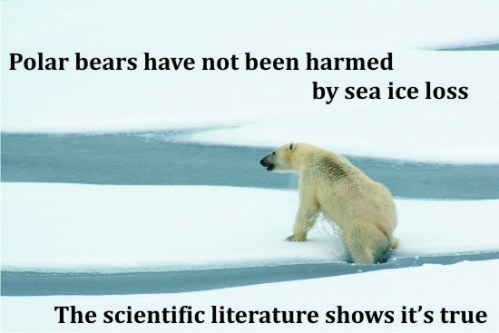
The evidence that polar bears have not been harmed by recent declines in sea ice is contained in the scientific literature, no matter what some researchers say when they talk to the media.

USGS w_polarbearscience_caption 2016

Here’s a few of those facts (not all, by any means), with the references to back them up:
Continue reading

Five facts that challenge polar bear hybridization nonsense

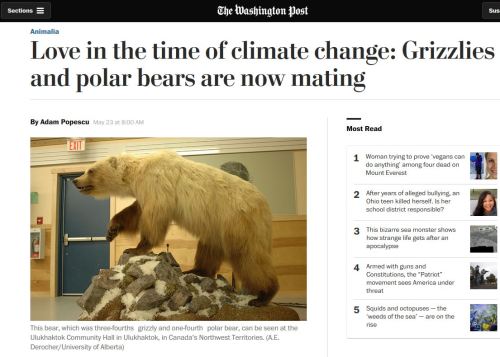
It was inevitable, I suppose, that the putative hybrid shot in Arviat, Nunavut last week (see my post here) would initiate the global warming blame game.

Hybrids again_Washington Post 23 May 2016_title screencap

Washington Post, 23 May 2016, Adam Popescu: “Love in the time of climate change: Grizzlies and polar bears are now mating

Here are the five points you need to know about polar bear hybridization, as there are several nonsense statements contained in this Washington Post article.

UPDATE 24 May 2016: References adding below regarding grizzly sightings south of Churchill on the west coast of Hudson Bay (H/T Doug Clark).

UPDATE 28 May 2016: See this 27 May 2016 follow-up post (Most polar bear hybrids said to exist have not been confirmed by DNA testing) for details on unconfirmed sightings or reports of hybrids.

Continue reading

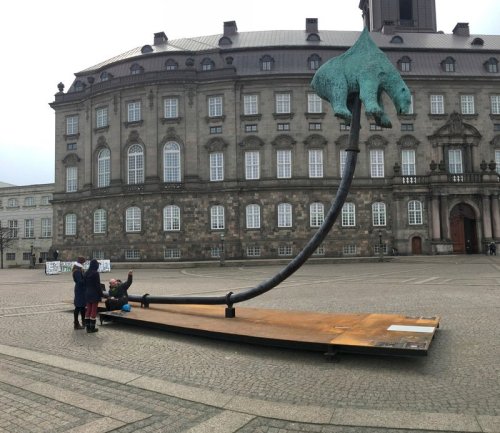
More politics of polar bears courtesy WWF: impaled polar bear sculpture

The offensively tasteless “art” produced by Danish sculptor Jens Galschiøt, in collaboration with the World Wildlife Fund, for the specific purpose of influencing politics has reappeared.

‘Unbearable’ is a portable exhibit originally designed for the Paris COP21 climate talks in December 2015 but here it is again in Copenhagen. [h/t Tom Nelson]

It’s simply the Politics of Polar Bears on a global scale that has no basis in science: polar bear numbers have not declined as CO2 has risen. Jens Galschiøt’s tasteless and costly message funded by WWF is not much better than Plane Stupid’s 2009 ad of polar bears falling from the sky (see below). It’s just about as asinine and not supported by science. Continue reading

Biggest threat to polar bears reconsidered

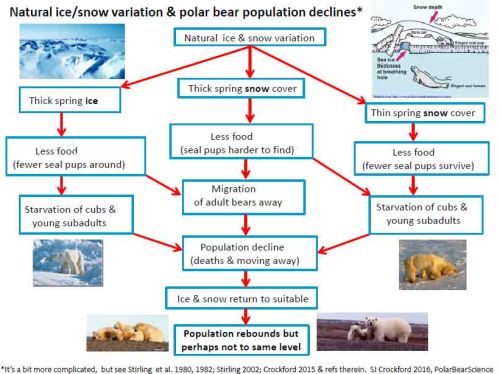
What presents a bigger risk to current polar bear populations: natural hazards that have already proven deadly or potential, yet-to-be-realized threats prophesied to occur due to human activities? That’s a perfect question for International Polar Bear Day.

Natural ice_snow variation and polar bears_model_PolarBearScienceFeb 20 2016

Dag Vongraven, chair of the IUCN Polar Bear Specialist Group, remarked last year that “until 2001, everything was fine.

Polar bear researchers thus assume that 2001 was the year climate change became the new over-hunting – but is it true? What are the relative harms presented by proven natural causes, potential human-caused threats, and predicted threats due to sea ice declines blamed on global warming? Considered objectively, is climate change really the single biggest threat to polar bear health and survival right now?
Continue reading

Many otherwise intelligent people believe only a few hundred polar bears remain

The other day, I got a call from an international journalist who admitted he’d done no research into the polar bear issue but believed, based on media reports he’d heard, that there must only be about 100-200 bears remaining in the Arctic. I know he’s not alone.

polar-bears-3-large_USGS

This journalist was utterly astonished to learn that the IUCN Red List assessment in 2015 put the polar bear population total at 22,000-31,000 bears and demanded proof that this was true.

Here is a summary of the Red List report, with references and links to the report:

The 2015 IUCN Red List assessment update for polar bears (published 18 November 2015) states that the global polar bear population is 22,000 – 31,000 (26,000), that the current trend is ‘unknown’ and that there is only a 70% chance that polar bear numbers will decline by 30% in 35 years (with virtually zero chance that the numbers will decline by 80% or more by 2050) – in other words, zero chance of extinction. [Detailed in a document called 22823 Ursus maritimus]. It classifies the polar bear as ‘vulnerable’ to extinction based on predictions of future sea ice decline due to global warming [similar to ‘threatened’ by other organizations] Pdf here.

Below is a list of what truly worrying species declines look like: that is, animals whose numbers have actually declined, no prophesies involved (Adler 2008).
Continue reading