Tag Archives: global warming

Genetic similarity of polar bears does not make them vulnerable to global warming

A new genetics paper suggests that global warming will “fragment” polar bear habitat to such an extent that it will further reduce the already-low genetic variability documented in the bears, with disastrous effects on survival.
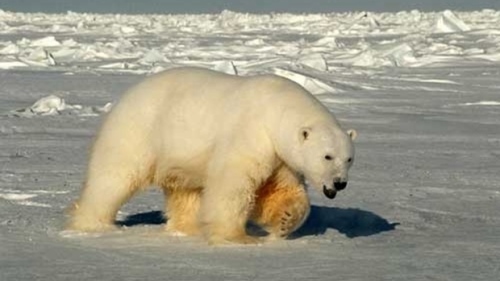
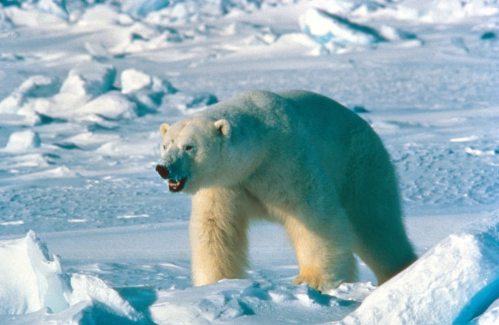
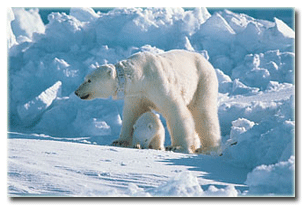
Beaufort Sea male polar bear USGS_2005 Amstrup photo

However, that argument only works if you disregard a rather large body of literature on other mammals as well as the history of polar bears themselves. I’ve addressed this issue before (“Low genetic diversity will not make polar bears more vulnerable to extinction”) and what I said then needs to be repeated now:

“…there is lots of evidence to support my contention that polar bears are not more vulnerable to extinction just because they have low genetic diversity.

I continued:

Many populations that were reduced to very low numbers (i.e., gone through a ‘bottleneck’ ), ending up with low genetic variation, have subsequently recovered dramatically without adverse affects.

In other words, they not only recouped their population size after a population bottleneck but did so while dealing with subsequent environmental fluctuations and other natural threats to their survival (Lehman 1998:R723-724).

In some cases, genetic diversity increased after a population bottleneck, via mechanisms biologists are only just beginning to understand.

In fact, there is good evidence to suggest that ice age cooling is what previously fragmented polar bear populations: past warm interglacial periods brought bears closer together, confined more or less to the area within the Arctic Circle – even in winter.

Go back and read the entire genetic diversity post. I concluded it by recounting several examples of abundant and successful mammal populations with low genetic diversity (with references), including Northern elephant seals, Guadalupe fur seal, Sand Nicolas Island fox, Mouflon sheep, and North Atlantic right whale. The details are worth reviewing. If you can’t access a paper you want to read, contact me via the contact page above and I’ll send it along.

Regarding this new paper (Kutschera et al. 2016), what I said before needs repeating:

“To suggest that polar bears cannot endure a bit of Arctic warming in the future (whether natural or due to human influences on climate, or a bit of both) is absurd: climatic extremes have defined the evolutionary history of polar bears, which means that climatic extremes have fine-tuned their biological adaptability.”

In fact, the paleoclimate/genetics paper by Cronin and Cronin (2015) which I summarized a few days ago, documents those climatic extremes. See below for details on the polar bear genetic diversity paper.
Continue reading
Hungry polar bear attacks: why my novel “Eaten” is set in early March

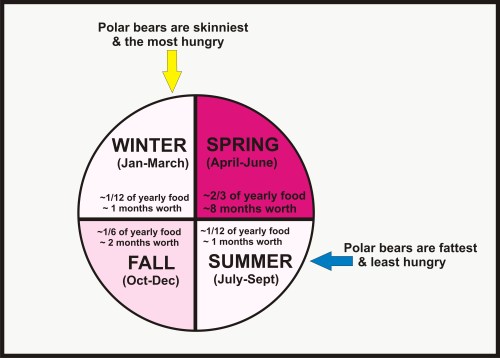
As I’ve pointed out previously, polar bears are leanest – and thus, hungriest and potentially the most dangerous to humans – at the end of winter (i.e. March).

Polar bear feeding by season simple_Nov 29 2015

That is why the unexpected prospect of hundreds of lean and hungry polar bears coming ashore in early March hunting available human prey would be a truly terrifying and daunting experience. Such a speculative scenario stands in marked contrast to an actual incident in July that involved a single well-fed bear that attacked a man asleep in a tent because he and his companions had chosen to dismiss the known risk.

Any predatory attack by a polar bear is terrifying but which is potentially the more deadly? One you can reasonably expect (and thus prepare for) or one that comes out of the blue and catches everyone unprepared?
Continue reading

Paris climate change deal will not stop polar bears dying due to thick ice in spring

Thick spring ice due to natural causes is currently the single biggest threat to polar bears. Not declining summer sea ice – thick spring ice. That could change in the future but right now, the evidence supports that statement.

polar_bear with collar_USGS

Polar bear deaths due to cyclical changes in Arctic sea ice thickness in the spring have continued despite rising CO2 emissions and declining summer sea ice extent (last major incident, 2004-2006): there is no reason to expect this will not continue. Unwarranted attention on summer ice extent has deflected attention from this major cause of local polar bear population decline.

Sea ice models do not address past or future changes in spring ice thickness and predictive models of polar bear survival blame all population declines on summer sea ice declines despite strong evidence to the contrary (Crockford 2015: The Arctic Fallacy). Continue reading

IUCN Red Book officials forced scientific standards on polar bear predictive models

As I reported Thursday, the IUCN announcement of a new Red List assessment for polar bear got the usual overwrought attention from international media outlets. However, not one of these contained a quote from a polar bear biologist.

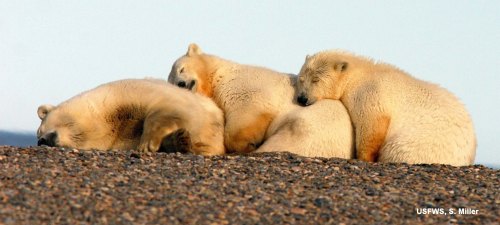
polarbears-arcticnatlwildliferefuge-suzannemiller-usfws_labeled_sm

Steven Amstrup, science spokesperson for activist conservation organization Polar Bears International, has so far had nothing to say to the media. Yet, Amstrup was a co-author of the IUCN Red List report. Not until late in the day following the release of the report did his his organization’s website post a short, bland news report (“Climate Change Still Primary Threat to Polar Bears”).

Similarly, Ian Stirling, Andrew Derocher, Nicholas Lunn (also a co-author of the IUCN Red List report), and former WWF employee Geoff York – who are usual go-to guys for polar-bears-are-all-going-to-die media frenzies – have so far been silent and invisible on this issue.

In addition, while the IUCN press release [backup here: 2015 IUCN Red List press release_Nov 19 2015] included a quote from IUCN Polar Bear Specialist Group (PBSG) chairman Dag Vongraven, as of this morning (21 November, PST), the website of the PBSG contains no mention of this decision – no item in the “News” category  and, more importantly, no update of the status table  or global estimates to reflect the changes contained in the report  (even though they obviously knew it was coming months ago: the report was submitted to the IUCN Red List 27 August 2015).

In my opinion, this silence says it all: polar bear specialists know this assessment is a severe de facto critique of their 2008 assessment (as well as Amstrup’s predictive models) and it’s a big step backwards for their conservation activism. I expect they are silent because they are royally pissed off.

However, this assessment is good news because finally, some standards of scientific rigor have been applied to polar bear predictive models – even though the PBSG were still been allowed to pretend that summer sea ice coverage is critical to polar bear health and survival (Crockford 2015).  Continue reading

IUCN Red List says global polar bear population is 22,000 – 31,000 (26,000)

The long-awaited 2015 IUCN Red List assessment for polar bears was released today (Wiig et al. 2015) and it includes some rather astonishing details − including the fact that the population trend is unknown.

polar_bear_usfws_no date_sm

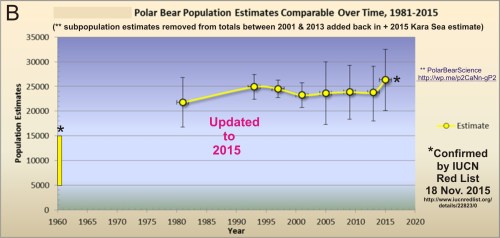
1) It confirms the global population size I published in May 2015 (20,129-32,558; average 26,344). See the graph below, now amended to reflect this point. If global numbers do decline over the next 35 years, it will be from a high point not previously acknowledged by the IUCN Polar Bear Specialist Group (PBSG).

Crockford OFFICIAL polar bear numbers to 2015_IUCN concurrs Nov 18

2) The current population trend is listed as: ? Unknown. [NOT declining – if anyone claims it is, send them here: IUCN Red List U. maritimus]

3) It puts the generation time for polar bears at 11.5 years (range 9.8-13.6), a huge drop from the 15 years used in previous predictive models. This change makes a big difference to the model results: three generations (the minimum period needed to show a trend) are now 35 years rather than 45 years.

4) It states there is a 70% chance of a 30% decline in polar bear numbers by 2050 and a 7% probability of a reduction > 50% if sea ice declines as predicted, but noted the large amount of uncertainty in these projections. That means there is a greater chance that numbers will not decline by 30% in the next 35 years (a 30% chance) than that the numbers will decline by 50% or more by 2050. That sounds like good news to me.

5) It will continue to list polar bears as Vulnerable. PBSG biologists managed to prevent polar bears from being listed as Least Concern or perhaps Near Threatened. But they had to give up a lot to get it.

6) The report supplement (Wiig et al. 2015 supppl.) explained why they did not calculate extinction probabilities and extinction is not mentioned at all on the IUCN Red List polar bear assessment page. This assessment only considers the probabilities of a decline in population size by 2050.

Yet, a spokesperson for the IUCN apparently stated (The Guardian, Climate change is ‘single biggest threat’ to polar bear survival; 19 November 2015 ) that:

“There is a high risk of extinction and the threat is serious,” said Dena Cator of the IUCN’s species survival commission. “You could consider polar bears to be a canary in the coal mine. They are an iconic and beautiful species that is extremely important to indigenous communities. But changes to their sea ice habitat are already being seen as a result of climate change.”

Apparently Dena Cator does not expect that people will read the report or find the assessment page on the IUCN Red List website – or she’s giving her personal opinion rather than explaining the report results. More on the points above and links to the report supplement pdf below, with quotes.
Continue reading

Barents Sea polar bears in excellent condition say Norwegian biologists

Conditions this year (2015) in the Barents Sea were excellent according to the polar bear researchers who work there (“Polar bears were as fat as pigs”).

Barents Sea bear 2015 August Cobbing_NPI
A new survey just completed for a population count showed the bears were are in excellent condition – except the injured ones, of course, which some news organizations are promoting as evidence of harm from global warming-induced sea ice changes because an activist photographer  – not scientists – said so.

Continue reading

Last year’s dead Svalbard polar bear used for this year’s propaganda

Via Mashable yesterday: “Global warming may have led to the death of this polar bear, researcher says”  Note this is about a death that occurred last year (2014), but Mashable author Andrew Freedman implies it happened this year.

Stirlings other pb that died of climate change_Sept 8 2015

The polar bear death occurred last year in Svalbard in the Barents Sea after a fall (2013) and winter (2014) of poor ice conditions due to well-known cyclical sea ice and weather patterns (not global warming). There is no doubt that 2014 was an unusually bad year for sea ice around Svalbard during the fall and winter. This year, however, conditions improved markedly: Norwegian researchers earlier this year reported a good crop of females with cubs this spring, many more than last year (see previous post Many polar bears cubs seen in Svalbard this year, says Norwegian biologist).

The photo above was taken by National Geographic photographer Paul Nicklan, who sent the instagram on 6 September 2015, with a photo and comments about a trip he’d taken to Svalbard in 2014.

Yet the Mashable article says the photo was taken “in recent days” and includes some quotes from Ian Stirling suggesting that the death relates to low summer sea ice and makes no mention of the fact that condition this year were excellent from fall 2014 through at least early July 2015 (see sea ice map below).

I guess if sea ice won’t cooperate and cause polar bears to die this year, it’s OK to use last years’ deaths instead and imply this year was just as bad. Oh, and none of them mention that starvation is the leading cause of death for all polar bears and always has been.

UPDATE 9 September 2015:Mashable’s Andrew Freedman has amended his article:

UPDATED 9:10 a.m. ET: This story was updated to indicate that Micklen’s photo was taken in 2014, not 2015. As Ian Stirling told Mashable, 2015 was also a year that featured extensive sea ice loss in parts of the Svalbard archipelago.”

Freedman’s update, especially the second sentence, is clearly a response to this post. The implication is that any amount of late summer sea ice that’s below average around Svalbard is a threat to polar bear survival. However, there is no published scientific evidence to support that. The evidence that links sea ice levels with polar bear body condition for Svalbard area bears is for spring and early summer ice, and for denning success, fall ice arrival dates. Many Barents Sea bears never come to land, they travel with the sea ice as it expands and contracts, and females den on the ice.

As I tweeted last month, with two maps (3 August 2015)

“Svalbard #polarbears den in the EAST, critical #seaice levels in fall, vary by yr; lots of hunting habitat N & E”

Low ice levels in western Svalbard in late summer are of little consequence for the polar bear population there. Sea ice in the Barents Sea varies with the state of the Atlantic Multidecadal Oscillation (AMO) — even the US National Snow and Ice Data Center says so.  Those changes are not evidence of global warming. And I reiterate: starvation is the leading cause of death for polar bears.

Continue reading

Pacific walruses hauled out at Point Lay Alaska again this year

A photo of a mass walrus haulout at Point Lay, Alaska taken a few days ago from a distance show thousands of animals. But no one’s counting because apparently, no one’s interested.

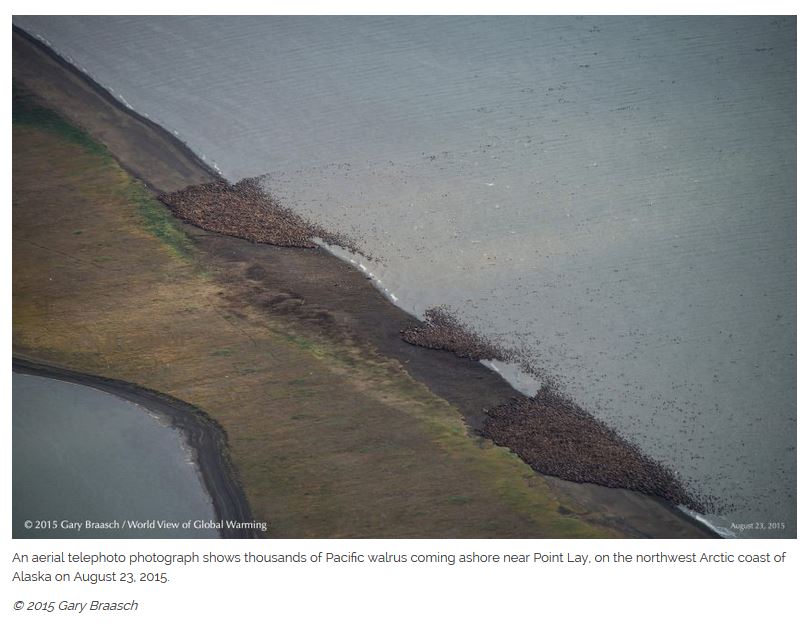
Walrus Pt Lay ADN story Aug 27 screencap
The picture on the left (above, courtesy Alaska Dispatch News) was taken 23 August by global warming activist photographer Gary Braasch, the day after a news report appeared about the US Fish & Wildlife Service and aviation authorities asking the media to approach USFWS about walrus photos and information that gave no hint that a large haulout of walruses was already in place (22 August 2015, “Federal agencies, Point Lay seek to minimize walrus disturbances” ):

“Federal agencies are stepping in to shield a North Slope village from the possibility of a deluge of international attention should a large walrus haulout develop nearby, as it has in years past — agreeing to act as an information clearinghouse on behalf of the Native Village of Point Lay.” [my bold]

Here is what the global warming activist site that published the pictures says about the haulout:

“Thousands of Pacific walrus are coming ashore near Point Lay, NW Arctic coast of Alaska. The huge sea mammals and young began coming up on this barrier island along Kasegaluk Lagoon about August 20, according to local natives. This is one of the earliest known summer haul outs of the walrus along the Alaska coast of the Chukchi Sea, according to wildlife biologists.” [my bold]

They say “thousands.” But the photos taken, reproduced in the Alaska Dispatch News story I read, were taken from a greater distance than the famous photo of ~35,000 animals released by government officials last year and looks like the total could be as large, or larger, than the 2014 haulout.

Said a Washington Post story (27 August 2015):

The U.S. Fish and Wildlife Service confirmed to the Post Wednesday evening that a mass of walruses had “hauled out,” or gathered on shore, near the remote community of Point Lay. The service did not estimate the number or provide images. But photojournalist Gary Braasch has posted dramatic photographs, taken during an Aug. 23 flyover, of what appear to be at least several thousand walruses crowding onto a barrier island.” [my bold]

Continue reading

In 1999, climate change apparently threatened Western Hudson Bay polar bears

Now, not so much. Here is a 16- year old CBC TV special on Churchill polar bears – listen to Ian Stirling and reporter Eve Savory use the early breakup of sea ice on Hudson Bay in 1999 to hype the alarm about Western Hudson Bay polar bears. Watch Stirling in action darting and measuring bears and bemoaning the good old days of the 1980s, claiming the “bears are sending a signal from the ecosystem.

Watch this archived copy of “The Shrinking Bears of Hudson Bay and compare his claims to what has actually happened in the 16 years since then. It runs just over 15 minutes.

Climate change threatens polar bears 2_CBC 1999

“Just as the ice is shrinking in Hudson Bay, so are its polar bears. Climate change has shortened the season for winter ice, a crucial period for the bears to feast on seals and build up their fat reserves. And so, over the 18 years that wildlife biologist Ian Stirling has been studying them, the polar bears have become skinnier and their offspring fewer. In this 1999 report for CBC-TV’s The National, Stirling says once their habitat is gone, there’s nowhere else the Hudson Bay polar bears can go.” [my bold – see notes below]

Program: The National [Canadian Broadcasting Company, CBC]
Broadcast Date: Sept. 23, 1999
Duration: 16:39

Stirling has continue to make these claims since 1999, yet no updated evidence has been provided. There is no plausible evidence that the decline of polar bear numbers in Western Hudson Bay was due to sea ice changes caused by human-caused global warming (Crockford 2015) or that continued declines in condition of bears or litter size have  occurred. Note that the latest survey of Western Hudson Bay polar bears found no trend in either breakup or freeze-up dates since 2001 (Lunn et al. 2013) and that the population is now stable.

Ice coverage charts and breakup dates graph below, for context.
UPDATE ADDED – see below
Continue reading

Polar bear doom and gloom from USGS vs. biologist Mitch Taylor’s reasoned thoughts

A few days ago polar bear biologist Mitch Taylor and Nunavut’s Gabriel Niryungaluk talked to Toronto radio host Roy Green about the recent USGS dire model predictions for the future of polar bears.

Taylor interview_5 July 2015 Polar bear numbers_radio

There’s an audio podcast and, courtesy of the valuable efforts of fellow blogger Alex Cull, a transcript. Links below, plus some excerpts of Mitch Taylor’s commentary.
Continue reading