Tag Archives: polar bear

Baffin Bay polar bears are abundant and the population is stable, study scientist admits

An article by CBC News today (3 March 2020) is a surprisingly well-balance report on a recently published paper by Kristin Laidre and colleagues on their work on Baffin Bay polar bears that I discussed last month. It presents the Inuit perspective that polar bears are currently abundant in the area and the population stable despite less summer sea ice and some documented declines in body weight and at least one scientist conceded this is indeed true.
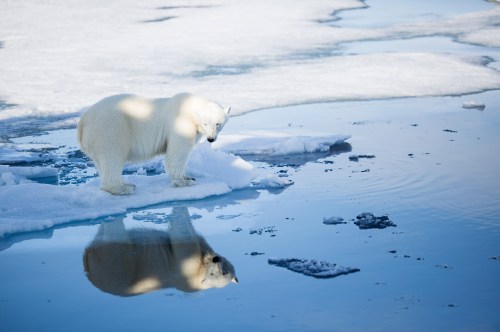
polarbearatthulerobindavies-500x349-sm

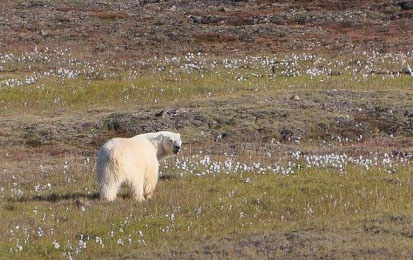
Fat polar bear, summer 2012 near Thule, NW Greenland (Baffin Bay subpopulation). Robin Davies photo.

However, the CBC writer still left out the most critical caveat included in the paper about the study: that factors other than changes in sea ice could have affected the body condition and litter size data that the authors documented but they didn’t look at anything except sea ice. This automatically means the conclusions are scientifically inconclusive.

See some quotes below from the CBC article and the caveat from the paper. Continue reading
Svalbard Norway now has more polar bear habitat than it did two decades ago

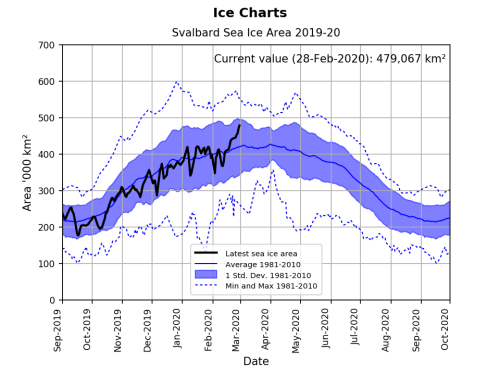
Sea ice around Svalbard, Norway at the end of February 2020 is way above average, as the graph below shows – with more polar bear habitat now than there has been in two decades.

Svalbard ice extent 2020 Feb 28 graph_NIS

Some comparison charts below show that the graph above includes some very high ice years in the 1980s (reaching that dotted line above the mean) for which only global charts are available.

However, contrary to suggestions that more Svalbard ice is better for polar bears, there is no evidence that low extent of sea ice habitat in winter or summer over the last two decades harmed polar bear health, reproductive performance, or abundance. In fact, polar bear numbers in 2015 were 42% higher than they were in 2004 (although not a significant increase, statistically speaking) and most bears were found to be in excellent condition.

Svalbard polar bear_Aars August 2015-NP058930_press release

This suggests a return to more extensive ice to the Svalbard region in winter will have little impact on the health of the entire Barents Sea subpopulation, although it might change where pregnant females are able to make their maternity dens if ice forms early enough in the fall. In other words, the population should continue to grow as it has been doing since the bears were protected by international treaty in 1973.

UPDATE 3 March 2020: According to 28 February tweet by the Norwegian Ice Service, which I just saw today, “the last time there was this much sea ice around Svalbard on this day of the year [28 February] was 2004“. Somehow, I missed 2004 when I was looking through the archive, so I have modified the text below accordingly; see the 2004 chart below and here.

Continue reading

State of the Polar Bear Report 2019: Are polar bear researchers hiding good news?

International Polar Bear Day is a good day to ask: Are polar bear researchers hiding good news? Extended lags in publishing polar bear counts and a failure to publish data on female polar bear body weights and cub survival in Western Hudson Bay for more than 25 years make it look like polar bear researchers are delaying and suppressing good news.

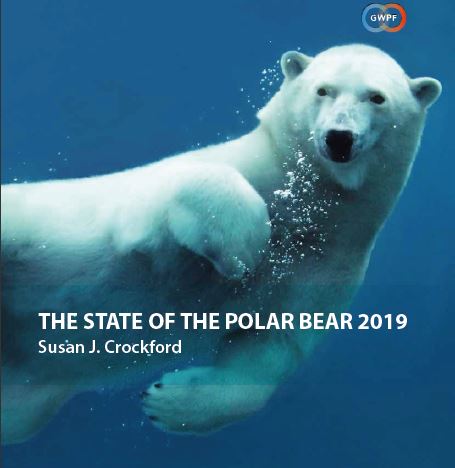
StatePB2019 cover image

In particular, the failure to report the data on cub survival and weights of female bears suggests that these health measures have not declined over the last two decades as claimed. If these figures are indeed the strongest evidence that sea ice loss due to climate change is harming Western Hudson Bay polar bears, why on earth have they not been made public? And why won’t a single journalist ask to see that data?
Continue reading

Claims polar bear cannibalism on the rise in Russian Arctic not supported by facts

The Guardian today expanded on a story published in the Moscow Times that quotes a Russian scientist claiming cannibalism among polar bears is on the rise in the Russian Arctic. However, the scientist offered no numbers to support this claim and there is no suggestion he had done a study on this phenomenon.

Cannibalism video 2015 Nat Geo_off Baffin Island

As I’ve said before, incidents of cannibalism cannot be said to be increasing because there is no scientific baseline for which recent occurrences can be compared. Scattered anecdotal reports of any behaviour cannot be touted as evidence for a trend even though they may be of interest and worth recording.

Continue reading

Why are polar bears going extinct?

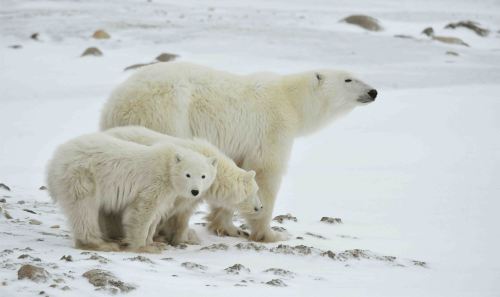
Google says many people ask this question so here is the correct answer: polar bears are not going extinct. If you have been told that, you have misunderstood or have been misinformed. Polar bears are well-distributed across their available habitat and population numbers are high (officially 22,000-31,000 at 2015 but likely closer to 26,000-58,000 at 2018): these are features of a healthy, thriving species. ‘Why are polar bears going extinct?’ contains a false premise – there is no need to ask ‘why’ when the ‘polar bears [are] going extinct’ part is not true.1

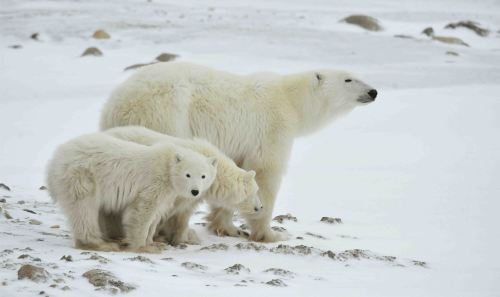
Mother with cubs Russia_shutterstock_71694292_web size

Continue reading

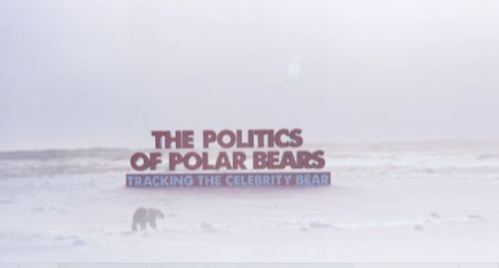
Flashback Friday: The Politics of Polar Bears CBC documentary from 2014

Worth watching if you haven’t seen it – and a second look if you have – a rare balanced documentary produced by the CBC in 2014 on polar bear conservation, with interviews with biologists Mitch Taylor and Andrew Derocher.

Politics of polar bears title

“In The Politics of Polar Bears, Reg Sherren will pick his way through the message track to help you decide what is really happening with the largest land carnivore on the planet.”

Short version here (about 18 minutes):

Entire version (45:30):

https://www.cbc.ca/player/play/2499432823

Online summary by the producer of the film, Reg Sherren (see excerpt below).

The most up-to-date discussion of polar bear numbers and the politics of polar bears are in my popular new book, The Polar Bear Catastrophe That Never Happened.

Continue reading

Polar Bear Scare Unmasked: The Saga of a Toppled Global Warming Icon [another look]

For almost twenty years, , we’ve endured the shrill media headlines, the hyperbole from conservation organizations, and the simplistic platitudes from scientists as summer sea ice declined dramatically while polar bear numbers rose. This video of mine from two years ago, which deconstructs the scare, is worth another look as International Polar Bear Day approaches with its associated ‘save the polar bear’ rhetoric.

Polar bear habitat at mid-winter as extensive as 2013 & better than 2006

Arctic sea ice at the middle of winter (January-March) is a measure of what’s to come because winter ice is the set-up for early spring, the time when polar bears do most of their feeding on young seals.

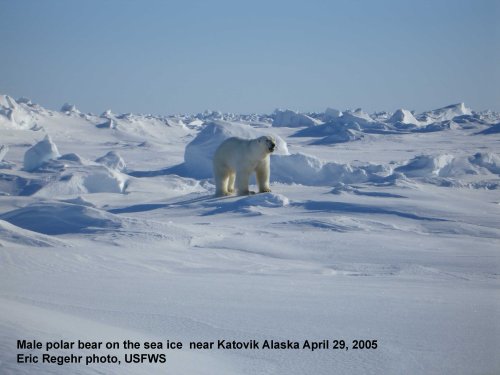
Polar_Bear_male on sea ice_Alaska Katovik Regehr photo_April 29, 2005_sm labeled

[Mid-winter photos of polar bears are hard to come by, partly because the Arctic is still dark for most hours of the day, it’s still bitterly cold, and scientists don’t venture out to do work on polar bears until the end of March at the earliest]

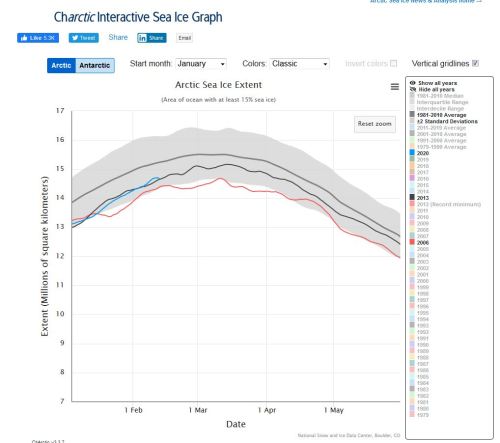
At 12 February this year, the ice was similar in overall extent to 2013 but higher than 2006.

Sea ice extent 2020 and 2013 and 2006 at 13 Feb 2020_closeup NSIDC interactive
Continue reading

First-ever polar bear population survey for entire Russian coast planned for 2021-2023

Word that Russia is planning to generate a count of polar bears along its entire Arctic coast within the next few years is good news indeed, as it will resolve a long-standing gap in population estimates that have not been dealt with at all well by the polar bear community. Whether North American and European academics will accept the results of the aerial surveys is another matter entirely, especially if the numbers are higher than they like, which is what happened with the first Russian Kara Sea count in 2013.

Mother with cubs Russia_shutterstock_71694292_web size

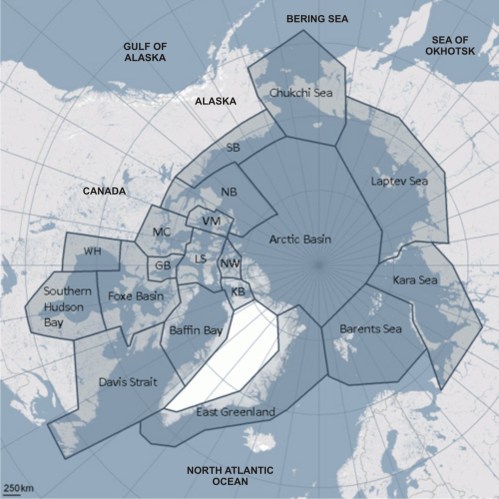
Up first will be the Chukchi and East Siberian Seas in 2021, the Laptev and Kara Seas, in 2022, and the eastern Barents Sea around Franz Josef Land in 2023.

Polar bear regions_larger

Continue reading

New paper says Baffin Bay polar bears may have been affected by less summer sea ice

A new paper on Baffin Bay polar bears reports data on body condition and litter sizes collected as part of a major study of the region completed in 2013 compared to sea ice declines since the 1990s; based on a computer model, the authors predict that in 37 years time (if sea ice declines continuously), the incidence of twin litters could “largely disappear.” However, no decline in population numbers was predicted and a critical caveat acknowledges that factors other than changes in sea ice could have affected the body condition and litter size data the authors analyzed, which means the conclusions are scientifically inconclusive.

polarbearatthulerobindavies-500x349-sm

Fat polar bear, summer 2012 near Thule, NW Greenland (Baffin Bay subpopulation). Robin Davies photo.

The last (2013) polar bear population survey of Baffin Bay (SWG 2016) generated an estimate of almost 3,000 (2,826; range 2,059-3,593), which means that regardless of some slight changes in body condition and litter size over the last two decades (which may or may not have been caused by loss of sea ice), there are currently a lot of bears in Baffin Bay.

Continue reading