Tag Archives: sea ice extent

Polar bears of W. Hudson Bay came ashore in 2009 as late as in 1992

It’s like pulling teeth, getting up-to-date information on breakup dates of Hudson Bay sea ice. You’d think with the importance of this seasonal event to the polar bears of Hudson Bay (some of which, we’re told, face the most perilous future of all polar bears worldwide), we’d get a press release every summer alerting us to the precise date of sea ice breakup and the subsequent arrival of the bears onshore. I’m thinking of something similar to the dispatches we get from the National Snow and Ice Data Center (NSIDC) when Arctic sea ice reaches its yearly maximum (e.g. March 2012) and its yearly minimum extent (e.g. September 2012).

Sadly, this is not the case.

So I was intrigued to see that a new paper just out in the Journal of Animal Ecology, by Seth Cherry (a Ph.D. student of Andrew Derocher) and colleagues, dealt with Hudson Bay breakup dates. I was hoping for some data beyond 2007, which has been the limit of information provided so far by polar bear biologists (see previous posts here and here). Unfortunately, because the methods for determining breakup dates in this paper are so different from previous ones (more detail below), the new data (1991-2009) can’t be compared to earlier studies that go back to 1979. But there is some good news.

Although you wouldn’t know it by the author’s conclusion, the results of the study confirm for this region my previously stated contention that polar bears need spring and early summer ice (March through June) for gorging on young, fat seals and documented declines in sea ice have rarely impinged on that critical feeding period – by which I meant, bears have seldom, if ever, been forced off the ice of Hudson Bay as early as June.

The study also confirms that there has not been any kind of spectacular retreat of sea ice breakup dates – coming earlier and earlier in the season – over the last 19 years and that polar bears did not arrive on shore in 2009 until very late – approximately 22 August – the same date they came ashore in 1992.

Below are two figures from the paper: one (the map) necessary to understand the new “Cherry method” of calculating breakup dates for Hudson Bay (no disrespect intended) and the other (the graph), which presents the data collected. The table with my converted breakup dates is below them. A few quotes from the study and some comments on it follows.

UPDATE (March 21 2013; 6:12 PM PST). A typo in the table has been fixed (2001 is Jun 21 not Jul 21) and the post amended accordingly.
UPDATE 2 (July 7, 2013) The Cherry et al. paper is now in print, the references have been updated accordingly.

Continue reading

Polar bear distribution shows they are limited by winter ice extent

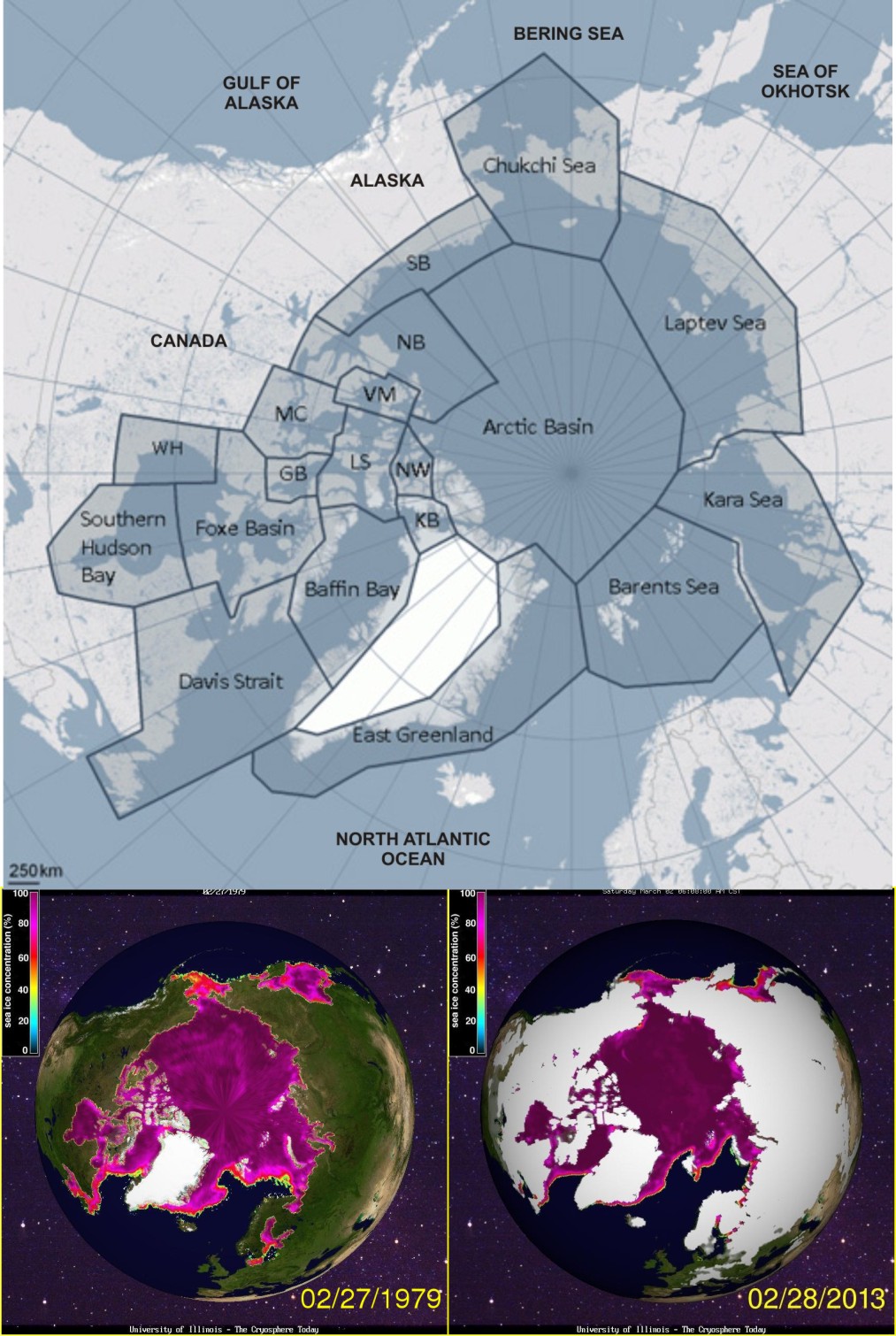
I’ve said it before but it’s worth saying again now that the sea ice in the Arctic is approaching its seasonal maximum extent and thickness: polar bears are limited by winter sea ice extent (Fig.1), not by the minimum extent of ice in the summer. Otherwise, their distribution would resemble the summer sea ice minimum (Fig. 2), not the winter maximum.

Despite the hue and cry about “declining sea ice,” polar bears are still as well distributed throughout their available winter habitat as they were in 1979, when detailed sea ice records began – see the map below. See further details on polar bear distribution here.

Figure 1. Polar bear distribution map (adapted from the one provided by the PBSG) compared to sea ice concentration at Feb 28 (at or near the seasonal maximum extent) 1979 and 2013. I can’t see a difference – can you see a difference? The only place there is consistently sea ice in winter but not polar bears is the Sea of Okhotsk, but there is no evidence that polar bears have ever lived there despite the presence of seals. Click to enlarge

Figure 1. Polar bear distribution map (adapted from the one provided by the PBSG) compared to sea ice concentration at Feb 28 (at or near the seasonal maximum extent) 1979 and 2013. I can’t see a difference – can you see a difference? The only place there is consistently sea ice in winter but not polar bears is the Sea of Okhotsk, but there is no evidence that polar bears have ever lived there despite the presence of seals. Click to enlarge

Continue reading

Matt Ridley’s foreword to my “10 good reasons not to worry” list – “We should be listening to Susan Crockford”

Benny Peiser over at the Global Warming Policy Foundation has just posted an essay by well-known author Matt Ridley (including “The Rational Optimist”), entitled “We should be listening to Susan Crockford” which is included as a foreword to a pdf of my earlier post, “Ten good reasons not to worry about polar bears.”

This stand-alone pdf is especially suitable for sharing with friends and policy makers.

I encourage you to have a look.

Polar bear spin reaches epic proportions at Bangkok CITES meeting

As I mentioned here in an update to my March 7th post, Damian Carrington at the Guardian Environment blog had this telling quote about the CITES deliberations that took place prior to the vote to ban polar bear trade (by uplisting its status from Appendix II to Appendix I):

As the debate raged, national delegates from other countries got confused by the strident but conflicting claims. “Where is the truth? Is it true that the polar bear is declining. Is it true that trade is increasing? We need to know,” said the Egyptian delegate.[my bold]

Indeed. Was there “truth” in the presentations heard by delegates? By that I mean, honest presentations of facts so that delegates could make up their own minds, or facts loaded with spin to sway the decision one way or another? I wasn’t there so I can’t say. But we can get some impression of what might have been said from two press releases statements issued after the vote failed by two parties that were actively promoting acceptance of the US-led proposal.[Update: Humane Society Press Release is here] Continue reading

Goldilocks in the Bering Sea: Less sea ice is bad and more ice is bad

This article from yesterday about sea ice in the Bering Sea is priceless: while we are still being told that below average ice coverage (common 10-20 years ago) is a sign of global warming that means the end of polar bears sometime in the future, it turns out that too much ice is bad, less ice is friendlier and lots of ice is hopefully something that we’ll never see again.

From the article:

After a 2012 Bering Sea snow crab season that saw unusually severe sea ice inhibit fishermen’s efforts to catch almost 89 million pounds of the shellfish, 2013 is shaping up to be much friendlier.

According to Kathleen Cole, a forecaster with the National Weather Service ice desk, this winter was unlikely to match 2012, even before it began. Despite some recent rumors of encroaching ice into the Bering Sea fishery, the situation is better than last year, she said.

“We’re just not going to have a year like last year. It’s going to be, by no means, that bad,” she said. “Last year was something that we’d never seen before, and hopefully something that we’ll never see again.”

Sea ice is still well above average in the Bering Sea this year – as it has been for 7 of the last 10 years. See the ice extent map from NSIDC from yesterday below and my previous post from December 2012: Now that Bering Sea ice cover is high again, variability is normal (note that polar bears of the Bering Sea are considered part of the “Chukchi Sea” subpopulation, which we know practically nothing about, see previous post here). Continue reading

New study says Western Hudson Bay polar bears could spend 2 to 4 months longer on shore than they do now

This a follow-up to my post from last week [“Extirpated polar bears of St. Matthew Island spent five months on land during the summer”]. UPDATED July 24, 2013 [see below]

A new study just published (Robbins et al. 2012, abstract below) suggests that non-pregnant polar bears that lived in Western Hudson Bay during the 1980s and 1990s had enough fat to spend at least 6-8 months on land, making the five months that St. Matthew Island bears spent fasting on shore a less than impressive feat.

Using data on polar bears that fasted around Western Hudson Bay (WHB) in the 1980s and 1990s, Charles Robbins and his colleagues created a model that predicted how long polar bears should be able to fast, given a measured amount of fat.

They concluded from their model results (pg. 1501) that polar bears sampled in Western Hudson Bay in the 80s and 90s had enough fat reserves to survive a fast that varied by sex, as follows:

Pregnant females: 7.7-12.3 months (mean 10.0) [vs. ~8 actual, including den time]
Lactating females with yearling cubs: 2.3-6.1 months (mean 4.2) [vs. ~4 actual]
Males: 5.4-10.6 months (mean 8.0) [vs. ~4 actual]

Note that a pregnant female could not really spend 12 months on shore fasting because she wouldn’t have any time to put on fat for the next year. The point is, however, that an eight month fast was leaving most pregnant WHB females with a good amount of fat left – they weren’t using up all they had (see photo in Featured Quote #7 here).

Lactating females had the lowest reserves of all but many had enough fat reserves to have lasted them through a 5-6 month fast (as the bears on St. Matthew were doing – females with yearling cubs as well as males were present).

This brings to mind one of the stories from my previous post on William Barents’ crew on Novaya Zemyla – that on Feb. 12, 1597, they killed a bear that gave them “at least one hundred pounds of fat.” That’s a lot of fat left on a bear that couldn’t have been eating very much over the previous 3-4 months (the depth of winter at that latitude).

In other words, both this study and the experience of Barents’ men more than 400 years ago suggests that most polar bears have an incredible ability to store fat and that this allows them to fast far longer than is usually assumed possible. Most is not all, however, and of course it is those individuals whose fat storage ability falls short that we hear about.

The authors of this new study, predictably (see abstract below), emphasized that some pregnant and lactating females were at the lower limit of survival (i.e. in the ranges given above, those pregnant females with only enough fat to endure a 7.7 month fast or a lactating female with the reserves to last only 2.3 months, when currently they would routinely spend 8 months and 4 months fasting, respectively, see previous post here).

However, this is hardly surprising. It is to be expected that some females, in any year and in any population, will be less-than-the-best hunters or turn out to have a fat-storage physiology that is not quite adequate. This is called individual variation – an entirely natural feature of any species. And the fact that some animals die because they do not have quite what it takes to survive natural fluctuations in habitat conditions (see previous posts here and here is why population fluctuations in wild animals are quite natural.

For polar bears, longer-than-average summer/fall fasts during longer-than-average ice-free periods mean that individual bears who are less-than-the-best hunters or who don’t have adequate fat storage physiology will die, fail to get pregnant or fail to raise their cubs. The animals that do survive and reproduce successfully, however, will be able to handle subsequent longer-than-average-summers with relative ease.

Longer-than-average ice-free periods also mean that for a short time, the population size will decline. But within a few years or so, the surviving animals – those who can reproduce as successfully as ever – will build the population numbers back up. Just as the bears of Western Hudson Bay appear to have done (see previous post here and Featured Quote #27 here).

This new study by Robbins and colleagues suggests that if the model results have real-world validity, most of the polar bears in Western Hudson Bay (including pregnant and lactating females) could survive an ice-free season that is 6 months long and that they could handle a 5 month fast with relative ease. However, a 5 month ice-free period is something we haven’t seen yet in Western Hudson Bay, despite the hue-and-cry we hear from some biologists (see previous posts here and here).

UPDATE July 24, 2013

I’ve added this because it seems to me that a few people may not have fully understood the above summary, so I’ve added a bit more detail from the study and my interpretation of it.

In this study (based on models, remember), the mean predicted survival time for all bears was 4.2 months.

As a result, the model results generated by these authors suggested that many (but not all) bears had enough fat reserves to last them through the current 4 month fast but some had enough to endure a 5-6 month fast.

For males in particular, their model results suggested that all males not only had enough fat reserves to survive a 4 month fast (as they currently do) but could have survived a fast of more than 5 months.

While the emphasis on this paper is the ‘catastrophe’ that not all bears would survive a 6 month fast, I should point out that this is their “worst case” scenario – an event that has not even come close to being realized.

While it is true that a few times over the last 40 years, Western Hudson Bay bears have had to endure a fast of 4 months plus three weeks, this length of fasting period has never occurred for more than one year at a time (Stirling et al. 2004; Cherry et al. 2013, see post here. In other words, polar bears have not even begun to approach a sustained 5 month long fasting period.

The authors of this study emphasize only that some pregnant and lactating females would not survive if the length of time onshore during the ice-free period in summer extended to 5 months (from the usual 4 months) and, should that time extend to 6 months, some males would not survive. They stated:

“…some pregnant or lactating females with lower levels of body fat content were already approaching or beyond the constraint of being able to produce cubs and survive the required 8 months of fasting if producing new offspring or 4 months if accompanied by older offspring

“…we estimate that as many as 16% of the adult males would die if fasting lasted for 5.4 months”. [my bold]

They suggest this is in general agreement with a prediction by Molnar et al. (2010) that 28% of adult male bears would die if global warming leads to a 6-month fast.

All of this fails to acknowledge that their results actually predict that most animals (72% of males) would survive the worst conditions they imagined (a 6 month fast), while if a 5-month-plus-2-week fast came to pass, most males (84%) would likely have enough fat reserves to survive. They imply  this would be a catastrophe – I call it remarkable survivability.

They do not provide similar quantification for their prediction of mortality among pregnant or lactating females (only adult male numbers were given). They nevertheless say that “pregnant or lactating females and particularly their dependent offspring have the most tenuous future as global warming occurs.”

What they mean is, some percentage (more or less than 84%) of pregnant or lactating females and their dependent young might not survive a 5 month fast and some percentage (more or less than 72%) might not survive a 6 month fast. Again, I wouldn’t call this a catastrophe – I say this is an example of remarkable resilience.

References
Cherry, S.G., Derocher, A.E., Thiemann, G.W., Lunn, N.J. 2013. Migration phenology and seasonal fidelity of an Arctic marine predator in relation to sea ice dynamics. Journal of Animal Ecology 82:912-921. [added July 24 2013]

Robbins, C.T., Lopez-Alfaro, C., Rode, K.D., Tøien, Ø., and Nelson, O.L. 2012. Hibernation and seasonal fasting in bears: the energetic costs and consequences for polar bears. Journal of Mammalogy 93(6):1493-1503. http://www.asmjournals.org/doi/abs/10.1644/11-MAMM-A-406.1

Stirling, I., Lunn, N.J., Iacozza, J., Elliott, C., and Obbard, M. 2004. Polar bear distribution and abundance on the southwestern Hudson Bay coast during open water season, in relation to population trends and annual ice patterns. Arctic 57:15-26. http://arctic.synergiesprairies.ca/arctic/index.php/arctic/article/view/479/509 . [added July 24 2013]

Abstract
Global warming has the potential to reduce arctic sea ice and thereby increase the length of summer–fall fasting when polar bears (Ursus maritimus) lose access to most marine mammals. To evaluate the consequences of such changes, we compared the cost of fasting by polar bears with hibernation by brown bears (U. arctos), American black bears (U. americanus), and polar bears and made projections about tissue reserves polar bears will need to survive and reproduce as fasts become longer. Hibernating polar bears expend energy at the same rate per unit mass as do brown bears and black bears. However, daily mass losses, energy expenditures, and the losses of lean mass are much higher in fasting, active polar bears than in hibernating bears. The average pregnant polar bear living around Hudson Bay during the 1980s and 1990s could fast for 10.0 ± 2.3 months (X̄ ± SD), and the average lactating female with cubs born during the preceding winter could fast for 4.2 ± 1.9 months. Thus, some pregnant or lactating females with lower levels of body fat content were already approaching or beyond the constraint of being able to produce cubs and survive the required 8 months of fasting if producing new offspring or 4 months if accompanied by older offspring. Pregnant or lactating females and their dependent offspring have the most tenuous future as global warming occurs. Thus, we predict a significant reduction in productivity with even modest increases in global warming for polar bears living in the very southern part of their range and are concerned about more northern populations depending on their ability to accumulate increasing amounts of fat.

Extirpated polar bears of St. Matthew Island spent five months on land during the summer

Did you know there used to be resident polar bears on two small islands in the Bering Sea? Given how much we don’t know about the polar bears of the Bering Sea, the bears that used to den and spend their summers on the St. Matthew Islands are a bright spot. These islands lay at the southern-most limit of the modern “Chukchi Sea” subpopulation (see Fig. 1) and were uninhabited by people when they were discovered in the 1760s – but they were a haven for polar bears.

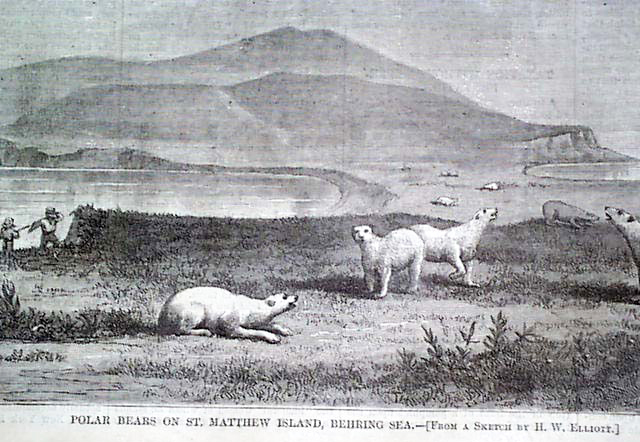
We have details of the polar bears that gave birth and summered there because a US government biologist (Henry Wood Elliott) and a US navy Lieutenant (Washburn Maynard) surveyed the islands in 1874. Elliott wrote both an official report and a popular magazine article (for Harper’s Weekly Journal of Civilization) in 1875 describing the polar bears they saw; Maynard wrote a separate report in 1876. By 1899, there were none left, victims of the relentless slaughter of polar bears everywhere in the Arctic in that era (see previous discussion here).

Figure 1. St. Matthew Island is in the Bering Sea off the west coast of Alaska: north of the Pribilofs and south of St. Lawrence Island, at about 60°N latitude. Compare this to the southern end of James Bay, Canada – which has a stable population of polar bears – at about 53 0N and Churchill, Manitoba – the “polar bear capital of the world” – at 58 046’N. Maps from Wikipedia.

Figure 1. St. Matthew Island is in the Bering Sea off the west coast of Alaska at about 60°N latitude. Compare this to the southern end of James Bay, Canada (which has a stable population of polar bears) at about 53 0N and Churchill, Manitoba (the so-called “polar bear capital of the world) at 58 046’N. Maps from Wikipedia.

Figure 2. A drawing of polar bears on St. Matthew Island that accompanied the May 1, 1875 Harper’s Weekly Journal of Civilization article written by Henry Elliot. See here.

Figure 2. A drawing of polar bears on St. Matthew Island that accompanied the May 1, 1875 Harper’s Weekly Journal of Civilization article written by Henry Elliot. See here.

[UPDATE: Jan. 27, 2013: a follow-up to this post is here.]

Continue reading

Hudson Bay sea ice and trapped killer whales

Last night, I was alerted by a reader (h/t MM) to an NBC news report with this headline: “Killer whales’ plight in ice an example of climate change impact, researcher says.” Here’s part of what it says:

The plight of a pod of killer whales that got trapped by ice in a mostly frozen Canadian bay this week was a “good example of what climate change can do” in the Arctic, a researcher said Friday.

The 11 killer whales apparently escaped the ice in Hudson Bay late Wednesday or early Thursday morning, when shifting currents helped break open a path to the sea, according to Petah Inukpuk, mayor of Inukjuak, a remote Inuit village in Quebec where locals had crafted a plan to help the animals, also known as orcas. Other reports said there were 12 orcas in the pod.

The killer whales were hundreds of miles from where they should be at this time of year, such as in the Hudson Strait or the North Atlantic, said Lyne Morissette, a mariner researcher with the Quebec-based St. Lawrence Global Observatory.

The bay, which normally freezes over in late November or early December only froze over earlier this week. 

“It’s definitely a direct effect, a good example of what climate change can do,” she told NBC News on Friday of the orcas’ plight. “All the dynamics of how the ice is going to move and where the ice is going to be — it’s not only about ice melting in the Arctic, you know — it’s the whole dynamics and currents that could change because of climate changes. [my bold]

I take issue, first, with this statement from Morissette (SLGO):
The bay, which normally freezes over in late November or early December only froze over earlier this week.”

Not true, according to the Canadian Ice Service. Continue reading

Did the PBSG game the polar bear listing process?

I was in the process of writing about something else last week when I came across a tidbit of information that, on closer examination, turned out to be part of a much bigger issue that I thought should be documented.

The story involves some machinations behind the scenes of the international Polar Bear Specialist Group, the “PBSG,” that you might find rather astonishing – and which may have implications for the various on-going battles about the polar bear’s conservation status.

A lone polar bear walking on ice [Kathy Crane (NOAA) photo].  We'll call this a metaphor for the expulsion of Mitch Taylor from the PBSG after the Group switched from emphasizing unregulated over-hunting as the primary threat to polar bear conservation to global warming.

A lone polar bear walking on ice [Kathy Crane (NOAA) photo].
We’ll call this a metaphor for the expulsion of Mitch Taylor from the PBSG,
after the Group switched from emphasizing unregulated over-hunting
as the primary threat to polar bears to global warming.

Continue reading

Now that Bering Sea ice cover is high again, variability is normal

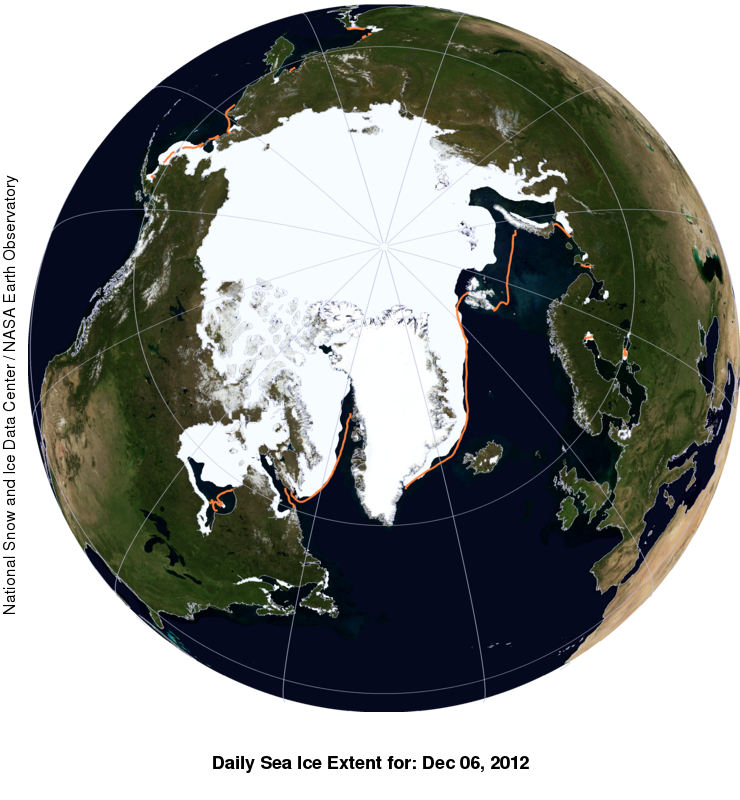
Sea ice development in the Bering Sea is trending higher than average again this year, even though it is early in the season. The NSIDC sea ice extent image for Dec 6 2012 below (Fig. 1) shows extensive ice development in the Bering Sea. [courtesy WUWT sea ice reference page]

Seven of the last 10 years have produced above-average freezing in the waters west of Alaska” says Kathleen Cole of the Alaska National Weather Service (Dec. 6, 2012) – see “Featured Quote” #20 in the right column (also filed in the “Quote Archive“).

Fig. 1 National Snow and Ice Data Center (NSIDC) sea ice extent at Dec. 6 2012. The orange line is the median extent for this date for 1979-2000.

Figure 1. NSIDC sea ice extent at Dec. 6 2012.
The orange line is the median extent for this date for 1979-2000. Click to enlarge.

The NSIDC, in their report on the annual freeze-up of the Arctic (November 2012), have this to say about the ice in the Bering Sea:

“…ice extent in the Bering Sea by the end of the month was greater than average, continuing a pattern seen in recent years. Extent in the Bering Sea was at record high levels last winter.”
Continue reading