Posted onJanuary 31, 2022|Comments Off on Davis Strait polar bears in Eastern Canada are thriving according to new survey
Pack ice is barreling down the Labrador coast, almost certainly bringing Davis Strait polar bears with it. And according to new survey results, those bears are doing just fine: numbers are stable, bears are fatter than they were in 2007, and cubs are surviving well – thanks largely to abundant harp seals.
Posted onJanuary 24, 2022|Comments Off on Polar bears at Kolyuchin Island weather station provide a rare photographer’s treat
Russian wildlife photographerDmitry Kokh took some photos and video last year of polar bears hunkered down at an abandoned weather station on the Chukchi Sea coast and he apparently won a prize for one of them, shown below. The shots are very cool, so I’ve provided some context for the story and posted the video here.
Posted onJanuary 13, 2022|Comments Off on East Coast sea ice so far similar to last year
Davis Strait ice pack is slowly moving south this year just as shorefast ice is developing in-place along the Labrador shoreline, similar to last year. East Coast harp seals that give birth in the region in March depend on this ice and so do many Davis Strait polar bears that feed on those newborn seals. In contrast, in 2017 the ice off Labrador was broader by mid-January (even more so by mid-February) and that seems to have made a huge difference by April, when ice north of Newfoundland was thick and extensive.
Compared to last year at this time, there was somewhat less ice along the Labrador coast but the difference is really negligible. By April, ice extent was well below average, especially in the Gulf of St. Lawrence, and there were few sightings of polar bears along the Labrador and Newfoundland coasts.
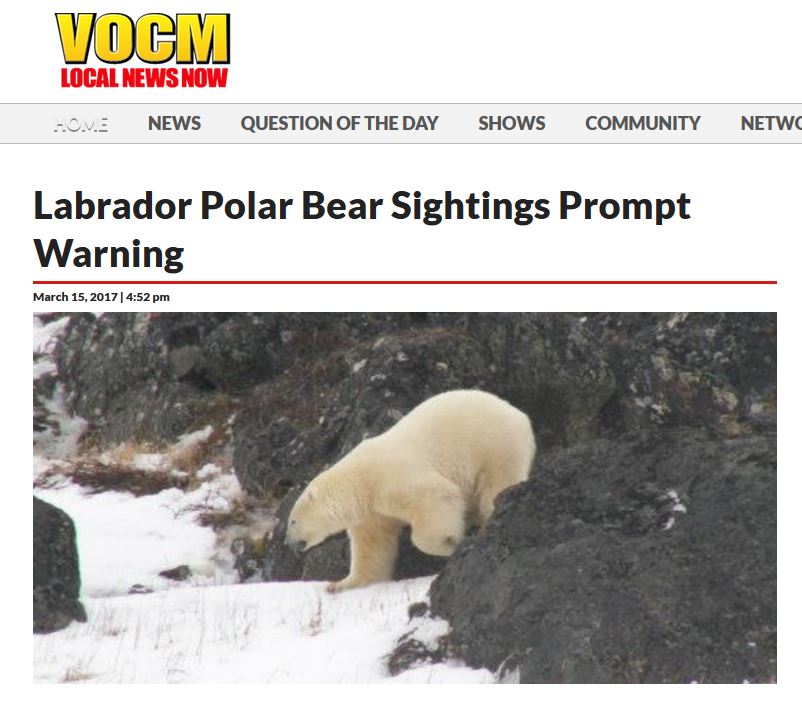
Back in 2017 at the same time (below), the band of ice along the southern Labrador coast was much broader, indicating more movement of Davis Strait ice from the north. This resulted in so many polar bear sightings in Newfoundland and Labrador by March and April that I could hardly keep up reporting them (Crockford 2019:32):
East coast conditions could change significantly over the next few weeks however, especially if weather conditions bring more north winds.
This year is a different story completely. It’s only early January and already there is abundant ice along the west coast of Novaya Zemlya; ice in the Barents Sea in general is well up over recent averages and the pack is already converging on Bear Island (Bjørnøya) to the south of the Svalbard archipelago. Ice this far south often brings polar bear visitors to the weather station there but that doesn’t usually happen until March or April.
You’ll find references in previous posts linked here.
Posted onJanuary 2, 2022|Comments Off on A ‘mass exodus’ of polar bears from Alaska to Russia has taken place, local residents claim
An article in a UK newspaper yesterday contains a claim made by local residents that polar bears which used to hang around Utqiagvik (formerly known as Barrow) in western Alaska, are ‘moving to Russia’ (i.e. the Chukchi Sea) in a ‘mass exodus’. It’s certainly possible but if so, it should come as a surprise to no one and is good news for polar bears.
If the allegation is upheld by scientific evidence, polar bears will not have been pushed out of Alaska by lack of summer sea ice (i.e. ‘forced to migrate’) but rather pulled into the Chukchi Sea by abundant food resources that did not exist when summer ice cover was more extensive. It’s a big difference and it speaks to the benefits of less summer sea ice that no one wants to discuss.
Moreover, moving temporarily to where conditions suit them best is what polar bears do all the time: it’s not a new phenomenon, it’s a prominent feature of their biology (Crockford 2019).
Posted onDecember 20, 2021|Comments Off on Educational video about Arctic sea ice to bookmark: excellent for adults and children
One of the recommended videos I included in my Arctic Sea Ice Ecosystem Teaching Guide is a film called “Edge of Ice”. Produced in 1986 (before climate change hype pervaded everything), this 55 minute documentary from the National Film Board of Canada (filmed in Lancaster Sound, Canada) is an excellent summary of Arctic sea ice and its ecology. Available for free streaming here.
Narrated in parts by an Inuk hunter, it not only shows virtually all of the species associated with ice edges in the central Canadian Arctic, including polar bears, but also explains the process of freezing and thawing; life under the ice and the importance of polynyas.
Worth bookmarking for future viewing if you can’t get to it right away. Beats watching the news these days. It’s also a reminder to tell your homeschooling friends and relatives over the holidays about my free Teaching Guide resource: it’s something many parents will find useful.
Comments Off on Educational video about Arctic sea ice to bookmark: excellent for adults and children
Posted onDecember 16, 2021|Comments Off on Mid-December polar bear habitat update
Compared to last year, polar bear habitat at 15 December 2021 is way up in the Barents and Bering Seas but way down in Hudson Bay but nothing any polar bear has to worry about.
Perhaps the last bear leaving Cape Churchill for the sea ice, 4 December 2021.
Moreover, considering that 2021 fall ice formation for the Arctic in general is well ahead of 2016 (and every year since, except 2018), it’s hard to see why human-caused global warming caused by ever-increasing CO2 emissions explains the slow freeze-up of Hudson Bay. Timing of Hudson Bay freeze-up has always been highly variable from one year to the next (Castro de la Guardia et al. 2017: Fig. 3, copied below). The average freeze-up date in the 1980s was 16 November ± 5 days, while from 2005-2015 this had shifted about a week to 24 November ± 8 days (Castro de la Guardia et al. 2017:230). This year freeze-up was later than usual but last year and the three years before that the ice froze as early as it did in the 1980s. Cue the zombie apocalypse.
UPDATE 11 December 2021: see chart below from Andrew Derocher on the position of tagged WH bears at 10 December.
Posted onDecember 1, 2021|Comments Off on Higher than average Svalbard sea ice extent in November 2021 has implications for birth of cubs
Early last November, sea ice around Svalbard was the lowest it had been since 1967 and pregnant females were simply unable to den on the eastern islands of the archipelago and instead had to make their dens and give birth in the pack ice or the Franz Josef Land archipelago further east, as they have done before. However, the ice is back this fall with a vengeance: even Hopen Island in the south of region was surrounded by ice well before the end of the month but whether it will attract a few pregnant females remains to be seen.
Results of polar bear health monitoring in the spring of 2021 indicated the bears are doing just fine after last year’s low ice levels. Despite this evidence, a single bear photographed killing a reindeer in August 2020 was falsely blamed on climate change. The narrative never seems to change.
Watch polar bear habitat reform in the Canadian Arctic: “last 10 days” Canadian Ice Service animation (works anytime) HERE.
See Quote archive for details.








 polarbearscience
You must be logged in to post a comment.