Posted onFebruary 3, 2026|Comments Off on Biologists allowed David Attenborough to tell BBC viewers that Barents Sea bears were dying of starvation in his 2011 Frozen Planet episode when they knew it wasn’t true
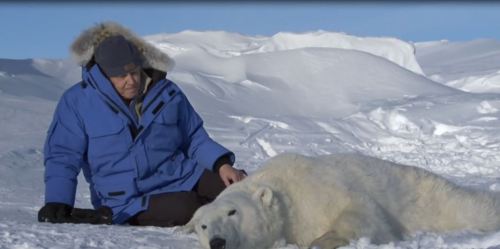
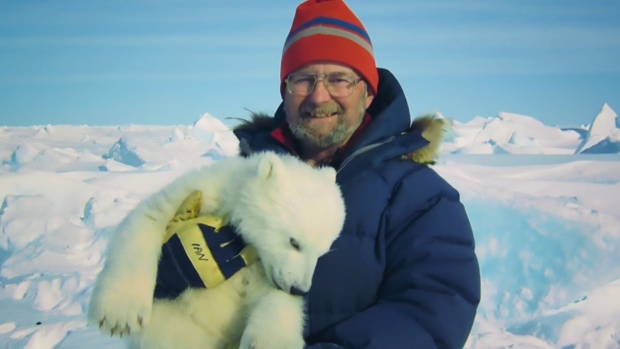
In the climate change episode of his 2011 BBC Frozen Planet series ‘On Thin Ice’, Sir David Attenborough told viewers that polar bear mothers and cubs across the Arctic were starving because climate change was melting the sea ice, even as he sat beside a fat, healthy Barents Sea female (below).
I wonder how Sir David Attenborough feels now? Has anyone bothered to tell him that Norwegian biologists have finally admitted that Barents Sea polar bears were actually fat and healthy in 2010 when they assisted in the filming of his BBC documentary? Or, did Attenborough know even then that this population of polar bears was thriving despite the large loss of sea ice – but let his viewers think otherwise?
Comments Off on Biologists allowed David Attenborough to tell BBC viewers that Barents Sea bears were dying of starvation in his 2011 Frozen Planet episode when they knew it wasn’t true
Posted onDecember 11, 2025|Comments Off on Was a recent wolf encounter near Tofino an aborted predatory attack?
It has recently been revealed that a human-wolf ” encounter,” in which a beach walker was forced to take refuge in the ocean when two wolves kept advancing in menacing fashion, has been described by Parks Canada officials as benign-sounding “escorting behaviour” rather than an aborted predatory attack.
This week, I was looking online to see if there had been any further reports of wolf encounters near Tofino since the end of October, when two recent incidents made national news. I discovered that a full week later, a local First Nations newspaper revealed some interesting details not available earlier, see “Encounters climb as habituated wolves establish core territory near Ucluelet” (7 November 2025).
Here’s my question: Are Parks Canada officials hiding important details of recent encounters – or sanitizing them with scientific-sounding language – to protect wolves at the expense of keeping park visitors safe?
Posted onSeptember 12, 2024|Comments Off on Churchill seemingly unworried about polar bears, fails to post problem bear reports on social media
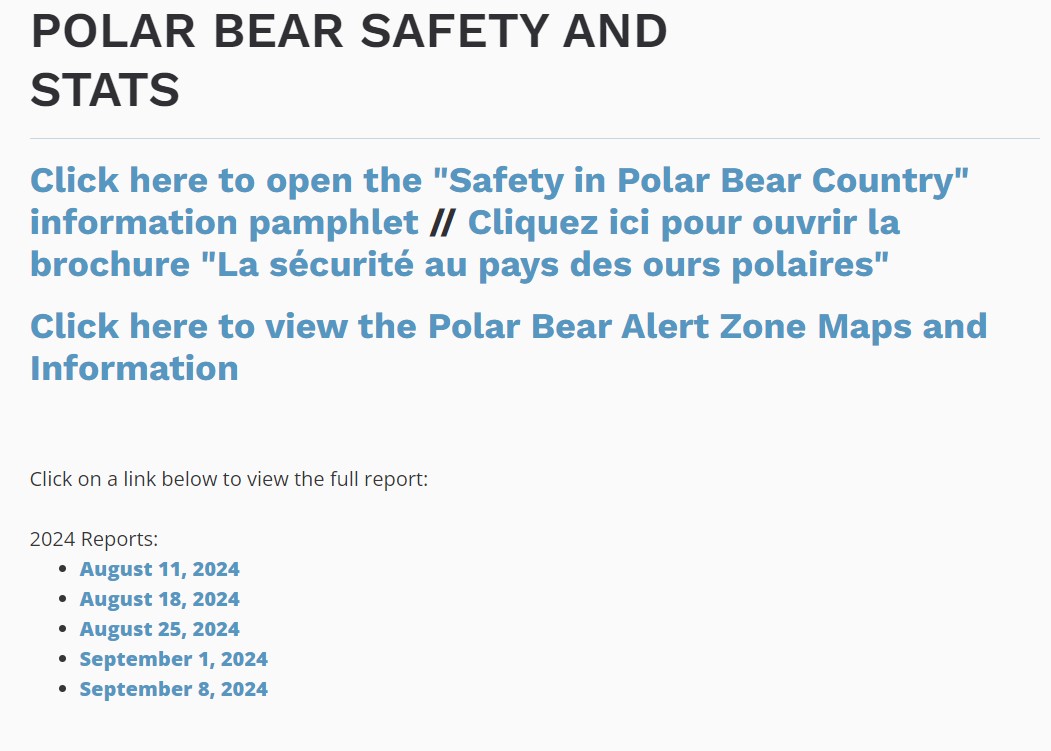
We know transparency’s gone out the window for many public officials, but still: Since early August, I’ve been checking daily for Problem Polar Bear Reports issued by the Churchill Polar Bear Alert Program managed by Manitoba Conservation. This morning (12 September), five reports were posted at once on the Town of Churchill website, dating back to first of the season for the week of August 5-11, see image below.
It’s apparent that the intent of these reports is in part public safety: to raise awareness of the potential threat of wandering polar bears around the town of Churchill because of the language that appears on virtually every report: “stay vigilant”, “be bear smart,” “be bear aware,” etc.
However, the X account for Town of Churchill seems to have been abandoned (last post 19 April 2024), which suggests the town is confident no residents or tourists would benefit from Alerts on X that polar bears are ashore:
The town’s Facebook account seems to be their only method of public communication yet even there, there have been no Polar Bear Alert reports posted this summer.
Oddly, even though it is now apparent from the just-released reports that one bear got so close to town that it had to captured and put in the ‘polar bear jail’ the week of 5-11 August — for the public’s safety — the only safety announcement the town issued that week was a ‘heat warning’ on 12 August:
I guess we are to assume that whoever is running this account – or the town council, or the mayor – believes that a day or two of hot weather (which Churchill gets regularly most years) is more dangerous to public safety than a massive predator wandering around town.
I can only conclude that keeping residents and tourists in the dark about potential threats from local polar bears is one way that Churchill is now adapting to climate change (from CBC News, 10 September 2024):
Bears Onshore and Effective Sea Ice Breakup dates
It is apparent from the wording of the Churchill reports that even by the last week of August this year, all bears were not yet off the ice, since they say only that “most bears” were on shore the week of 26 August to 1 September (see next section).
That suggests the last bears came ashore this year at least a week later than they did in 2020 (at 21 August), which at the time polar bear specialist Andrew Derocher presented as an anomaly (see tweet below). Compare to the situation last year here.
The last report I’ve seen from Derocher (via X) for 2024 on the status of his teams’ tagged females is that many of them (11/29 or 38%) were still on the ice as of 8 August (posted 11 Aug):
Derocher referring to this an “amazing” year that’s “similar” to the 1980s probably doesn’t tell the half of it, since he hasn’t posted any maps since then (as of noon, 12 September).
This effectively keeps secret the date when the last of these females bears actually came ashore, which is in any case a biased microcosm of the entire subpopulation. In other words, we can expect that if 40% of tagged female were still on bits of remnant ice at 8 August, there will have been many more bears, especially males, out there as well – which of course he never mentions.
He also never mentions that satellites under-report the amount of ice at this time of year by as much as 20% because of the effects of melt-water sitting on ice, but we’ve come to expect that.
Oddly, a recent study tried to explain the importance to survival of the recent phenomenon (since about 2015 or so) of bears staying out on melting bits of remnant ice rather than heading immediately to shore when the ice coverage over Western Hudson Bay drops below 50%. They suggested this behaviour was largely confined to male bears because they had to make up for feeding missed during the breeding season (McGeachy et al. 2024).
Females, alternatively, appear to respond to break-up in WH by coming onshore approximately 3 weeks after the mean ice concentration in WH reached 50%, … However, suitable habitat was still present elsewhere in the Bay and appeared to be used by a portion of WH prime age males. [McGeachy et al. 2024: 494, where “prime age males” are aged 5-19 years.]
However, these authors never mention the data reported by Derocher every year showing fairly significant numbers of tagged females lingering on tiny chunks of ice well into August, even though Derocher is a co-author. Funny, that.
Problem Bear Reports 2024, Weeks 1-5
Week 1, 5-11 August
Week 2, 12-18 August
Week 3, 19-25 August
Week 4, 26 August-September 1
Week 5, 2-8 September
References
McGeachy, D., Lunn, N.J., Richards, E.S. and Derocher, A.E. (2024). Sea ice influence on male polar bear survival in Hudson Bay. Arctic Science 10, 483-498. https://doi.org/10.1139/as-2023-004 Open access.
Comments Off on Churchill seemingly unworried about polar bears, fails to post problem bear reports on social media
Posted onAugust 13, 2024|Comments Off on Western Hudson Bay sea ice breakup for polar bears like the 1980s for 3 of the last 5 yrs
The 1980s and early 1990s are said to have been the “good old days” for sea ice conditions and polar bears in Western Hudson Bay, with all tagged bears usually ashore by mid-to-late August. Then an abrupt step-change in sea ice breakup dates brought polar bears to shore an average of two weeks earlier in the late 1990s. From then until 2019, the only significant outlier to all tagged bears being ashore by about late July was 2009, which was such an unusually cold year that the last bears came ashore about August 20.
That pattern changed in 2020, when the last bears came off the ice as late as they had in 2009, on August 21. Something similar happened in 2022, when the last bears came off a small remnant of ice even later, about August 26. And this year, the bears may be moving ashore even later: there is even more ice remaining off WH and much of it is thick compacted ice that hasn’t melted much over the last few weeks, which means bears have been as late onshore as the 1980s for three out of the last five years.
Posted onJuly 11, 2024|Comments Off on Last month of Arctic spring fails to bring sea ice to its knees, even in Southern Hudson Bay
Polar bear habitat for June — the last month of spring in the Arctic — is still within 2 standard deviations of the long-term average despite sea ice experts’ predictions that catastrophic declines can be expected any year now.
The Arctic sea ice cover in June 2024 retreated at a below average pace, leading to a larger total sea ice extent for the month than in recent years. NSIDC, 3 July 2024
Oddly, the National Snow and Ice Data Center (NSIDC) employees who wrote up the sea ice summary for June felt it appropriate to bring up a recently-published prediction of impending doom for Southern Hudson Bay polar bears based on a sea ice prediction (Stroeve et al. 2024), which I covered here. The inclusion of this topic is a naked promotion of the Stroeve sea ice modelling paper which not only doesn’t fit the reality of this year’s sea ice conditions but their discussion doesn’t include a single piece of evidence that Southern Hudson Bay polar bears came off the ice earlier than usual.
The fact that recently-deceased Ian Stirling was a prominent co-author should come as no surprise: his irrational promotion of the idea that future “climate warming” could doom polar bears to near-extinction – even after recording and publishing evidence to the contrary – will go down in history as an appalling violation of scientific principles.
Adding to the dubious validity of the paper: lead author Julienne Stroeve’s 2007 paper predicting summer sea ice decline by 2050 was proven wrong by actual data by the time it was published (Stroeve et al. 2007, 2014) and a more recent update failed to foresee the recent 17-year stall in decline. And co-author Steve Ferguson, a seal biologists, rashly stated in 2016 that Hudson Bay could be ice-free in winter as early as 2021 [which, needless to say, never came close to fruition].
I’d say if Southern Hudson Bay polar bears might be extirpated as soon as 2030, as the paper’s co-author Alex Crawford suggests, the global temperature and ice melt had better get a move on: a survey showed the SH population was thriving in 2021 and Hudson Bay sea ice hasn’t hit any kind of death spiral in the three years since.
Posted onMay 19, 2024|Comments Off on Ian Stirling, grandfather of polar bear biologists, dead at 82
Ian Stirling, who laid the foundation for our understanding of polar bear ecology and almost single-handedly made the polar bear an icon of global warming, died last week in Edmonton at the age of 82 [my mistake in the headline: he would have turned 83 this September]. Stirling was said to have played a critical and calming diplomacy role at international Polar Bear Specialist Group meetings but over the last several decades, like so many other “conservationists,” he became an outspoken activist for what he called the “climate warming” issue.
It was sad for me to have witnessed a respected and dedicated biologist turn his back on science the way he did but I am also saddened by his passing. He truly did make a huge contribution to science but could have done so much more with the time he had.
Posted onFebruary 27, 2024|Comments Off on State of the Polar Bear 2023: W. Hudson Bay polar bear numbers have not declined since 2004
In my State of the Polar Bear 2023 report for the Global Warming Policy Foundation, I discuss recent news relevant to polar bear conservation and science issues. The most startling of these is the revelation that Western Hudson Bay polar bear numbers have not declined since 2004.
Posted onFebruary 13, 2024|Comments Off on When polar bears die, they die of starvation: new Nature paper is propaganda, not news
Is it a coincidence that a paper reporting the results of a no-news study on polar bears, but which predicts future starvation due to climate change, was published two weeks to the day ahead of a climate change marketing event made up by the activist organization Polar Bears International? I doubt it.
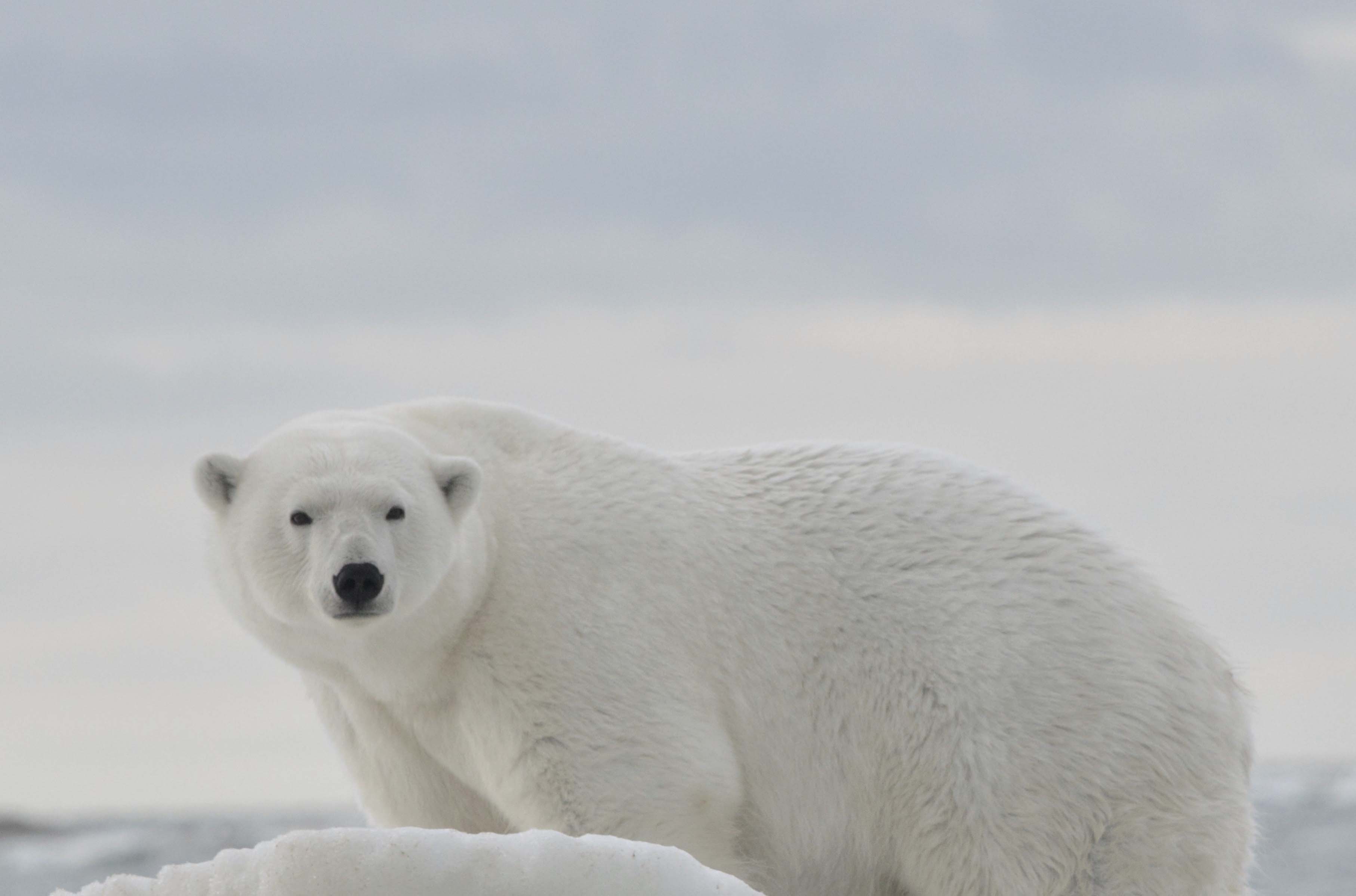
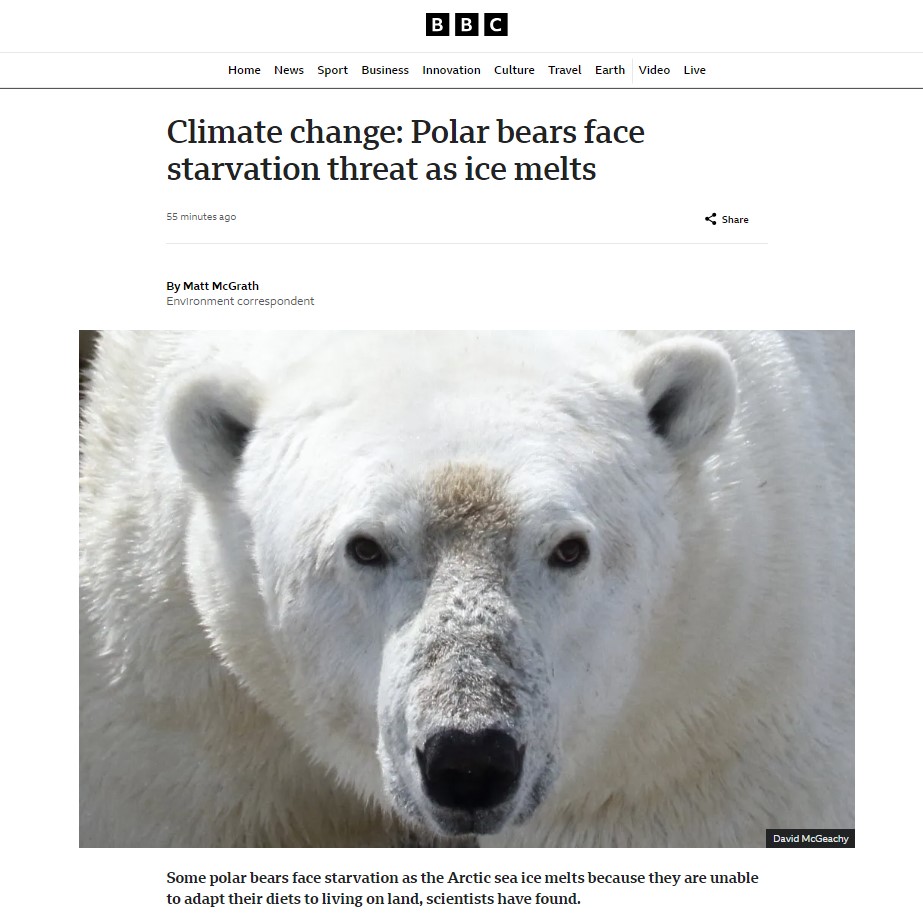
And do I think the high-profile journal Nature Communications would not only agree to publish such a useless bit of propaganda but also rig the timing to advance the climate change emergency narrative? Silly question. And the media worldwide are of course lapping it up, happy for an excuse to promote the perils of climate change, see here, here, and here using images of fat polar bears. Image above is from the BBC headline, 13 February 2024.
They believe this strategy is effective because they think the public is stupid, but they are deluding themselves. Most people are now laughing at their obvious acts of desperation.
Posted onFebruary 8, 2024|Comments Off on Activists just can’t stop using emotional blackmail to sell the climate change narrative
Even though a big deal was made earlier this year about climate activists not using polar bears anymore to try and sell the climate change emergency narrative, they just can’t seem to help themselves.
So it’s not at all surprising that yet another amateur climate activist has resorted to using the emotional ploy of a photo of a polar bear on sea ice to win the 2023 Wildlife Photo of the Year People’s Choice Award sponsored by the Natural History Museum London (UK).
His thought-provoking image is a stark reminder of the integral bond between an animal and its habitat and serves as a visual representation of the detrimental impacts of climate warming and habitat loss.“
Watch polar bear habitat reform in the Canadian Arctic: “last 10 days” Canadian Ice Service animation (works anytime) HERE.
See Quote archive for details.











 polarbearscience
You must be logged in to post a comment.