Posted onJanuary 18, 2024|Comments Off on Tom Nelson interview with me about the failed polar bear narrative and rapid evolution
You can watch my interview with Tom Nelson about the latest issues in polar bear conservation and highlights of my latest book, Polar Bear Evolution.
On Youtube:
Tom tells me, “It’s also up on other video sites such as Rumble and BitChute, and will soon be available on other podcast apps such as Apple Podcasts (most, but not all, of those are audio-only). It should also be on Spotify, Google Podcasts, Pocket Casts, Podvine, Overcast, Amazon Music podcasts, Audible podcasts, Castbox, RadioPublic, Twitter, etc.”
Summary: Susan Crockford, a zoologist, discusses the challenges in accurately estimating polar bear populations and the ongoing debate between Inuit communities and polar bear specialists regarding population sizes. She also shares her theory on the role of thyroid hormones in polar bear evolution and the quick adaptation of species to new environments using the example of the Russian foxes.
A list of topics covered, by time-stamp in the interview, is listed below.
Except for the lying and obfuscation that most of us have come to expect, I’ve mostly been left to reiterate that polar bears are not “canaries in the coal mine” indicators of climate change and to point out that Arctic sea ice extent and polar bear survival are not inextricably tied. For example, in some specific areas of interest, like Western Hudson Bay, there has not been a consistent decline in sea ice over the last few decades and bears are not attacking people at increased rates because they are desperately hungry. In other areas, like the Svalbard area of the western Barents Sea, sea ice has declined dramatically in recent years yet polar bears have not been attacking people more than usual.
Contradictions and failed predictions abound.
All in all, a rather boring year for the anticipated implosion of polar bear health and survival, despite my constant tracking of publicly-available information. That said, I would like to take this opportunity to thank you all again for your continued support, and especially those who have donated hard-earned cash over the last few months: your support makes it possible for me to continue my work keeping polar bear science honest. Together, we have made a difference and I know it’s worth the fight. Because if we let evidence-based science die without challenge, we lose our ability to make sense of the world.
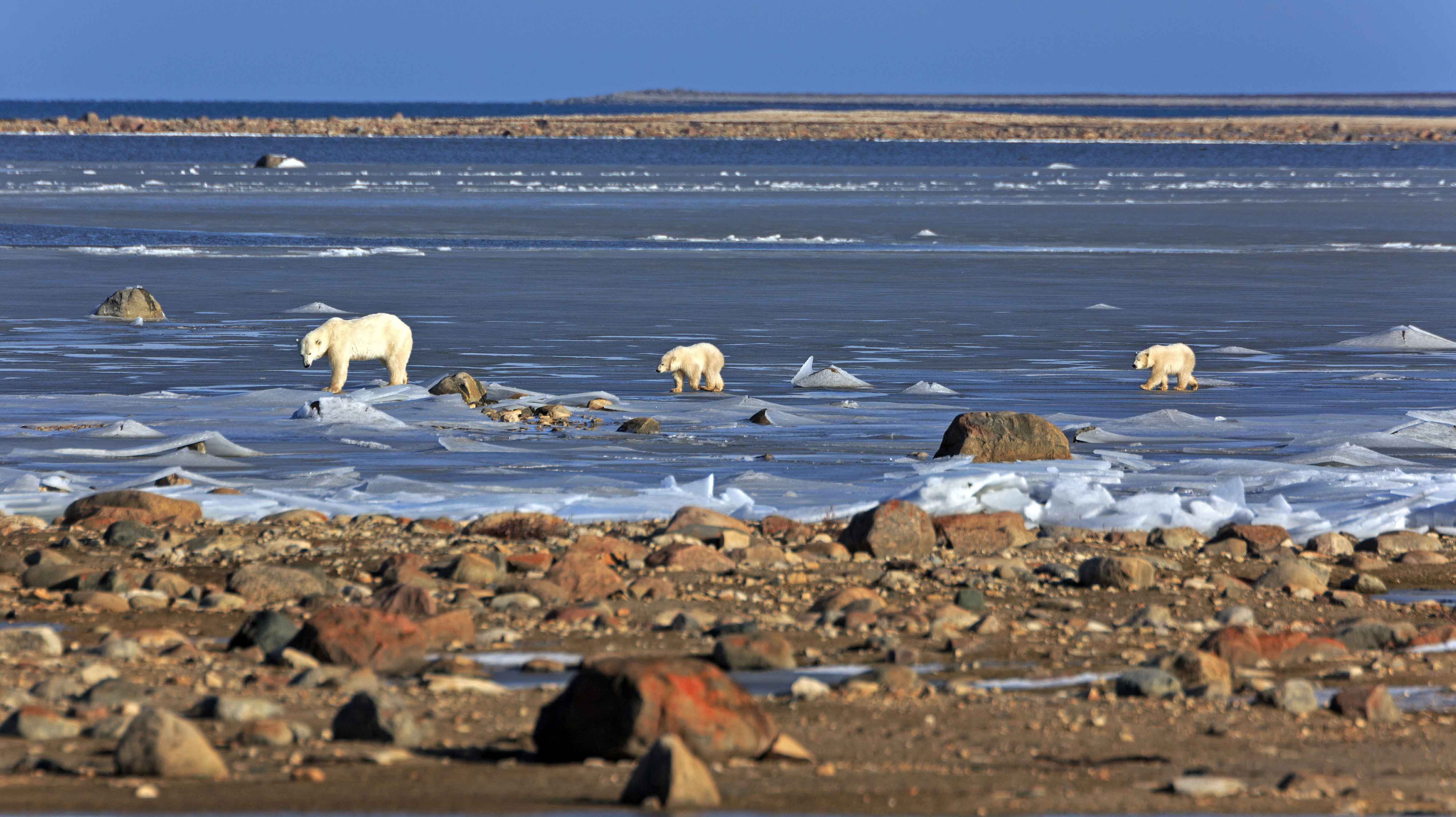
Posted onDecember 9, 2023|Comments Off on Despite hand-wringing about Churchill polar bears this year, 2023 wasn’t their worst summer
For months, the media has been bleating about the poor polar bears of Churchill suffering from lack of sea ice blamed on human-caused climate change during the so-called ‘hottest year’ on record: in April, July, August, November, and December.
From a Churchill Wild report on the condition of WH polar bears, January 2023
However, while breakup of sea ice on Hudson Bay was indeed early this year and freeze-up came later than usual, Western Hudson polar bears apparently spent only the fifth-longest time on land since 1979, according to a polar bear specialist. How is that even possible, given that sea ice conditions should be getting worse and worse as CO2 levels increase and average global temperatures rise? As I’ve pointed out before, it is apparent that Arctic sea ice is not closely coupled to CO2 levels (as the ‘experts’ claim), which makes me wonder if there is any ecologically-relevant correlation between CO2 and sea ice at all.
Money quote from Geoff York, from Polar Bears International: “As of Nov. 28 this year, the bears in western Hudson Bay had spent 164 days on shore, he said. That’s tied for the fifth-longest amount of time the bears have spent off the ice since 1979.” CBC, 9 December 2023 [my bold]
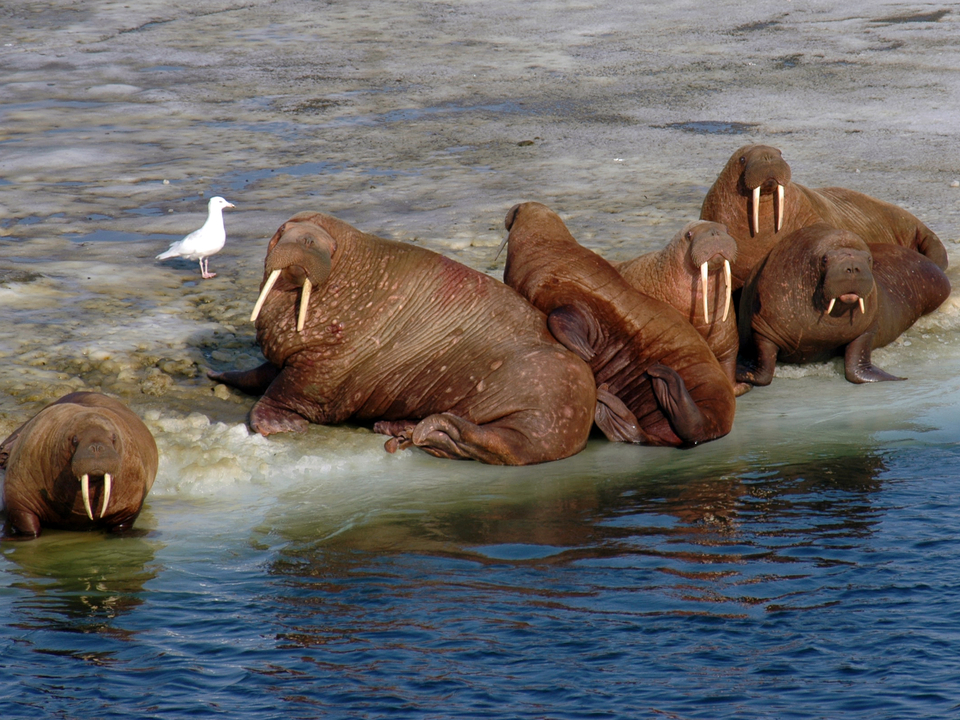
Posted onNovember 14, 2023|Comments Off on Walrus and polar bear population size changes in the N. Atlantic over the last 20k years
This is a lesson in how to assess the potential worth of scientific papers. One of two similar Arctic evolution studies got media attention, at least in Canada — about the polar bears, of course — but in my opinion the walrus research conclusions are much better supported, less biased by climate change rhetoric, and lack the hubris present in the polar bear paper.
Both studies use similar sample sizes for the regions they had in common (North Atlantic) and used computer models to determine genetic diversity and population size changes since the LGM. However, the tone of the walrus paper was less emotionally-charged and the caveats of the work were appropriately stated. In my opinion, papers like the polar bear example contribute to eroding the public’s trust in science.
The last Ice Age peaked between about 27,000 and 19,000 years ago. At this time the Arctic was buried under kilometers of glacial ice sheets, and so marine mammals were pushed southwards to areas of ice floes and more open water. Walrus survived in some areas of the Atlantic located further to the south, and as soon as climates warmed again, the ice edge retreated and walrus populations pushed quickly northwards again. This combination of warming and climate-driven dispersal led to local walrus populations becoming more genetically differentiated. Walrus study, Lund University press release 27 September 2023
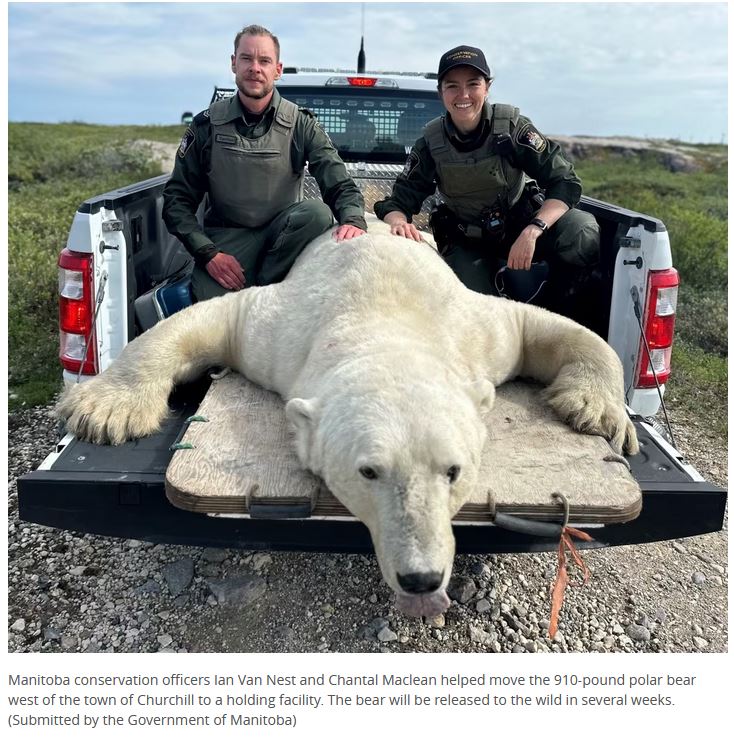
Posted onOctober 26, 2023|Comments Off on Churchill so far has few problems with polar bears despite predictions of a record bad year
Despite misleading warnings in mid-August that a record number of incidents had already taken place, and that Churchill was on track for a record-number of bear problems this fall, the number of incidents and bears captured so far have been well below other years after the same number of weeks ashore. And while this is shaping up to be the longest ice-free season on record for Western Hudson Bay bears, it may not be a record year for problem bears in Churchill.
“On average, officers receive around 250 calls from residents and detain around 50 bears every year, according to statistics provided to Live Science by the Manitoba government. The record number of bears captured in a single year was 176, in 2003.” LiveScience, 16 August 2023
Posted onOctober 16, 2023|Comments Off on Polar bear researchers hiding significant increase in Southern Hudson Bay numbers
Last December, researchers vigorously promoted a possible 27% decline in Western Hudson Bay (WH) polar bear abundance but kept hidden the fact that adjacent Southern Hudson Bay (SH) numbers increased by 30% over the same period.
And surprise, surprise: the bombshell SH results call into question everything the ‘experts’ have been saying about polar bears in Hudson Bay for years.
Posted onSeptember 25, 2023|Comments Off on Evolution Earth documentary comments on polar bear survival & adaptation: let’s see how they do
Just a heads-up that this week, PBS in North America will broadcast the “polar” episode of a new documentary called “Evolution Earth.” In my area, it’s scheduled for Wednesday, September 27 at 10:00 PM. It remains to be seen whether this is really about evolution or (given those involved in its production) simply more climate change propaganda similar to that promoted by Attenborough, but I intend to watch and report back.
About the Show: “Evolution Earth embarks on a global expedition to reveal the animals keeping pace with a planet changing at superspeed. Heading out across the globe to distant wilds and modern urban environments, five episodes track how animals are moving, using ingenuity to adapt their behavior, and even evolving in unexpected ways.
…We follow heart-warming tales of resilience that redefine our understanding of evolution, and hint at how nature can show us a path towards a sustainable future for Planet Earth. The series is narrated by Dr. Shane Campbell-Staton, who guides us through each episode in an intimate narrative style, drawing on his background as an evolutionary biologist.”
Episode 4 | Ice “At the planet’s frozen extremes, shifts in animal movement and behavior reveal vital information about our future world. Examine polar bears in the Arctic, penguins in Antarctica and other animals surviving in icy worlds.“
UPDATE 27 September 2023: Well, as I expected, this show was full of Attenborough-style nonsense about starving polar bears waiting for sea ice to form along Western Hudson Bay, the bears presented as “canaries in a coal mine” indicators of climate change, with an activist scientist saying she’s “pissed” about climate change. They used charts of the very distinctive pattern of sea ice formation that took place in November 2020 to illustrate how freeze-up was “later and later each year” even though 2020 was one of the earliest freeze-ups on record (bears were successfully hunting from shorefast ice as early as 30 October). A waste of 15 minutes: I couldn’t bear to watch what they did with the penguins.
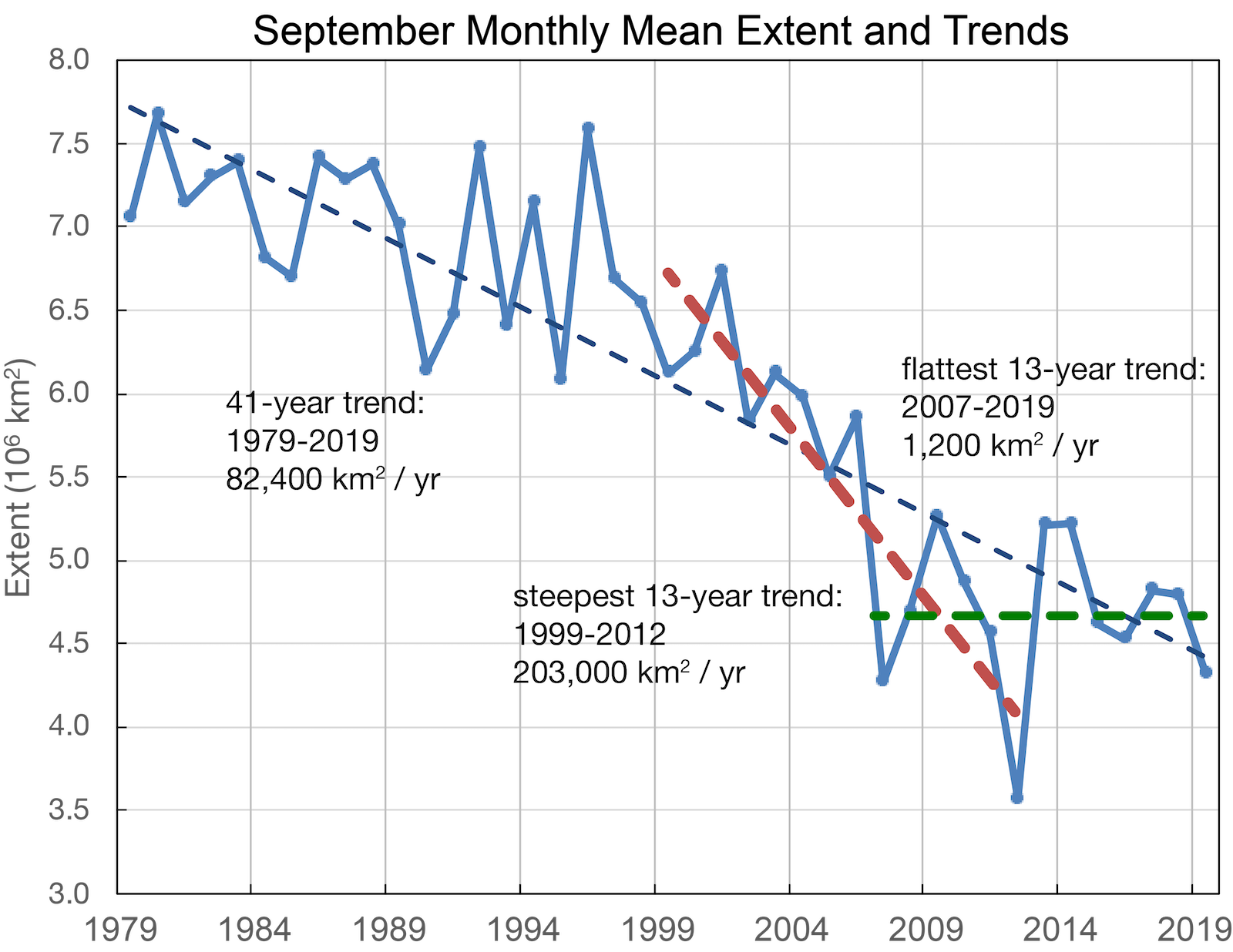
Posted onSeptember 22, 2023|Comments Off on 17 years of near-zero trend in September sea ice demolishes claim that more CO2 means less sea ice
If the hottest year ever can’t precipitate ‘ice-free’ conditions in September, what’s it going to take? Arctic sea ice failed to nose-dive again this year, undoubtedly disappointing expects who have been anticipating a ‘death-spiral’ decline for ages. Arctic sea ice hit its seasonal low sometime around mid-September this year and although the precise value hasn’t been published, the average September ice coverage will likely be about 4.2 mkm2 once it gets announced in early October.
This means we have now had 17 years of a near-zero trend for September sea ice, extending the nearly-flat trend NSIDC sea ice experts acknowledged four years ago. This surely busts a huge hole in the prevailing concept that more atmospheric CO2 causes less summer sea ice. Note that CO2 levels measured in August 2023 were 419.7 parts per million (ppm), compared to 382.2 in August 2007, a rise of 37.5ppm with no corresponding decline in summer sea ice (and vs. 314.2 ppm in 1960). Measured in metric tons, CO2 emissions due to fossil fuels rose from 31.1 billion in 2007 to 37.1 billion in 2021 (last year of data), again with no corresponding decline in summer sea ice.
Posted onAugust 31, 2023|Comments Off on New study that claims it can directly link GHG emissions to polar bear cub survival is poppycock
A global warming miracle has happened. While no scientist worldwide has ever drawn a straight line between greenhouse gas emissions and population declines in a species considered at risk due to climate change, a new paper just published in Science Magazine claims to have performed this unlikely feat for polar bears. It’s called “Unlock the Endangered Species Act to address GHG emissions.”
Note this analysis has not been peer reviewed: as a “Policy Forum” contribution, it’s considered by the journal to be a public interest commentary, not a research paper.
One might be forgiven for asking whether this work represents solid, reproducible science or simply well-timed, sciency-looking rhetoric ready-made for the litigious Center for Biological Diversity to pressure the US government to increase protections for polar bears before the 2024 US election. It is surely no coincidence that this paper made its appearance near the seasonal low for Arctic sea ice as well as during the 15-year anniversary of the ESA listing of polar bears as ‘threatened’ and the 50th anniversary of the ESA itself.
Moreover, knowing this paper was in the pipeline might explain why the 2022 government report on the most recent Western Hudson Bay polar bear decline, which I discussed yesterday, has been kept secret for so long: the results of that report are cited in this new Science paper as supporting evidence that sea ice declines are responsible for recent population declines, which Reuters said in December was clearly not the casefor the period 2017-2021.
Watch polar bear habitat reform in the Canadian Arctic: “last 10 days” Canadian Ice Service animation (works anytime) HERE.
See Quote archive for details.








 polarbearscience
You must be logged in to post a comment.