Category Archives: Life History

Polar bears in winter: insights from Behouden Huys, 1596-1597

As a follow-up to my previous post on polar bears giving birth (December is polar bear nativity month) I thought I’d continue the generalized theme of “polar bears in winter.”
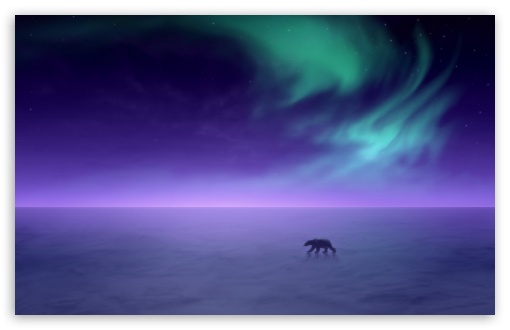
polar bear aurora_borealis_3-t2 free

While we don’t really know for sure what non-pregnant polar bears do during the depth of the Arctic winter, we have bits of evidence – some from modern hunters and polar bear researchers but also from Arctic explorers. One explorer in particular comes to mind: William Barents [Willem Barentsz] of Holland, who attempted to reach China via the Arctic Northeast Passage in the late 16th century. On their third voyage (1596-1597), Barents and his crew were forced to spend the winter on the northern tip of Novaya Zemlya (latitude 760N, see Fig. 1) when their ship became trapped in the sea ice. Crew member Gerrit De Veer (1609) kept a journal account of the long, horrifying winter they spent on shore, in a shelter they built with materials salvaged from the ship. They called their winter home Behouden Huys (“the saved house”).
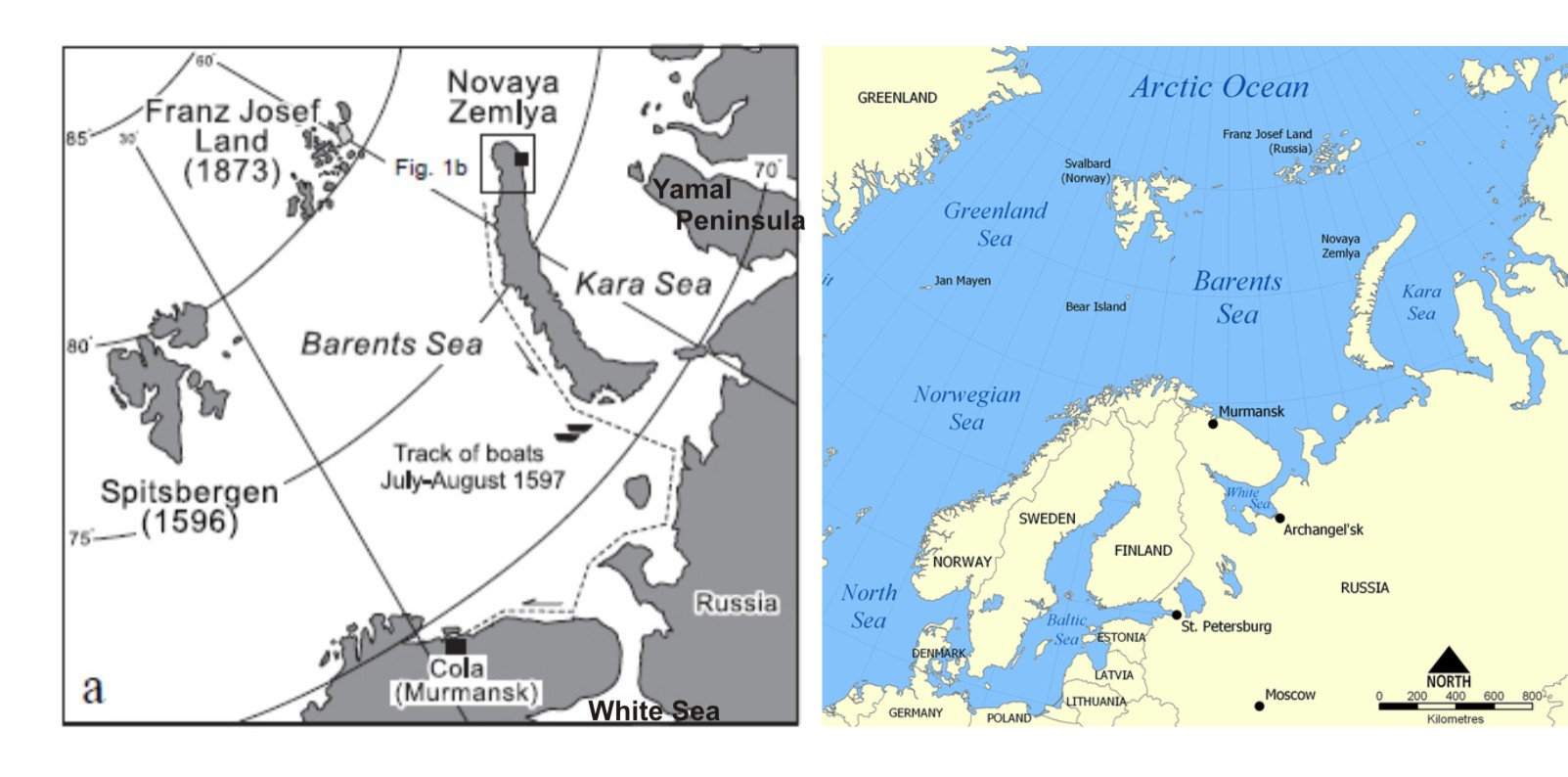
Figure 1. Location of Novaya Zemlya, in the Barents Sea. On the map at left (a), the black square marks the location of Behouden Huys, the over-winter home of William Barents and his crew (1596-97) on Novaya Zemlya (the “track of boats” noted marks the return journey of Barents in the summer of 1597). This is modified from Zeeberg et al. 2002:331. The map on the right is from Wikipedia, for perspective. click to enlarge.

Figure 1. Location of Novaya Zemlya, in the Barents Sea. On the map at left (a), the black square marks the location of Behouden Huys, the over-winter home of William Barents and his crew (1596-97) on Novaya Zemlya (the “track of boats” noted marks the return journey of Barents in the summer of 1597). This is modified from Zeeberg et al. (2002:331). The map on the right is from Wikipedia, for perspective. click to enlarge.

An English translation of De Veer’s journal is now available online and it offers a fascinating glimpse of what it meant to live through that long dark winter under almost-constant fear of attack by polar bears. The Dutchmen were plagued by polar bears almost the entire time they were on Novaya Zemlya (see Fig. 2). De Veer’s notes on these encounters provide a unique perspective on polar bear activities over the Arctic winter – ironically, it is not the havoc the bears caused that provides the most important clue but rather, the timing of when they left Barents and his crew alone.
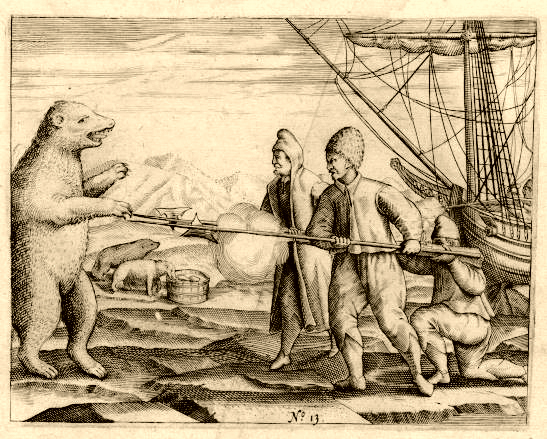
Figure 2. An engraving from De Veer’s journal conveys the struggle the crew faced in warding off polar bears during their winter stay at Novaya Zemlya. The bears not only stalked and attacked the crew - they got into the food stores on the ship (From Wikipedia).

Figure 2. An engraving from De Veer’s journal conveys the struggle the crew faced in warding off polar bears during their winter stay at Novaya Zemlya. The bears not only stalked and attacked the crew, they got into the food stores on the ship.
(From Wikipedia).

Continue reading

December is Polar Bear Nativity Month

Polar bears are generally out of sight at this time of year and will be for several more months. Pregnant females will be snug in maternity dens giving birth and all others will be out on the sea ice looking for seals to eat – if they can find them in the dark.

In most areas of the Arctic, December is when polar bear cubs are born, although in southern regions (like Western and Southern Hudson Bay), some may be born in late November and in the far, far north, a few may be born as late as early February.

The actual “date of birth” for polar bear cubs is often back-calculated from when they emerge with their mothers in the spring, because they are born well away from our prying eyes in the dark of the Arctic winter, deep with a snow or soil den dug for that purpose (see previous post here). So our knowledge of the “true” dates of birth in various regions is limited. We have some evidence from native Canadian hunters prior to 1968, when it was both legal and common practice in Canada for Inuit to hunt bears in their dens (Van de Velde et al. 2003), and from a few scientific research expeditions (Amstrup and Gardner 1994; Harington 1968; Ramsay and Stirling 1988; Derocher et al. 1992).

Polar bear cubs, like all bears, are born tiny and rather undeveloped (see Figs 1 and 2 below). Their eyes do not open until about one month after birth. By the time they are 63 days old (two long months after birth, see Toronto Zoo photo here ), their eyes are wide open and they are well furred. Keep in mind, for perspective, that domestic dogs are born after a 63 day gestation period and their eyes open at about 12 days.
Continue reading

The sea ice is back and polar bears are heading out

It appears from the ice maps that most of the polar bears throughout the world that have chosen to remain on land during the late summer and fall (about July/August through October/November) can now return to the ice.

I can tell most of this tale with maps, so I will.

Continue reading

Western Hudson Bay polar bears are not like the others – Part 2

In Part 1 of the Western Hudson Bay (WHB) polar bear story, I promised to explore the idea that rather than declining due to the effects of global warming, WHB polar bear populations may simply be returning to ‘normal’ after the rapid population increase that followed the intense over-harvests that occurred between 1890 and 1930 and again from 1945 to 1970.

Derocher and Stirling (1995:1664) had this to say about the life history features (like incidence of triplets and age of weaning) that made the polar bears of WHB unique:

The results of our analyses suggest that the unique reproductive characteristics of polar bears in western Hudson Bay in the 1960s and 1970s were either a function of a population increasing from a depleted state and feeding on a relatively abundant prey base, or density-independent fluctuations in prey population size, or availability due to sea ice variation.

In my last post, I discussed some of the evidence for how polar bear reproductive characteristics had changed since 1985. But how different were WHB polar bears, before and after 1985, from the other populations that had been dramatically reduced between 1890 and 1970, such as those in Svalbard/Barents Sea and Davis Strait?

There are two factors to consider in this recovery from over-harvest: population size changes and reproductive characteristics. Turns out, we don’t know much about the Davis Strait subpopulation but we do know a bit about Svalbard/Barents Sea bears since the 70s. And the Svalbard/Barents Sea vs. WHB comparison is a bit of an eye-opener.
continue reading

Critical evidence on polar bears in W. Hudson Bay is unpublished

In my last post, Western Hudson Bay polar bears are not like the others – Part 1 I stopped at the point where the following question arose: “The documented decline in cub survival and condition of females documented above occurred between 1985 and 1992 – what about now?

I promised to address that question in a separate post because it revealed some interesting issues that deserve star billing.

What I found might surprise you: apparently, virtually all of the data supporting a decline in the western Hudson Bay polar bear population since 1985 has been collected but has not been published. This revelation came from none other than the 2012 summary by Ian Stirling and Andrew Derocher that I’ve mentioned before here.

[updated Sept. 28, 2012 – reference added, see below]

continue reading

Western Hudson Bay polar bears are not like the others – Part 1

A review paper, purporting to list the “effects of climate warming on polar bears” (Stirling and Derocher 2012:2697), has this to say about the state of research in western Hudson Bay:

“The most comprehensive long-term research on polar bear demography, body condition, subpopulation size, abundance, and reproductive success has been conducted on the Western Hudson Bay subpopulation.”

This means that compared to all of the 19 subpopulations of polar bears (see fig. 1), the very best information we have is for Western Hudson Bay (WHB) bears (fig. 2).

But are western Hudson Bay polar bears biologically typical of all polar bears? In this post, I’ll begin to examine that question.

Continue reading

Record low sea ice extent and what it means for polar bears…

On Aug. 27, 2012 sea ice extent dipped below the yearly minimum extent reached in 2007.

The sea ice at this point, a five-day average, was 4.1 million km squared and the lowest point reached since satellite records began in 1979. The National Snow and Ice Data Center (NSIDC) thought it was important enough to issue a press release.

There are sure to be more than a few media-hungry folks who will be moaning about the fate of the poor polar bears because of this report. Before people get too hysterical, a bit of rational perspective might be helpful.

Keep in mind that 4.1 m sq. km (Fig. 5) is about the size of Greenland (2.166 m km2) plus Mexico (1.972 m km2), or about the size of India (3.287 m km2) plus Pakistan (0.809 m km2), figures from Wikipedia.

It may be a ‘record’ low, but it’s still a lot of ice: 4.1 m km2 is not anywhere close to an ‘ice-free’ Arctic!

Arctic sea ice melts – or gets pushed out of the Arctic and then melts – every year, leaving various amounts behind. The ice lingering at mid-September adds to next year’s ‘multiyear’ ice.

The maximum extent is usually reached mid-to-late March. Have a look at how this ‘low extent’ developed from the March maximum this year. Even if you’ve looked at some of these maps, you may not have looked at them one after the other. I’ll compare these to the fall maps for 2007, after the Sept. minimum and discuss these in relation to polar bear habitat. Contineu reading

Is there insufficient ice for polar bears to den offshore?

In an earlier post (July 26), I had some critical things to say about an article in the Edmonton Journal (July 17, 2012) by veteran Arctic science writer and photographer Ed Struzik called “Bleak future for polar bears, U of A scientists say“, which was picked up by news outlets across Canada.

The Struzik article publicized a summary academic paper written by polar bear biologists Ian Stirling and Andrew Derocher (a former Ph.D. student of Stirling) that appeared “in press” behind the paywall at the journal Global Change Biology on July 9.

The academic paper is a summary of Stirling and Derocher’s dire predictions on the future fate of polar bears as a result of melting of Arctic sea ice over the next few decades, one of the prophesied catastrophes of anthropogenic global warming. These views mirror to a large degree the chapter on “climate warming” in Ian Stirling’s book on polar bears released in 2011, which I reviewed recently here.

Let’s look at one of the statements made in the Struzik article:

In Alaska, many bears are denning on land because there is insufficient ice for them to give birth offshore.

Update added Aug. 28, 3:35 PM  below the post
Continue reading

The conundrum of cold winter effects in Hudson Bay

[Deleted April 20 2015 – this post needed revision, and I decided it was easier to re-do it completely. Which I haven’t done yet. I’ll insert a link here when the new post is done]