Category Archives: Polar bear attacks

Spring sea ice prediction for next year off Newfoundland: extensive ice coverage

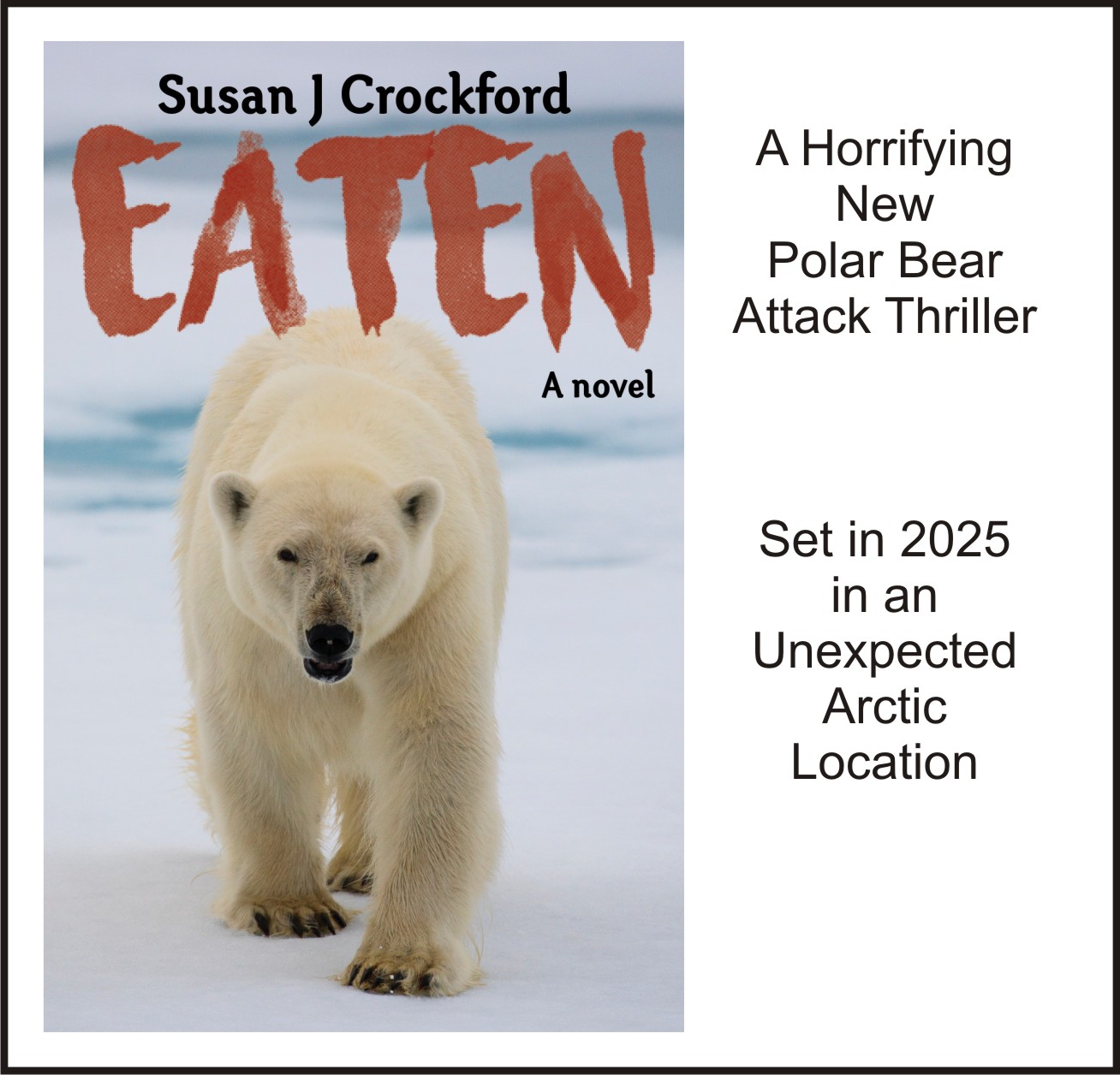
EATEN – my new polar bear attack novel – is set in Newfoundland 2025 for a reason. I wondered: what if sea ice coverage 10 years from now is as high or higher than it has been for the last two years, with inevitable positive effects on Davis Strait harp seal and polar bear populations?

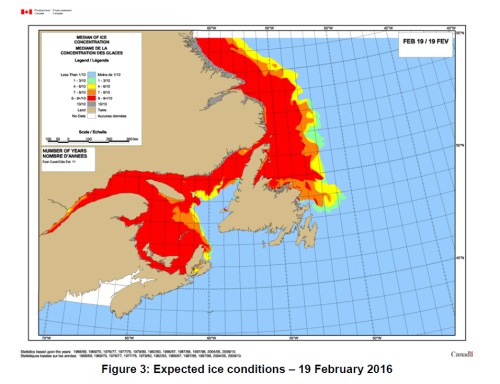
The Canadian Ice Service prediction for this region, released earlier this week (1 December 2015, see references for link), is that 2016 is set to meet my “what-if” scenario handily. Nine years to go! See the CIS expected ice coverage for 19 February 2016 below (CIS fig. 3):

2016 Newfoundland Ice outlook for 19 Feb 2016_at Dec 1 2015

How does the above ice map compare to the last two years? At least as high or higher. Have a look below.

Continue reading

Eaten: A novel, now available

My new novel has been published! The paperback is ready to order and will ship immediately; the ebooks are available for pre-order and will download November 30, 2015.

More detail and links here: www.susancrockford.com

Paperback book or Kindle ebook can be ordered on Amazon.com (US and Canada), click here: http://www.amazon.com/Eaten-novel-Susan-Crockford/dp/151930255X [temporary Kindle link here, until Amazon gets it linked to the paperback: http://www.amazon.com/dp/B0182FUIV0 ]

In the UK, find the paperback here and the Kindle version here.

ePub version (via Smashwords, which ships to Apple, Barnes & Noble, and Kobo), see https://www.smashwords.com/books/view/592875

LIMITED TIME OFFER for the ePub version: November 30, 2015 until December 3, 2015 only

     FREE with promotion code GW98Q (not case-sensitive)

This will make a great Christmas/holiday present for friends and family who don’t read science books – give them an alternative with this great story with a bit of science lite.

EATEN – My first novel, coming soon!

Watch for it!

EATEN_A new novel_final_lg

For years, polar bear specialists have being playing “what-if.”

They’ve used computer models to predict polar bear responses to computer predicted sea ice conditions 25-90 years into the future and insist their prophecies will become reality unless human behaviour changes. They like to call their “what-if” science.

I decided to play too – except I call my “what-if” a novel. Perfect for people who never read science books and everyone who likes a good story.

Coming soon in Paperback , Kindle, and ePub formats!

Churchill problem polar bear report for 13-18 October 2015

Latest report on problem bears in Churchill, Manitoba, from the town’s Facebook page.

2015 Oct 13_18_at Oct 19_lg

Polar Bear Alert Program Activity Report as of Oct. 19 (click to enlarge):

30 polar bears handled to date this year; 11 bears in the holding facility this week (6 released, including a sow and two cubs). As mentioned in the new Polar Bear Town reality TV show, Churchill officials have been more vigilant and pro-active since the two polar bear attacks in 2013 than they were previously, capturing any bears than come close to the town.

See previous post here for map and background. Last week’s report here.


BBC perspective on Arviat polar bears – those not included in the last mark-recapture study

In a polite but misleading article today in a BBC magazine (The polar bears are coming to town) about the relationship of polar bears and Inuit in Arviat, Western Hudson Bay, there is no mention of the on-going feud between Nunavut Inuit and Canadian polar bear scientists regarding invasive research.

Churchill_Polar_Bear_2004-11-15 Wikipedia

Nor is there a mention of the fact that according to the most recent research, there has been no trend in sea ice conditions since 2001.
Continue reading

Churchill problem polar bear report for 14-20 September 2015

Latest report on problem bears in Churchill, Manitoba, from the town’s Facebook page. See previous post here for map and background. Last week’s report here.

Polar bear-TRANSPORTED-TO-POLAR-PRISON_w Huff Post 2011

Photo above: A bear is transported to Churchill’s polar bear holding facility (from a 2011 Huffington Post article, “Polar Bear Prison”).

22 polar bears handled to date this year; 15 bears in the holding facility this week. See also last post on Polar Bear Town – a new TV reality show about Churchill polar bears.

Polar Bear Alert Program Activity Report as of Sep 21 (click to enlarge):

2015 Sept 14_20_at Sept 21

Churchill problem polar bear report for 7-13 September 2015

Latest report on problem bears in Churchill, Manitoba, from the town’s Facebook page. See previous post here for map and background.

19 polar bears handled to date this year; 12 bears in the holding facility.

Polar bear-TRANSPORTED-TO-POLAR-PRISON_w Huff Post 2011

Photo above: A bear is transported to Churchill’s polar bear holding facility (from a 2011 Huffington Post article, “Polar Bear Prison”).

Activity report for 7-14 September 2015 copied below (click to enlarge):

2015 Sept 7-13_at Sept 14

Polar bears are not hungriest in summer when scientists are busy in the Arctic

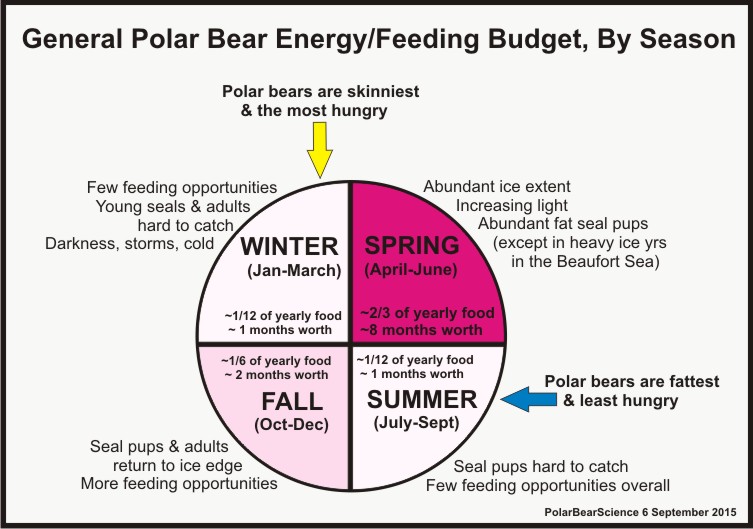
Polar bears are leanest – and therefore, hungriest – at the end of March, not in the summer, as chemist Crispin Halsall stated in a recent article about working in the Arctic.
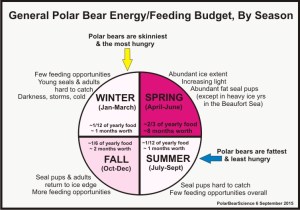
Polar bear feeding budget_PolarBearScience_6Sept2015

Recent September 1st stories by CNN and the BBC, based on a press release by WWF Russia on 27 August 2015, that five bears in the southern Kara Sea were hanging around a weather station and frightening workers there, apparently prompted chemist Crispen Halsall to make a nonsensical statement about polar bears being at their “hungriest” in summer (first here, reproduced here and picked up yesterday (September 5) by The Guardian here).

“In the path of the polar bears: what it’s like to be an Arctic scientist” (4 September 2015; Crispin Halsall, Reader in Environmental Chemistry at Lancaster University) had this to say:

“The case of Russian scientists trapped in their remote Arctic base by a group of inquisitive yet hungry polar bears does not come as a surprise. By late summer, Arctic sea ice is at a minimum and polar bears are effectively landlocked in coastal areas eagerly awaiting the return of ice during the autumn freeze and the chance to hunt seals again.

The Arctic summer is also the time of year when scientific activities are at their maximum, with bases operating at capacity and fieldwork operations at full flow, particularly in tundra and coastal regions. Polar bears are hungriest when scientists are busiest – “encounters” are inevitable. [my bold]

Polar bears are leanest – and therefore, the hungriest – at the end of winter (when it is more likely to kill with the intent to consume human prey) as stated clearly by Stirling and Øritsland (1995:2603):

Polar bears reach their lightest weights for the year in late March, just prior to the birth of the next cohort of ringed seal pups, which also suggests that it is the success of their hunting in spring and early summer that gives them the body reserves they need to survive through the rest of the year.” [my bold]

A polar bear that has not fed properly in spring – because it was young and inexperienced, too old or too young to defend its kills from bigger, stronger bears, or simply sick or injured – it might be unusually hungry in summer but it’s not the norm.  Polar bears eat nothing or very little over the summer (whether on land or on the ice) because they live off their stored fat – the physiological condition known as ‘fasting.’

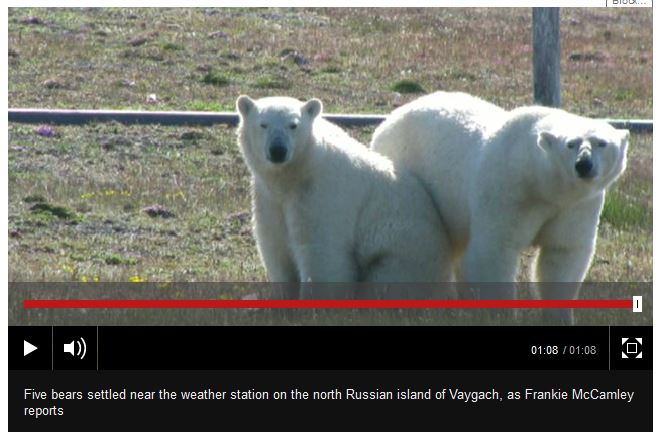
The photos and video in the September 1, 2015 BBC story of the Russian bears shows this: the bears are fat, not skinny (“Video caption: Five bears settled near the weather station on the north Russian island of Vaygach, as Frankie McCamley reports”):
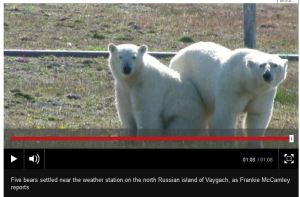
Beseiged by bears Russia BBC video Sept 1 2015

Polar bears might approach humans working in the Arctic during the summer because they are curious and/or bored, and they might attack and even eat humans because they have a drive to eat whenever the opportunity arises. But it’s not because they are “hungriest” in the summer.

References
Stirling, I. and Øritsland, N. A. 1995. Relationships between estimates of ringed seal (Phoca hispida) and polar bear (Ursus maritimus) populations in the Canadian Arctic. Canadian Journal of Fisheries and Aquatic Sciences 52: 2594 – 2612. http://www.nrcresearchpress.com/doi/abs/10.1139/f95-849#.VNep0y5v_gU

Barents Sea polar bear research in the good old days – 1968/69 – with video

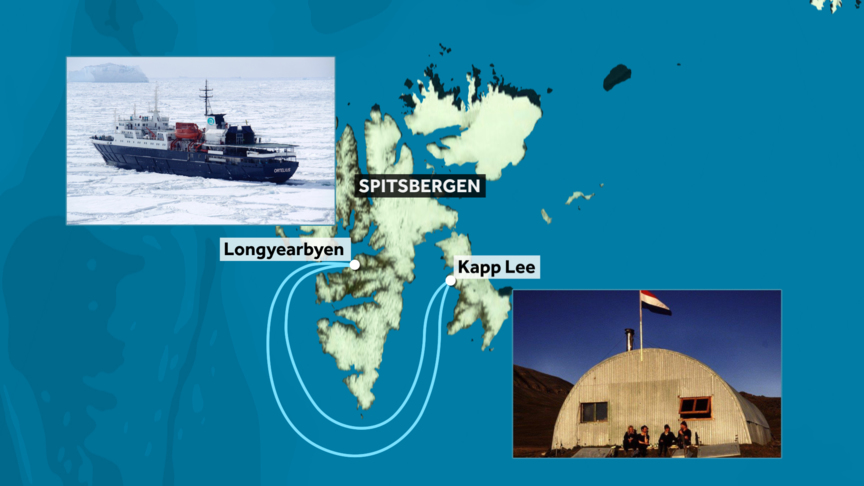
Here is some old footage shot in 1968-1969 of four Dutch researchers – none of whom had any experience with large carnivores – sent to study polar bears at Kapp Lee on Edgeøya (eastern Svalbard). It’s in Dutch so I don’t know what they’re saying but given the choice of music (Beatles, “All You Need is Love”) I can guess the message.

Still, the images are kind of cool, it’s interesting to see how research was conducted at the time by inexperienced personnel. FYI, I began my university studies in 1968, I was not much younger than these students at the time.

Overwintering Spitsbergen 1968-1969 [Uploaded to youtube 21 October 2012; length 45:55]

Description: In the winter of 1968-1969 stayed four Dutch students on the island Edgeøya east of Spitsbergen to do research as to polar bears. During that expedition, this film made by Paul van de Bosch and Hans Sweet and exhibited by the NOS on Dutch television in 1969. 

[Barents Sea polar bear subpopulation background here and here]

I found some additional background that I’ve included below, which shows how naive these young men were, although clearly they had enthusiasm. Dutch researcher Piet Oosterveld was one of the original four on the 1968 expedition and according to a recent news report (see below), will accompany a new expedition to study the effects of global warming. Map below is from the Dutch News story cited below. Spoiler alert: in 1987, Oosterveld was attacked by a polar bear and seriously injured, blamed in part on the rapid increase in polar bear numbers due to their protected status.

Dutch expedition route map
Continue reading

Well-fed polar bears onshore at height of summer easily deterred by noise, CBC reports

From the CBC this morning, we have the report of a female polar bear and her cub paying a visit to an Nunavut campsite near Chesterfield Inlet in northwestern Hudson Bay, which is technically within the boundary of the Foxe Basin polar bear subpopulation.

Maggie Putulik photo, 29 July 2015 Chesterfield Inlet, Nunavut.

Maggie Putulik photo, 29 July 2015 Chesterfield Inlet, Nunavut.

These are not the desperate bear victims of global warming we have been warned about by polar bear specialists but well-fed curious ursids not averse to an easy meal if there’s one to be had. Such bears are easily deterred by a loud noise. Note this was the second visit by polar bears this Nunavut family had experienced at this location within a three-week period – two other bears had stopped by earlier. Note that ice in this region of Hudson Bay broke up earlier than usual this year yet these bears seem to be in fine condition and can expect the first fall ice of the season (freeze-up) to appear in their neighbourhood, see maps below.
Continue reading