Category Archives: Sea ice habitat

Polar bears are distributed throughout their available habitat

All Arctic sea ice habitats that are currently suitable for polar bears have polar bears living in them 1 – even the southern-most regions of Hudson Bay that are well below the Arctic Circle (see previous post on polar bear numbers here).

Have a look at the maps below and see how well the current maximum extent of sea ice correlates with the present range of polar bears around the Arctic.

Fig. 1. Sea ice extent at April 25, 2012, from NSIDC (the winter maximum). Note that although there is sea ice in the Sea of Okhotsk (top right of the map), polar bears do not currently live there nor is there any evidence they ever did1.
Compare to the polar bear’s official range below.

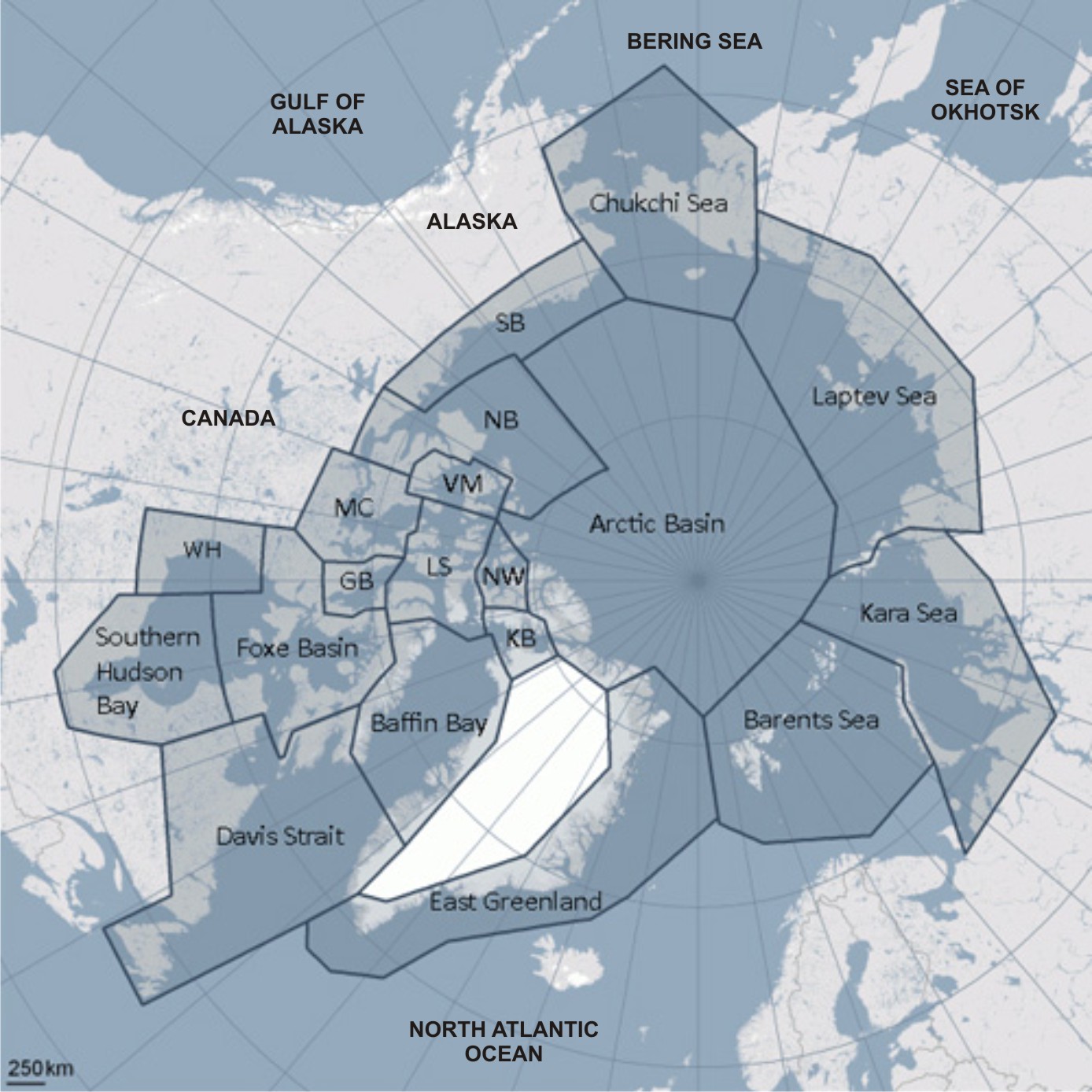
Fig. 2. The global range of the polar bear, showing the 19 regional subpopulations. Map from Polar Bear Specialist Group (PBSG), with a few extra labels added.

Continue reading

Ancient Polar Bear Remains of the World

How does the ancient distribution of polar bears – based on finds of natural-death remains (“fossils”) and bones found in archaeological sites – compare to the modern distribution of polar bears?

[Note: this post was updated 16 Feb. 2026 to indicate that an updated, published version of the data provided below is now available, and links are provided to my 2023 book on polar bear evolution that also includes more up-to-date information]

I have pulled together information from all of the reports I could find that listed ancient polar bear remains and summarized them into one table and one map. A low resolution copy of the map and a simplified version of the map notes are embedded in this post but a higher resolution version of the map and map notes (with pertinent details, including references) is available as a pdf. This document has been assigned an ISBN number (which means it is copyrighted and filed at Library and Archives Canada). The pdf can be downloaded below and will also be available on the PolarBearScience “references” page.

DOWNLOAD HERE: Ancient Polar Bear Remains_Crockford 2012
[small error fixed in yesterday’s version]

CITATION HERE:
Crockford, S.J. 2012. Annotated Map of Ancient Polar Bear Remains of the World. Electronic resource available at http://polarbearscience/references ISBN 978-0-9917966-0-1.

CITATION for the updated published version is below, announced and discussed in this blog post, which includes an updated copy of the map shown below: Ancient polar bear remains explained by sea ice and polynyas: my peer-reviewed paper, 6 May 2022. 

Crockford, S. J. 2022. Polar bear fossil and archaeological records from the Pleistocene and Holocene in relation to sea ice extent and open water polynyas. Open Quaternary 8(7): 1-26. https://doi.org.10.5334/oq.107  [Open Access]

See also my polar bear evolution book published in 2023:

Crockford, S.J. 2023. Polar Bear Evolution: A Model for How New Species Arise. Amazon Digital Services, Victoria.  https://www.amazon.com/dp/1778038328  Discussed here and here.
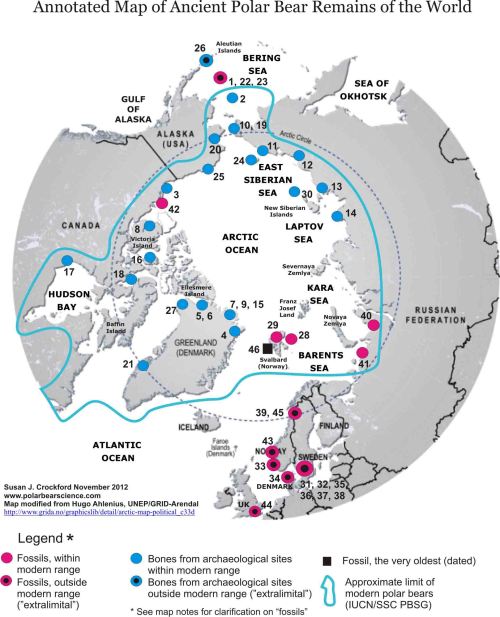
See map notes on pdf below for more details. Click to enlarge.

Continue reading

The sea ice is back and polar bears are heading out

It appears from the ice maps that most of the polar bears throughout the world that have chosen to remain on land during the late summer and fall (about July/August through October/November) can now return to the ice.

I can tell most of this tale with maps, so I will.

Continue reading

How long have polar bears lived in Hudson Bay?

The unique geographical position and oceanographic properties of Hudson Bay make it very different from other Arctic regions that polar bears inhabit.

Hudson Bay is a large shallow basin that freezes over every winter – somewhat like an enormous salt-water lake. This ice cover melts completely every summer, in part because it is well south of other truly “arctic” regions. As a consequence, while Hudson Bay offers excellent seal-hunting conditions for polar bears from winter through early summer, the long ice-free period with no or few feeding opportunities presents a unique challenge that polar bears elsewhere do not routinely encounter (see previous posts here, here and here).

Modern polar bears on the sea ice of Hudson Bay (Wikipedia photo and map).

But Hudson Bay also has a unique geological history. Since the end of the last ice age Hudson Bay has been available as polar bear habitat about half as long as other Arctic regions. This phenomenon is rarely discussed in the polar bear literature (although Andrew Derocher, in his new book [reviewed here] does mention it). In this post, I’ll summarize the geological history of Hudson Bay over the last 30 thousand years, as it pertains to polar bear habitat.

Continue reading

Record low sea ice extent and what it means for polar bears…

On Aug. 27, 2012 sea ice extent dipped below the yearly minimum extent reached in 2007.

The sea ice at this point, a five-day average, was 4.1 million km squared and the lowest point reached since satellite records began in 1979. The National Snow and Ice Data Center (NSIDC) thought it was important enough to issue a press release.

There are sure to be more than a few media-hungry folks who will be moaning about the fate of the poor polar bears because of this report. Before people get too hysterical, a bit of rational perspective might be helpful.

Keep in mind that 4.1 m sq. km (Fig. 5) is about the size of Greenland (2.166 m km2) plus Mexico (1.972 m km2), or about the size of India (3.287 m km2) plus Pakistan (0.809 m km2), figures from Wikipedia.

It may be a ‘record’ low, but it’s still a lot of ice: 4.1 m km2 is not anywhere close to an ‘ice-free’ Arctic!

Arctic sea ice melts – or gets pushed out of the Arctic and then melts – every year, leaving various amounts behind. The ice lingering at mid-September adds to next year’s ‘multiyear’ ice.

The maximum extent is usually reached mid-to-late March. Have a look at how this ‘low extent’ developed from the March maximum this year. Even if you’ve looked at some of these maps, you may not have looked at them one after the other. I’ll compare these to the fall maps for 2007, after the Sept. minimum and discuss these in relation to polar bear habitat. Contineu reading

Is there insufficient ice for polar bears to den offshore?

In an earlier post (July 26), I had some critical things to say about an article in the Edmonton Journal (July 17, 2012) by veteran Arctic science writer and photographer Ed Struzik called “Bleak future for polar bears, U of A scientists say“, which was picked up by news outlets across Canada.

The Struzik article publicized a summary academic paper written by polar bear biologists Ian Stirling and Andrew Derocher (a former Ph.D. student of Stirling) that appeared “in press” behind the paywall at the journal Global Change Biology on July 9.

The academic paper is a summary of Stirling and Derocher’s dire predictions on the future fate of polar bears as a result of melting of Arctic sea ice over the next few decades, one of the prophesied catastrophes of anthropogenic global warming. These views mirror to a large degree the chapter on “climate warming” in Ian Stirling’s book on polar bears released in 2011, which I reviewed recently here.

Let’s look at one of the statements made in the Struzik article:

In Alaska, many bears are denning on land because there is insufficient ice for them to give birth offshore.

Update added Aug. 28, 3:35 PM  below the post
Continue reading

Is it plausible that polar bears are 4-5 million years old? Part 3, sea ice

Last in a three-part series of my critique of Miller et al.’s (2012)
paper on the newest genetic evidence for the origin of polar bears. Part 1 here, Part 2 here.

Here is my final (I hope) comments on the claims made in that paper, suggesting why we might want to take them with a grain of salt.

These are the points regarding this paper that I think deserve a critical look. In this post, I’ll elaborate on Claims #3 and #4. [I’ve added one more to the original three listed].

Claim #1 Polar bears and brown bears (aka grizzlies) arose 4-5 million years old. [I countered with fossil evidence]

Claim #2 Hybridization in both directions occurred repeatedly throughout the evolutionary history of polar bears and brown bears. [I countered with full details on known hybrids]

Claim #3 Svalbard may have been an important refugium for polar bears during warm interglacial periods – and related sea ice issues related to the origin of polar bears as a species.

Claim #4 Polar bear population numbers (population size estimates) over the last one million years track changes in climate (warmer/colder periods).

Claim #3 Svalbard may have been an important refugium for polar bears during warm interglacial periods (and related sea ice issues related to the origin of polar bears as a species) [Which I’ll counter with evidence on paleo sea ice]

Continue reading

The conundrum of cold winter effects in Hudson Bay

[Deleted April 20 2015 – this post needed revision, and I decided it was easier to re-do it completely. Which I haven’t done yet. I’ll insert a link here when the new post is done]

Cooling the polar bear spin

I’ve had quite enough of the obfuscation of facts and model-based extrapolations into the future with regards to polar bears. I’m pretty sure I’m not the only one who is interested in what polar bears are doing now and, as much as can be determined, get some understanding of what the biological, geological and evolutionary history of polar bears and their habitat looks like. Spare us the emotional media hype, icon-peddling and fear-mongering about the future — we’d just like some information about the bears!

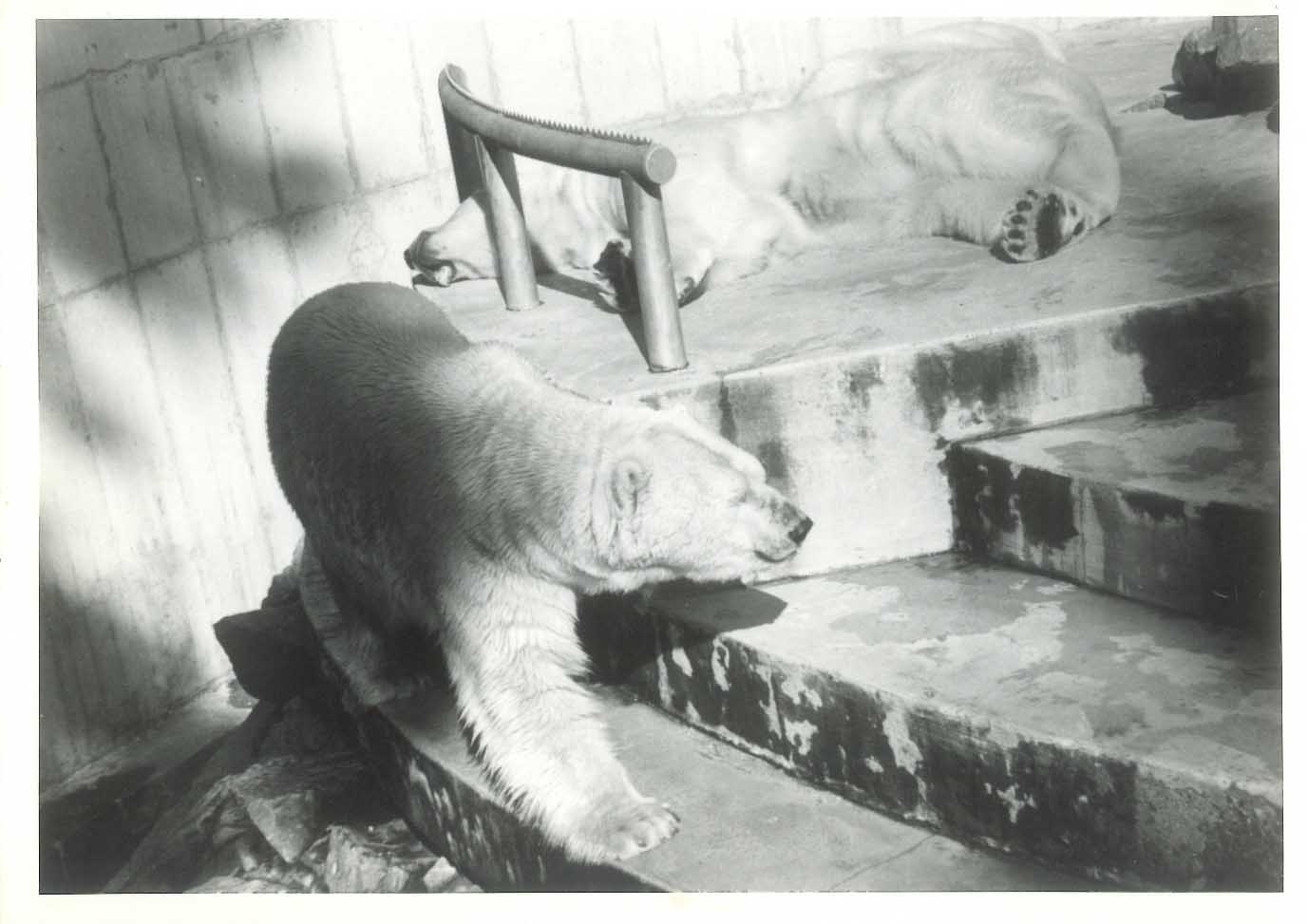
Polar bears at the Stanley Park Zoo, Vancouver, taken with my first camera in the early 1970s.

I’ve been looking at the scientific literature produced by polar bear and Arctic seal biologists for some time and I’ve found it contains some rather interesting and potentially important facts that are being left out, glossed over, or misrepresented in statements and publications generated by polar bear advocates of all kinds. It’s past time for these issues to be brought to light and publicized in one easily-accessible, up-datable forum. Hence, PolarBearScience.com — a new blog in which I discuss the science of polar bears while throwing cold water on some of the spin. Continue reading