Category Archives: Sea ice habitat

New Chukchi Sea polar bear survey – exciting preliminary results

Back in October, I wrote about US Fish & Wildlife biologist Eric Regehr comments about a recent survey of Chukchi Sea polar bears, the results of which are still not published. Since then, I’ve been able to track down a bit of information.

This project appears to have run for five years, from 2008 to 2011. The work was confined to the eastern (US) portion of the Chukchi, see maps below (Polar Bear News 2010; Rode and Regehr 2010). Researchers were doing mark-recapture work with helicopters, putting radio collars on some females and radio ear tags on a few males. They worked primarily in March and April (mating season for polar bears), operating entirely on the offshore sea ice – working, I might add, on bears that technically speaking do not exist, since the official population estimate for this region is “zero” (they are not included in the global estimate of 20,000-25,000, see pdf here,, discussed here).
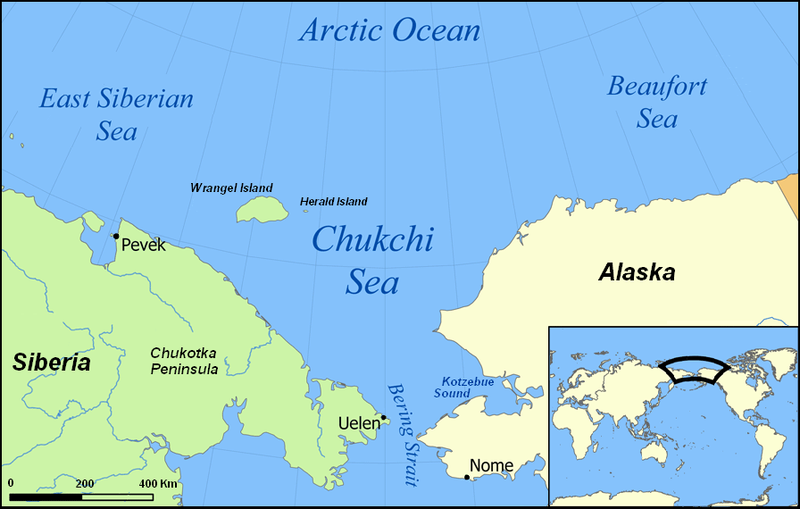
Figure 1. Chukchi Sea – getting you oriented. Note the location of Kotzebue Sound, northeast of the Bering Strait. Map from Wikipedia.

Figure 1. Chukchi Sea – getting you oriented. Note the location of Kotzebue Sound, northeast of the Bering Strait. Map from Wikipedia.

In 2012, US Fish & Wildlife biologist Eric Regehr told reporter Jill Burke at Alaska Dispatch that they found the bears were “reproducing well and maintaining good body condition.” I’ve finally found some details regarding what he meant by that statement (although no final reports or peer-reviewed papers are out, see footnote below).

Continue reading

Stirling and Derocher’s sea ice trick – omitting facts to make polar bears appear endangered

Polar bear biologists Ian Stirling and Andrew Derocher continue to insist that western Hudson Bay (WHB) polar bears are already showing negative effects of reduced sea ice due to global warming. In their 2012 summary paper (Stirling and Derocher 2012), they updated someone else’s graph of global sea ice (to 2011) but used a graph for Hudson Bay (HB) ice breakup dates that ended in 2007. However, we know from other evidence that at least one of those years (2009) would have required extending the scale of the breakup date graph upwards and flattened the slope of the trend line. Updating the HB breakup date graph would not have supported Stirling and Derocher’s premise that polar bears in WHB are starving due to increasingly earlier sea ice breakup, so they simply left the data out (see Fig. 1).

In other fields, this is called fraud.

Is it fraud here? You decide.

I’ve expressed my outrage about this before (here and here), because we know from news reports that in 2009, breakup of Hudson Bay sea ice was unusually late: the Port of Churchill (in WHB) did not open for ship traffic until Aug. 12, a full three weeks later than average (July 21) – and the latest opening of the Port since records began in 1974.

I try not to keep thinking of Stirling and Derocher’s unscientific behaviour but was reminded of it again on Monday (March 4) when I attended a lecture at the University of Victoria given by paleoclimatologist Michael Mann. To my disbelief, Mann tried to argue that global temperatures predicted by NASA scientist James Hansen in 1988 have “closely resembled” actual temperatures since then – by presenting a graph of actual temperatures (observations) that ended in 2005, despite the fact that recent temperatures have not risen at the rate depicted in his graph (see previous post, #8). He did say, as an aside, that “you could argue that if the data were extended out to the present, the line might more closely resemble scenario C [a flat line]” but then continued with his story that observations were matching the ever-rising-temperatures of Hansen’s scenario B (see Figure 2 below).

For both parties – Stirling/Derocher and Mann – the recent data points left off their graphs did not fit their narrative: sea ice in Hudson Bay is not on a steady, precipitous decline and global temperatures have not continued to rise as predicted by Hansen in 1988. The graphs look like science, but they are not.

Continue reading

Ten good reasons not to worry about polar bears

IMPORTANT UPDATE March 13, 2013 Benny Peiser over at the Global Warming Policy Foundation has just posted an essay by well-known author Matt Ridley, entitled “We should be listening to Susan Crockford” which is included as a foreword to a pdf of this very post (“Ten good reasons not to worry about polar bears”), suitable for sharing. I encourage you to have a look.

[Update September 28, 2013: See also this follow-up post “Polar bears have not been harmed by sea ice declines in summer — the evidence.”]

Polar Bear-Cubs-Canada_Wallpaper

PB  logo colouredThis year marks the 40th anniversary of the signing of an international agreement to protect polar bears from commercial and unregulated sport hunting. The devastating decades of uncontrolled slaughter across the Arctic, including the Bering Sea, finally came to an end. And so in honor of International Polar Bear Day (Wed. February 27) – and because some activists are calling 2013 The Year of the Polar Bear – I’ve made a summary of reasons not to worry about polar bears, with links to supporting data. I hope you find it a useful resource for tuning out the cries of doom and gloom about the future of polar bears and celebrating their current success.

Continue reading

Where were the appeals to feed starving polar bears in 1974?

The so-called “policy paper” that polar bear biologist Andrew Derocher has been promoting over the last few weeks, which I commented on briefly when the press release came out, is still grabbing headlines. Online news outlets continue to run stories on this bizarre discussion of what officials might decide to do 40 years from now if global warming causes Western Hudson Bay polar bears to spend 6 months on land (Molnar et al. 2010), causing some of those polar bears to starve (see here, here, and here) – as if this is something likely to happen within the next couple of years.

But forget imagined future starvation: where was the media attention on the plight of starving polar bears back in 1974  and 1975 when polar bears were actually starving in large numbers in the eastern Beaufort Sea?

At least two of the co-authors of the paper getting all the attention – Drs. Ian Stirling and Nick Lunn – witnessed polar bears starving in the Beaufort in 1974 because of an especially cold winter and said nothing even though polar bear populations worldwide at the time were already low due to the wanton slaughter of previous decades. Did Stirling and Lunn humanely euthanize the bears they saw starving? Contact the media? [If they did, I’d like to know.] Appeal to governments to make a plan in case it happened again? Apparently not, because it did happen again, at least twice in the following two decades – with no attendant hue and cry then either. No, those Beaufort Sea bears starved to death, time and time again, without a word to the media from Ian Stirling and Nick Lunn.
Continue reading

Belugas as food for hungry polar bears

Here’s a refreshing change from the litany of cries to “save the killer whales” we heard last month when a few killer whales got temporarily trapped in the ice of Hudson Bay, which I commented about at the time. A story with an entirely different tone emerged last week, with updates today, about beluga whales trapped in the ice on Hudson Bay (see maps and photos below) that came without emotional pleading. It’s a story of life in the Arctic. Continue reading

Goldilocks in the Bering Sea: Less sea ice is bad and more ice is bad

This article from yesterday about sea ice in the Bering Sea is priceless: while we are still being told that below average ice coverage (common 10-20 years ago) is a sign of global warming that means the end of polar bears sometime in the future, it turns out that too much ice is bad, less ice is friendlier and lots of ice is hopefully something that we’ll never see again.

From the article:

After a 2012 Bering Sea snow crab season that saw unusually severe sea ice inhibit fishermen’s efforts to catch almost 89 million pounds of the shellfish, 2013 is shaping up to be much friendlier.

According to Kathleen Cole, a forecaster with the National Weather Service ice desk, this winter was unlikely to match 2012, even before it began. Despite some recent rumors of encroaching ice into the Bering Sea fishery, the situation is better than last year, she said.

“We’re just not going to have a year like last year. It’s going to be, by no means, that bad,” she said. “Last year was something that we’d never seen before, and hopefully something that we’ll never see again.”

Sea ice is still well above average in the Bering Sea this year – as it has been for 7 of the last 10 years. See the ice extent map from NSIDC from yesterday below and my previous post from December 2012: Now that Bering Sea ice cover is high again, variability is normal (note that polar bears of the Bering Sea are considered part of the “Chukchi Sea” subpopulation, which we know practically nothing about, see previous post here). Continue reading

Extirpated polar bears of St. Matthew Island spent five months on land during the summer

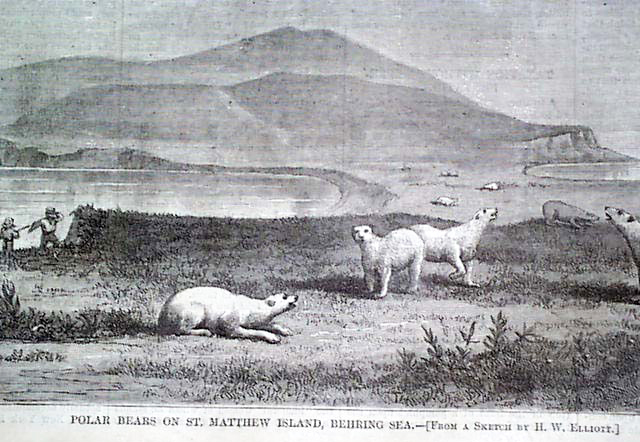
Did you know there used to be resident polar bears on two small islands in the Bering Sea? Given how much we don’t know about the polar bears of the Bering Sea, the bears that used to den and spend their summers on the St. Matthew Islands are a bright spot. These islands lay at the southern-most limit of the modern “Chukchi Sea” subpopulation (see Fig. 1) and were uninhabited by people when they were discovered in the 1760s – but they were a haven for polar bears.

We have details of the polar bears that gave birth and summered there because a US government biologist (Henry Wood Elliott) and a US navy Lieutenant (Washburn Maynard) surveyed the islands in 1874. Elliott wrote both an official report and a popular magazine article (for Harper’s Weekly Journal of Civilization) in 1875 describing the polar bears they saw; Maynard wrote a separate report in 1876. By 1899, there were none left, victims of the relentless slaughter of polar bears everywhere in the Arctic in that era (see previous discussion here).

Figure 1. St. Matthew Island is in the Bering Sea off the west coast of Alaska: north of the Pribilofs and south of St. Lawrence Island, at about 60°N latitude. Compare this to the southern end of James Bay, Canada – which has a stable population of polar bears – at about 53 0N and Churchill, Manitoba – the “polar bear capital of the world” – at 58 046’N. Maps from Wikipedia.

Figure 1. St. Matthew Island is in the Bering Sea off the west coast of Alaska at about 60°N latitude. Compare this to the southern end of James Bay, Canada (which has a stable population of polar bears) at about 53 0N and Churchill, Manitoba (the so-called “polar bear capital of the world) at 58 046’N. Maps from Wikipedia.

Figure 2. A drawing of polar bears on St. Matthew Island that accompanied the May 1, 1875 Harper’s Weekly Journal of Civilization article written by Henry Elliot. See here.

Figure 2. A drawing of polar bears on St. Matthew Island that accompanied the May 1, 1875 Harper’s Weekly Journal of Civilization article written by Henry Elliot. See here.

[UPDATE: Jan. 27, 2013: a follow-up to this post is here.]

Continue reading

Hudson Bay sea ice and trapped killer whales

Last night, I was alerted by a reader (h/t MM) to an NBC news report with this headline: “Killer whales’ plight in ice an example of climate change impact, researcher says.” Here’s part of what it says:

The plight of a pod of killer whales that got trapped by ice in a mostly frozen Canadian bay this week was a “good example of what climate change can do” in the Arctic, a researcher said Friday.

The 11 killer whales apparently escaped the ice in Hudson Bay late Wednesday or early Thursday morning, when shifting currents helped break open a path to the sea, according to Petah Inukpuk, mayor of Inukjuak, a remote Inuit village in Quebec where locals had crafted a plan to help the animals, also known as orcas. Other reports said there were 12 orcas in the pod.

The killer whales were hundreds of miles from where they should be at this time of year, such as in the Hudson Strait or the North Atlantic, said Lyne Morissette, a mariner researcher with the Quebec-based St. Lawrence Global Observatory.

The bay, which normally freezes over in late November or early December only froze over earlier this week. 

“It’s definitely a direct effect, a good example of what climate change can do,” she told NBC News on Friday of the orcas’ plight. “All the dynamics of how the ice is going to move and where the ice is going to be — it’s not only about ice melting in the Arctic, you know — it’s the whole dynamics and currents that could change because of climate changes. [my bold]

I take issue, first, with this statement from Morissette (SLGO):
The bay, which normally freezes over in late November or early December only froze over earlier this week.”

Not true, according to the Canadian Ice Service. Continue reading

Bearded and ringed seals join the polar bear as “threatened” by a computer-modeled future

As I pointed out in Featured Quote #22 (posted on Dec. 23, 2012), bearded and ringed seals have recently joined the polar bear on the American ESA’s list of animals that are “threatened” by computer-modeled predictions of Arctic sea ice declines projected 50-100 years into the future (USFWS 2008, 2012a, 2012b).

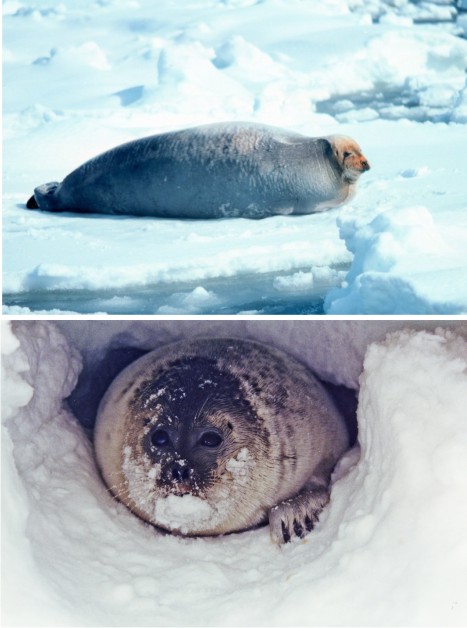
NOAA photos of bearded seal (top) and ringed seal (bottom)

NOAA photos of bearded seal (top) and ringed seal (bottom). The bearded seal is one of the largest Arctic ice seal while the ringed seal is the smallest. Both are eaten by polar bears, although ringed seals are consumed most often.

The decision by NOAA (National Oceanographic and Atmospheric Administration) affects the Arctic subspecies of ringed seal (Phoca hispida hispida) as well as the Okhotsk subspecies (Phoca hispida ochotensis) (in addition to several others) and thus includes all ringed seals off Alaska’s coast in the Beaufort, Chukchi and Bering Seas. The decision also affects two particular subpopulations of bearded seal (Erignatha barbatus): the “Beringia” [Bering Sea/Chukchi] subpopulation (about half of which reside in Alaskan waters), and the subpopulation that lives in the Sea of Okhotsk. (Alaska Fisheries (NOAA) Final Decision). Continue reading

Now that Bering Sea ice cover is high again, variability is normal

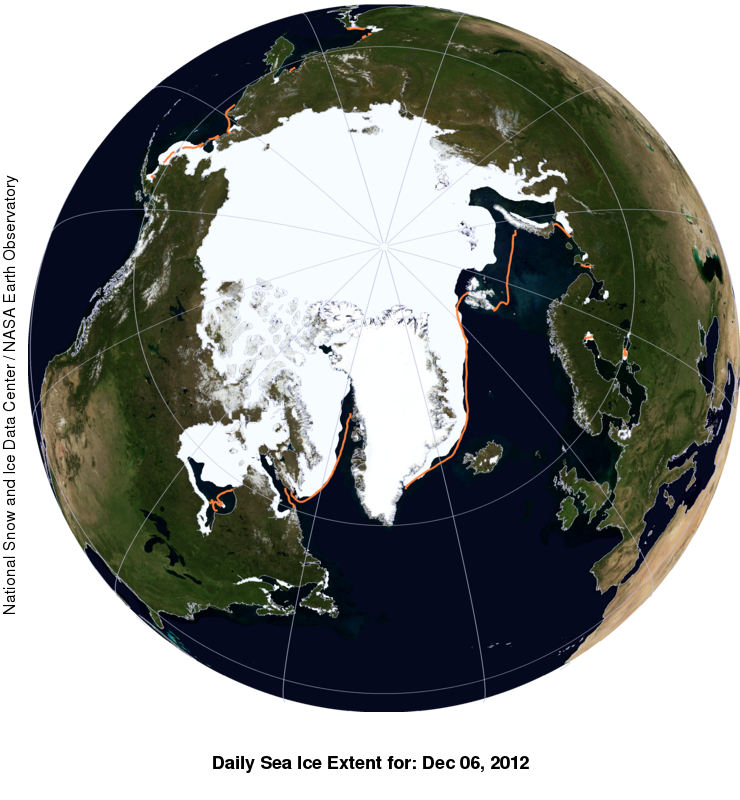
Sea ice development in the Bering Sea is trending higher than average again this year, even though it is early in the season. The NSIDC sea ice extent image for Dec 6 2012 below (Fig. 1) shows extensive ice development in the Bering Sea. [courtesy WUWT sea ice reference page]

Seven of the last 10 years have produced above-average freezing in the waters west of Alaska” says Kathleen Cole of the Alaska National Weather Service (Dec. 6, 2012) – see “Featured Quote” #20 in the right column (also filed in the “Quote Archive“).

Fig. 1 National Snow and Ice Data Center (NSIDC) sea ice extent at Dec. 6 2012. The orange line is the median extent for this date for 1979-2000.

Figure 1. NSIDC sea ice extent at Dec. 6 2012.
The orange line is the median extent for this date for 1979-2000. Click to enlarge.

The NSIDC, in their report on the annual freeze-up of the Arctic (November 2012), have this to say about the ice in the Bering Sea:

“…ice extent in the Bering Sea by the end of the month was greater than average, continuing a pattern seen in recent years. Extent in the Bering Sea was at record high levels last winter.”
Continue reading