Posted onSeptember 5, 2019|Comments Off on Western Hudson Bay polar bears in great shape after five good sea ice seasons
Polar bear researcher Andrew Derocher says it takes four years of good sea ice conditions to recruit a polar bear from birth but implies that 2019 is the first year in decades that conditions for bears have been ‘good’ in Western Hudson Bay. He thinks he can get away with saying this because he hasn’t published any of the data on body weight and body condition he’s collected on these bears over the last 25 years (apparently, whatever funding agency pays for his research does not require him to publish the data he collects).
But independent observations such as dates of ice freeze-up in fall, ice breakup in summer, dates and condition of bears recorded onshore, suggest he’s blowing smoke: at least five out of five of the last sea ice seasons for WH bears have been good. That means we should be seeing more bears in the next official population count.
Posted onSeptember 1, 2019|Comments Off on Walruses climbing cliffs and falling off them are natural events: 1994 video from Alaska
US Fish and Wildlife officials in 1994 explain walruses falling to their deaths from a cliff at Cape Pierce in the southern Bering Sea (a haulout for adult males during the ice-free season). Explanation? Overcrowding (too many walruses)!
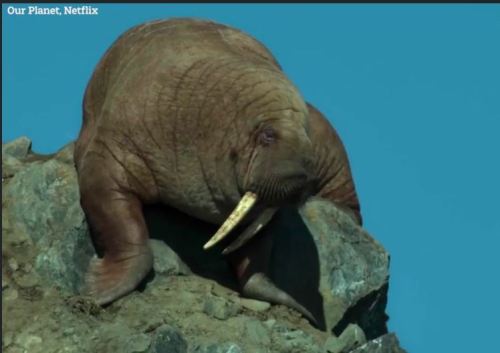
Hype from the Netflix/Attenborough ‘climate change is gonna destroy the world’ fearmongers earlier this year notwithstanding – or the media this summer trying to stir up climate change fever – the US Fish and Wildlife Service determined in October 2017 that the Pacific walrus is not being harmed by climate change and is not likely to be harmed within the foreseeable future (USFWS 2017). The IUCN Red List (2015) lists the Pacific walrus as ‘data deficient‘.
Large herds onshore are a sign of population health, not climate change, and walruses have come ashore in the Chukchi Sea during the ice-free season in summer and/or fall for more than 100 years (Crockford 2014; Fischbach et al. 2016; Lowrey 1985). Those are the relevant scientific facts.
Fischbach, A.S., Kochnev, A.A., Garlich-Miller, J.L., and Jay, C.V. 2016. Pacific walrus coastal haulout database, 1852–2016—Background report: U.S. Geological Survey Open-File Report 2016–1108. http://dx.doi.org/10.3133/ofr20161108. The online database is found here.
Lowry, L. 1985. “Pacific Walrus – Boom or Bust?” Alaska Fish & Game Magazine July/August: 2-5. pdfhere.
MacCracken, J.G., Beatty, W.S., Garlich-Miller, J.L., Kissling, M.L and Snyder, J.A. 2017. Final Species Status Assessment for the Pacific Walrus (Odobenus rosmarus divergens), May 2017 (Version 1.0). US Fish & Wildlife Service, Anchorage, AK. Pdf here (8.6 mb).
Posted onAugust 29, 2019|Comments Off on Sea ice melt in the Arctic Basin leaves an area for polar bears larger than Greenland
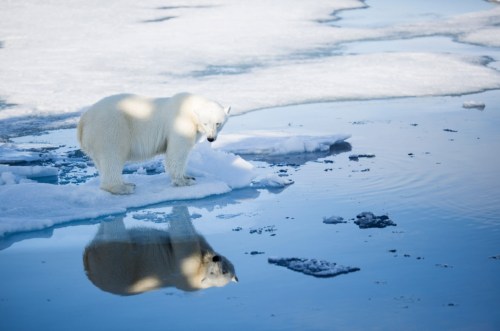
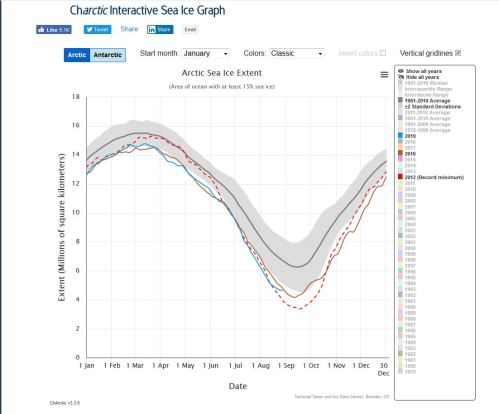
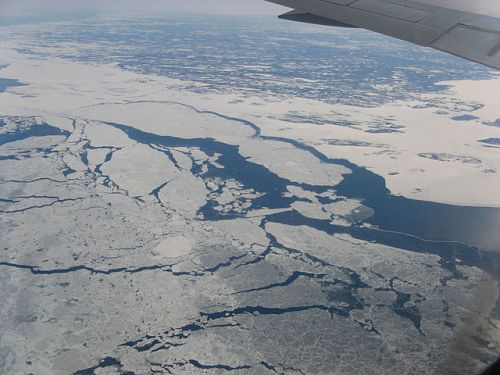
Most polar bears that spend the spring feeding in the peripheral seas of the Arctic Basin (such as the Beaufort, Chukchi, Kara, and Barents Seas) remain on the persistent pack ice of the central Arctic during the summer and this August, that refugium is still larger than Greenland. Most of these bears do not use this July-September Arctic Basin ice as a hunting platform unless they are very lucky: the few seals available are hard to catch. For the most part, polar bears fast or eat very little during the summer whether they are on land or on ice (see references in this post).
Posted onAugust 27, 2019|Comments Off on Churchill polar bear activity report for week 7 shows oddly few problems so far
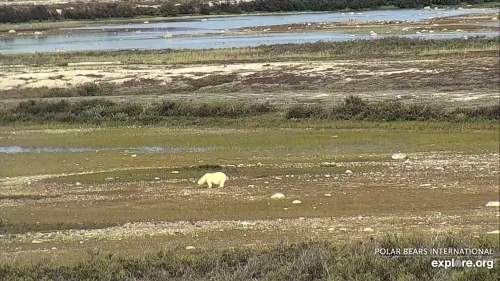
It’s week 7 of the Churchill polar bear season that began in early July and it’s been remarkably quiet: compared to 208 and 2016, there were half as many problem bear incidents in 2019. A few bears have come off the ice near the community and they’ve been in good shape, as are the bears to the east at Cape Churchill (see one captured on live cam 23 August shown below) and the north at Seal River.
But it looks like many more bears than usual may have decided to ride out the slow-melting ice that lingered well past the first week of August and came ashore further south, towards the Manitoba/Ontario border.
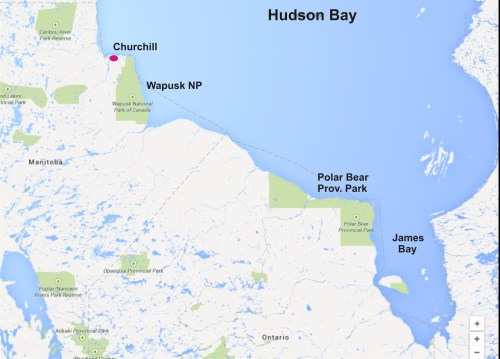
If so, these bears will have to make their way north over the summer so they can intercept the first ice forming along the northwest coast off Wapusk National Park near Churchill. That’s why Western Hudson Bay bears are said to undergo a migration: no matter where they leave the ice in summer, most bears head to areas around Churchill so that they can resume seal hunting on the early fall ice.
A paucity of bears around Churchill in late summer/early fall is not unprecedented, however. Stirling and colleagues pointed out that in 1972 and 1973, for reasons they could not explain, there had been fewer bears than usual around Churchill well before freeze-up and therefore, fewer problem bears (Stirling et al. 1977:17).
Below is a comparison of the Polar Bear Alert Program report for last week (Week 7, Aug 19-25) to previous years.
For this group of radical protesters, ‘the truth‘ is a narrative that serves their traffic-disrupting purposes. Since many gullible people – young and old – were horrified by the Netflix claim that hundreds of walruses in the western Arctic had hurled themselves off a cliff because of human-caused climate change, Extinction Rebellion plan to exploit this emotional connection during upcoming protests, apparently believing that what Attenborough told them was a fact. But in accepting docu-drama content without question, they are rejecting the best available science produced in 2017 by biologists who determined that Pacific walrus are not being harmed by the effects of climate change and are not threatened with extinction.
Posted onAugust 20, 2019|Comments Off on Keeping the climate catastrophe message on track: a friendly warning from a colleague
Given the issues raised by the Nature Communications blacklist fiasco last week, I thought it might be useful to show readers who don’t work in science an example of the kind of not-so-subtle dissuasion that can be used by scientists-with-a-climate-message to keep their colleagues in line.
A male colleague I know from work in another field of biology recently sent me a cordial email that I’m sure he thought was simply helpful advice to a like-minded associate. I doubt he realized how outrageously patronizing and presumptuous he was being.
If I were a female scientist with less confidence and experience, a note like this might have intimidated me into silence. The fact that he thought it was an appropriate thing to do is one of the reasons we have such a problem in science right now. See what you think:
Posted onAugust 17, 2019|Comments Off on Blacklist by Nature follows defamation by BioScience: journals reject ethics of science
Along with hundreds of other people – 385 to be exact – I have been blacklisted [#181] by the science journal Nature Communications in a recently-published abysmal paper by three authors from University of California Merced, after I and a number of others were publicly defamed by a squadron of authors in a similarly-stupid paper less than two years ago in the general interest journal BioScience. This obsession that scientists-with-a-message have about silencing peers with other viewpoints (rather than constructing and communicating a winning argument themselves) is vile and utterly counter to what real science is about. Not surprisingly, they positively fawn over media stars like Al Gore and Greta Thunberg who have no science background but willingly repeat the accepted message of climate-change-doom.
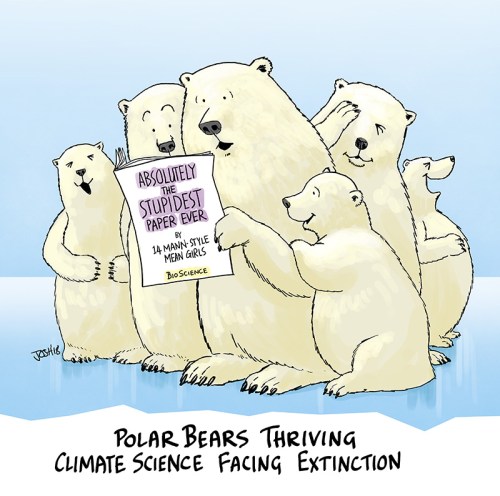
Now we have two stupid papers that purport to uphold the sanctity of one particular view of climate change: the Harvey et al. “absolutely the stupidest paper I have ever seen published” (Curry 2017) – which we all truly thought could not be matched – and now the Petersen et al. “worst paper published in a reputable journal” (Curry, 2019).
Judith Curry: “Apart from the rank stupidity of this article and the irresponsibility of Nature in publishing this, this paper does substantial harm to climate science.”
Jo Nova: “Skeptics get banned, rejected, blocked and sacked from the mainstream media yet somehow Nature has a paper on Skeptics getting too much media. Believers don’t have to be an expert to control the news agenda, just a Greenpeace activist, or a teenage girl. Skeptics on the other hand, can be Nobel Prize winners, but the BBC won’t even phone them.”
UPDATE 18 Aug. 2019: Additional commentary on this new paper (new or previously overlooked in my initial story); do cruise the comments, some additional gems of analysis there:
ADDED 20 Aug 2019: See this scathing letter to the Editor of Nature Communications by President of the National Association of Scholars, Peter Wood. (15 Aug 2019). In part, he states:
“Nature Communications has published an article which forwards the technology of censorship in pursuit of political activism, but which does not even pretend to forward scientific knowledge.” Continue reading
Comments Off on Blacklist by Nature follows defamation by BioScience: journals reject ethics of science
Posted onAugust 12, 2019|Comments Off on Media and USGS biologist sensationalize recent report of a polar bear encounter in Alaska
It’s been a slow summer for polar bear news to hype, so we shouldn’t be surprised that a local report that polar bears this summer have descended on the town of Kaktovik, Alaskaone week earlier than 2017 has morphed into an international story that makes a 2016 research report sound like this year’s news, with headlines trumpeting: “polar bear encounters are increasing” due to a longer open water period. Nevertheless, it was reported just two weeks ago that Alaska has not had a polar bear attack since 1993.
This is a particularly blatant example of how the media skew polar bear ‘news’ for public consumption, aided by scientists with a particular message to sell. Not surprisingly, a number of essential facts have been left out of this sensationized account, in part because the polar bear specialist the media consulted left those facts out of his statement. This is the sort of bias displayed by polar bear specialists that I discuss in my new book, The Polar Bear Catastrophe That Never Happened.
Posted onAugust 12, 2019|Comments Off on USA finally updates Endangered Species Act after 45 years & the decision is final
Just out this morning:
“Today, U.S. Secretary of the Interior David Bernhardt unveiled improvements to the implementing regulations of the ESA designed to increase transparency and effectiveness and bring the administration of the Act into the 21st century.” USFWS Press Release, 12 August 2019.
Although much hue-and-cry will be written by conservation organizations and the media (here is one), I am providing for easy reference here links to the original press releases and documents issued this morning by the Department of the Interior and the US Fish and Wildlife Service. I am also providing pdf copies of the official documents to appear shortly in the Federal Register and quote the above USFWS press release in full.
It remains to be seen whether polar bears or other Arctic species of interest to me and readers of this blog will be affected. The new changes affect both the listing and delisting process as well as designation of critical habitat.
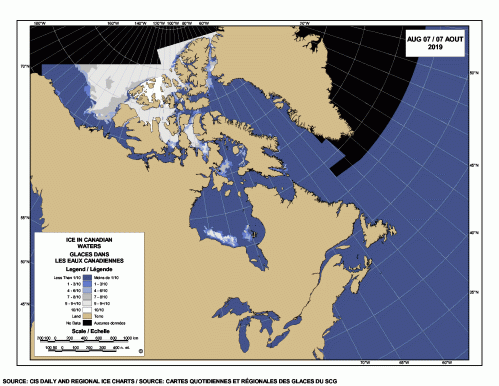
Watch polar bear habitat reform in the Canadian Arctic: “last 10 days” Canadian Ice Service animation (works anytime) HERE.
See Quote archive for details.







 polarbearscience
You must be logged in to post a comment.