Willie Soon on fire talking to Tucker Carlson about the role of the sun in climate change

Well worth the 50 minutes or so to listen to astrophysicist Willie Soon’s interview with Tucker Carlson, on Twitter/X Episode #62. You don’t have to be signed up to Twitter/X to listen. Background information on the topics covered by Soon can be found here: https://www.ceres-science.com/post/dr-willie-soon-s-interview-by-tucker-carlson-december-2023
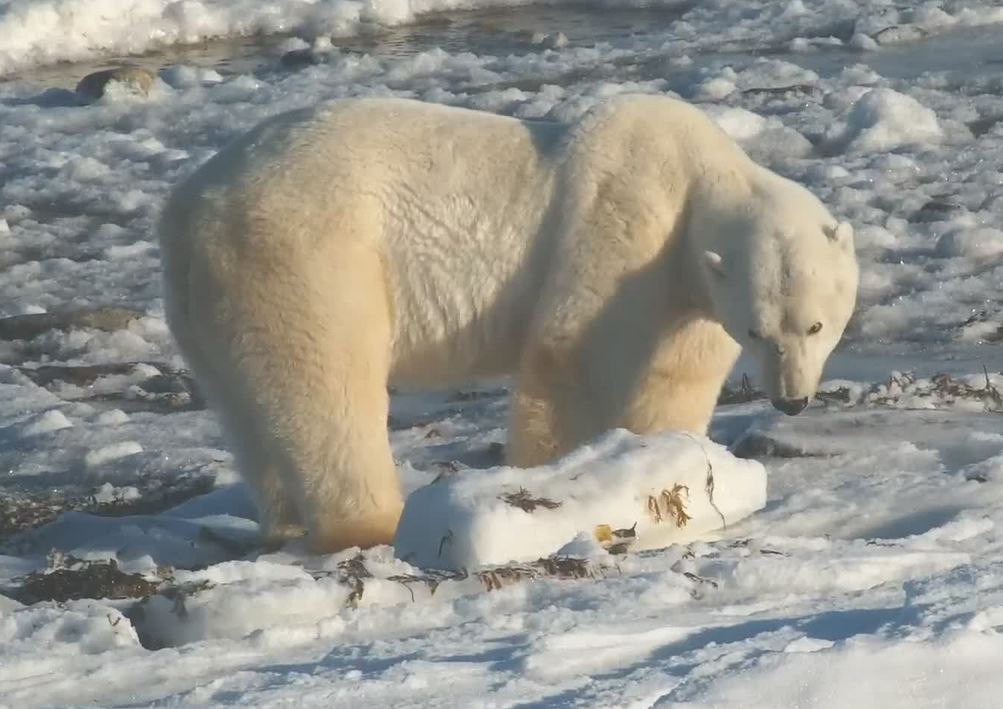
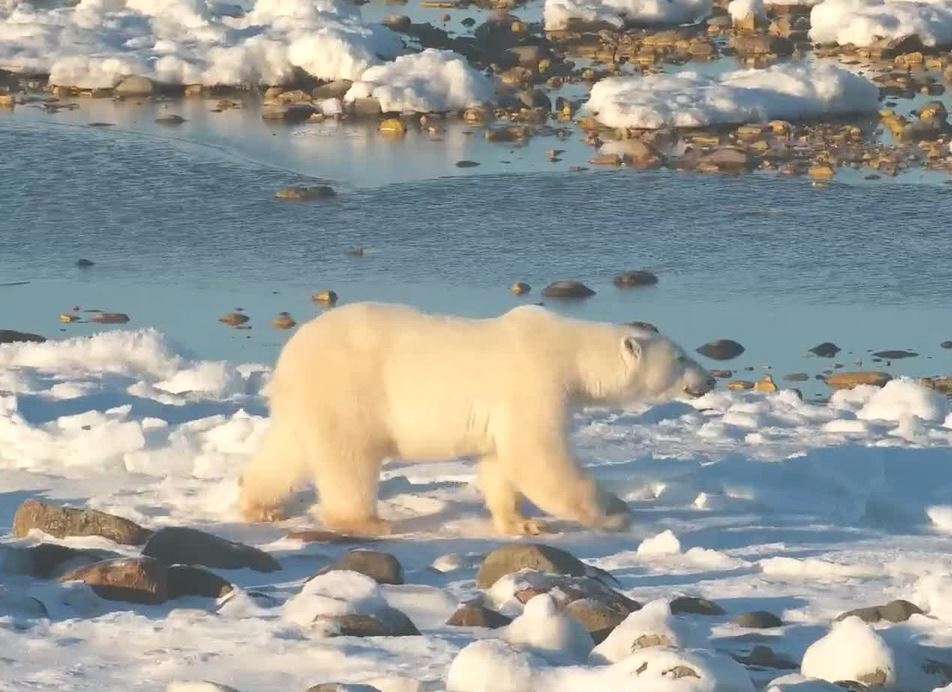
Polar bears and sea ice fail to implode in 2023 as predicted, with special thanks for your support

As this year draws to a close, it is worth noting that over the last 12 months — and contrary to predictions and headlines, including claims about “the warmest year ever” — polar bears have not been reported dying, starving, or eating each other in large numbers, or relentlessly attacking people. On top of that, summer sea ice coverage in the Arctic has stalled for the last 17 years, not melted out in a death spiral of rotten ice.

Except for the lying and obfuscation that most of us have come to expect, I’ve mostly been left to reiterate that polar bears are not “canaries in the coal mine” indicators of climate change and to point out that Arctic sea ice extent and polar bear survival are not inextricably tied. For example, in some specific areas of interest, like Western Hudson Bay, there has not been a consistent decline in sea ice over the last few decades and bears are not attacking people at increased rates because they are desperately hungry. In other areas, like the Svalbard area of the western Barents Sea, sea ice has declined dramatically in recent years yet polar bears have not been attacking people more than usual.

Contradictions and failed predictions abound.

All in all, a rather boring year for the anticipated implosion of polar bear health and survival, despite my constant tracking of publicly-available information. That said, I would like to take this opportunity to thank you all again for your continued support, and especially those who have donated hard-earned cash over the last few months: your support makes it possible for me to continue my work keeping polar bear science honest. Together, we have made a difference and I know it’s worth the fight. Because if we let evidence-based science die without challenge, we lose our ability to make sense of the world.

All the best for 2024 to you all.

Continue reading

Churchill end-of-season problem polar bear reports finally published

Today the Town of Churchill finally published the final problem bear reports of the season, which presents an opportunity to do a quick comparison to recent years.

This season lasted 24 weeks, the longest I can remember but apparently only the 5th longest on record. There were a total of 265 incidents by the end of November, more than 100 less than the most recent late-freeze-up year of 2016, which didn’t end until the first week of December (after bears had spent 22 weeks onshore). However, two recent years when freeze-up didn’t come until the end of November (2017 and 2020) had far fewer incidents (more than 100 less each compared to this year).

Continue reading

Despite hand-wringing about Churchill polar bears this year, 2023 wasn’t their worst summer

For months, the media has been bleating about the poor polar bears of Churchill suffering from lack of sea ice blamed on human-caused climate change during the so-called ‘hottest year’ on record: in April, July, August, November, and December.

From a Churchill Wild report on the condition of WH polar bears, January 2023

However, while breakup of sea ice on Hudson Bay was indeed early this year and freeze-up came later than usual, Western Hudson polar bears apparently spent only the fifth-longest time on land since 1979, according to a polar bear specialist. How is that even possible, given that sea ice conditions should be getting worse and worse as CO2 levels increase and average global temperatures rise? As I’ve pointed out before, it is apparent that Arctic sea ice is not closely coupled to CO2 levels (as the ‘experts’ claim), which makes me wonder if there is any ecologically-relevant correlation between CO2 and sea ice at all.

Money quote from Geoff York, from Polar Bears International: “As of Nov. 28 this year, the bears in western Hudson Bay had spent 164 days on shore, he said. That’s tied for the fifth-longest amount of time the bears have spent off the ice since 1979.CBC, 9 December 2023 [my bold]

Continue reading

Western Hudson Bay polar bears on their way offshore to hunt seals: freeze-up has begun

Official confirmation has come in this morning that polar bears that have spent the summer fasting along Western Hudson Bay now have enough ice to move offshore. That makes this year a bit later than usual (average is 16 November) but is not one of the extremely late freeze-ups, as happened in 1981, 2016 and 2021 when bears didn’t leave until the first week of December (Castro de la Guardia et al. 2017; Miller et al. 2022). Since breakup of sea ice came earlier than usual this summer, this means (as of 30 November) many bears will have been off the ice and without food for 166 days or 5.5 months.

However, so far, there have been no reports from this region of incidents of cannibalism, starving bears found wandering the landscape like zombies, or desperate attacks on people that polar bear specialists have warned us to expect (Abrahms et al. 2023; Stirling and Derocher 2012; Wilder et al. 2017).

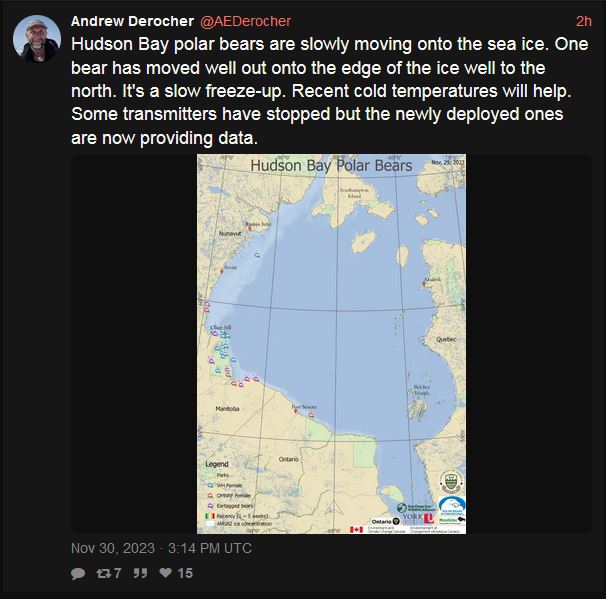
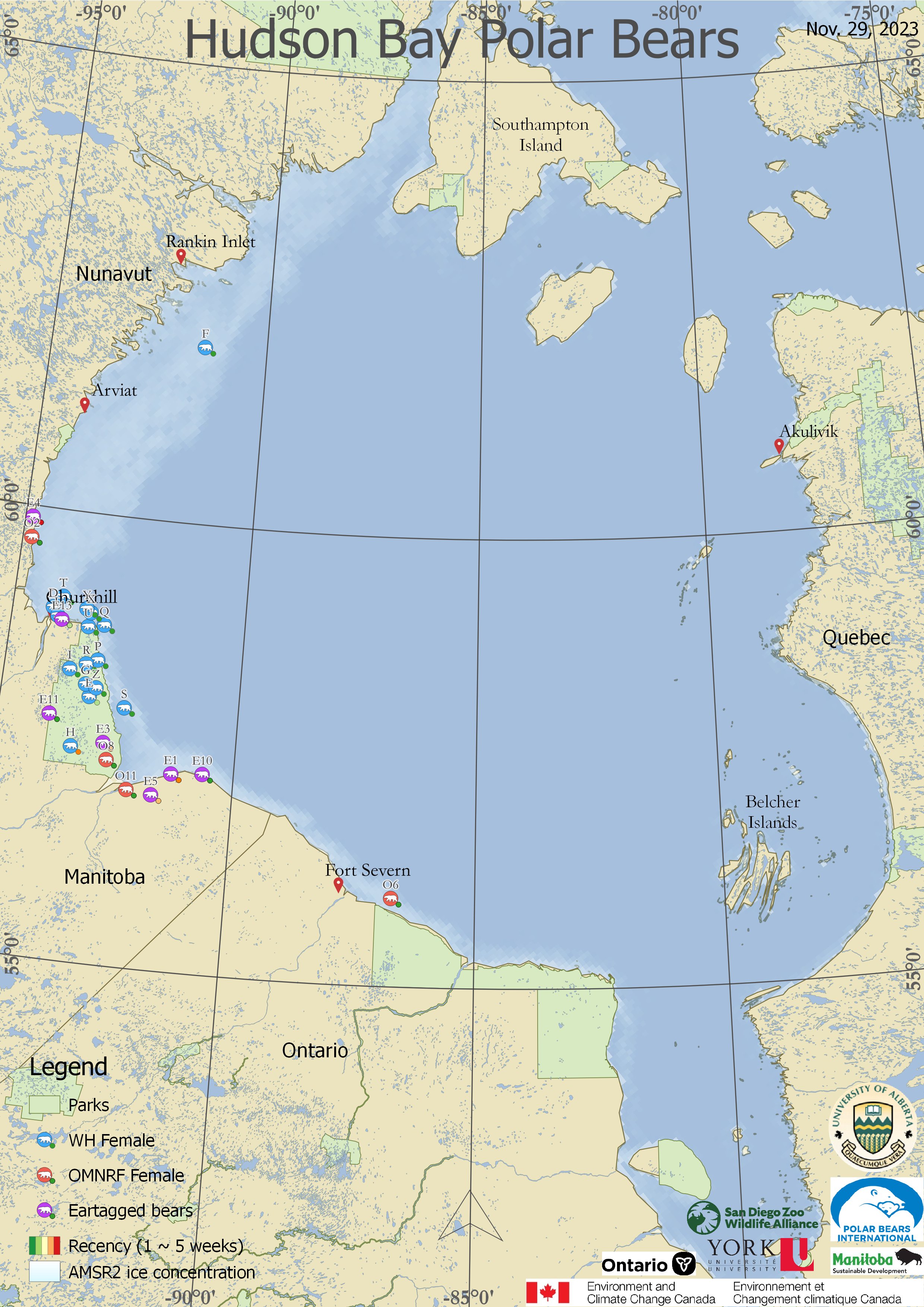
Tracking WH Bears

Courtesy Andrew Derocher, University of Alberta, who monitors WH bears:

Close-up of the tracking map below. Note that pregnant females will stay ashore to give birth so not all of these tagged bears are expected to head onto the ice this fall to hunt for seals:

Still not a word from the Polar Bear Alert folks in Churchill, who as of today, haven’t released any of their weekly reports since 23 October 2023.

Ice Conditions in Canada

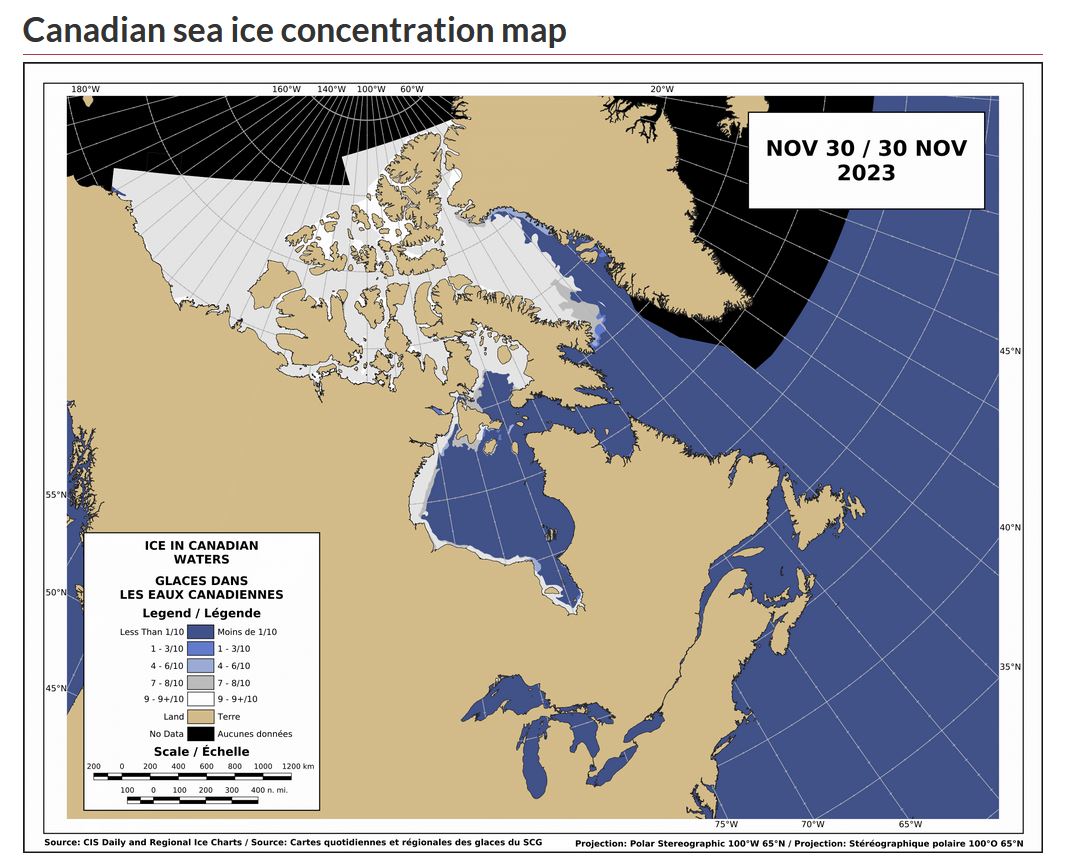
At 30 November 2023, courtesy Canadian Ice Services shows the expanding band of ice developing along the western shore of Hudson Bay but note also that the rest of the Canadian Arctic, as well as the Beaufort Sea, is completely covered in ice, as is most of Baffin Bay and Foxe Basin:

References

Abrahms, B., Carter, N.H., Clark-Wolf, T.J., et al. 2023. Climate change as a global amplifier of human–wildlife conflict. Nature Climate Change 13:224-234. https://doi.org/10.1038/s41558-023-01608-5

Castro de la Guardia, L., Myers, P.G., Derocher, A.E., Lunn, N.J., Terwisscha van Scheltinga, A.D. 2017. Sea ice cycle in western Hudson Bay, Canada, from a polar bear perspective. Marine Ecology Progress Series 564: 225–233. http://www.int-res.com/abstracts/meps/v564/p225-233/

Miller, E.N., Lunn, N.J., McGeachy, D., and Derocher, A.E. 2022. Autumn migration phenology of polar bears (Ursus maritimus) in Hudson Bay, Canada. Polar Biology 45:1023-1034.

Stirling, I. and Derocher, A.E. 2012. Effects of climate warming on polar bears: a review of the evidence. Global Change Biology 18(9): 2694–2706.

Wilder, J.M., Vongraven, D., Atwood, T., et al. 2017. Polar bear attacks on humans: implications of a changing climate. Wildlife Society Bulletin 41(3):537-547.  https://doi.org/10.1002/wsb.783

Polar bear sea ice habitat update at 15 November & problem bears in Western Hudson Bay

Abundant polar bear habitat this fall across the Arctic so far, with only Hudson Bay sea ice formation a bit behind schedule. However, Churchill has not seen the anticipated spike in problem bear reports, given the vocal pronouncement by polar bear specialists that it should be experiencing more and more problems with bears when they spent more than 4 months ashore in summer and fall.

News of the most egregious attack by a bear I could find world wide this fall is shown in the video below, filmed 14 November 2023: apparently, the offending bear had spent several days displaying this offending behaviour.

Continue reading

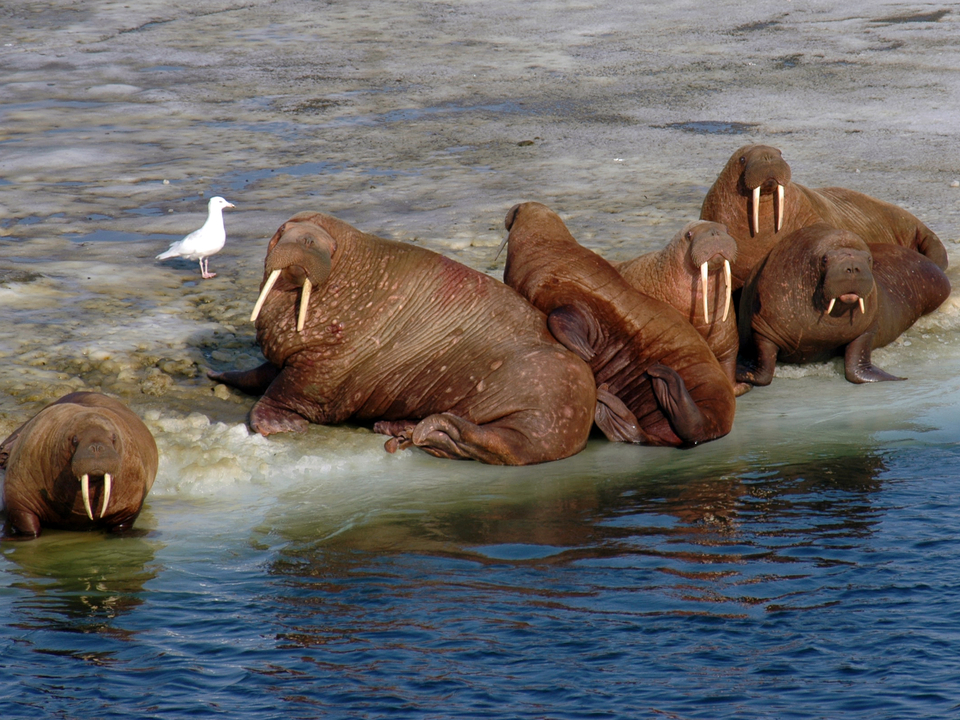
Walrus and polar bear population size changes in the N. Atlantic over the last 20k years

This is a lesson in how to assess the potential worth of scientific papers. One of two similar Arctic evolution studies got media attention, at least in Canada — about the polar bears, of course — but in my opinion the walrus research conclusions are much better supported, less biased by climate change rhetoric, and lack the hubris present in the polar bear paper.

Both studies use similar sample sizes for the regions they had in common (North Atlantic) and used computer models to determine genetic diversity and population size changes since the LGM. However, the tone of the walrus paper was less emotionally-charged and the caveats of the work were appropriately stated. In my opinion, papers like the polar bear example contribute to eroding the public’s trust in science.

The last Ice Age peaked between about 27,000 and 19,000 years ago. At this time the Arctic was buried under kilometers of glacial ice sheets, and so marine mammals were pushed southwards to areas of ice floes and more open water. Walrus survived in some areas of the Atlantic located further to the south, and as soon as climates warmed again, the ice edge retreated and walrus populations pushed quickly northwards again. This combination of warming and climate-driven dispersal led to local walrus populations becoming more genetically differentiated. Walrus study, Lund University press release 27 September 2023

Continue reading

Polar Bear Evolution pre-Christmas book sale: discounts on all formats!

I have reduced prices on all formats of my Polar Bear Evolution book for four weeks starting today (8 November-6 December 2023), in time for holiday gift-giving. The ebook version has the largest price reduction (60% of regular price, to US$17.40) but the other discounts are also substantial. This sale is a time limited offer: don’t miss out! Links below.

This is the book for those who are really interested in how grizzly bears could have turned into polar bears and why the story of polar bear evolution could not be told without discussing climate change.

One Amazon reviewer said this about Polar Bear Evolution:

The author of Polar Bear Evolution, Susan Crockford, is a good, credentialed scientist. Her writing is clear; her thinking is also. She has a broad understanding of biology and an informed paleo perspective. Crockford condenses a very large literature on polar bear biology and evolution in this book which will help readers understand the science related to the evolution of an Arctic species. Perhaps the most important aspect of this book is its synthesis of information from the fields of wildlife biology, molecular evolution, paleontology, and climate. Her original ideas and hypotheses on thyroid hormone’s role in evolution are very important and add a credible mechanism of phenotypic change which complements the literature on molecular genetic evolution. Polar Bear Evolution is an important contribution to science and its application in evolutionary biology and wildlife biology. Matthew A. Cronin, Ph.D.

Available at the links below (others also available):

USA https://www.amazon.com/dp/1778038328

UK https://www.amazon.co.uk/dp/1778038328

Canada https://www.amazon.ca/dp/1778038328 [shipping delay for hardcover version is 4-5 weeks]

Australia https://www.amazon.com.au/dp/1778038328

Germany https://www.amazon.de/dp/1778038328

Churchill so far has few problems with polar bears despite predictions of a record bad year

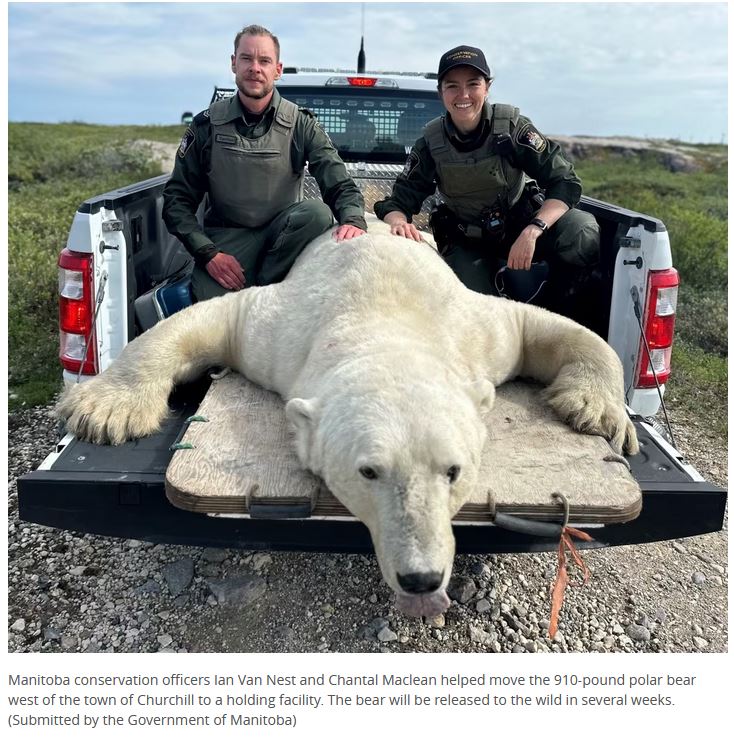
Despite misleading warnings in mid-August that a record number of incidents had already taken place, and that Churchill was on track for a record-number of bear problems this fall, the number of incidents and bears captured so far have been well below other years after the same number of weeks ashore. And while this is shaping up to be the longest ice-free season on record for Western Hudson Bay bears, it may not be a record year for problem bears in Churchill.

On average, officers receive around 250 calls from residents and detain around 50 bears every year, according to statistics provided to Live Science by the Manitoba government. The record number of bears captured in a single year was 176, in 2003.” LiveScience, 16 August 2023

Pro

Polar bear researchers hiding significant increase in Southern Hudson Bay numbers

Last December, researchers vigorously promoted a possible 27% decline in Western Hudson Bay (WH) polar bear abundance but kept hidden the fact that adjacent Southern Hudson Bay (SH) numbers increased by 30% over the same period.

And surprise, surprise: the bombshell SH results call into question everything the ‘experts’ have been saying about polar bears in Hudson Bay for years.

Continue reading