Posted onOctober 6, 2023|Comments Off on Feeding time for Russian polar bears as shorefast ice returns to Laptev Sea, ice-generator of the Arctic
Fall is the second-most important feeding season for polar bears after spring but it comes at different times for different subpopulations. Sea ice formation along shorelines attracts fish and seals and that means polar bears which spent the summer onshore will soon eat again after their summer fast. As usual, the earliest ice formation this year is along the coast of the Laptev Sea, which is one of the primary ‘ice-generators’ of Arctic sea ice. Western and Southern Hudson Bay bears will have longer to wait but the ice will eventually come to them too.
Three adult male polar bears share a seal kill on the newly-formed ice off Wapusk National Park, Western Hudson Bay. 5 November 2020. Buggy cam, Explore.org
Posted onSeptember 25, 2023|Comments Off on Evolution Earth documentary comments on polar bear survival & adaptation: let’s see how they do
Just a heads-up that this week, PBS in North America will broadcast the “polar” episode of a new documentary called “Evolution Earth.” In my area, it’s scheduled for Wednesday, September 27 at 10:00 PM. It remains to be seen whether this is really about evolution or (given those involved in its production) simply more climate change propaganda similar to that promoted by Attenborough, but I intend to watch and report back.
About the Show: “Evolution Earth embarks on a global expedition to reveal the animals keeping pace with a planet changing at superspeed. Heading out across the globe to distant wilds and modern urban environments, five episodes track how animals are moving, using ingenuity to adapt their behavior, and even evolving in unexpected ways.
…We follow heart-warming tales of resilience that redefine our understanding of evolution, and hint at how nature can show us a path towards a sustainable future for Planet Earth. The series is narrated by Dr. Shane Campbell-Staton, who guides us through each episode in an intimate narrative style, drawing on his background as an evolutionary biologist.”
Episode 4 | Ice “At the planet’s frozen extremes, shifts in animal movement and behavior reveal vital information about our future world. Examine polar bears in the Arctic, penguins in Antarctica and other animals surviving in icy worlds.“
UPDATE 27 September 2023: Well, as I expected, this show was full of Attenborough-style nonsense about starving polar bears waiting for sea ice to form along Western Hudson Bay, the bears presented as “canaries in a coal mine” indicators of climate change, with an activist scientist saying she’s “pissed” about climate change. They used charts of the very distinctive pattern of sea ice formation that took place in November 2020 to illustrate how freeze-up was “later and later each year” even though 2020 was one of the earliest freeze-ups on record (bears were successfully hunting from shorefast ice as early as 30 October). A waste of 15 minutes: I couldn’t bear to watch what they did with the penguins.
Posted onSeptember 22, 2023|Comments Off on 17 years of near-zero trend in September sea ice demolishes claim that more CO2 means less sea ice
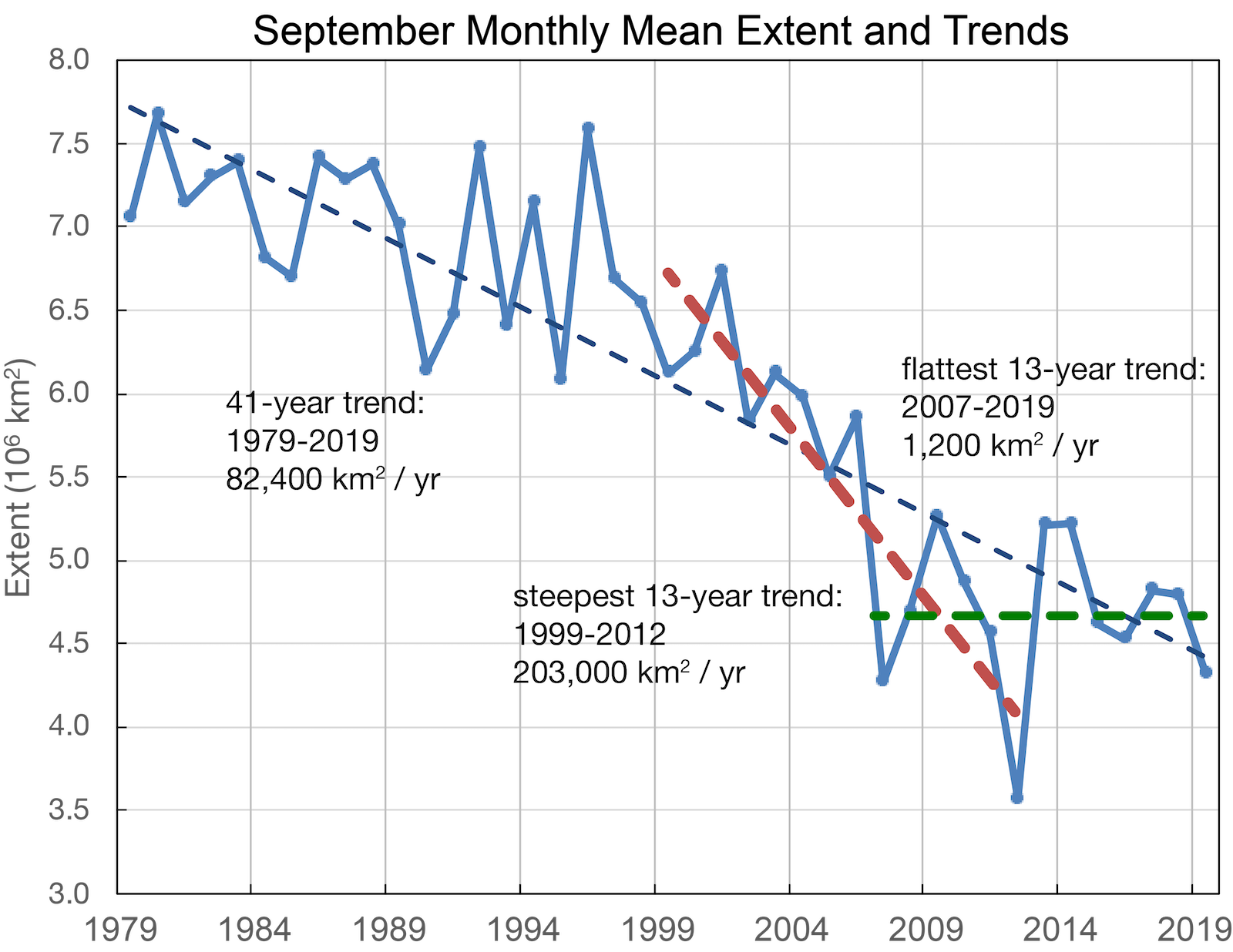
If the hottest year ever can’t precipitate ‘ice-free’ conditions in September, what’s it going to take? Arctic sea ice failed to nose-dive again this year, undoubtedly disappointing expects who have been anticipating a ‘death-spiral’ decline for ages. Arctic sea ice hit its seasonal low sometime around mid-September this year and although the precise value hasn’t been published, the average September ice coverage will likely be about 4.2 mkm2 once it gets announced in early October.
This means we have now had 17 years of a near-zero trend for September sea ice, extending the nearly-flat trend NSIDC sea ice experts acknowledged four years ago. This surely busts a huge hole in the prevailing concept that more atmospheric CO2 causes less summer sea ice. Note that CO2 levels measured in August 2023 were 419.7 parts per million (ppm), compared to 382.2 in August 2007, a rise of 37.5ppm with no corresponding decline in summer sea ice (and vs. 314.2 ppm in 1960). Measured in metric tons, CO2 emissions due to fossil fuels rose from 31.1 billion in 2007 to 37.1 billion in 2021 (last year of data), again with no corresponding decline in summer sea ice.
Posted onAugust 31, 2023|Comments Off on New study that claims it can directly link GHG emissions to polar bear cub survival is poppycock
A global warming miracle has happened. While no scientist worldwide has ever drawn a straight line between greenhouse gas emissions and population declines in a species considered at risk due to climate change, a new paper just published in Science Magazine claims to have performed this unlikely feat for polar bears. It’s called “Unlock the Endangered Species Act to address GHG emissions.”
Note this analysis has not been peer reviewed: as a “Policy Forum” contribution, it’s considered by the journal to be a public interest commentary, not a research paper.
One might be forgiven for asking whether this work represents solid, reproducible science or simply well-timed, sciency-looking rhetoric ready-made for the litigious Center for Biological Diversity to pressure the US government to increase protections for polar bears before the 2024 US election. It is surely no coincidence that this paper made its appearance near the seasonal low for Arctic sea ice as well as during the 15-year anniversary of the ESA listing of polar bears as ‘threatened’ and the 50th anniversary of the ESA itself.
Moreover, knowing this paper was in the pipeline might explain why the 2022 government report on the most recent Western Hudson Bay polar bear decline, which I discussed yesterday, has been kept secret for so long: the results of that report are cited in this new Science paper as supporting evidence that sea ice declines are responsible for recent population declines, which Reuters said in December was clearly not the casefor the period 2017-2021.
Posted onAugust 30, 2023|Comments Off on W. Hudson Bay polar bear numbers declined 27% in 2021 but not because of missing ice: secret paper
As will become apparent tomorrow, Western Hudson Bay polar bear numbers apparently declined 27% between 2017 and 2021 but not because of sea ice loss. This fact, gleaned from a secret government report leaked to the media, emerged just before Christmas last year and spread around the world. I commented on it here at the time.
It will also be apparent tomorrow why that government report is still unavailable. Thursdays are when the big two science magazines publish their papers, which means associated news stores promoting preferred narratives are embargoed until then. Stay tuned.
Posted onAugust 27, 2023|Comments Off on “10k dead penguin chicks” more animal tragedy porn used to advance global warming agenda
Like the 2017 video of the National Geographic starving polar bear, the 2022 deaths of emperor penguin deaths promoted last week is emotional blackmail. Both are examples of preposterous fear-mongering pushed by activist scientists and the media for political purposes. Don’t fall for it.
Despite the hype last week over the newly published paper by Peter Fretwell and colleagues, there is no plausible ecological rationale for proposing that that a single season’s reproductive failure in four small colonies of emperor penguin (Aptenodytes fosteri), due to La Nina conditions — phenomena unrelated to carbon dioxide emissions — are signs of a future “quasi-extinction” of the species, as proposed in the BAS video here. None of the estimated 282,150 breeding pairs of adult emperors were lost in 2022 off the Antarctic Peninsula and chicks born in several dozen other emperor colonies around the Antarctic continent survived, which means this was a tiny bump in the road rather than a catastrophe for the species.
Posted onAugust 20, 2023|Comments Off on Activists try to reboot Pacific walrus as climate change icons just as numbers reach a new high
Activists have again resorted to using documentary film to promote Pacific walrus haulout deaths as contrived “proof” of gruesome climate change impacts even as evidence emerges that walrus numbers are higher than at any other time since the late 1970s. Oops! Busted by facts yet again!
Posted onAugust 16, 2023|Comments Off on Conservation officers misleading the public about polar bear problems in Churchill
Canadian government-funded media outlet CBC ran a story this morning about problem polar bears in the town of Churchill, Manitoba, the self-described “Polar Bear Capital of the World” that contains some very misleading statements from Manitoba Conservation officers.
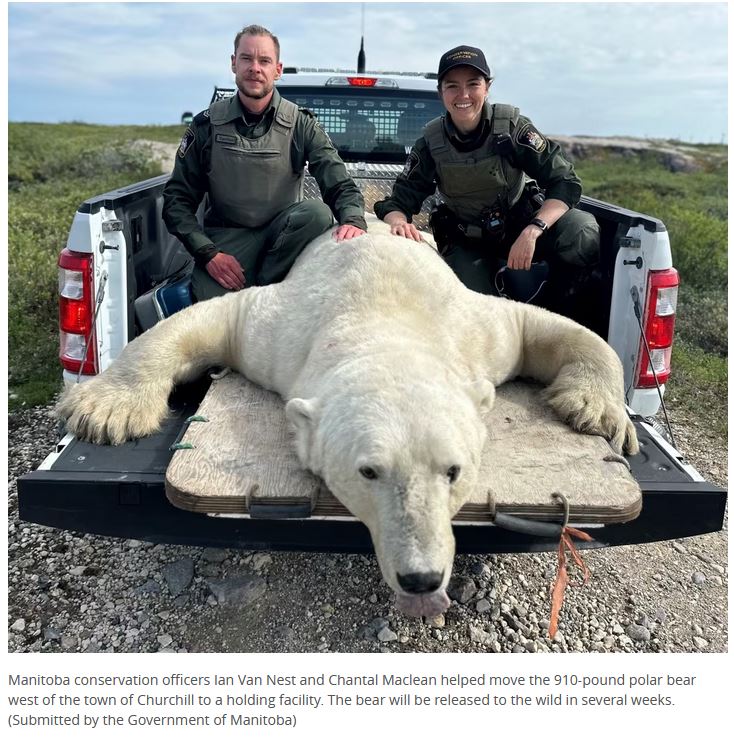
Breakup of sea ice on Hudson Bay was earlier this year than it has been in more than a decade (17 June) and some people are trying to hype the significance of this phenomenon to support a tenuous link to human-caused climate change, even though bears out on the ice this spring were reportedly in good condition and one of the problem bears captured on 8 August was also in good condition (a male weighing 910 lbs, photo above). Unfortunately, reports for similar early breakup years in the early 2000s have not been made public. However, I’ve been keeping track of these Polar Bear Alert Program Reports since 2015 and have read the available literature about their history: these records simply do not corroborate the statements in this CBC account.
Posted onAugust 8, 2023|Comments Off on Climate activists are silent on polar bears because their doom-mongering blew up in their faces
A Grist article last week pandered to activist polar bear specialists over their failed climate change agenda as it tried to minimize why the climate movement doesn’t talk about polar bears anymore. Apparently, the Arctic icon has “largely fallen out of fashion” through “overexposure” resulting in polar bear images invoking “cynicism and fatigue.” But that isn’t really true, is it?
While there is an admission that the over-hyped lies about starving bearspromoted by National Geographic in 2017 and 2018 were a factor, there is no mention in the article of the well-known, documented evidence of scientists’ own failed assumptions that polar bears require summer sea ice for survival have had any impact on public opinion (Amstrup et al. 2007; Crockford 2015, 2019, 2022, 2023; Lippold et al. 2019; Rode et al. 2021).
Thriving populations in the Chukchi Sea and elsewhere amid low summer ice levels have busted the myth that polar bears need ice year-round.
Andrew Derocher was also allowed to repeat, unchallenged, the ridiculous narrative he and his activist supporters have peddled before, that insists the polar bear had become a climate change icon by accident rather than design, a lie I addressed in detail last year. Some excerpts from that 2022 post are copied below.
Posted onJuly 30, 2023|Comments Off on Repeat of 2013 high-profile Sierra Club polar bear attack, this time with Inuit victims
Almost 10 years later to the day, another polar bear attack resulting in serious injury has taken place in the northern Labrador/Quebec region of Eastern Canada. Remember the Sierra Club lawyer snatched, tent and all, in the middle of the night on 24 July 2013, in an almost-fatal attack that was reported around the world, see here and here? This time virtually the same thing happened to two Inuuk campers on July 26, in the same general area, as reported last week by Nunavut News. This will undoubtedly renew concerns that Davis Strait Inuit have raised about their safety in the face of high population numbers of polar bears (Tomaselli et al. 2022).
Sea ice conditions were similar in both attacks. In 2013, the attacking bear appeared to be a fully adult male in good condition that had been watching the hiking party since the previous day but this year the predatory bear was described as a small “young adult” animal, suggesting it could have been a 3-4 year old female or perhaps a 2 year old male.
Watch polar bear habitat reform in the Canadian Arctic: “last 10 days” Canadian Ice Service animation (works anytime) HERE.
See Quote archive for details.










 polarbearscience
You must be logged in to post a comment.