Tag Archives: advocacy

Biologists spreading misinformation: hybridization with grizzlies not due to polar bears moving inland

A paper published last week in the journal Science, written by a team of biologists and atmospheric scientists, expounds on a possible dire future for a range of Arctic animals. It’s called, “Ecological consequences of sea-ice decline” and surprisingly, polar bears are discussed only briefly.

However, with the inclusion of one short sentence, the paper manages to perpetuate misinformation on grizzly/polar bear hybridization that first appeared in a commentary essay three years ago in Nature  (Kelly et al. 2010)1. The Post et al. 2013 missive contains this astonishing statement (repeated by a Canadian Press news report):

Hybridization between polar bears and grizzly bears may be the result of increasing inland presence of polar bears as a result of a prolonged ice-free season.

Lead author of the paper, Professor of Biology Eric Post, is quoted extensively in the press release issued by his employer (Penn State University, pdf here). In it, Post re-states the above sentence in simpler terms, removing any doubt of its intended interpretation:

“… polar and grizzly bears already have been observed to have hybridized because polar bears now are spending more time on land, where they have contact with grizzlies.

Both statements are patently false. All recent hybridization events documented (2006-2013) occurred because a few male grizzlies traveled over the sea ice into polar bear territory and found themselves a polar bear female to impregnate (see news items here and here, Fig. 1 below). These events did not occur on land during the ice-free season (which is late summer/early fall), but on the sea ice in spring (March-May).

Grizzlies have been documented wandering over the sea ice of the western Arctic since at least 1885 (Doupe et al. 2007; Fig. 2, below) and the presence in this region of hybrid grizzly/polar bear offspring is not an indicator of declining summer sea ice, whether due to global warming or natural causes, or some combination thereof.

Continue reading

Cannibalism update and insight on the timing of media hype

In my last post, I went over some of the spin and misrepresentation of fact contained in the claim by leading polar bear biologists Steven Amstrup, Ian Stirling and Andrew Derocher (Amstrup et al. 2006; Stirling and Derocher 2012) that cannibalism is on the increase because of the effects of global warming on Arctic sea ice.

I’ve had an opportunity to follow up on three points that puzzled me. Three relate to the Amstrup et al. paper that described three cases of cannibalism in the southeastern Beaufort Sea in 2004 and one to the incidents in western Hudson Bay in 2009. In the process, I found at least three more misrepresentations of fact and gained some insight on why these incidents of cannibalism were hyped so enthusiastically when they were. Continue reading

Collapse of polar bear snow dens – Stirling and Derocher’s anecdotal evidence

In their summary of facts supposedly supporting the premise that global warming is already having an impact on polar bear populations (discussed previously here, here, and here), biologists Ian Stirling and Andrew Derocher (2012:2700) include a list of incidents of warm winter weather and/or “rain on snow events” that have led to the collapse of polar bear maternity dens and ringed seal birthing lairs.

Stirling and Derocher state that both polar bears and ringed seals (their primary prey) have a demonstrated

high vulnerability …to increased mortatily resulting from warm temperatures and rain. Such rain on snow events are predicted to increase as the climate warms in the Arctic (Hansen et al. 2011).”[my bold]

However, their so-called evidence for polar bears and ringed seals having a proven vulnerability to these events comes not from scientific studies but what they admit outright are anecdotal reports.

They describe four incidents, including one case of a maternity den collapse (involving a 6 yr old, probably first-time mother and two, 3-4 week old cubs) in the southern Beaufort in 1989, apparently caused by a bit of warm weather followed by heavy snow in late January (a picture of the dead bear is included, see below, just so we don’t forget that a bear died).

Continue reading

Polar bear spin reaches epic proportions at Bangkok CITES meeting

As I mentioned here in an update to my March 7th post, Damian Carrington at the Guardian Environment blog had this telling quote about the CITES deliberations that took place prior to the vote to ban polar bear trade (by uplisting its status from Appendix II to Appendix I):

As the debate raged, national delegates from other countries got confused by the strident but conflicting claims. “Where is the truth? Is it true that the polar bear is declining. Is it true that trade is increasing? We need to know,” said the Egyptian delegate.[my bold]

Indeed. Was there “truth” in the presentations heard by delegates? By that I mean, honest presentations of facts so that delegates could make up their own minds, or facts loaded with spin to sway the decision one way or another? I wasn’t there so I can’t say. But we can get some impression of what might have been said from two press releases statements issued after the vote failed by two parties that were actively promoting acceptance of the US-led proposal.[Update: Humane Society Press Release is here] Continue reading

Where were the appeals to feed starving polar bears in 1974?

The so-called “policy paper” that polar bear biologist Andrew Derocher has been promoting over the last few weeks, which I commented on briefly when the press release came out, is still grabbing headlines. Online news outlets continue to run stories on this bizarre discussion of what officials might decide to do 40 years from now if global warming causes Western Hudson Bay polar bears to spend 6 months on land (Molnar et al. 2010), causing some of those polar bears to starve (see here, here, and here) – as if this is something likely to happen within the next couple of years.

But forget imagined future starvation: where was the media attention on the plight of starving polar bears back in 1974  and 1975 when polar bears were actually starving in large numbers in the eastern Beaufort Sea?

At least two of the co-authors of the paper getting all the attention – Drs. Ian Stirling and Nick Lunn – witnessed polar bears starving in the Beaufort in 1974 because of an especially cold winter and said nothing even though polar bear populations worldwide at the time were already low due to the wanton slaughter of previous decades. Did Stirling and Lunn humanely euthanize the bears they saw starving? Contact the media? [If they did, I’d like to know.] Appeal to governments to make a plan in case it happened again? Apparently not, because it did happen again, at least twice in the following two decades – with no attendant hue and cry then either. No, those Beaufort Sea bears starved to death, time and time again, without a word to the media from Ian Stirling and Nick Lunn.
Continue reading

Misleading “State of the Polar Bear” graphic cost advocate scientists more than US$50,000

UPDATE FEBRUARY 19, 2014The misleading “State of the Polar Bear” graphic is now GONE (as of January 31, 2014). A new 2013 status table is offered by the PBSG here. It has detailed text explanations and harvest information, with references, hyperlinked to each subpopulation entry (“Press the subpopulation hyperlink and more information will appear“) and may have replaced the “State of the Polar Bear” graphic that the PBSG commissioned for upwards of US$50,000, although the PBSG website says it is being “updated [A pdf copy of the 2013 colour table is here, and my commentary on it is here.] I have left the original post as is, below.

I’ve had some time to do a little digging regarding the IUCN Polar Bear Specialist Group (PBSG) State of the Polar Bear web graphic. It turns out this fancy but misleading document was designed by a US company called Periscopic (Portland, Oregon) at a cost of US$50, 000-70,000. So apparently, rather than put $70,000 towards much-needed polar bear research, the PBSG chose to use the money to tell people, in a slightly different way, that it thinks polar bears are doomed. [see UPDATE: April 1 2013]

Just to refresh your memory, last month I pointed out that this fancy summary “tool,” which sits prominently on the home page of the PBSG website, suggests that there are now 22,600-32,000 polar bears worldwide, when tallied by nation (when you add up the individual population estimates provided on each of the two maps on this web “tool” (without clicking through to more detail), you get two different numbers that have no resemblance to the “official” estimate of 20,000-25,000: the page “Nations” gives totals by country that add up to 22,600-32,000 and the numbers given on the “Subpopulations” page (when you hover your mouse over each of the 19 regions) add up to only 13,036 – a far cry from 20,000-25,000 official estimate).

A few days later, I got a response to the email I’d sent to Norwegian polar bear biologist Dag Vongraven, who said it was his job to supervise work on this summary. But, he said, he had “not yet had time to review all details in it as well as I should.” So it seems that without a careful review of the final product, the graphic was posted on the home page of the PBSG website (sometime in October 2012).

It turns out there had been a discussion at the 2009 PBSG meeting, documented in its official report (Obbard et al. 2010:11, Fig. 1 below), about their intention to hire Periscopic as part of on-going PBSG website developments supervised by Vongraven. Several PBSG members agreed this would be a good idea and offered to help by providing data. Continue reading

Why is the US pushing to ban polar bear trade? Polar bears have been saved

One of the items on the agenda at the upcoming 16th meeting of the signatories to the Convention on International Trade in Endangered Species of Wild Fauna and Flora (CITES) in Bangkok Thailand (3-14 March, 2013) is a proposal to upgrade the polar bear from Appendix II to Appendix I status – prepared by the US Fish & Wildlife Service. The suggested change is based on what is claimed to be “a marked decline in the population size in the wild, which has been inferred or projected on the basis of a decrease in area of habitat and a decrease in quality of habitat.” If this proposition is adopted by CITES, it would be illegal to trade legally harvested polar bear parts of any kind.

The US tried this maneuver at the last CITES meeting in 2010 and it failed rather miserably. I see little reason to believe it will pass this year, even though the US is actively campaigning and has motivated activists worldwide to pressure other countries to vote in their favour (see “Activists push for international ban on legal trade in polar bear items” which discusses the absurdity of the World Wildlife Fund (WWF) not supporting the CITES proposal because they want to keep the focus on model-predicted future “threats” of global warming, see Clark et al. 2012, abstract below).

But here’s the question I have for all the folks involved in this CITES petition and other similar proposals to upgrade the conservation status of the polar bear to a “threatened” or “endangered” level: why is all this time, money and effort going toward ever-more restrictive regulations for a species that has clearly been saved but about which we still know so little?

Continue reading

PBSG invited WWF and PBI advocates to its last polar bear experts meeting

In 2009, for the first time, the polar bear biologists that make up the IUCN’s Polar Bear Specialist Group (PBSG) invited four professional advocates – not one or two, but four – to their exclusive, once-every-four-years meeting of top polar bear biologists (called “delegates”) from the world’s Arctic nations (Canada, Russia, USA, Greenland/Denmark and Norway) – two from World Wildlife Fund (WWF) and two from Polar Bears International (PBI).

[Recall that 2009 was also the year that PBSG Chairman Andrew Derocher stripped veteran Canadian polar bear biologist and long-time PBSG member Mitch Taylor of his delegate attendee status because he did not have the appropriate attitude to global warming (see previous post here). Update – just to be clear, Mitch had retired from his government polar bear research job (a valid reason for not being included as a delegate) but with more than 30 years experience and his vast publication record on polar bears – as well as his long association with the PBSG as a delegate – he certainly should have qualified as an “invited specialist” at the 2009 meeting]

I expect Canadian journalist and author Donna LaFramboise would call this inclusion of WWF and PBI advocates in an otherwise exclusive meeting of polar bear biologists a behind-the-scenes lobbying opportunity,” similar to the inclusion of WWF personnel in the IPCC review process (see original article here and email interview here and “WWF infiltrates UK gov’t” here).

WWF and PBI are organizations devoted to changing public policy to suit their idea of how the world should be – whether others agree or not. They are passionate lobbyists with money behind them and they use their influence to pressure politicians – and now, supposedly impartial scientific organizations – to make decisions that fit their agenda.

Continue reading

Polar bear population now 22,600-32,000 – when tallied by nation

UPDATE FEBRUARY 19, 2014The misleading “State of the Polar Bear” graphic is now GONE (as of January 31, 2014). A new 2013 status table is offered by the PBSG here. It has detailed text explanations and harvest information, with references, hyperlinked to each subpopulation entry (“Press the subpopulation hyperlink and more information will appear“) and may have replaced the “State of the Polar Bear” graphic that the PBSG commissioned for upwards of US$50,000, although the PBSG website says it is being “updated” [A pdf copy of the 2013 colour table is here, and my commentary on it is here.] I have left the original post as is, below.

This afternoon I came across some startling information. [updated here, here from Feb. 10, 2013, and here from April 1, 2013]

According to a dynamic summary report on the home page of the IUCN/SSC Polar Bear Specialist Group website  called State of the Polar Bear, there are now 22,600-32,000 polar bears worldwide, when tallied by nation.

Here are the numbers, by nation, listed in the State of the Polar Bear summary report (see map below):
Canada                              13,300-17,500
USA                                   1,200-1,800
Russia                               2,700-4,800
Norway                             1,900-3,600
Greenland
(Denmark)                        3,5000-4,400
Total                            22,600-32,000

The “Nations” page of the Polar Bear Specialist Group’s “State of the Polar Bear,” a dynamic summary that can be launched from the home page of the IUCN PBSG  http://pbsg.npolar.no/en/dynamic/app/ [published Oct. 15, 2012] Click to enlarge.

The “Nations” page of the Polar Bear Specialist Group’s “State of the Polar Bear,” a dynamic summary that can be launched from the home page of the IUCN PBSG website, http://pbsg.npolar.no/en/ [published Oct. 15, 2012] Click to enlarge.

This is a big change from the 20,000-25,000 that has been touted as the global polar bear population since 2005 (see Aars et al. 2006; Obbard et al. 2010) and my post on polar bear population estimates.
[updated Jan. 9 2013 at 8:20 PST, see end of post]

UPDATE Jan. 7. 2014 – The PBSG has announced that a new population assessment is due later this month, see this January 1 post. The graphic described in this post has moved to the page called “Population information” and the official estimate of 20,000-25,000 is no longer present. There was no press release associated with this announcement.
Continue reading

Bearded and ringed seals join the polar bear as “threatened” by a computer-modeled future

As I pointed out in Featured Quote #22 (posted on Dec. 23, 2012), bearded and ringed seals have recently joined the polar bear on the American ESA’s list of animals that are “threatened” by computer-modeled predictions of Arctic sea ice declines projected 50-100 years into the future (USFWS 2008, 2012a, 2012b).

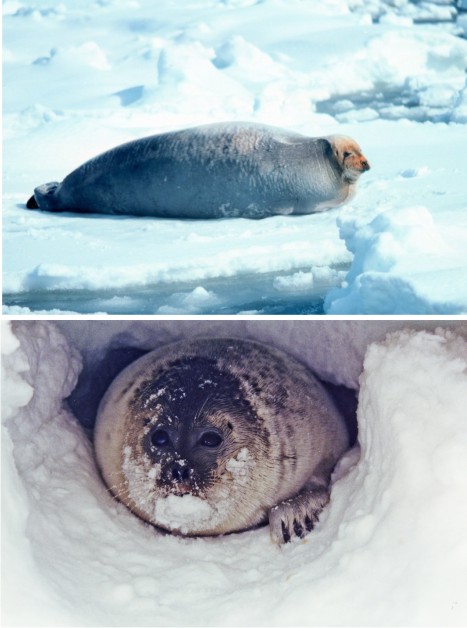
NOAA photos of bearded seal (top) and ringed seal (bottom)

NOAA photos of bearded seal (top) and ringed seal (bottom). The bearded seal is one of the largest Arctic ice seal while the ringed seal is the smallest. Both are eaten by polar bears, although ringed seals are consumed most often.

The decision by NOAA (National Oceanographic and Atmospheric Administration) affects the Arctic subspecies of ringed seal (Phoca hispida hispida) as well as the Okhotsk subspecies (Phoca hispida ochotensis) (in addition to several others) and thus includes all ringed seals off Alaska’s coast in the Beaufort, Chukchi and Bering Seas. The decision also affects two particular subpopulations of bearded seal (Erignatha barbatus): the “Beringia” [Bering Sea/Chukchi] subpopulation (about half of which reside in Alaskan waters), and the subpopulation that lives in the Sea of Okhotsk. (Alaska Fisheries (NOAA) Final Decision). Continue reading